


When I booked a week in Seminyak, I braced for expensive beach clubs and told myself the real sting would be the tickets at the door. What I actually found was more complicated and, in many cases, far more expensive. Seminyak’s most famous beach clubs proudly advertise free entry, but once you add timed cover charges, minimum spends, strict daybed rules, plus tax and service, an innocent plan to “just have a drink at sunset” can quietly climb into the millions of rupiah.
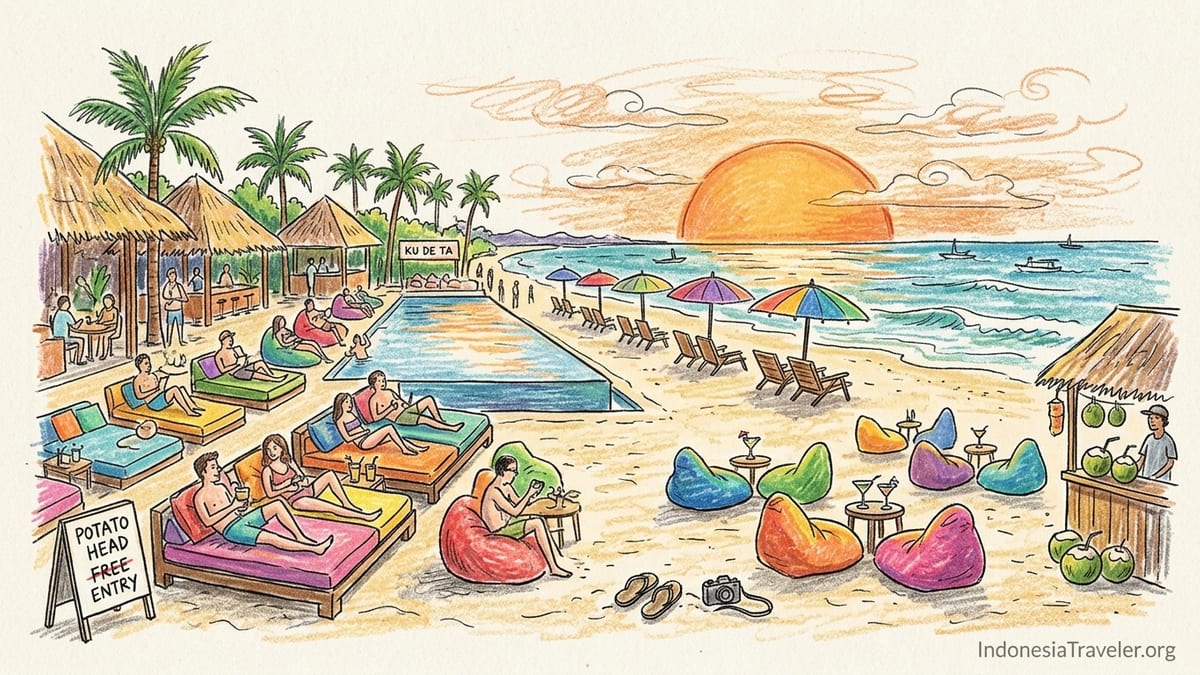
How I Tested Seminyak’s “Free” Beach Clubs
I spent several evenings and one full day moving between Seminyak’s headline venues: Potato Head Beach Club at Desa Potato Head, KU DE TA, La Plancha on Double Six Beach, and Mrs Sippy inland behind Petitenget. I also walked past and checked current conditions at Mari Beach Club and Mano Beach House, plus a couple of hotel-operated options along the same stretch of sand. I went in like any regular visitor, paid normal menu prices, and only used information boards or staff explanations when the rules were not clear.
For venues I did not sit down in on this specific trip, I relied on official FAQs, booking pages and current daybed listings checked in October 2026, cross-referenced with recent visitor reports, and I only describe policies where I could see them confirmed in writing or on-site. If a detail is not published or staff contradicted each other, I treat it as uncertain rather than guess. Prices below are in Indonesian rupiah and may change, but the structures themselves reveal how quickly “free entry” becomes a high-commitment spend.
Across the week I made four separate bills that I kept down to earth: usually one cocktail or beer, a snack or main, plus tax and service, with only one day where I pre-booked a daybed. Even with this modest approach, the totals were surprisingly high once all the quiet charges were added. The frustrating part was not paying for quality, but how hard it was to understand what I had really agreed to in advance.
What follows is not a ranking of Seminyak beach clubs, but a consumer-eye view of how each venue’s rules and pricing actually work at ground level, and what that means for different types of traveler.
Potato Head: Free Entry Until the Sunset Window
Potato Head Beach Club sits inside Desa Potato Head on Jalan Petitenget, backing directly onto Seminyak’s surf with an infinity pool, lawn and rows of daybeds facing the ocean. On my first visit I arrived at about 2.30pm on a weekday. Entry at that time was indeed free. Staff at the podium confirmed what the official FAQ also states: general admission to the beach club is free outside the 4:00pm to 6:30pm window, when a 200,000 rupiah cover charge applies, redeemable against selected drinks.
Because I walked in early, I was guided to a regular table on the lawn. There was no minimum spend for this seating category, only the expectation that I would order. I had one signature cocktail and a small plate, plus a large bottle of water. The food and drink quality was solid: the cocktail balanced and not overly sweet, the snack well presented but more hotel-lounge than destination restaurant. My bill before extras came to roughly 260,000 rupiah. Once 10 percent service and 11 percent tax were added, it landed just under 320,000 rupiah. For one drink, one snack and water, that is not outrageous value, but it is a long way from the casual beach bar image most visitors have of Bali.
The real money trap sits around sunset. On a second visit, I arrived just before 5pm to test the cover charge. At the entrance, staff explained I would need to pay the 200,000 rupiah cover per person to enter during that time window, which could be used as credit against a short list of cocktails, beers and soft drinks. Anything ordered outside those items would be charged separately, and the credit would not roll over to another day. Once inside, the range of “redeemable” choices was noticeably narrower than the full menu, nudging you toward mid-tier drinks rather than cheaper local beers or premium spirits.
Daybeds, Minimum Spends and Paying for Space You Cannot Use
The most misleading piece of the Potato Head puzzle is the daybed economy. General admission may be free most of the day, but front-row daybeds beside the pool and along the seawall are priced in a completely different universe. In October 2026, I was quoted a 3,000,000 rupiah minimum spend for a smaller beach bed that included bottles of spirits, and 4,000,000 rupiah for a larger configuration, confirmed by staff and consistent with current visitor reports. That minimum is per bed, usually shared by up to four people, but must be met by the end of the booking period. Anything under is still charged in full.
For my test I shared a smaller bed with two friends on a late afternoon. We paid a 3,000,000 minimum that effectively prepaid our drinks and food. Service began with a bottle of mid-range spirit and mixers, then we added a few snacks and one extra cocktail each. At the natural pace of conversation and photos, we struggled to hit the minimum. Staff were polite but made it clear that any unspent balance would simply be forfeited. By the time we reached sunset around 6pm, the bill plus 10 percent service and 11 percent tax pushed the total close to 3,630,000 rupiah for three people, and we left with the sense that we had consumed more than we really wanted just to avoid “wasting” the prepaid amount.
Our reservation officially started at 2pm and ran to 7pm, but like many guests we arrived later and focused on the 4pm to 7pm sunset prime time. That meant the daybed technically blocked for five hours, with only around three used. From a consumer angle, this feels like paying for both space and time you cannot realistically enjoy. You will not be in the pool for five straight hours, yet the pricing is structured as if you will. If you simply walk in for a table, by contrast, you can spend less than one million rupiah for three people and still share a good view from the lawn, just without your own mattress and bottles.
Potato Head’s system is not hidden. The cover charge window is clearly stated on its FAQ and the daybed minimums are communicated at booking. The frustration lies in how easy it is for new visitors to fixate on the words “free entry” and fail to grasp that the actual experience most people want the daybed by the pool at sunset requires several million rupiah in prepaid, non-refundable spend.
KU DE TA: Walk-in Drinks vs Prepaid Daybed Commitments
KU DE TA, a short walk further down the same beach, operates on a similar two-tier system. The main restaurant and bar accept walk-ins for food and drinks without an entry fee, and there is no general minimum spend just to step inside. On my early evening visit as a solo diner, I arrived around 5.15pm without a reservation and was seated at a high table on the terrace. The view to the ocean was partially blocked by daybeds and the glass balustrade, but I still had a clear sunset line. I ordered one classic cocktail and a main course. The quality easily matched high-end hotel dining: careful plating, well-trained service, a curated soundtrack rising gently as the sun dropped.
My pre-tax bill landed at around 420,000 rupiah. After 10 percent service and 11 percent tax, the total was roughly 510,000 rupiah. For one person, this felt expensive but honest. KU DE TA does not pretend to be a cheap spot. You pay for a polished setting and a location that has been on Bali postcards for more than a decade. Crucially, there was no surprise minimum spend and no additional cover for what was essentially a good seat at peak sunset time.
The picture changes when you want a daybed. KU DE TA’s own booking terms state that daybeds come with a minimum spend that must be paid in full at the time of booking and is non-refundable. For example, current daybed listings show packages at around 3,500,000 rupiah for a bed recommended for three guests, fully creditable toward food and drinks, but with any unused balance forfeited. There are larger sofas for more guests at higher minimums. The terms explain that daybeds are held only for a set grace period, and if you arrive late and your original zone is no longer available, staff may move you elsewhere without changing the minimum spend or refunding it.
In practice this means that a couple who books a daybed and then feels unwell or arrives during heavy rain is still locked into paying the full minimum, regardless of how much they actually eat or drink, or how much usable time they get by the pool. There is some flexibility for rescheduling with at least 48 hours notice, but for most tourists who plan beach clubs near the start or end of a trip, that is not always realistic. During my visit, I watched one group of six negotiate with staff after arriving almost 40 minutes late. They were allowed to sit at a different lounge area, but were told their original minimum spend still applied. Their faces when they realized their “deposit” was actually a full prepaid bill said everything.
KU DE TA publishes these conditions clearly in its terms, yet the minimum-spend language “fully credited to your F&B” can lull visitors into thinking they still retain some flexibility. Once you understand that money is treated more like a concert ticket fee than a restaurant deposit, your perception of value changes sharply.
La Plancha: Beanbags without a Pool, But Not Always Free-For-All
La Plancha on Mesari Beach, the Double Six stretch, is often described as a more relaxed, budget way to watch sunset on colorful beanbags in the sand. There is no pool, and that immediately lowers the infrastructure costs compared with a resort-style beach club. On the late afternoon I visited, access from the street down to the sand was free. Staff were busy directing people to vacant beanbags as early as 4pm, when the sky was still bright. Unlike Potato Head and KU DE TA, there was no formal cover charge or fixed minimum spend printed on signs at the entrance.
Instead, the unwritten rule is active ordering. Staff expect every occupied beanbag to be attached to a paying customer, and they keep informal track of how much each group has ordered. On my visit, a large Bintang beer, a mojito and a serving of grilled seafood skewers came to a little under 200,000 rupiah before tax and service. A modest 5 percent service plus 10 percent tax pushed the total to around 230,000 rupiah. For an unobstructed front-row sunset with my feet in the sand, this felt like the best value of the Seminyak venues I tested.
The ambiguity appears in busier periods. Some recent visitor reports and conversations with staff suggest that during peak weeks, different rows of beanbags can be associated with informal minimums. Front-row bags may quietly be reserved for guests who agree to spend a certain amount, while walk-ins without a budget get pushed further back. None of this is printed clearly on boards, and on my evening staff gave inconsistent answers: one said there was “no minimum as long as you keep ordering,” another hinted that a couple should expect to spend “at least a few hundred thousand each” if they wanted to stay through sunset in the front row.
La Plancha proves that you can have a memorable Seminyak sunset for well under half a million rupiah for two people, but only if you are comfortable with a casual, sometimes chaotic service model and occasional pressure to order more. It also shows how “no minimum spend” can, in reality, feel like a soft minimum shaped by your seat location and the mood of a busy staff team trying to keep turnover high.
Mrs Sippy: Pool Club Pricing Without the Ocean
Mrs Sippy sits inland behind Petitenget, not on the beach but built around a huge lagoon-style pool with diving platforms. It is marketed as a pool club rather than a true beach club. The lack of direct ocean view means you are effectively paying for waterpark-style facilities and a party scene, not for a horizon over the sea. That difference matters when you look at the entry fees and minimum spends.
According to Mrs Sippy’s own general FAQ, there is a standard pool club entry fee, most recently listed at around 100,000 rupiah per person, with towel rental on top and free entry only for non-pool users or sports bar guests. Current third-party passes and promos sometimes quote 150,000 rupiah including a towel. Once inside, daybeds and cabanas work on a clear minimum-spend basis. Documentation checked in 2026 lists single beds for one person at around 750,000 rupiah minimum, regular daybeds for up to four at 2,500,000, cabanas at 3,000,000 and larger lounge zones at 6,000,000, all excluding the separate entry fee unless bundled in a package.
On my visit I declined the daybed and paid only the entry fee, choosing a regular table. This immediately made the cost structure more palatable. One frozen cocktail and a pizza came to just over 250,000 rupiah before extras. Add 10 percent service and 11 percent tax and the total was around 305,000 rupiah, plus my earlier entry ticket. The food was solid party fare rather than destination dining, the music was louder and more club-like than the beach venues, and there was no sunset to speak of, only shifting poolside light as the afternoon passed. It felt more like paying for a resort day pass than for a classic Bali sundowner.
The catch at Mrs Sippy is obvious once you connect the dots. If you simply want a swim and a cocktail, the combination of entry fee, one or two drinks and food can still stay below 500,000 rupiah per person. If you are lured into a daybed or cabana so you “have somewhere to leave your stuff and lie down,” you are suddenly locked into multi-million minimums that make no sense unless you are a group of heavy drinkers or intend to stay most of the day. And because there is no ocean, you cannot even justify it as paying for a rare view.
Mari, Mano and Hotel-Operated Venues: Subtler Versions of the Same Game
Seminyak’s newer or adjacent venues around Petitenget and Batu Belig, such as Mari Beach Club and Mano Beach House, combine some of the same traits with slightly more flexible entry experiences. Recent experiences and local reports suggest that Mari often works with minimum spends linked to specific seating zones, especially for front-row lounges and sofas, while allowing walk-ins to use bar areas more casually. Mano, at the time of checking, positioned itself as more of a laid-back beach house with dining and cocktail focus, yet still applied soft minimum expectations for premium beachfront chairs.
Several hotel-operated venues along this strip, including upscale resorts in Seminyak, offer sunset-facing pools and loungers to outside guests on a more traditional model. In some cases, buying a drink or snack at the pool bar informal is enough to use a sunbed if the hotel is not fully occupied. In others, there is a fixed day pass or minimum spend that behaves similarly to a beach club, but with slightly more tolerance if your bill falls just short. I visited one such hotel bar where 250,000 rupiah spent on food and drinks per person granted use of the pool and towels for several hours, with no extra entry fee.
Compared with the high-commitment structures at Potato Head or KU DE TA, these hotel venues feel more forgiving and better aligned with traditional hospitality norms. You still pay resort prices for cocktails and snacks, but your money tracks fairly closely to what you actually consume, rather than to what you might theoretically be able to consume if you used every facility for the full length of a reservation.
The common thread is that anywhere near the sand in Seminyak has learned to segment space into revenue zones. The closer you sit to the water, and the more private and padded your seat, the more likely it is that you will face some kind of minimum spend or prepayment, even if entry itself remains technically free.
What My Receipts Revealed: Comparing Real Costs
Across the week, my actual receipts painted a clear picture of how costs cluster around certain types of experience. For “one drink with a view,” the cheapest route was La Plancha’s beanbag. One large beer plus shared skewers for two people ended up around 230,000 rupiah with tax and service. At Potato Head, a cocktail plus snack and water pushed my solo bill to just under 320,000 rupiah. At KU DE TA, a cocktail and main dish for one crossed the 500,000 rupiah line. For Mrs Sippy, one cocktail and pizza plus entry fee drifted toward the same threshold, depending on whether you count the ticket as part of the drink’s cost.
Dinner with a sunset view for two landed very differently depending on venue. At La Plancha and similar beach-level bars nearby, two mains, two beers and a shared starter slipped in under 600,000 rupiah once tax and service were included. At KU DE TA, the same pattern easily doubled that number, hitting around 1,200,000 rupiah without dessert or premium bottles. At Potato Head, dinner on the lawn with two cocktails and two mains sat somewhere in between, at roughly 900,000 to 1,000,000 rupiah for two.
The starkest gap lay in daybed and group bookings. One three-person daybed at Potato Head, with a 3,000,000 rupiah minimum plus tax and service, ended up costing more than 1,200,000 rupiah per person for an afternoon and early evening. A comparable daybed package at KU DE TA clocked in slightly cheaper per head for three people, but with the same risk of unused balance. By contrast, a casual group table for six at a hotel pool bar where we ordered cocktails and shared plates for three hours came to about 3,000,000 rupiah in total including tax and service, with no minimum, and we left feeling satisfied rather than bloated or guilty for not “using up” a prepaid spend.
These comparisons show that you are not simply paying for food and drink. You are paying for reserved space during a specific time window, for views you might not fully see if the weather turns, and for facilities that you may barely touch once the novelty of a plunge in the pool wears off. The key question every traveler should ask is not “can I afford the minimum spend,” but “am I likely to get genuine enjoyment from everything bundled into that minimum.”
Five Big Frustrations Hidden Behind “Free Entry”
After a week of receipts and small arguments with my own conscience, I walked away with at least five recurring frustrations that kept showing up across Seminyak’s beach clubs. The first is confusing minimum-spend language. Words like “fully redeemable” or “credited to your F&B” imply flexibility, but in practice that money behaves like a non-refundable ticket. You are not pre-authorising a charge that might be adjusted. You are purchasing a block of credit that expires the moment your booking does, whether or not you have used it.
The second frustration is taxes and service added later, often in smaller print at the bottom of menus. A 21 percent uplift is standard in Bali for many venues, but a surprising number of beach club menus still show “net” prices without spelling it out in large type. The effect is that a 300,000 rupiah cocktail and snack session quietly becomes more like 360,000 rupiah by the time you sign the bill, and a 3,000,000 rupiah daybed minimum becomes 3,630,000 rupiah, not counting tips.
Third is the rise of prepaid, non-refundable bookings, especially for premium sunset seating. Once you have transferred millions of rupiah to secure a daybed or sofa, the venue has already won, regardless of whether heavy rain, haze, illness or Bali traffic eats into your time. Policies that allow date changes with two days notice sound generous, but they rarely match the real-world flexibility most independent travelers need.
Fourth is sheer peak demand at sunset. In practice, “free entry” often means free entry to secondary or back-row seating, while the seats that made you want to visit in the first place have long been locked up by people paying high minimums or booking weeks ahead. Walk-ins get shuffled to bar stools or side tables with obstructed views, yet often still pay premium drink prices.
Finally, there is the problem of paying for facilities you do not use. At both Potato Head and Mrs Sippy, I saw guests who never once entered the pool, yet were effectively paying pool-park prices for the privilege of leaving their bags beside the water. At KU DE TA I watched couples hunched over phones on daybeds they had paid millions for, using them as couches rather than as part of an immersive experience. The emotional pressure to “get your money’s worth” can actually reduce your enjoyment of an otherwise beautiful place.
Who Really Benefits and How to See Sunset Without Overspending
Not every traveler loses in this system. Certain types of visitor genuinely do well from premium seating and large minimum spends. A group of six close friends on a special celebration who enjoy drinking, appreciate attentive table service and plan to stay from mid-afternoon until late evening may find that a 6,000,000 rupiah lounge at a pool club or a 3,500,000 rupiah daybed at a beachfront venue works out to decent value per head compared with buying a la carte in multiple bars.
Similarly, families with young children who want a fixed base where kids can nap, swim and snack without relocating might find that a hotel-operated beach club day pass with a clear, moderate minimum spend offers a stress-reducing hub for a full day, particularly if parents already budget for higher-end dining on vacation. For these travelers, the key is clear information and a realistic plan to actually use the space for most of the booking time.
For everyone else couples, solo travelers, digital nomads, backpackers and casual holidaymakers the best strategy is to separate the sunset from the status. If all you really want is the sky turning orange over the Indian Ocean, you can get that for almost nothing just by walking down to the public sand in front of any of these venues. Bring a sarong or towel, buy a 20,000 rupiah coconut or soft drink from a small beach vendor, and you have the same horizon the people on 4,000,000 rupiah daybeds are photographing.
If you also want a drink and a seat without feeling exploited, lean toward beach-level bars like La Plancha and its neighbors, or smaller warungs with plastic chairs on the sand, and keep your expectations simple. You may not get infinity pools and curated playlists, but you will keep your bill under control and avoid the mental gymnastics of trying to “use up” an arbitrary minimum spend. For a mid-range splurge, look to hotel bars that offer pool access for a straightforward spend per person, ideally clarified in writing when you arrive.
Seminyak’s beach clubs are not inherently bad value. Many are architecturally beautiful, employ large local teams and host impressive events. The problem is a marketing message built on “free entry” that does not align with how most visitors end up using them. Once you strip away the Instagram gloss and scrutinize the receipts, the choice becomes clearer: either lean into the full-price, prepaid experience with eyes open, or step to one side and enjoy the same sunset for a fraction of the cost.
The Takeaway
My week of hopping between Seminyak’s signature venues taught me that entry tickets are often the least important part of the cost equation. The real money flows through minimum spends, reserved seating, timed cover charges and the invisible 21 percent that lands on your bill at the end. Beach clubs that claim to be free to enter are not lying, but the experience most travelers imagine a plush daybed by the pool at sunset, attentive service and unobstructed ocean views is firmly paywalled behind several million rupiah.
For travelers who value space, service and a social scene, and who are genuinely comfortable with those price tags, prebooking a premium spot can still make sense. For everyone else, the smartest move is to detach the sunset from the furniture. Walk in early if you want a taste of the big-name clubs without committing to beds, keep a tight eye on taxes and surcharges, and remember that some of the best views in Seminyak are still available from a simple patch of public sand with a cold drink from a small vendor. The beach is free. How much you pay to sit beside it is up to you.
FAQ
Q1. Are Seminyak beach clubs really free to enter?
Many Seminyak beach clubs offer free general entry outside specific peak windows, but prime sunset times and premium seating often involve cover charges or minimum spends that quickly add up.
Q2. How much should I budget for one drink at a big-name beach club?
A single cocktail at venues like Potato Head or KU DE TA often costs around 150,000 to 200,000 rupiah before tax and service, which adds roughly 21 percent to the final bill.
Q3. What is a minimum spend and how does it work in practice?
A minimum spend is a fixed amount you commit to spend on food and drink for specific seating, such as a daybed. You prepay it or guarantee it, and if you do not use the full amount, the unused balance is usually forfeited.
Q4. Do I need to book a daybed in advance for sunset?
For front-row daybeds at popular clubs, advance booking is strongly recommended, especially in high season. However, advance bookings often require full prepayment and come with strict cancellation or change conditions.
Q5. Can I enjoy a Seminyak sunset cheaply without beach clubs?
Yes. You can walk onto the public beach with a sarong, buy a low-cost drink from a small vendor and watch the same sunset as beach club guests without paying minimum spends or cover charges.
Q6. Are taxes and service charges always added on top of menu prices?
At many Seminyak beach clubs, a combined 10 percent service charge and 11 percent government tax is added to the menu prices, so your final bill will be about 21 percent higher than the listed totals.
Q7. Is Mrs Sippy a true beach club with ocean views?
No. Mrs Sippy is a pool club located inland, built around a large lagoon-style pool with diving platforms. You pay for the pool facilities and party atmosphere, not for a direct oceanfront sunset.
Q8. Which travelers actually benefit from premium daybeds?
Groups celebrating a special occasion, heavy social drinkers, or families planning to stay for many hours can sometimes get reasonable per-person value from high minimum spends, provided they fully use the space and time.
Q9. What should I watch for when booking a beach club online?
Check whether the payment is a non-refundable minimum spend, how long your reservation lasts, which seating zone you are in, and whether there are restrictions on late arrivals, weather, or changing dates.
Q10. Are there better alternatives for a relaxed sunset with a swim?
Hotel-operated beachfront bars and pools often offer clearer day-pass or minimum-spend terms, and smaller beach-level bars provide cheaper, simpler options, as long as you are happy with fewer amenities and less curated styling.