


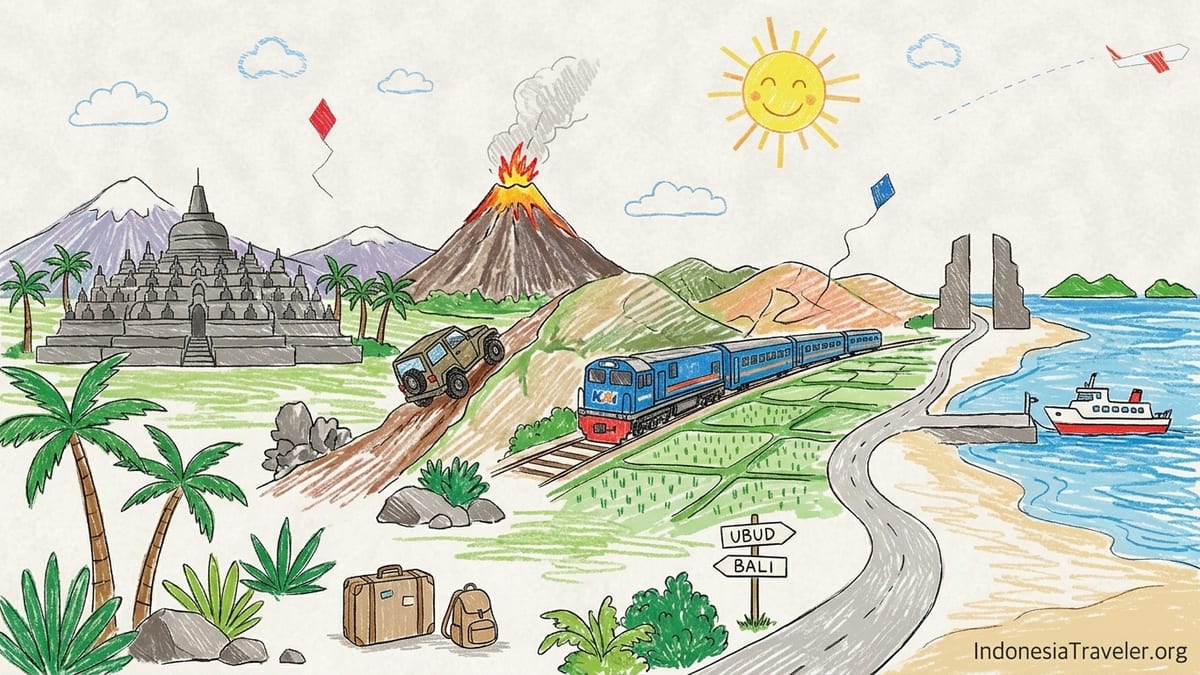
Indonesia rewards travelers who choose depth over frantic island-hopping. With a bit of planning, you can experience Java’s temple heartland, Bali’s cultural core and beaches, and even Lombok or Flores without turning your holiday into a race. This guide lays out a genuinely executable west to east route that begins in Yogyakarta and ends in Bali, with clear trains, ferries and flight options, realistic travel times, and built-in buffers for weather and volcano closures.
How to Use This Indonesia Itinerary
This itinerary is built as a practical route that most independent travelers can actually follow, rather than an overstuffed checklist of islands. The core plan is a fourteen-day journey that starts in Yogyakarta on Java and ends near Bali’s main Ngurah Rai International Airport, moving steadily west to east by train, car and ferry. Each segment has realistic transfer times, suggested booking channels and room for rest.
From this core, you will find two main extensions. The first is a twenty-one-day version that adds either Lombok and the Gili Islands or an alternative Flores and Komodo ending, each with enough time to be worthwhile. The second is a distinct fourteen-day “marine alternative” that focuses on Bali, the Nusa islands and Lombok instead of Java, for travelers who would rather dive and snorkel than chase sunrises on volcanoes.
Because Indonesia’s volcanoes and national parks can close at short notice due to gas, ash or safety concerns, you will also find a no-volcano alternative, a family-friendly variation, and a transparent omission strategy that shows how to skip or swap sections without breaking your trip. Wherever possible, transport options are based on current services as of late 2026, but schedules and prices can change, so always recheck close to departure.
All travel times in this guide are realistic but approximate. A train from Yogyakarta to Surabaya might take around five to six hours; a ferry across the Bali Strait could take forty-five minutes on the water but several hours door to door. These examples are intended to help you plan buffers so you are not sprinting between stations or risking a missed flight on your last day.
Days 1–3: Yogyakarta, Kraton and the Great Temples
Plan to arrive in Yogyakarta, often abbreviated as Jogja, on Day 1. The city is served by Yogyakarta International Airport, located some distance from the city center, and connected by airport train and shuttle services. Build in enough time to reach your accommodation near the Kraton or Malioboro area, drop your bags and have a late afternoon stroll. Malioboro Street is busy and commercial but offers an easy first taste of local batik shops, street snacks and simple warungs where you can try dishes such as gudeg or nasi campur.
On Day 2, focus on the city itself. Spend your morning at the Kraton, the Sultan’s palace complex, which is still a living cultural institution with resident musicians and dancers. In the surrounding neighborhoods you can easily visit Taman Sari, the Water Castle, and explore narrow lanes of old Jogja on foot or by becak pedicab. In the evening, you might watch a wayang kulit shadow puppet performance or a gamelan concert, which are still often staged in the Kraton or nearby cultural centers, though performance days and times should be checked once you arrive.
Day 3 should be set aside for the twin temple giants of Borobudur and Prambanan. They are in different directions from the city and each deserves unhurried time. Many travelers are tempted to see sunrise at Borobudur and sunset at Prambanan on the same day, but this can feel rushed. A realistic option is to book a Borobudur structure-access slot in advance for the morning, using official ticketing channels or authorized partners listed by the temple’s management, then return to Yogyakarta for a rest and lunch before heading out to Prambanan in the late afternoon.
Access to Borobudur’s upper levels is now controlled by timed tickets and limited quotas that can often sell out for popular days, and tickets are typically available through official booking platforms and partner agencies. You can usually book these online ahead of time, and as of 2026 many travelers report that slots open several weeks in advance. For Prambanan, you can often buy tickets on arrival, but during peak school holiday periods and major festivals it is wise to purchase in advance if online options are offered. Build your Borobudur visit first, then schedule Prambanan around it, rather than squeezing both into a rigid timetable that allows no delays.
Days 4–5: East by Train for Mount Bromo
On Day 4 you leave Yogyakarta and start moving east toward Mount Bromo. The key is to understand that there is no single “Bromo train station.” Most travelers take an intercity train from Yogyakarta to Surabaya or to a smaller station closer to Bromo, then use a car transfer to reach either Malang or Probolinggo, which are common bases for arranging Bromo tours. Long-distance trains in Java are operated by Kereta Api Indonesia, also known as KAI, and many intercity services can now be booked up to around forty-five days in advance through the KAI Access app, KAI’s website, or ticket machines and counters at major stations.
A common route is Yogyakarta to Surabaya Gubeng station, which can take around five to six hours depending on the service class and stops. From Surabaya, onward travel to Probolinggo by local train can take roughly two hours, followed by a private car or shared minivan transfer of approximately ninety minutes to the slopes of Bromo. Some travelers prefer to stay in Malang instead, as it can feel more relaxed and offers different tour options, but the logistics to the volcano rim from Malang are slightly longer than from Probolinggo.
Day 5 is typically your Bromo sunrise day, which requires a very early start. Hotel pick-ups for 4WD jeep tours often begin shortly after midnight or around 1 to 2 am to reach the viewpoint near Mount Penanjakan or other designated sunrise spots before first light. Operators usually combine the viewpoint, a jeep ride across the Sea of Sand and a walk to the base of the Bromo crater staircase. Regulations on how close you can get to the crater can change if volcanic activity increases, so be prepared for last-minute route adjustments or partial closures for safety reasons.
Because the sunrise excursion cuts heavily into your night’s sleep, avoid planning major transfers on the same day after a Bromo tour. Many travelers choose to nap after returning from the volcano and travel onward the following morning. If you must move on the same day, leave generous buffer time before any fixed onward train or flight, and consider arranging private transport back to Probolinggo or Malang so you are not dependent on group schedules.
Days 6–7: Onward to Banyuwangi and Ijen, With a Buffer
On Day 6, travel further east toward Banyuwangi, the main gateway to Kawah Ijen. If you started from Probolinggo, you can take a daytime train east along the north coast line, often a journey of around four to five hours to Banyuwangi’s main station. Seats on popular intercity trains should be reserved in advance, again using KAI’s official channels or reputable ticket agents in town, especially in school holidays or Eid travel periods when trains across Java can fill up quickly weeks ahead.
Once in Banyuwangi, treat the rest of the day as a recovery window. Check into an accommodation that can help organize Ijen logistics, which typically include a very early departure in the night or before dawn to reach the trailhead. The town has grown as a tourist base, with a range of guesthouses and mid-range hotels that can arrange shared or private transport to the Ijen parking area and provide information on required entrance fees, local guides and safety updates.
Day 7 is your Ijen attempt day, but it should also function as a weather and closure buffer. Kawah Ijen is a working volcanic area and can close with limited notice due to high volcanic gas levels, strong winds or other safety concerns. In recent years there have been periods when overnight blue flame visits into the crater have been restricted or suspended, and sometimes the entire trekking area is temporarily closed. Local authorities typically announce closures through park offices and local government channels, and responsible tour operators will pass along these updates.
If Ijen is open and conditions are acceptable, expect a very early departure from Banyuwangi, often in the range of midnight to 2 am, followed by a drive of around 60 to 90 minutes to the trailhead and a hike of roughly 1.5 to 2 hours uphill on a well-trodden but steep path. Bring a proper jacket, headlamp and shoes with grip, as conditions can be cold and slippery. If the crater area is closed or you decide against a night hike, you can repurpose Day 7 to rest, explore coffee plantations or beaches near Banyuwangi, or simply move your Bali crossing forward a day.
Day 8: Crossing to Bali, Beyond the Ferry
On Day 8, you cross from Java to Bali. It is important to understand that the short ferry from Ketapang in Banyuwangi to Gilimanuk in west Bali is only one part of a longer door-to-door transfer. First, you must travel from your Banyuwangi accommodation to the ferry terminal, typically a drive of around 15 to 30 minutes. The passenger and vehicle ferries across the Bali Strait usually run 24 hours, and the sailing itself can be around forty-five minutes depending on conditions, but there can be waiting times for boarding, disembarkation and ticket checks.
Once you arrive at Gilimanuk, you still face a substantial road journey to reach popular parts of Bali such as Ubud or the south. The drive from Gilimanuk to Ubud can easily take four to five hours, while Gilimanuk to Sanur or Kuta often takes a similar length of time, depending on traffic and any stops along the way. You can arrange a private car in advance through your Banyuwangi hotel or a Bali-based driver who agrees to meet you at Gilimanuk, or you can connect through local buses, though the latter will be slower and less predictable with luggage.
Because the total transfer from Banyuwangi to central or southern Bali can take most of a day, treat Day 8 primarily as a travel day. If you aim for Ubud, you may arrive in the late afternoon or evening. Build in flexibility for delays, especially in peak domestic travel seasons or during major Balinese festivals when road traffic can be heavier. For travelers short on time or uncomfortable with long overland journeys, there are often domestic flights between Banyuwangi and Bali’s Ngurah Rai Airport, though frequencies and schedules can change and should be checked carefully when planning.
Even if you fly, remember that airport transfers at both ends, check-in times and potential delays still turn this into a half-day or more of travel. The advantage of the ferry route is that it keeps your journey continuous at ground level, allowing you to experience the gradual shift from Java’s landscapes into the greener hills of west Bali, but it is not simply a quick hop between two tourist hubs.
Days 9–11: Ubud and Central Bali
Days 9 through 11 are dedicated to Ubud and central Bali. Ubud works well as a base because it combines cultural sights, rice terrace landscapes and day-trip access to much of inland Bali. Choose accommodation within walking distance of the town center if you enjoy being close to cafes and galleries, or stay slightly outside in Tegallalang or near the Ayung River if you prefer a quieter setting with views over rice fields or jungle ravines.
Use one of your Ubud days to visit nearby rice terraces and village temples. Tegallalang is close and often busy, yet still offers classic stepped rice field views. For a quieter experience, you can ask a driver to take you to less-trafficked rural routes north of Ubud, where village paths pass between irrigation channels and family compounds. You might combine such a drive with a stop at Tirta Empul, a holy spring temple where Balinese Hindus perform purification rituals, observing respectfully from the side or joining only if you are properly briefed on etiquette by a knowledgeable guide.
Another day can focus on Ubud’s town life. The Monkey Forest remains popular, though visitors should take care with belongings and treat the macaques as wild animals rather than performers. The main streets host art galleries, craft shops and a growing number of contemporary cafes and restaurants that highlight local ingredients. Cultural performances like legong or kecak dances are still regularly staged in temple courtyards or community halls in the evenings, with tickets available from venues or tourist information stands in town.
Keep a flexible day in Ubud to rest or to join activities such as a Balinese cooking class, a yoga session or a cycling tour that starts in the cooler highlands and rolls down through villages and rice paddies. These experiences can be booked locally through studios, hotels and tour desks, often a day or two in advance, though high season dates and morning classes may need more lead time. Use this buffer day to absorb travel fatigue from the Java segment before moving on to the coast.
Days 12–14: Southern Bali and Departure
For Days 12 and 13, choose a base in southern Bali that is reasonably convenient for the airport. Sanur, Jimbaran and parts of the Bukit Peninsula such as Nusa Dua or the areas near Balangan and Padang Padang each offer different atmospheres. Sanur has a calmer seaside promenade and easier access to boat transfers to the Nusa islands, while Jimbaran is known for its bay, seafood restaurants on the sand and short driving distance to Ngurah Rai. Nusa Dua and nearby beaches provide more resort-style stays with sheltered swimming and walking paths.
From a southern base you can spend one day on gentle coastal time and one day on short excursions. For example, from Jimbaran you might visit Uluwatu Temple for its dramatic cliff setting and sunset kecak dance, arranged with a private driver or a ride-hailing service where available. From Sanur you could rent bicycles for the beachfront path or simply enjoy a quieter shallow-water beach day, which can suit families or travelers who are ready for a slower pace.
Day 14 should be kept deliberately light, with no long excursions and a generous airport buffer. Traffic in southern Bali can be unpredictable, and it is wise to be at the airport at least two to three hours before an international flight, with even more time allowed if your hotel is far from the airport or if your departure falls during peak road congestion such as late afternoon or early evening. Use the morning for final packing, a last short swim or a café visit, then make your way to the airport without rushing.
If you have an evening flight and need to check out of your accommodation at midday, ask in advance about luggage storage and late check-out options. Many hotels will hold your bags and allow you to use showers or common areas so you can enjoy a relaxed final day before heading to the terminal. Avoid stacking a boat return from another island and an international departure on the same day unless you have a very large buffer and understand the risks of weather delays and rough seas.
Extending to 21 Days: Lombok & Gilis or Flores & Komodo
With a full three weeks, you can expand this itinerary in two main ways without turning it into a rushed island sprint. The first option is to add Lombok and the Gili Islands after your Ubud stay, before finishing in southern Bali. The second is to replace Lombok with a Flores and Komodo segment that ends in Labuan Bajo, coupled with a domestic flight back to Bali for your international departure. Trying to include both Lombok and Flores in a single seven-day extension is likely to result in too many long transfers and too little actual time on the ground.
For a Lombok and Gilis extension, after Day 11 in Ubud you can transfer to Padangbai or Serangan for fast boat services to the Gilis or to northern Lombok. Boat operators and schedules change regularly, and sea conditions can affect services, so choose reputable companies, confirm departure points and build in contingency time. Spend roughly three to four nights on the Gilis, using Gili Air or Gili Meno if you prefer a quieter feel than Gili Trawangan. This gives you enough time for snorkeling, diving courses with established dive centers and slow days by the water.
From the Gilis, take a local boat to Lombok and head south to areas such as Kuta Lombok, Selong Belanak or further west along the coast. Plan at least three full days here to enjoy beaches, simple surf breaks and small-scale cultural visits to Sasak villages arranged through responsible local operators who respect community wishes. Morning trips to local markets, cooking classes featuring Lombok dishes and sunset viewpoints over the coastline are more enjoyable when you are not squeezing them between transfers.
If you prefer a Flores and Komodo ending, consider flying from Bali to Labuan Bajo on Day 12, spending four to five nights in town. From there, you can book a properly organized Komodo National Park excursion, either as a one-day speedboat trip or an overnight liveaboard, through licensed operators in Labuan Bajo. These trips must be planned carefully, as park regulations, permitted landing sites and conservation rules have evolved over time. Use one day on land in Labuan Bajo before and after any boat trip to rest, visit local viewpoints and ensure you are well recovered before flying back to Bali for your international departure around Day 20 or 21.
Whichever extension you choose, keep at least one spare day as a buffer for weather or transport disruptions, particularly with boat-based sections. Fast boats between Bali, the Gilis and Lombok can be cancelled or rescheduled in rough seas, and small domestic aircraft may face occasional delays. Planning a dedicated buffer day instead of compressing your schedule allows you to absorb these changes without missing critical onward flights.
Fourteen-Day Marine Alternative: Bali, Nusa Islands and Lombok
If Java’s overnight volcano hikes do not appeal, you can instead spend a full fourteen days focusing on Bali, the Nusa islands and Lombok. Begin with several days in Ubud to get a sense of Balinese culture and inland scenery, then move to Sanur or another east coast point for a boat transfer to Nusa Lembongan or Nusa Penida. Boat services from Sanur to these islands usually take around thirty to forty-five minutes on the water, but check-in, boarding and disembarkation can stretch the total time, so treat each crossing as a half-day activity.
Spend three to four nights split between Nusa Lembongan and Nusa Penida, or base on one island and take day trips to the other. Activities here center on snorkeling, diving, beach visits and viewpoints. Nusa Penida’s western cliffs such as Kelingking and Broken Beach draw many visitors for photographs, while eastern sites and quieter coves provide more relaxed atmospheres. Road conditions on Penida can be rough in some stretches, so choose drivers familiar with the routes and avoid planning too many sites in a single day.
From the Nusa islands, you can return briefly to Bali or connect by boat to the Gilis or directly to Lombok, depending on available routes when you travel. Once on Lombok, divide your remaining days between the Gilis and the southern beaches. This might mean two to three nights on Gili Air for snorkeling and village bikes, and three to four nights around Kuta Lombok or Selong Belanak for beach days, surf lessons and short walks to headland viewpoints. The pace should be unhurried, with at least one full “do nothing” day in each location.
Finish your marine alternative back in southern Bali, ideally with two nights near the airport to provide a buffer before departure. Whether you choose Jimbaran, Sanur or another area, keep your final full day free of long boat trips or far-flung excursions. This structure keeps your focus on coastal and underwater experiences without the overnight hikes and long train journeys of Java, while still providing a coherent loop that begins and ends in Bali.
No-Volcano, Family and Omission Strategies
Because Indonesia’s volcanic areas can close without much notice, it is important to build a plan that can adapt. If Kawah Ijen is closed during your visit, an easy adjustment is to spend an extra day exploring the Banyuwangi area, then cross to Bali a day earlier and distribute the extra time in Ubud or on the coast. If Mount Bromo access is limited due to increased activity, you can either shorten your stay in Probolinggo or Malang or skip the Bromo segment entirely and travel from Yogyakarta directly to Banyuwangi by train over two days, with a city stop in Surabaya.
For travelers who decide from the outset to avoid volcanoes, a no-volcano version of the fourteen-day route would spend more time in Yogyakarta, Surabaya and coastal Java before crossing to Bali. For example, after three days in Yogyakarta you could take a train to Surabaya, explore its historic neighborhoods, markets and waterfront for a night or two, then continue by train along the north coast to Banyuwangi, adding a stop in a smaller city or town along the way. In Bali, the days freed from Bromo and Ijen can be reallocated to the north coast around Lovina or Pemuteran, or to extended time in Ubud.
Families with younger children often benefit from fewer very early starts and more time in accommodations with pools and easy food options. A family-friendly version might keep the Yogyakarta segment but limit late-night performances; replace Bromo’s pre-dawn jeep trip with a gentler sunrise viewpoint closer to town, or skip it entirely; and treat Ijen as a scenic region for plantations and waterfalls rather than a night trek. In Bali, Sanur and Nusa Dua are often easier with children than more crowded or surf-heavy beaches, thanks to calmer waters and paved promenade areas.
Transparent omission strategy simply means acknowledging what you are cutting and why. If you know that pre-dawn hikes and long train journeys are not realistic for your group, it is better to remove Bromo and Ijen from the plan without guilt and concentrate on Java’s cultural and culinary experiences and Bali’s variety of landscapes. Likewise, if adding both Lombok and Flores would reduce each to a rushed stop, choose one extension and enjoy it fully rather than trying to touch both lightly. This mindset leads to a better trip than a technically “complete” itinerary that leaves you exhausted and rushed.
Regardless of which version you choose, always leave at least one uncommitted day in your schedule, ideally somewhere in the middle and another toward the end, as buffers. These can absorb weather delays on boat crossings, minor illnesses, sudden closures of trails or temples, and simple tiredness. In a country as large and complex as Indonesia, that small amount of slack can make a large difference to how your journey feels.
FAQ
Q1. How far in advance should I book Java intercity trains?
Many intercity trains on Java can be booked through Kereta Api Indonesia’s official channels up to about forty-five days ahead. For popular routes such as Yogyakarta to Surabaya or holiday periods, booking as soon as your dates are fixed is wise, while outside peak times you may still find seats closer to departure.
Q2. Do I need to book Borobudur and Prambanan tickets in advance?
For Borobudur structure access, advance booking is strongly recommended because daily quotas can sell out, especially for weekend and holiday dates. Prambanan entry can often be purchased on the day, but during school holidays, major festivals or if you want to attend special performances, it is safer to secure tickets in advance when online options are available.
Q3. Is the Mount Bromo sunrise tour suitable for everyone?
The Bromo sunrise experience involves a very early departure, cold temperatures at the viewpoint, and travel in 4WD jeeps over rough terrain. Most tours require some walking on sandy and sometimes uneven ground. Travelers with mobility issues, respiratory concerns or young children may find the conditions challenging, and it is reasonable to opt for a gentler daytime visit or to skip Bromo entirely.
Q4. How risky is the Ijen night hike and blue flame visit?
The Ijen night hike involves climbing in the dark at high altitude in an area with volcanic gases. In some periods, access into the crater for blue flame viewing has been restricted or suspended for safety, and authorities may close the entire area during times of higher risk. Guides generally provide gas masks when necessary, but anyone with respiratory or heart conditions should consult a doctor before considering the hike and be prepared to turn back if conditions feel unsafe.
Q5. Are fast boats between Bali, the Gilis and Nusa islands reliable?
Fast boats are widely used, but their reliability is closely tied to sea conditions. In calm weather, services usually run close to schedule, while in rough seas departures can be delayed, rerouted or cancelled altogether. Choosing established operators, traveling outside of known high-wind periods when possible and building a buffer day around boat segments will help manage this uncertainty.
Q6. What is a realistic daily budget for this itinerary?
Budgets vary with style of travel and season, but many independent travelers on a mid-range plan allow for accommodation, meals, local transport and entrance fees that together amount to a moderate daily spend by Southeast Asian standards. City stays in Yogyakarta and Ubud can be more affordable than island extensions like the Gilis or Nusa Penida, where transport and some activities cost more; check current local prices and adjust accordingly.
Q7. Is this route suitable for families with children?
Yes, with adjustments. Families often shorten or skip the pre-dawn volcanic hikes, choose accommodations with pools and on-site dining, and favor calmer beach areas such as Sanur, Nusa Dua or Gili Air. Building in extra rest days, avoiding too many one-night stops and scheduling travel segments at child-friendly times of day will make the journey more comfortable.
Q8. How many domestic flights does this itinerary require?
The core fourteen-day Java to Bali route can be completed entirely overland, using trains, cars and ferries. Optional flights become relevant if you choose to fly from Banyuwangi to Bali instead of taking the ferry, or if you add an extension to Flores and Komodo, which usually involves flights between Bali and Labuan Bajo and back before your international departure.
Q9. Can I drive myself instead of hiring drivers and joining tours?
Self-drive car or motorbike rentals are available in many parts of Indonesia, but traffic conditions, road quality and local driving habits can be demanding, especially for visitors not used to them. For longer transfers or visits to volcanic areas, many travelers find it more relaxing and safer to hire experienced local drivers or join organized tours, and to reserve self-drive for shorter, less complex segments if at all.
Q10. What is the best time of year to follow this itinerary?
Many travelers aim for the drier months when Java and Bali see less rain and hiking trails are in better condition, but exact patterns can vary by region and year. Shoulder periods just before or after peak dry season can offer a balance of manageable weather and fewer crowds, though you should still remain flexible because sudden weather changes or volcanic activity can affect specific days along the route.