


Seminyak has evolved into one of Bali’s most polished beach neighborhoods, yet it still works best when you approach it as a compact coastal district rather than a launchpad for far flung day trips. From the sands of Double Six Beach up to Petitenget Temple and Batu Belig, most of what visitors actually do in Seminyak fits into a few walkable kilometers: surf lessons and sunsets, temple visits, boutique shopping, destination restaurants, spa sessions and late night bars. This guide focuses on what genuinely happens on that strip today, with current examples of prices, booking rules and practical details so you can match Seminyak’s style to your own budget and pace.
Reading the Ocean: From Double Six to Batu Belig
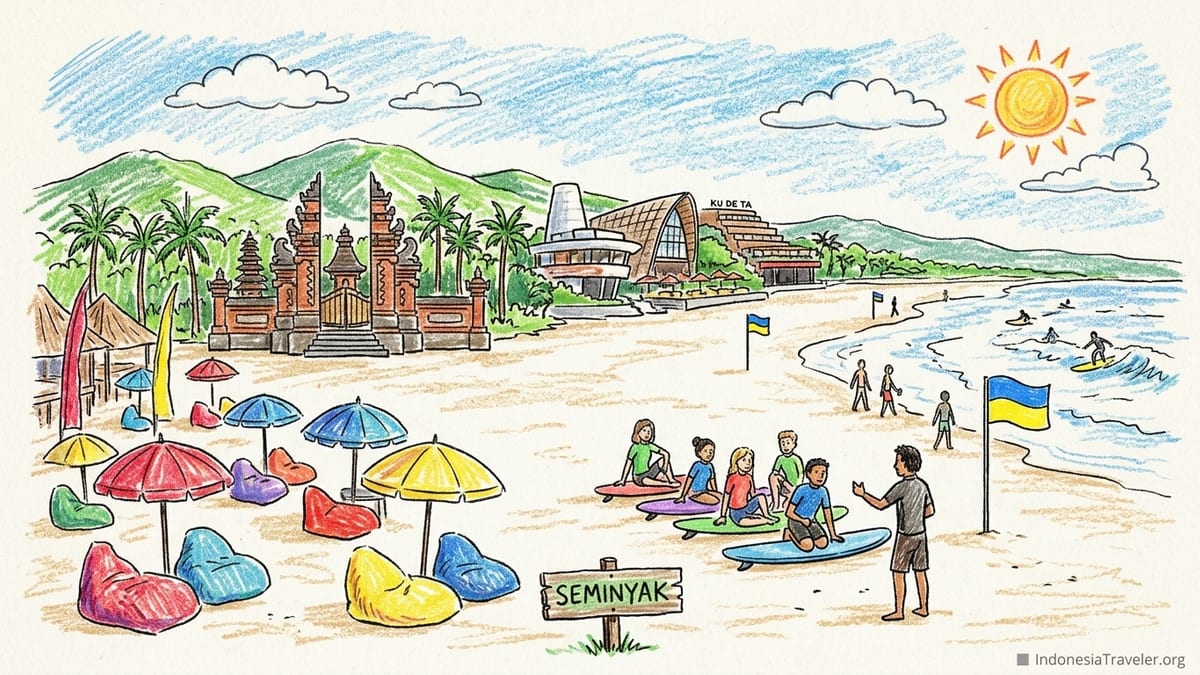
Most visitors first meet Seminyak where the sand flattens out at Double Six Beach, the stretch between Legian and central Seminyak that fills each afternoon with surf classes and beanbags. Although it is technically one long coastline from Kuta to Batu Belig, conditions for walking, supervised surfing and independent swimming are not identical. The beach is a wide, hard packed strip at low tide, excellent for long shoreline walks of 30 to 60 minutes in either direction. At mid and high tide, especially on days with a stronger swell, the water can push high enough to leave only a narrow band of dry sand, so walking in regular shoes or with children can feel crowded and splash heavy. Lifeguard towers and flags mark safer zones, and it is worth checking where these are before you commit to a long stroll.
Surf lessons cluster at Double Six and Seminyak Beach because the sandy bottom gives a more forgiving “beach break” than reef based spots elsewhere. Locally run schools and beach instructors commonly charge in the region of 300,000 to 450,000 Indonesian rupiah per person for a 2 hour group lesson including board and rash vest, with slightly higher prices for private sessions. That price range reflects checks made with current operators around Double Six and Seminyak in 2026, although individual schools may sit a little above or below. Lessons normally run at mid tide when waves are fuller but not closing out too heavily, and many schools avoid late afternoon high tides when currents can pick up. For a more economical option, confident swimmers sometimes negotiate a shorter, 1 hour one to one session directly with a beach instructor, or simply rent a foam board for a few hours at roughly half the price of a full lesson, but that is only advisable if you already understand ocean safety and basic surfing etiquette.
Independent swimming is a different question. The same waist high waves that feel fun under an instructor’s eye can become punishing if you wade out alone on a day with strong rip currents. Red flags on the sand indicate “no swimming” zones and are taken seriously by local lifeguards, especially during the July to September dry season when swell from the Indian Ocean is stronger, and again when early rainy season storms arrive around October and November. Between Double Six, Seminyak, Petitenget and Batu Belig, you will sometimes see alternating safe and unsafe sections across a single afternoon as the tide and wind shift. A realistic plan for casual swimmers is to stick to flagged yellow and red zones, keep sessions short, and consider beach club or hotel pools when the high tide is pushing close to the sea wall and waves look messy.
As you walk north from Double Six, you cross a notional line into Seminyak Beach and then Petitenget Beach, though there are no fences or borders. Petitenget’s sand is slightly darker and can slope more steeply into the sea, which concentrates waves during high water and occasionally limits how much dry shoreline remains at sunset. At extreme high tides, especially around full and new moons, parts of Petitenget and Batu Belig can feel almost cut off, with waves washing right up to bar terraces. At lower tides the same areas open into vast, walkable flats perfect for sunrise runs and tide line photography. In rainy season, onshore winds sometimes bring more floating debris to shore; many beachside businesses now organize morning cleanups so conditions generally improve by late morning. If you want to prioritize long, calm walks and photos, aim for mornings around low tide; if your priority is surfing or people watching, late afternoon mid to high tide on a dry season day offers more energy, with the tradeoff of rougher water.
Visiting Pura Petitenget: Culture, Etiquette and Ceremony
Amid the cafes and beach clubs, Pura Petitenget is Seminyak’s most important cultural landmark and a living Hindu temple with its own rules. It sits just inland from Petitenget Beach near the bend where Jalan Petitenget meets the sea. Unlike many hotel shrines, this is an active community temple that hosts regular ceremonies, so visitors are guests, not ticket holders. There is no fixed, universally advertised admission price. Instead, there is usually a small donation box near the entrance where international visitors commonly leave a contribution of around 20,000 to 50,000 rupiah per person to support temple upkeep, although the exact amount is voluntary.
Dress standards are straightforward. To step inside the inner temple areas, you are expected to wear a sarong that covers the legs and a sash tied around the waist; shoulders should be covered with at least a T shirt or light blouse. Some sarongs and sashes can be borrowed or rented near the entrance for a modest fee if you arrive wearing shorts. Visitors who are menstruating or recovering from serious illness are traditionally requested not to enter the holier inner courtyards, a guideline that may be explained on signs or by temple staff. You will also be asked to remove shoes at certain points. A realistic visit that respects the atmosphere, walks the outer compounds, notes the intricate brickwork and guardian statues, and pauses to watch locals bring offerings can last 30 to 60 minutes.
Photography is generally permitted in the outer courtyards, but flash and intrusive lenses are discouraged, and you must not block pathways or step onto raised platforms used for offerings. During ceremonies, which often take place in the late afternoon or on key Balinese calendar days, rules tighten. Visitors are usually directed to specific viewing areas or asked to wait outside entirely until rituals finish, particularly if you are not dressed for worship. Close up portraits of worshippers, priests or children in ceremonial dress should only be taken after clear permission; telephoto “sniping” is frowned upon. If you arrive to find the temple particularly busy with locals in full temple whites, it is better to watch respectfully from a distance and return another time for casual photography.
From central Seminyak near Jalan Kayu Aya, Pura Petitenget is a 10 to 20 minute walk depending on your starting point, or a short 5 to 10 minute ride by taxi or online motorbike. There is modest parking in the area, but congestion builds around ceremony times and sunset. For visitors with limited mobility, the main entrance involves a short set of steps and some uneven paving stones inside; there are no formal ramps, so a companion’s support is helpful. A lower cost alternative for those who find Petitenget too busy is to attend a smaller neighborhood temple ceremony further inland via a local guide or cultural walk, where similar etiquette applies but visitor numbers are lower.
Shopping in Seminyak: Boutiques, Designers and Malls
Seminyak’s reputation as a shopping hub rests on three main streets: Jalan Kayu Aya, Jalan Raya Seminyak and Jalan Petitenget, each with a slightly different personality. Jalan Kayu Aya, often called “Eat Street,” mixes cafes and restaurants with fashion and accessory boutiques like Indonesian resort wear labels, jewelry shops and small art galleries. Prices on this street are squarely mid to upper mid range by Bali standards. A cotton sundress by a local designer can easily sit between 700,000 and 1,500,000 rupiah, while simple silver jewelry and beaded clutches may range from a few hundred thousand rupiah upwards depending on craftsmanship and branding. Bargaining is limited in fixed price boutiques, although independent stalls on side alleys may still negotiate.
Jalan Raya Seminyak runs inland and carries a blend of long standing textile stores, homeware showrooms and fashion outlets. Here you find shopfronts selling batik fabrics by the meter, carved wooden decor, rattan furniture and tableware suited to villas and apartments, alongside racks of beach clothing. Compared with beachside lanes, Jalan Raya Seminyak presents more local Indonesian ownership and slightly broader price bands, from budget friendly sarongs around 100,000 rupiah in simple cottons to more elaborate batik pieces and handmade lamps that climb into the millions of rupiah. Because the road is busy, many shoppers hire a driver for a half day, combining visits to several stores with short drop offs, which usually costs somewhere in the region of 350,000 to 550,000 rupiah for four hours depending on vehicle and season.
Jalan Petitenget, which extends north from Petitenget Temple, leans more toward contemporary lifestyle brands and concept stores. Here you might move between minimalist fashion labels, jewelry designers working in brass and semi precious stones, and home fragrance or skincare boutiques focused on Indonesian botanicals. Prices reflect a “city boutique by the beach” positioning: a tailored linen shirt or dress from a local designer might be tagged around 1,200,000 to 2,000,000 rupiah, while scented candles, ceramics and basketry sit in varied brackets below that. Several stores showcase Indonesian designers alongside imported lines, which provides useful comparisons if you want pieces that travel well beyond Bali.
For a more conventional mall environment, Seminyak Village and the adjacent Seminyak Square near the end of Jalan Kayu Aya remain open at the time of writing, hosting a mix of fashion, swimwear, footwear, homeware and food tenants. Current information from their own listings and recent 2026 visitor reports indicates operating hours roughly from late morning to around 10 pm for most outlets, though individual cafes may open earlier for breakfast. Tenants in Seminyak Village include a supermarket, fashion and accessory boutiques and a few beauty and service outlets, while Seminyak Square combines retail with restaurants and coffee. These malls work well on hot or rainy afternoons when walking the main roads feels punishing. A realistic window to browse both is 1.5 to 3 hours. Budget travelers sometimes use Seminyak Village’s supermarket and fixed price shops to benchmark what everyday items should cost before bargaining in smaller markets elsewhere.
Where to Eat and Drink: From Beachfront Icons to Local Warungs
Dining in Seminyak ranges from destination restaurants that book out weeks in advance to simple warungs on backstreets. Along the beachfront, venues operate not just as restaurants but also as sunset lounges with complex booking and minimum spend rules. Potato Head Beach Club on Petitenget Beach, now part of a larger creative village, illustrates how those rules currently work. As of checks made in late 2026, entry to the beach club is free for most of the day, but from around 4 pm to 6:30 pm there is a cover charge of 200,000 rupiah per person that is redeemable against a selection of drinks. Seating such as daybeds and cabanas often have separate minimum spends that are credited toward food and beverages and can rise significantly during peak seasons and special events. The practical takeaway is that walking in before mid afternoon, finding a bar seat and ordering a drink is still accessible to mid range budgets, while reserving a prime daybed for a big sunset session suits groups who are comfortable with a bill that can reach several million rupiah by the end of the night.
KU DE TA, a long established beach club and restaurant a short walk south of Petitenget Temple, uses a different structure. Its restaurant and bar are generally open from morning through late night, with walk in tables available in many time slots. For everyday dining in the main restaurant and bar areas there is no blanket entry fee and no compulsory minimum spend beyond what you order, although special event nights can be exceptions. However, its beachfront daybeds and some premium sunset seating operate on a prepayment system: a minimum spend per daybed or per prime table is payable in advance and credited to your food and drink consumption, often reaching into the low millions of rupiah in high season according to recent 2026 rate checks. Reservations for these premium spots are recommended 4 to 8 weeks ahead for July and August sunsets, whereas casual lunch tables may still be available for walk ins. This illustrates why labeling a venue simply as “expensive” is not helpful; the cost depends heavily on whether you accept general seating or insist on the front row.
Further along the beach, La Plancha near Double Six is one of the most recognizable casual beachfront bars, known for its colorful beanbags on the sand. Entry is free, and you pay for what you order, with sunset drinks and simple plates like grilled seafood, satay and fries. Prices here tend to sit just above neighborhood warungs but below the polished beach clubs: a basic cocktail or mocktail commonly lands between roughly 90,000 and 150,000 rupiah, with large Bintang beers and juices lower than that. Beanbag seating usually operates on a soft minimum of one drink per person, enforced more strictly at peak times when staff need to turn over high demand spots. The atmosphere skews social and loud at sunset, but families still find it accessible earlier in the afternoon.
For travelers looking to keep food costs under tighter control, local warungs and small cafes a few streets back from the beach remain the best option. Here, plates of nasi campur, mie goreng or grilled fish with rice can still be found in the 35,000 to 80,000 rupiah range according to 2026 menu snapshots, especially at venues serving mainly Indonesians and long stay residents. Many of these places are cash only or accept local e wallet payments, have fans instead of air conditioning, and do not take reservations, so they work best for flexible diners who do not mind simple surroundings. A common pattern is to have breakfast or lunch at modest cafes and warungs, then allocate a larger share of the budget to one or two high profile sunset dinners at venues like KU DE TA or Potato Head.
Wellness and Spa Time: Massages, Treatments and Quiet Corners
Seminyak’s wellness scene is less about hardcore retreats and more about massages, facials and body treatments that slot between beach time and late evenings. Across the district, you will find everything from simple family run massage shops on side streets to upscale spa complexes inside hotels and dedicated wellness centers. Prices for a 60 minute Balinese massage in no frills parlors currently cluster around 120,000 to 220,000 rupiah, depending on location and the finish of the space. In mid range and upscale spas that emphasize design, music and skilled therapists, the same hour can climb to 400,000 to 900,000 rupiah, with multi hour ritual packages priced higher. These figures reflect 2025 and 2026 rate cards posted by several Seminyak spas checked during research, but individual venues may sit slightly outside this range.
For most visitors, the practical considerations are hygiene, training and reservation policies. Well known spas and hotel facilities near Petitenget and Jalan Kayu Aya usually request reservations, at least for afternoon and early evening slots, and may require a small deposit through an online payment link, especially for couples packages. They tend to offer private treatment rooms, air conditioning and after treatment relaxation areas with tea or snacks included. In contrast, walk in massage shops on Jalan Raya Seminyak and smaller lanes often operate on a first come, first served basis, with simple curtained cubicles and fans. They are more affordable and flexible but can book out spontaneously when a tour group or large family arrives. A good strategy is to walk by earlier in the day to check cleanliness and ask about quieter hours.
Visitors with limited mobility or sensory sensitivities should pay attention to access and atmosphere. Many Seminyak spas are up a short flight of stairs, and only some have lifts. Treatment rooms can be dimly lit and scented with oils or incense, which may be an issue for people sensitive to fragrance. When booking, you can request unscented oils and firmer or lighter pressure; better run spas already ask these questions at check in. For a lower cost, calmer alternative to intricate spa packages, consider a basic 30 or 45 minute foot massage and leg reflexology at a reputable street side spa, which typically costs well under 150,000 rupiah, allows you to stay clothed, and still offers a meaningful reset between busy activities.
Nightlife and Sunset Venues: Potato Head, KU DE TA, Mano & More
Sunset is the hinge between Seminyak’s daytime beach mood and its nightlife. Beach clubs like Potato Head and KU DE TA dominate the conversation, but smaller venues including Mano Beach House at Petitenget, bars along Double Six and rooftop lounges inland fill out the picture. Understanding each venue’s booking rules matters more than broad price labels. As already noted, Potato Head currently uses a time window cover charge of 200,000 rupiah per person between mid afternoon and early evening, redeemable for selected drinks, alongside separate minimum spends for daybeds and cabanas. General bar seating often has no formal minimum spend beyond your orders, but during peak dates such as Christmas and New Year, prebooked packages and tickets become the norm.
KU DE TA distinguishes between walk in bar and restaurant guests and those who reserve daybeds or special event seating. Walk ins for breakfast, lunch and many dinner time slots simply pay for what they eat and drink. For premium front row sunset daybeds and occasionally for large group tables, current 2026 terms and recent traveler reports suggest a prepaid minimum spend in the low to mid millions of rupiah per daybed that is fully credited but non refundable if you underspend. Reservations typically open weeks in advance, and there is a clear dress code that shifts from neat casual by day to smart casual after 4 pm, with sports jerseys and beachwear excluded from the restaurant in the evening. This combination of open access with pockets of formality makes KU DE TA suitable both for travelers who want a one off splurge and those who prefer just a single drink at the bar.
Mano Beach House, near the end of Petitenget Beach, offers a smaller scale sunset option with a mix of daybeds, tables and a pool, generally without the large cover charges of its bigger neighbors outside of special events. Recent 2026 menu checks place many cocktails in the 120,000 to 160,000 rupiah range, with beers and mocktails lower. Some seating categories have modest minimum spends, especially poolside beds, but there is still space for casual walk in visitors who are happy with a standard table or bar stool. Early evening live music or DJs are common a few nights a week, though the atmosphere tends to stay more relaxed than party heavy. For an even more budget conscious sunset, the simple bars and cafes directly on the sand at Double Six and Seminyak Beaches rent plastic chairs or beanbags with little more than an expectation that you order a drink and perhaps a snack.
Transport for nightlife in Seminyak usually involves short taxi rides or online ride hailing cars and motorbikes, as walking along dark, busy roads with narrow pavements can be uncomfortable. Between central Seminyak and Petitenget, expect evening car journeys of 10 to 25 minutes for distances that would take less than half that time on foot during the day due to traffic. Fares with regulated taxi companies remain relatively low for such short hops, often in the range of 40,000 to 80,000 rupiah depending on time and route. Those who want to avoid queuing for taxis after big events commonly leave venues slightly before the main crowd, or choose smaller bars along Jalan Petitenget and Jalan Drupadi where walk in space is more reliable and booking rules are loose or absent.
Practical Beach Experiences: Surf Lessons, Bars and Day Trips
Planning a typical beach day in Seminyak often means combining surf time, relaxed meals and perhaps one special venue booking. At Double Six Beach, you can arrange surf lessons directly on the sand or through established schools based in nearby lanes that walk you down to the water with rash vests and soft top boards. Group lessons in 2026 cluster around 300,000 to 450,000 rupiah for approximately two hours including instruction and equipment, with private classes priced higher. Sessions often start mid morning and mid afternoon, avoiding the harshest midday sun. Expect at least 30 minutes of dry land warm up and safety briefing. For beginners on a budget, one or two formal lessons followed by board rental for shorter sessions under your own steam is a common pattern, provided you remain conservative about conditions and stay near lifeguard posts.
Casual beachfront bars along Double Six and central Seminyak work without complex reservation systems. Here, a cold beer may cost 35,000 to 50,000 rupiah, simple cocktails and fresh juices more, and plates of grilled corn, satay, fried rice or seafood remain accessible to moderate budgets. You can occupy plastic chairs or simple loungers facing the sunset for a couple of hours with a bill that stays well below what you would spend at a full service beach club, which appeals to backpackers and families aiming to keep daily costs under tight control. These bars are typically open from late morning until around 11 pm, weather permitting. In heavy rain or stormy seas, many strip back their seating but continue serving under more sheltered awnings.
Within Seminyak itself there is no need for long transfers, but some visitors do choose a half day excursion to Tanah Lot temple on the coast northwest of Canggu. It is important to label this clearly as outside Seminyak: driving there takes around 45 to 75 minutes each way depending on traffic. Many drivers quote around 400,000 to 700,000 rupiah for a half day private car that includes waiting time, while organized tour prices vary widely based on inclusions. Entrance for international visitors to the Tanah Lot complex is charged separately and adjusted from time to time by local authorities. Because this can be one of Bali’s most crowded viewpoints at sunset, a realistic plan is to visit early in the morning or combine it with other inland stops, returning to Seminyak for the evening rather than attempting both a full beach club sunset and a Tanah Lot sunset on the same day.
For travelers who prefer to stay entirely within Seminyak’s footprint, alternative low key activities include early morning jogs along the beach before the heat rises, coffee tasting at local roasters around Jalan Kayu Aya, and simple cooking classes run by neighborhood restaurants that teach Indonesian dishes in half day formats. Prices for such classes often hover between 450,000 and 900,000 rupiah per person, including a market visit and meal, but checking current rates and availability directly with venues is necessary, as offerings shift by season. These experiences round out a Seminyak trip without the need for long car rides or aggressive bargaining.
The Takeaway
Seen up close rather than as a generic resort area, Seminyak is a narrow coastal band anchored by Double Six Beach, Petitenget Temple and a triangle of shopping and dining streets. Within that small footprint you can surf, walk miles of sand at the right tide, attend a functioning temple, shop Indonesian designers, eat at venues with strict booking rules or warungs with none, and wind down in spas and sundowner bars that suit different budgets. The details matter: the same ocean that looks gentle for shoreline walks can be unsuitable for unsupervised swimming on a heavy swell day, and the same beach club that feels “too expensive” from afar may be approachable if you choose bar stools over prepaid daybeds.
By matching your plans to real world scheduling and pricing information collected from current 2026 sources, you can avoid both underestimating and overcomplicating Seminyak. Arrive at Double Six with a realistic idea of surf lesson costs and ocean safety, treat Pura Petitenget with the same respect you would any urban place of worship, shop Jalan Kayu Aya, Raya Seminyak and Petitenget with a sense of what different designers and homewares actually cost, and read the fine print on sunset venues before you commit. Do that and Seminyak becomes less of a blur of names and more of a coherent beach neighborhood where you can fill three to five days without leaving town, and still feel you have experienced the place on its own terms.
FAQ
Q1. When is the best time of day to walk the beach in Seminyak?
Early mornings around low tide are usually best for long, calm walks with plenty of firm sand, while late afternoons bring more crowds and higher water that can narrow the shoreline.
Q2. How much should I budget for a beginner surf lesson at Double Six Beach?
In 2026, a realistic budget for a two hour beginner lesson with board and instructor is around 300,000 to 450,000 rupiah per person, with private lessons costing more.
Q3. Is it safe to swim independently at Seminyak and Petitenget Beaches?
Swimming can be safe when you stay inside flagged lifeguard zones and conditions are calm, but strong currents and changing tides mean unsupervised ocean swimming is not advisable everywhere every day.
Q4. Do I need a sarong to visit Pura Petitenget, and can I rent one?
Yes, legs and waist should be covered with a sarong and sash, and shoulders should be covered; simple rental or loan options are usually available near the entrance for a modest fee.
Q5. Are Seminyak Village and Seminyak Square still worth visiting for shopping?
Both remain open with a mix of fashion, homeware, services and dining, and they are useful for air conditioned browsing or benchmarking fixed prices before visiting smaller boutiques and stalls.
Q6. How do cover charges and minimum spends work at Potato Head Beach Club?
Entry is generally free outside a late afternoon window where a 200,000 rupiah cover applies and is redeemable against selected drinks, while daybeds and special seating have separate minimum spends credited to food and beverages.
Q7. What is the difference between walk ins and daybed bookings at KU DE TA?
Walk in guests usually pay only for what they order in the bar and restaurant, but reserved daybeds and premium sunset spots require a prepaid minimum spend in the low to mid millions of rupiah that is credited but non refundable if you spend less.
Q8. How expensive are spa treatments in Seminyak compared with local massage shops?
Simple street side massage shops often charge around 120,000 to 220,000 rupiah for a 60 minute massage, while upscale spas can range from about 400,000 to 900,000 rupiah or more for similarly timed treatments.
Q9. Is Tanah Lot an easy day trip from Seminyak?
Yes, it is a common excursion but sits outside Seminyak and involves a 45 to 75 minute drive each way, so most visitors treat it as a half day trip with a private car and driver.
Q10. Can I enjoy Seminyak on a lower budget without beach clubs and designer boutiques?
Yes, by focusing on beach walks, local warungs, modest massage shops, free temple visits with small donations and casual beachfront bars, you can experience much of Seminyak’s atmosphere without high minimum spends.