


Canggu’s beach roads and rice field shortcuts tempt many visitors to jump on a scooter. Yet a growing number of travelers prefer to avoid motorbikes altogether, whether for safety, licensing, children or luggage. Getting around without a scooter is entirely possible, but it requires understanding how Bali’s traffic works in real time, what airport transfers actually cost, and why a road that looks short on the map can still trap you in a one-hour jam.
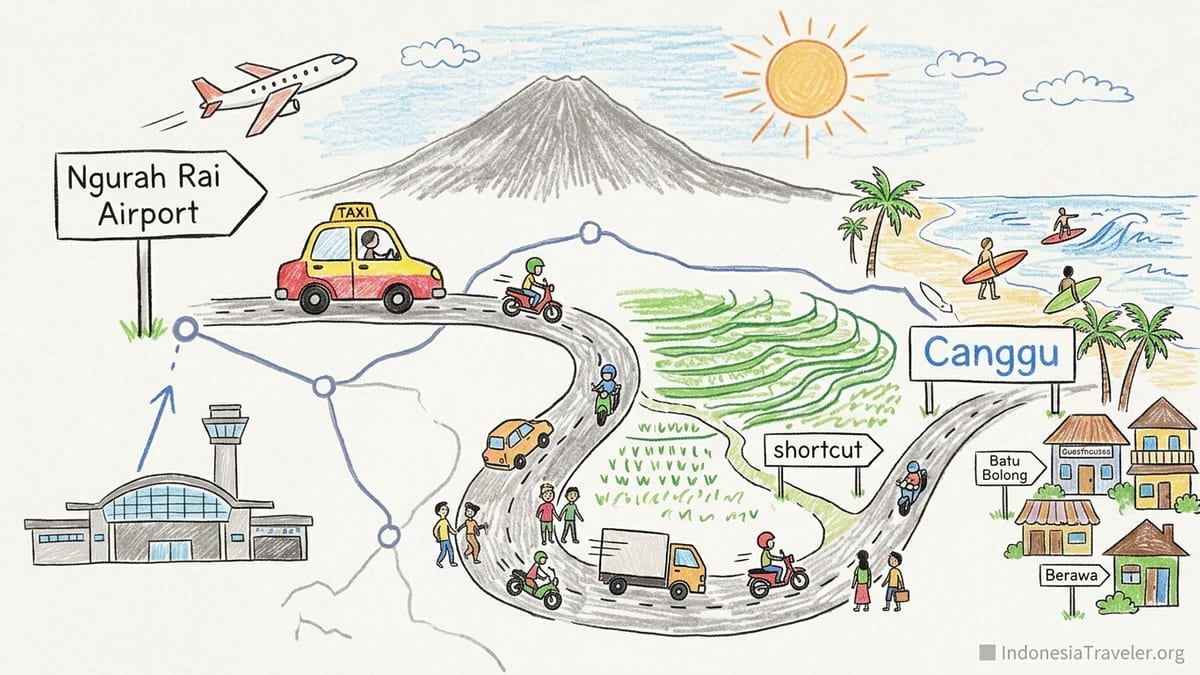
From Ngurah Rai Airport to Canggu: Short Distance, Long Journey
Bali’s I Gusti Ngurah Rai International Airport sits roughly 15 to 20 kilometers south of Canggu, depending on whether you aim for Batu Bolong, Berawa or Pererenan. On any map, the distance looks modest. In free-flowing traffic, a car could cover it in around 35 minutes. In practice, current reports in late 2026 suggest that a realistic airport to Batu Bolong travel time ranges from about 50 to 90 minutes, and it can stretch longer in heavy evening or holiday congestion.
Part of the time difference comes from the route choice. A typical path runs north from the airport through Kuta and Seminyak before bending toward Canggu along Jalan Raya Canggu or coastal streets. Each area has its own busy junctions, traffic signals and bottlenecks where local trips, delivery vehicles and tourist transfers all compete for the same narrow lanes. The final approach into Batu Bolong, Berawa or Pererenan often slows again as cars funnel onto village roads lined with cafes, guesthouses and beach clubs.
Costs fluctuate with demand and fuel prices, so it is important to treat any figure as time-stamped. In October 2026, several airport transfer guides and ride-hailing price examples describe airport-to-Canggu car fares in roughly the IDR 150,000 to 400,000 span for standard vehicles, depending on provider, time of day and exact drop-off point. Some prebooked services and hotel transfers charge more, especially for larger vehicles or late-night arrivals, while occasional promotions or off-peak app rides fall toward the lower end. Travelers should always check live prices on their chosen service, because these October 2026 figures serve only as dated reference points.
The key lesson from the airport run is to plan for time rather than distance. If your flight lands at 16:00 and you have dinner booked in Batu Bolong at 19:00, you may reach Canggu in under an hour on a lucky day. On a busy Sunday before a surf festival or during a long weekend, the same trip can nudge toward two hours. Building in margin for immigration queues and baggage reclaim is just as important as picking the right car service.
Choosing Between Prebooked Transfers, Taxis, Apps and Hotel Pickups
Most visitors who avoid scooters will rely on four main options from Ngurah Rai Airport: the official airport taxi counter, prebooked private transfers, ride-hailing apps like Grab and Gojek, and hotel-arranged pickups. Each works differently in terms of price, convenience and predictability.
The airport taxi counter, operated by the airport’s licensed cooperative, remains the most straightforward walk-up choice. Inside the arrivals hall you give staff your destination, pay a fixed-zone fare and receive a driver. Recent traveler reports in 2026 describe counter fares to Canggu as sitting in a higher band than app rides, with typical ranges from the low 200,000s into the 300,000–400,000 rupiah area for a standard car to Batu Bolong or Berawa. The benefit is simplicity: you do not need local data or an account, and you avoid haggling outside.
Prebooked transfers, arranged through global platforms or local drivers, can be cost-competitive and reduce stress if you are landing late at night or with surfboards. Some online booking services, as of October 2026, list private cars from the airport to Canggu at headline rates around the mid-200,000 to mid-300,000 rupiah bracket for one to four passengers, with higher prices for vans, premium vehicles or last-minute bookings. The driver usually waits with a sign in the arrivals area and walks you straight to the car, which can be reassuring if you are traveling with children or multiple suitcases.
Grab and Gojek cars typically offer dynamic pricing. In quiet times, app quotes to Batu Bolong or Berawa sometimes appear around the mid-100,000s to low-200,000s for basic categories. During rainstorms or when several flights land together, the same journey might rise closer to or above airport counter levels. At Ngurah Rai, online guides note that app drivers are often required to use designated pickup zones slightly away from the immediate arrivals curb. This may involve following in-terminal signs or messaging your driver within the app. Pickup rules can change, so it is wise to read the latest instructions on the day you arrive.
Hotel pickups add another layer. Midrange and upscale properties in Canggu sometimes quote airport transfer prices that are noticeably higher than apps, especially if they use larger vehicles or outsource to a trusted partner driver. Quotes above 300,000 rupiah for a private car to Batu Bolong or Berawa are not unusual, and luxury hotels can charge substantially more. The trade-off is reliability and communication: the hotel already has your booking details, can track delays, and often coordinates with the driver if your flight is late or your luggage takes longer than expected.
Understanding Canggu’s Road Network: Main Arteries and Shortcuts
Once you reach Canggu, the way the road network is laid out largely determines how efficiently you can move without a scooter. The core north-south and east-west movements revolve around Jalan Raya Canggu, several beach access roads and one high-profile shortcut between Canggu and Berawa.
Jalan Raya Canggu functions as the primary spine connecting the inland area around Kerobokan and Tibubeneng to the beaches. From there, smaller roads run south toward Pantai Batu Bolong, Pantai Nelayan and Pantai Berawa, and west toward Batu Mejan and Echo Beach. These beach roads are lined with guesthouses, villas, cafes and small supermarkets, which means frequent vehicle turns, loading stops and pedestrians crossing between shops and accommodation.
Pantai Batu Bolong Road drops from Jalan Raya Canggu down to Batu Bolong Beach, passing many of Canggu’s best-known cafes and bars. Pantai Nelayan runs parallel closer to the coast, forming a quieter back route in places but still narrowing near the beach where parking eats into the carriageway. Pantai Berawa Road curves toward the Berawa beachfront, beach clubs and villa pockets. Batu Mejan, leading toward Echo Beach, is narrower again and often feels more like a village lane than an urban street, with parked motorbikes, delivery trucks and temple activity all using the same space.
Between Canggu and Berawa, a purpose-built shortcut over former rice fields connects the two areas without detouring through Kerobokan. The shortcut was widened and resurfaced in recent years to relieve pressure on the main roads, but by April 2026 local media were already reporting that congestion remained heavy, especially at peak hours. Police and the Badung transport agency highlighted rising vehicle numbers and driver behavior as key causes, and by August 2026 further coordination meetings focused on managing jams around Canggu’s main intersections.
By September 2026, regional officials were publicly discussing additional one-way systems and traffic management schemes to ease gridlock, particularly in and around Pantai Berawa and key junctions with Jalan Raya Canggu. These remained proposals rather than implemented rules at the time of writing, so visitors should not assume that any specific future plan, such as permanent one-way circulation around Berawa beach, is already in force. What matters for travelers is that authorities recognize the problem and may adjust circulation patterns, so navigation apps and driver habits can change over the coming months.
When Shortcuts Become Slower Than Main Roads
Canggu’s road network encourages the idea that small shortcuts always save time. In practice, a narrow connector like the Canggu–Berawa shortcut can easily become slower than taking the longer main-road loop via Jalan Raya Canggu, particularly for cars and vans.
Several factors influence this. The shortcut crosses areas where schools, local warungs and small shops attract repeated stopping and turning, especially around morning and mid-afternoon school runs. Parked vehicles, including delivery trucks and lines of motorbikes, effectively reduce sections to a single lane. When two large vehicles meet opposite each other in a constricted point, one must reverse, which can hold up every car and scooter behind for several minutes.
Unlike wider urban boulevards, many of these roads lack consistent shoulders or lay-bys. A ride-hailing car stopping for a pick-up outside a guesthouse, or a villa delivery van paused to unload water gallons, forces all following traffic to wait or squeeze around at very low speed. Once a small queue forms, the impact multiplies quickly because the road has almost no spare width to allow overtaking.
There is also a psychological feedback loop. Because the shortcut looks faster on the map, many navigation apps will route drivers through it by default, especially when recent travel times are not updated. As more drivers redirect themselves off the main road onto the shortcut, congestion there increases while the main alternative through Kerobokan or along Jalan Raya Canggu can, at times, flow more predictably. Local drivers often decide in real time based on the time of day, weather, school schedules and informal reports from fellow drivers rather than relying solely on the map’s suggested route.
Walking in Canggu: Short Distances, Uneven Reality
On paper, Canggu’s core areas appear close enough to stroll. Batu Bolong Beach to many restaurants on Jalan Batu Bolong is only a few hundred meters. Parts of Nelayan, Berawa and Pererenan also form compact pockets where you might walk between cafes, co-working spaces and sunset bars. In these dense pockets, daytime walking can be pleasant, especially along stretches where pavements have been upgraded.
However, walking more than short segments in Canggu quickly exposes infrastructure limits. Sidewalks are often broken, missing or blocked by parked motorbikes and signage. Open storm drains line many streets; covers can be uneven or absent, posing a risk after dark or in heavy rain. Lighting is inconsistent once you leave the busiest restaurant strips, and glare from oncoming headlights can make it difficult to judge the edge of the road.
Pedestrians usually share the roadway itself with scooters and cars, particularly on Batu Mejan and smaller lanes off Pantai Nelayan and Pantai Berawa. Drivers in Bali are generally accustomed to navigating around pedestrians, but the narrow width means you may find yourself stepping into the verge to let a passing van through. For travelers with strollers, mobility impairments or heavy luggage, walking beyond a few hundred meters can become impractical.
As a result, many visitors treat walking as a “last few hundred meters” option between their drop-off point and their accommodation or chosen cafe. For example, you might ask a driver to stop near the intersection of Jalan Batu Bolong and Jalan Raya Canggu, then walk the remaining 400 meters to your guesthouse rather than expecting a car to weave down every small gang (alley). This approach balances realism about sidewalks with the desire to be on foot where it is comfortable and safe.
App Cars, Local Drivers and Pickup Restrictions
Beyond the airport, most visitors who refuse to ride scooters end up alternating between app-based cars and locally arranged drivers. Each comes with its own rhythm and set of expectations around pickup points and waiting times.
GrabCar and Gojek’s GoCar cover much of South Bali, including Canggu, Berawa, Seminyak, Kuta and parts of Denpasar. In 2026, typical short hops inside Canggu, such as Batu Bolong to Berawa, can be relatively inexpensive when traffic is light. However, you should expect surge pricing in evening peaks or during major events at beach clubs. Pickup restrictions sometimes apply near certain hotels, beach accesses or main intersections where local transport groups have a strong presence. In these cases, drivers might ask you to meet them at a nearby main road or landmark rather than directly at a contested kerb.
Locally arranged drivers are often individual freelancers or small companies contacted through your accommodation, a past airport driver, or recommendations in traveler communities. They may not use a meter, instead quoting point-to-point prices for day trips, sunset runs to Tanah Lot, or evening restaurant transfers. Many visitors appreciate the familiarity of working with the same driver over several days, especially when traveling with children or surfboards, because the driver learns your schedule and preferred pickup spots that are comfortable and legal.
In some parts of Bali, there is tension between app-based drivers and local taxi groups that control certain stands or village zones. Travelers occasionally encounter signs discouraging the use of ride-hailing apps immediately outside particular beaches or club entrances. In these situations, it is important to follow posted guidance and any instructions from your driver rather than trying to force app pickups in restricted spots. If an app shows that pickup is not available directly at a location, walking a short distance to an agreed roadside point usually resolves the issue without conflict.
Where possible, confirm fares before you depart if you are not using a metered or app-based service, and keep small notes ready. While many drivers now accept digital payments through apps or QR codes, cash still smooths many everyday journeys, especially in areas where mobile data signals fluctuate.
Why Scooters Are Not a Simple Solution
Motorbikes are deeply woven into Bali’s transport culture, and countless social media posts show visitors weaving along rice paddies at golden hour. For travelers who choose not to ride, or are undecided, it is worth looking at scooters with a critical eye rather than romantic images.
Indonesian law requires riders to hold an appropriate license, which for most visitors means a valid motorbike license from their home country plus an international driving permit that covers motorcycles. Many short-term visitors do not have this combination yet still rent scooters, which can create problems if an accident occurs or police carry out roadside checks. Fines for riding without proper documentation are one risk; more serious is the possibility that travel insurance declines coverage if you were riding illegally or without a helmet.
Helmet use is compulsory, and quality varies. Rental helmets may be old, poorly fitting or lack proper certification. Even when worn, a helmet does not remove the vulnerability of being on a two-wheeled vehicle in mixed traffic that includes trucks, buses and vans on narrow roads with unpredictable surfaces. Potholes, sand patches and wet rice field runoff all appear frequently around Canggu and Berawa, especially after rain.
Accident statistics for Bali are difficult to interpret precisely, but hospital staff and long-term residents frequently describe scooter crashes as a routine part of life. Typical incidents include low-speed falls when trying to brake on gravel, collisions at crowded intersections, and injuries from other riders cutting across suddenly. For inexperienced riders, night driving and wet-season conditions amplify these risks sharply.
Given this context, choosing not to ride a scooter is a reasonable and often safer decision, especially for families with children, older travelers or anyone uncomfortable with chaotic traffic. The trade-off is relying more heavily on cars, which can increase your time in jams, but which provide more physical protection and do not require you to navigate Bali’s licensing and insurance complexities.
Longer Journeys Without a Scooter: Seminyak, Tanah Lot, Ubud and Sanur Harbour
Once settled in Canggu, you may want to explore farther afield without ever touching a motorbike. The main inter-town routes are all manageable by car, whether booked through an app, a driver or your accommodation.
Seminyak lies south of Canggu and is often combined as a dining or shopping detour. Travel time from Batu Bolong or Berawa to Seminyak typically ranges from about 30 to 60 minutes by car, depending on whether you depart during afternoon or evening peaks. Ride-hailing fares in 2026 for this route often sit in the mid-five-figure to low-six-figure rupiah range for a standard car, with higher prices at peak times or for larger vehicles. Many visitors hire a car and driver for three to four hours to cover both the outbound and return legs without worrying about finding an app car late at night.
Tanah Lot, northwest of Canggu along the coast, is a classic sunset outing. Distance from Batu Bolong is modest, but the road narrows after you leave the more built-up parts of Canggu. Travel time can run from about 40 minutes in quiet periods to over an hour when sunset tours converge. Booking a return with the same driver is usually wise, since app coverage can be patchier once you move away from the main tourist centers, and phone signals may fluctuate around the temple parking areas.
Ubud, inland to the north, involves a longer, more variable journey. Drivers generally route through Kerobokan and central or east Denpasar before climbing toward Gianyar and Ubud. In 2026, many travelers report travel times between 80 minutes and two hours by car from Canggu, with morning and late-afternoon rush hours inviting the longest delays. Airport and transfer guides surveyed in October 2026 put car fares between South Bali and Ubud in a broad band, frequently from around 300,000 rupiah upward for standard private cars, with app examples fluctuating above or below that depending on demand.
Sanur Harbour, used for many fast boats to Nusa Penida and the Gilis, lies on Bali’s southeast coast. From Canggu, a predawn departure to meet morning boats might take 50 to 80 minutes by car, while a late-morning return journey after the boats come back can stretch beyond an hour with Denpasar traffic. Some harbor transfer lists for October 2026 show airport-to-Sanur app fares in the high-90,000 to mid-100,000 rupiah area for basic cars, with airport taxis charging more. From Canggu itself, prices are typically higher, so checking live app quotes the day before a boat trip, and padding your schedule, is essential.
Door-to-Door Scenarios and a Practical Decision Matrix
Putting the pieces together, it helps to imagine specific door-to-door days without a scooter. Consider a family of four landing at Ngurah Rai at 15:00 with two large suitcases and a surfboard bag, booked into a villa off Batu Bolong. They might prebook a private van in advance, paying a confirmed fare in the higher hundreds of thousands of rupiah, in exchange for guaranteed space for luggage and a driver waiting in arrivals. Travel time could range from about 60 to 100 minutes depending on traffic. On arrival in Canggu, the driver may stop at the top of a narrow gang, and the family walks the remaining 100 meters to the villa to avoid threading a large van down a tiny lane.
Another example is a remote worker staying near Pantai Berawa who wants to attend a sunset yoga class in Pererenan. Instead of renting a scooter, they could book a Grab or Gojek car for each leg. In late afternoon, an app pickup from Berawa to Pererenan might take 25 to 45 minutes including traffic, even though the distance is only a few kilometers. The fare can still be modest compared to the overall trip cost, but they should allow for possible delays at the Canggu shortcut and carry a small umbrella or poncho in case of a rain-soaked wait for the return car.
For a couple based on Jalan Nelayan planning a full-day trip, a local driver might offer a day rate to combine Tanah Lot at sunrise, a coffee stop in central Canggu, and an afternoon transfer on to Seminyak. Instead of booking three separate app rides and worrying about coverage at Tanah Lot’s parking area, they pay a single negotiated fee, perhaps similar to or slightly higher than three individual rides but with the benefit of flexibility and a vehicle that remains with them.
When choosing between options, think in terms of a simple decision matrix. If cost is the primary concern and you are traveling solo or as a couple with minimal luggage, ride-hailing apps usually offer the lowest per-trip prices and may undercut hotel transfers by a wide margin. For safety and comfort, especially with children, privately booked cars or hotel-arranged transfers with seatbelts and known drivers can feel more reassuring, even at a higher price.
Travelers with bulky luggage or surfboards should prioritize vehicle size and roof rack or interior space over the absolute cheapest fare, which pushes them toward prebooked vans or established drivers. Families with strollers, older relatives or anyone with limited mobility may want to choose accommodations on or near main roads like Batu Bolong or Pantai Berawa where cars can safely pull in, rather than remote rice field villas at the end of long gravel tracks. Accessibility in Canggu is improving in some pockets, but elevated curbs, steps and irregular pavements still present daily obstacles.
Ultimately, your mix of services might change over the course of your stay. Many visitors start with a hotel pickup from the airport, then switch to a combination of Grab or Gojek and a trusted local driver for longer days out. Walking remains useful within compact zones, especially along Batu Bolong and selected parts of Nelayan, Berawa and Pererenan, but planning around Canggu’s traffic and road layout remains the key to a low-stress, scooter-free visit.
FAQ
Q1. How long does it really take to get from Bali airport to Canggu by car?
In current late-2026 conditions, most travelers report around 50 to 90 minutes from Ngurah Rai Airport to Batu Bolong or Berawa, with occasional longer journeys at peak times or during holidays.
Q2. What is a reasonable price range for an airport car to Canggu right now?
Recent guides and example bookings in October 2026 show standard cars from roughly the mid-100,000s to around 400,000 rupiah, depending on provider, time of day and vehicle type, but it is essential to check live app or booking quotes.
Q3. Are Grab and Gojek allowed to pick up directly at Bali airport?
Ride-hailing apps operate at Ngurah Rai, but cars usually pick up from designated zones rather than the immediate arrivals curb. You book in the app, follow the directions to the pickup area and meet your driver there.
Q4. Is walking around Canggu safe at night without a scooter?
Short walks between restaurants, bars and accommodation in Batu Bolong, parts of Nelayan, Berawa and Pererenan are common, but broken pavements, open drains and limited lighting mean you should use a flashlight, avoid long dark stretches and consider a car for longer distances.
Q5. Can I rely only on taxis and app cars without hiring a scooter?
Yes. Many visitors now get around entirely by airport taxis, prebooked transfers, Grab and Gojek cars, and local drivers, accepting longer travel times in exchange for avoiding motorbike risks.
Q6. What are the main risks of renting a scooter in Canggu?
Key risks include riding without a proper motorbike license and international permit, inconsistent helmet quality, lack of insurance coverage in accidents, and a high likelihood of falls or collisions in congested, narrow traffic.
Q7. How bad is traffic on the Canggu–Berawa shortcut?
The shortcut was upgraded but still experiences frequent congestion, especially at school times and evenings, when parked vehicles and narrow sections can slow traffic so much that the longer main-road route is sometimes faster.
Q8. What is the best way to reach Ubud from Canggu without a scooter?
The most practical option is a car arranged through Grab or Gojek if available, or a private driver booked via your accommodation, with travel times usually between about 80 minutes and two hours depending on traffic.
Q9. How should I plan transfers from Canggu to Sanur Harbour for fast boats?
Allow at least 50 to 80 minutes for the car journey, book a pickup well before your boat check-in time, and confirm live prices through apps or a driver the day before, as traffic through Denpasar can be unpredictable.
Q10. Are there any official changes to Canggu’s traffic rules I should know about?
In 2026, local authorities have discussed and trialled various congestion responses, including potential one-way schemes near Berawa, but some remain proposals, so always follow current roadside signs, any police directions and your driver’s local knowledge.