


Many visitors arrive in Ubud imagining quiet village lanes, then discover steep hills, narrow pavements and busy motorbikes. If you do not want to ride a scooter, you can still move around comfortably, but it helps to understand how Bali’s transport actually works in 2026, from Ngurah Rai International Airport to Ubud’s lanes and onward to temples, rice terraces and harbours.
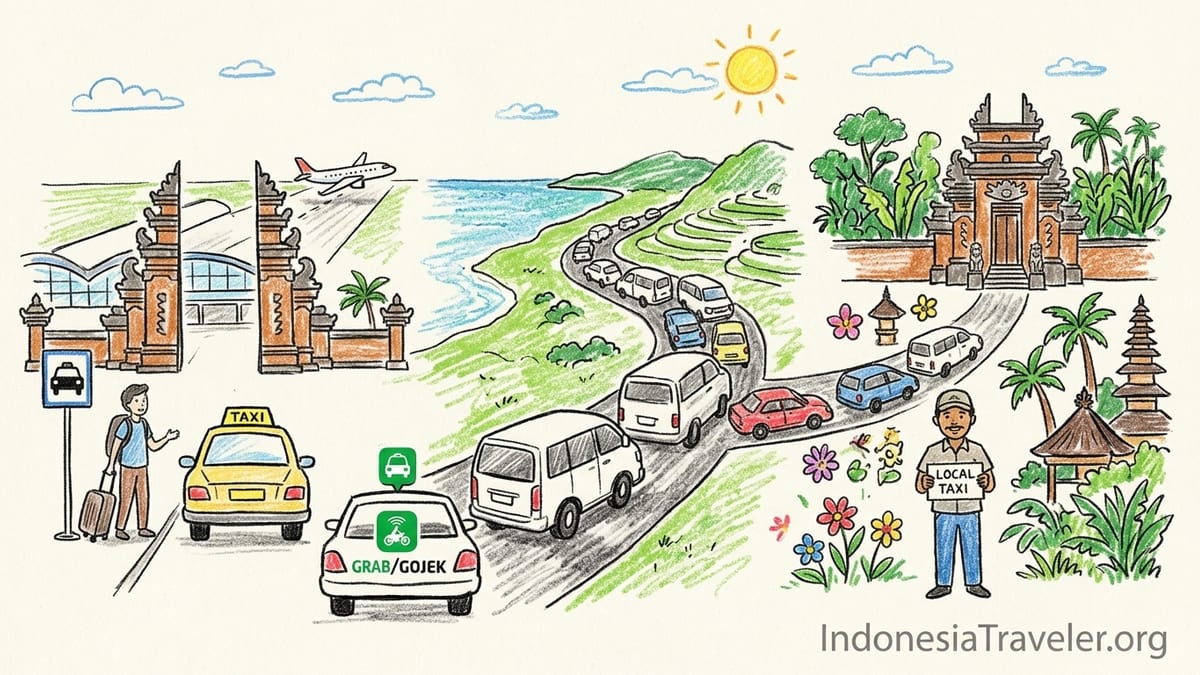
From Ngurah Rai Airport to Ubud Without a Scooter
Your journey usually begins at Ngurah Rai International Airport, south of Denpasar. There is no passenger railway to Ubud, and there is no direct metro or light rail from the terminal. Travellers almost always continue by road in a car or van, either through licensed airport taxis, ride-hailing apps such as Grab and Gojek, prearranged private transfers, or hotel drivers.
Driving time from the airport to central Ubud is currently around 75 to 105 minutes in typical daytime traffic, although the wide range reflects Bali’s frequent congestion and the exact location of your hotel. An airport taxi or private car that reaches a guesthouse behind Ubud Palace in 75 minutes on a mid-morning weekday might need closer to 100 minutes in late afternoon or on a rainy Sunday when traffic stalls around Sanur and Batubulan.
For app-based transfers, October 2026 spot checks put GrabCar and Gojek GoCar in a broad band that aligns with the often-quoted 300,000 to 450,000 rupiah range per car from Ngurah Rai to Ubud, depending on time of day, demand and car size. A Bali-focused transport guide in October 2026 reports about 300,000 to 450,000 rupiah for app cars from the airport to Ubud for standard sedans, with larger vehicles at the upper end. A detailed airport-to-Ubud comparison updated in September and October 2026 shows overlapping estimates, with Grab or Gojek typically around 280,000 to 400,000 rupiah for small cars and 400,000 to 550,000 rupiah for larger ones, while multiple traveller reports in mid to late 2026 describe paying between roughly 250,000 and 400,000 rupiah through apps for an airport to Ubud ride. Together, these three sets of observations confirm that 300,000 to 450,000 rupiah remains a realistic mid-range example rather than a fixed tariff, and that both congestion and surge pricing can push your fare above or below that band.
At the airport itself, you will see a fixed-price taxi counter in arrivals where you can buy a car ride to Ubud. Staff quote a zone-based fare, you pay in rupiah, then they match you with a driver. This option avoids negotiating outside in the heat, though it is often slightly more expensive than a ride-hailing app booked from the airport’s Grab or Gojek pickup zones in the parking structure. Many visitors now compare prices by quickly checking their phone at the luggage carousel, then either walk to the app pickup lounge or choose the taxi counter if they prefer to pay cash and step straight into a car.
Choosing Between Taxi, App Car, Hotel Driver and Prebooked Transfer
If you are determined not to ride a scooter, the good news is that almost every accommodation in Ubud can arrange a car and driver. The choice is less about what is possible and more about budget, comfort and timing. Hotel drivers and prebooked transfers tend to be the most straightforward. You agree on a price in advance, your driver waits at arrivals with a sign, and the car is usually a larger MPV or van with air conditioning and room for luggage. Prices commonly fall in the 350,000 to 600,000 rupiah range from the airport to Ubud for a private transfer, depending on vehicle size and the distance north of the palace.
App rides with Grab or Gojek usually cost less than a hotel car if you are travelling light and do not mind a short walk to the pickup area. For example, a couple arriving at 3 pm on a weekday might open GrabCar and see an estimate around 320,000 rupiah for a standard car to a guesthouse near Jalan Hanoman, while an XL car to a villa north of the Monkey Forest appears closer to 420,000 rupiah. If heavy rain begins or a number of flights arrive together, surge pricing can nudge those figures higher for 15 or 20 minutes.
Bluebird, Bali’s well-known metered taxi company, operates widely in the south of the island but is less central in Ubud itself and does not dominate the airport in the way it does in some other Indonesian cities. Where available, Bluebird gives you a meter and a phone app, which can be reassuring if you dislike bargaining, but most Ubud visitors will still rely on prearranged drivers or ride-hailing services after they leave the airport area.
Local taxi cooperatives, especially in Ubud, fill the gaps that ride-hailing apps do not always cover. Around Ubud Palace, the central market and the Monkey Forest you will find men offering “taxi, taxi” with laminated rate cards or handwritten price lists. These drivers do not normally run meters. Instead, they quote a flat price, which you can accept, gently negotiate, or compare to your app if ride-hailing pickups are permitted where you are standing. A short hop from the palace to a hotel on Monkey Forest Road might be quoted at 60,000 rupiah for two people, while a longer ride to a villa in Tegallalang can sit around 150,000 to 250,000 rupiah depending on the hour.
Understanding Ubud’s Geography Before You Book a Room
Distance on the map can be misleading in Ubud. A hotel described as “only two kilometres from Ubud Palace” might sit up a steep hill with crumbling pavements, or down a narrow lane that drivers avoid because of tight access and limited turning space. When you will depend on cars and your feet instead of a scooter, accommodation location becomes one of the most important transport decisions you make.
Streets that function relatively well on foot in daylight include Jalan Raya Ubud, the east-west main road through the centre, and the cluster of southbound streets that branch from it such as Monkey Forest Road, Jalan Hanoman, Jalan Goutama and Jalan Dewisita. These roads have a mix of shops, cafes, guesthouses and small temples, and they are where many first-time visitors choose to stay. If your hotel sits directly on one of these streets or just off a short spur lane, you can usually walk out to eat or shop, then call a car to pick you up near the main road instead of at your door.
The challenge lies in the details. Pavements in central Ubud are often interrupted by driveways, cracked concrete and open drainage channels covered by loose concrete slabs. Motorbikes sometimes use the pavement as overflow lane when traffic slows, especially at the top of Monkey Forest Road near the football field. In heavy rain, puddles form around broken paving stones and uncovered drains. After dark, street lighting can be uneven, and in some stretches you may need to use a phone torch to see where you are stepping.
North and east of the palace, accommodation quickly spreads into semi-rural rice fields and ridge roads. A villa that looks idyllic in marketing photos might be reached via a 400-metre footpath only, suitable for motorbikes and walking but not for cars. In practice this means your airport driver must stop at the main road while staff from the villa shuttle you and your luggage by small vehicle or carry bags along the path. If you plan to use Grab or Gojek during your stay, check reviews to see whether other guests found car access easy or difficult and whether drivers could find the property at night.
Walking in Ubud: Ordinary Streets versus Scenic Ridges
Within the compact central area, many visitors choose to walk between key landmarks such as Ubud Palace, the traditional art market and the Sacred Monkey Forest Sanctuary. Jalan Raya Ubud has stretches of usable pavement on both sides, while Monkey Forest Road and Jalan Hanoman offer a more continuous strip of shops and restaurants. Jalan Goutama and Jalan Dewisita, along with nearby side lanes, form a semi-pedestrianised feel in places, with narrower carriageways and calmer traffic than the main road.
At the same time, walking in Ubud remains more like careful urban hiking than a casual European promenade. Pavements can drop abruptly where a drain cover is missing, and tree roots twist up through tiles. Scooters will occasionally appear from side alleys or cut across the footpath to reach a parking area. For a simple example, strolling from the palace to the Monkey Forest, a distance of around 1.5 kilometres, you might step up and down dozens of small ledges, skirt around parked motorbikes and sidestep groups of tourists near popular cafes.
It is also important to distinguish everyday walking from Ubud’s famous recreational paths. Campuhan Ridge Walk, just west of the centre, is a scenic paved track that runs along a ridge above river valleys with views of coconut palms and rice fields. It is beautiful in soft morning light but it does not function well as a transport shortcut, because entry and exit points are limited and the path is exposed to sun and rain. Similarly, the paths around Juwuk Manis, often called the Sweet Orange Walk, thread through rice paddies north of the main road and feel tranquil, yet they are narrow concrete strips or earth trails that are not practical for luggage or regular commuting.
For everyday errands, assume that your realistic walking zone is roughly the rectangle bounded by Jalan Raya Ubud, Monkey Forest Road, Jalan Hanoman and the neighbouring cluster of lanes such as Goutama and Dewisita. Beyond that, especially after dark or in heavy rain, most visitors who do not ride scooters rely on a car.
Ride-Hailing, Local Taxis and Bluebird in Ubud
Ride-hailing services such as Grab and Gojek are widely used in Bali and remain popular in and around Ubud, but pickup rules are patchy. In some parts of town, especially directly outside cooperatively controlled hotspots such as the Ubud Market or the Monkey Forest entrance, local taxi groups attempt to block app pickups and put up signs warning against “online taxis.” These are not island-wide bans, and enforcement varies by hour and by who is watching, but it does mean that you should expect to walk a short distance to meet your GrabCar or GoCar on a more neutral stretch of road.
In practice, many visitors adopt a hybrid strategy. For longer trips such as Ubud to Sanur Harbour, they open the Grab or Gojek app from their hotel and ask the driver to meet them on Jalan Raya Ubud or another main street where pickups proceed without fuss. For short hops inside Ubud, some simply use local taxi cooperatives by asking the hotel reception to call a “car taxi” or by approaching drivers waiting near the palace and agreeing a price in advance.
Bluebird’s bright blue metered taxis remain a trusted brand in Bali, particularly in areas like Kuta, Seminyak and Sanur, where you can hail them on the street or book through the official app. However, Ubud is dominated more by unmetered local cars and app-based services than by Bluebird’s own fleet. You might see the occasional Bluebird car around central Ubud, often after dropping visitors from the south, but you cannot rely on walking outside and spotting one within minutes in the way you might near Kuta Beach.
Because of this patchwork, travellers who need reliability for flights or boat connections often keep the business cards or WhatsApp numbers of one or two trusted drivers. A driver who takes you from the airport to your homestay on arrival may be happy to handle your trip to Tegallalang the next day and your pre-dawn run to Sanur Harbour later in the week, often at a daily or per-trip rate agreed in advance.
Buses and Why Kura-Kura Is Not a Full Public Network
Bali has several forms of bus transport, but few Ubud visitors will experience them as an everyday alternative to cars. A regional bus rapid transit corridor now connects Denpasar and the airport to parts of the island, and one line serves an area that includes Kedewatan and Ubud. In practice, however, understanding stop locations, buying tickets and stitching the route into hotel-to-restaurant trips remains challenging for short-stay tourists, especially those carrying luggage or travelling with children.
The Kura-Kura Bus is the most visible shuttle for visitors. It is a privately operated network that links popular tourist areas including Kuta, Seminyak, Sanur, Ubud and Kintamani. Current fare tables show one-way tickets on several Kuta–Sanur–Ubud routes at about 100,000 rupiah and return tickets at around 160,000 rupiah, while a longer line that continues to Kintamani lists higher one-way and round-trip fares. Tickets are sold per person, not per vehicle, and must be used on specific routes with fixed timetables.
This setup means Kura-Kura works best for a day trip pattern, such as staying in Kuta and riding the bus to Ubud for an afternoon, or using it to reach Sanur from a hotel near one of the designated stops. It does not operate as a full municipal network where you can jump on a frequent bus at the corner of any street to reach any other part of town. Buses run at set hours, only stop at marked points and can fill up during busy seasons. If your accommodation is a fifteen-minute uphill walk from the nearest Kura-Kura stop, it may feel inconvenient compared with a door-to-door car.
For that reason, most travellers who avoid scooters still find that private cars remain their primary mode of transport in and around Ubud. Buses can play a supporting role for those who like planning around timetables and travelling light, but they do not yet replace ride-hailing apps or private drivers for flexible, late-night or luggage-heavy journeys.
Private Drivers for Temples, Rice Terraces and Day Trips
Once you are settled in Ubud, the next challenge is reaching classic sights such as Tegallalang rice terraces, Tirta Empul water temple, Gunung Kawi, Kintamani’s caldera viewpoints or waterfalls like Tegenungan and Tibumana, all without riding a scooter. Here, hiring a car with a driver for a half-day or full day is usually the easiest option.
Typical half-day arrangements last four to six hours and might include, for example, hotel pickup at 8 am, a first stop at Tegallalang, a second at Tirta Empul in Tampaksiring and a drop back in Ubud by early afternoon. Full-day bookings often run eight to ten hours and add additional stops such as Gunung Kawi’s ancient temple complex, a coffee plantation or a cafe overlooking Mount Batur in Kintamani. Drivers usually quote a flat price that includes vehicle, fuel and basic waiting time at each attraction, with parking and entrance fees paid separately at the sites.
Prices change with fuel costs and demand, but as of 2026 many visitors report paying roughly what an airport transfer might cost again for a half-day car, and somewhat more for a full day that ranges widely across central and north Bali. For example, if your hotel-arranged transfer from the airport to Ubud was 450,000 rupiah in a comfortable MPV, you might expect to pay around that figure again for a five or six-hour loop to Tegallalang and Tirta Empul, and somewhere above that for a ten-hour day that reaches Kintamani and several waterfalls.
Practical advantages go beyond cost. A driver who spends the day with you can suggest visit times that avoid the worst crowds, explain dress codes for temples, help you find elevators or gentler stair options where available, and coordinate with your accommodation if your return time changes. Many travellers end up using the same trusted driver several times during their stay, turning the relationship into a flexible on-call service that replaces any need to navigate scooter rentals.
Door-to-Door Examples Around Ubud
To make all of this more concrete, it helps to picture real journeys. Consider first the classic airport to Ubud trip. A couple arriving from Singapore at 1 pm clears immigration and baggage claim by 2 pm, then walks to the Grab or Gojek lounge in the parking building. They request a standard car to a small hotel on Jalan Dewisita and see an estimate of about 330,000 rupiah, with a projected travel time of 80 minutes. By 3:20 pm they are checking in, having walked only a short distance from the drop-off point to the reception. If they had chosen a hotel 2 kilometres north in the rice fields, the app might instead show 95 minutes of travel time and the final approach could involve a short walk along a narrow lane with their bags.
For a much shorter example, imagine moving from Ubud Palace to a hotel beside the Monkey Forest after an evening dance performance. The distance is around 1.5 kilometres along Monkey Forest Road. At 9 pm, with pleasant temperatures and some street lighting, many visitors would simply walk, watching their footing on broken pavement and making room for other pedestrians. If heavy rain is falling, they might ask staff at the palace or a nearby cafe to call a local taxi. A driver from the cooperative could quote, for instance, 60,000 rupiah to take two people and their bags to a hotel opposite the Monkey Forest entrance, a trip that will still take 10 to 15 minutes in traffic.
Ubud to Tegallalang provides a third perspective. A small group staying near Jalan Hanoman might arrange a four-hour private car starting at 8:30 am. The driver collects them at the hotel entrance and reaches Tegallalang rice terraces about 30 to 40 minutes later, depending on traffic through Andong and northbound roads. They spend an hour walking the terraces and taking photos while the driver waits in the parking area, then stop at a coffee plantation on the way back and return to Ubud before lunchtime.
For Ubud to Tirta Empul, a popular water temple near Tampaksiring, many visitors reserve a half-day driver. From central Ubud, the drive takes approximately 45 to 60 minutes each way. The driver drops you near the main entrance, waits while you store your belongings, borrow a sarong and complete the purification ritual, then brings you back to your hotel. Combining Tirta Empul with either Gunung Kawi or Tegallalang is a common full-morning circuit that keeps total time within six hours while avoiding midday heat.
An early-morning transfer from Ubud to Sanur Harbour, for fast boats to Nusa Penida or the Gilis, illustrates the value of planning. To catch an 8:00 am boat, most hotels will recommend leaving Ubud around 5:30 or 6:00 am, allowing one to one and a quarter hours for the drive plus check-in time at the harbour. Some travellers use a scheduled GrabCar or GoCar, arranged shortly before departure, while others prefer to book a private driver the day before to ensure a car is waiting at their door in the pre-dawn darkness.
Special Considerations: Wheelchairs, Strollers, Luggage and Night Travel
Travelling without a scooter in Ubud is perfectly feasible, but travellers with mobility needs or young children should take extra care when choosing where to stay and how to move around. Pavements along Jalan Raya Ubud and Monkey Forest Road feature frequent steps, narrow sections and occasional obstacles, which can make self-propelled wheelchairs or lightweight strollers difficult to push for more than a few hundred metres at a time.
For wheelchair users, it is worth contacting accommodations directly to ask about step-free access from the car drop-off point to the room, and whether staff can assist with ramps or portable solutions. Some newer hotels near major roads offer elevators from underground parking to the lobby, which makes direct car-to-room movement much easier, while traditional homestays tucked behind family compounds may involve staircases and uneven stone paths. When arranging private drivers, specify that you need a vehicle with sufficient space to load a folding wheelchair or stroller flat in the boot.
Luggage is another reason to prioritise properties with drive-up access. Many boutique villas in rice fields market the charm of being “away from the road,” but this often means your airport driver will stop at a small roadside shelter while porters transfer your bags along a concrete footpath on a motorbike. This can be part of the experience if you are carrying a small backpack, yet far less appealing with two large suitcases and a baby stroller arriving after a long-haul flight.
Night-time travel in and around Ubud demands extra caution. Street lighting is inconsistent, dogs may sleep on warm pavement, and some drains are covered only loosely. If you plan to walk in the evening, carry a small torch or use your phone light, stay alert for scooters emerging from side streets and consider booking dinner within a comfortable walking radius of your hotel. For airport runs that depart or arrive in the dark, prearranging a trusted driver gives both peace of mind and practical support with bags in unlit car parks or narrow lanes.
FAQ
Q1. Can I get from Ngurah Rai Airport to Ubud without riding a scooter?
Yes. Most visitors travel by licensed airport taxi, Grab or Gojek car, prebooked private transfer or a hotel-arranged driver. All of these are car or van options that allow you to avoid scooters entirely.
Q2. How long does the airport to Ubud drive usually take?
In 2026, most daytime journeys from Ngurah Rai Airport to central Ubud take about 75 to 105 minutes, with heavier congestion and distant villas sometimes pushing travel time beyond that range.
Q3. How much should I expect to pay for an app-based airport transfer to Ubud?
Recent in-app checks and transport guides suggest a broad working example of about 300,000 to 450,000 rupiah for a standard GrabCar or GoCar to central Ubud, though lighter traffic, surges and vehicle size can shift the fare above or below that band.
Q4. Are Grab and Gojek banned in Ubud?
No. Grab and Gojek operate in and around Ubud, but local taxi cooperatives sometimes restrict pickups in specific hotspots such as directly outside the market or Monkey Forest entrance, so you may need to walk a short distance to meet your car.
Q5. Is it realistic to walk everywhere in Ubud if I choose a central hotel?
You can walk many everyday routes around Jalan Raya Ubud, Monkey Forest Road, Hanoman, Goutama and Dewisita, but pavements can be uneven, drains exposed and lighting patchy, so walking feels more like careful urban hiking than effortless strolling.
Q6. What is the difference between Campuhan Ridge Walk and ordinary streets?
Campuhan Ridge and the Juwuk Manis rice field paths are scenic recreational walks with limited access points and narrow tracks. They are lovely for sunrise or sunset strolls but are not practical transport shortcuts for luggage or daily errands.
Q7. Does Kura-Kura Bus replace the need for taxis and private drivers?
No. Kura-Kura is a private shuttle linking areas like Kuta, Sanur and Ubud, with fares around 100,000 rupiah one way and 160,000 rupiah return on some routes, but it runs on fixed timetables and limited stops rather than acting as a full citywide bus network.
Q8. How do private drivers work for day trips from Ubud?
You agree a flat price for a half-day or full day, including car and fuel. The driver picks you up at your door, waits at places like Tegallalang or Tirta Empul and brings you back to your accommodation when you are finished.
Q9. Is Ubud suitable for travellers with wheelchairs or strollers?
It can be, but planning is essential. Choose accommodation with direct car access and minimal steps, confirm accessibility in advance and expect uneven pavements that may limit how far you comfortably roll or push on ordinary streets.
Q10. How should I handle very early or late-night journeys to or from Ubud?
For pre-dawn airport or harbour runs, it is wise to prebook a trusted private driver via your hotel or a reputable service. This ensures a car is waiting at your door at the agreed time and reduces stress in the dark when ride-hailing availability can fluctuate.