


By the time my driver needed fifteen minutes to crawl the last 600 meters along Jalan Monkey Forest, the Instagram version of Ubud had already cracked. I had landed expecting a hushed jungle town of empty temples, misty rice terraces and inexpensive yoga nirvana. What I met instead was a dense, noisy cultural center wrestling with traffic experiments, tour buses, selfie swings and a wellness economy that knows exactly how much Western stress is worth in rupiah.
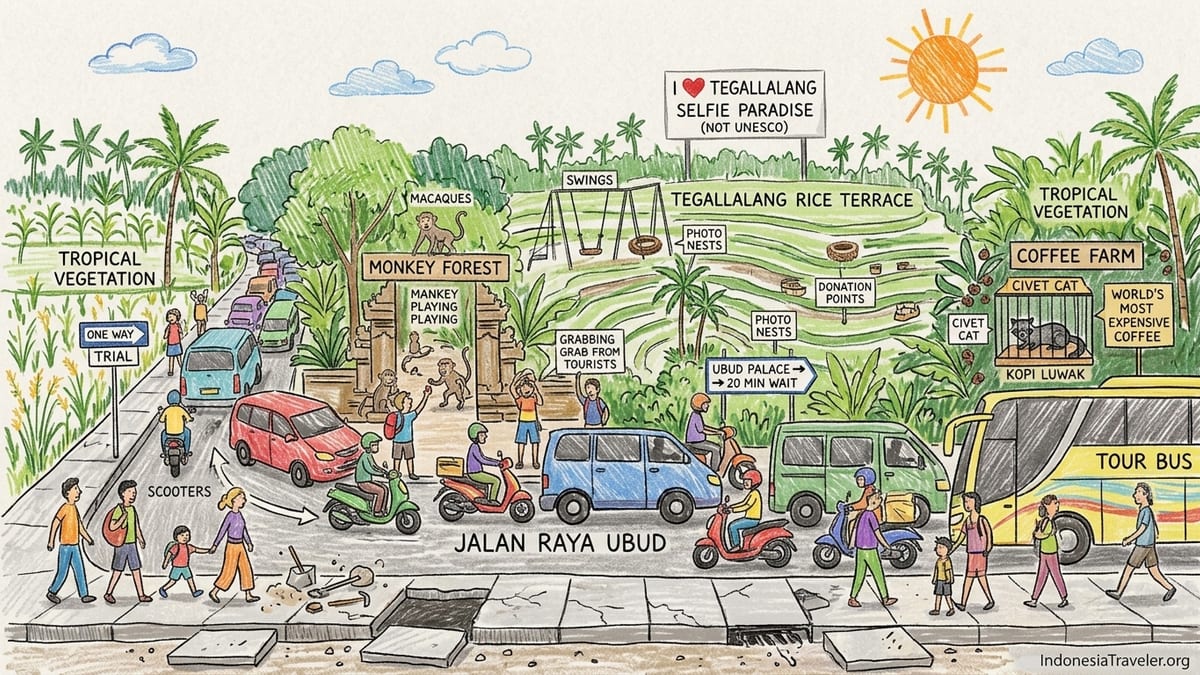
From Dreamy Lanes to One-Way Gridlock
I arrived in Ubud a few days after watching the May 22, 2026 TVRI report that showed exactly what I was about to sit in: parked cars hanging off sidewalks, tour buses wedged into tight corners and officers weaving through Jalan Raya Ubud to ticket illegal parking while traffic barely moved. The coverage focused on central junctions around the Arjuna statue and the main market area, where even the police admitted congestion had become a “classic problem” rather than a temporary inconvenience.
On paper, the later one-way traffic trials introduced in August and September 2026 should have helped. In reality, my first full morning in town coincided with the September 8 test phase that sent Jalan Raya Ubud eastbound only, while Monkey Forest and Hanoman formed part of a looping circuit. What this looked like from the passenger seat at 10:30 a.m. was a solid line of scooters and minivans inching forward past Coco Supermarket, brake lights stretching from the Monkey Forest entrance back up Hanoman and side streets jammed with drivers trying to improvise short cuts.
During that third-phase trial, local media showed long queues of cars trapped from Jalan Raya Ubud down toward the Arjuna statue intersection. The next day, Gianyar’s transport department publicly acknowledged that this particular configuration had produced “macet parah,” or heavy gridlock, and quickly reverted to an earlier scheme. That official language sounded dry compared with the lived detail: a twenty-minute journey from Pengosekan to Ubud Palace turned into forty-five; a two-kilometer Grab car ride that would normally cost around 25,000 rupiah almost doubled in time as the driver circled the one-way system looking for somewhere, anywhere, to pull over.
None of this matches the brochure version of Ubud as a little artist village. Jalan Raya Ubud, Monkey Forest Road and Hanoman are not sleepy strips of warungs and galleries. In peak hours after 9 a.m., they are narrow arteries clogged with chartered minibuses, day-tour caravans from the south, local workers on scooters and pedestrians forced off broken sidewalks into the traffic stream. The town still functions, and Balinese residents navigate it with impressive patience, but visitors who arrive expecting a tranquil base for spontaneous wandering discover very quickly that movement in and out of the center now has a schedule and a strategy.
The Villa “Near Ubud” That Is Nowhere Near
The second shock in Ubud came not from the air but from the map. My first villa was marketed as “a five-minute drive from Ubud Palace” and showed carefully cropped images of rice paddies and a floating breakfast tray. Only after booking did the exact location appear: Sayan, a lush ridge west of town that is beautiful and absolutely not walking distance from anything around the central crossroads.
Over the following weeks I kept meeting others caught by the same elastic geography. Friends staying in Payogan discovered that their advertised “jungle retreat just outside Ubud’s heart” required a 15 to 20 minute car or scooter ride each way. Kedewatan, which features in glossy photos of villas hanging above the Ayung River, sat so far along winding local roads that grabbing a car back from dinner near the market cost them roughly 80,000 to 120,000 rupiah per trip, if a driver was willing to crawl into the congestion at all. Tegallalang properties selling themselves as “Ubud rice terrace escapes” were a straight-line distance of about 10 kilometers or more north, which translated into 25 to 35 minutes when traffic thickened.
For couples who planned to shuttle between yoga studios near Hanoman, cafes on Dewi Sita and evening dance at Ubud Palace, that mismatch added up quickly. A guesthouse genuinely inside the ring of central streets might charge 700,000 rupiah a night. The scenic villa in Payogan might come in at a similar nightly rate, then quietly demand an extra 200,000 to 300,000 rupiah per day in transport once you factored in two or three round-trip rides. Over a week, that pushed the real cost of the “same” stay up by well over a million rupiah and chipped away at the spontaneous, on-foot roaming that makes historic Ubud appealing in the first place.
It is not that these outer districts are unworthy. Sayan at sunset, the river bends below Kedewatan and the terraces around Tegallalang can be magical. The problem is the marketing language that blurs the difference between “Ubud area” and “central Ubud.” When a listing pairs aerial photos of the palace with a location pin that actually drops near Payogan, the expectation is that you can stroll out for a coffee and a temple visit. The reality can be a 20-minute wait for a ride-share in the heat, a slow crawl through the same constricted junctions you thought you were avoiding, and a nagging sense that your precious vacation time is dissolving in the back of a minivan.
Tegallalang: Selfie Economy in a Non-UNESCO Terrace
Few places illustrate the distance between Ubud’s jungle fantasy and its cash-register reality as clearly as Tegallalang Rice Terrace. Online, it is often bundled together with the UNESCO recognition of Bali’s subak irrigation landscape. The fine print, which many blogs skip, is that while Tegallalang uses the same traditional irrigation principles, it is not itself one of the officially inscribed UNESCO component sites. That recognition sits with other areas, such as the Jatiluwih terraces in Tabanan, not with the crowded Ceking valley that most visitors mean when they say “Tegallalang.”
On my first visit, roughly 20 minutes’ drive north from central Ubud, the fantasy held for about three minutes. Morning light fell beautifully on the stepped valley, and the palms did frame everything in a gorgeous green arc. Then the practicalities started. There was a parking fee of 5,000 rupiah for the scooter, a main entrance ticket around 25,000 to 40,000 rupiah depending on which booth was operating, and then a steady stream of informal donation points as I followed paths and bamboo bridges deeper into the terraces. Each farmer who maintained a bridge or a steep shortcut reasonably asked for a contribution, but the cumulative effect was a relay of outstretched hands between every photo opportunity.
Above the paddies, several swing operators offered the classic “flying over the rice fields” picture. Prices quoted to me ranged between 150,000 and 350,000 rupiah per person, often bundled with a costume rental and “professional” photos taken on a staff phone. Elsewhere on the rim, separate swing parks and selfie complexes ran their own platforms, nests and zip-lines for similar prices. At popular spots, visitors queued in the dirt in full makeup and long dresses, waiting for their thirty seconds of curated weightlessness. Cafes along the roadside charged coffee prices far higher than in other parts of Bali, banking on the terrace view. None of this is illegal, and much of it provides income for local families, but for travelers who believed they were visiting a serene landscape preserved primarily for agriculture and culture, the segmentation of every angle into a chargeable product comes as a rude awakening.
The consequence is not only financial. The constant negotiation over payments, the presence of fake ticket sellers reported by some guides, and the tension between genuinely farmed plots and foregrounded photo props can make Tegallalang feel less like a living agricultural system and more like a theme park built out of rice fields. By contrast, a day trip to Jatiluwih, which does belong in the UNESCO listing, involves a longer drive but a flatter ticket structure and a much calmer walking experience. There, the rice terraces stretch to the horizon without a swing in sight, and you are more likely to encounter farmers actually working than queues for a heart-shaped nest.
Monkey Forest: Rules, Risks and a Tragic Storm
Ubud’s Sacred Monkey Forest Sanctuary appears in almost every top things-to-do list, often illustrated with visitors giggling while macaques sit on their shoulders. The official guidelines tell a more cautious story. The sanctuary’s published rules instruct visitors not to bring food or drink into the forest, not to feed the monkeys, not to touch or grab them and to avoid sudden movements or direct eye contact. Notices around the entrance highlight the risk of bites if people break these guidelines, and educational materials emphasize that the long-tailed macaques are wild animals, not performers.
Despite this, there is a lingering expectation among some tourists that interaction is not only allowed but guaranteed. I watched one visitor hold a banana just out of reach for a juvenile macaque in the hope of coaxing it closer for a selfie, exactly the kind of behavior the sanctuary warns against. Staff members intervened quickly and firmly. They now devote a significant part of their day to enforcing the no-feeding rules that were tightened in recent years as the forest’s popularity grew and research partnerships with university primate centers highlighted the health and behavioral issues that come with overfeeding.
Any honest assessment of Monkey Forest has to mention December 10, 2024, when a large tree fell during severe weather and injured visitors near one of the main paths. Witness accounts and local coverage make clear that this was a sudden, storm-related accident rather than the result of structural negligence, but it shook confidence for a while and underlined an uncomfortable truth: the sanctuary is a real forest with old, tall trees, not a manicured zoo. High winds, slippery paths and falling branches are genuine risks during heavy rain, which often hits the Ubud area in dramatic bursts.
Yet it would be unfair to call Monkey Forest unsafe. On my visits, staff were visible along the paths, often reminding visitors to keep belongings secure and to move away if monkeys approached too closely. There were hand-washing stations, clear warning signs about bites and scratch protocols and obvious efforts to balance visitor access with the religious function of the temples inside. The disappointment for some travelers lies less in an actual danger and more in the gap between the viral videos of “tame” monkeys and the sober, rule-bound reality of walking through a sacred forest filled with unpredictable animals in tropical weather.
Waterfalls: Slippery Steps, Crowds and Staged Moments
Waterfall excursions from Ubud promise a refreshing break from the town’s traffic. In practice, many of the most popular falls have their own version of the Tegallalang effect: layered fees, crowds and carefully stage-managed photo opportunities that can undermine the sense of discovery. Tegenungan, perhaps the best-known waterfall within half an hour’s drive south of Ubud, is a textbook case.
Recent guides put the foreign adult entrance fee at roughly 20,000 to 30,000 rupiah, collected at a ticket booth near a large car park, with separate parking charges for cars and scooters. Opening hours typically stretch from early morning around 6:30 a.m. until early evening. When I visited in mid-morning, hundreds of steps led down from the rim to the river, their stone surfaces damp from spray and recent showers. Even in dry season, the lower sections were slick enough that several visitors clung nervously to railings. At the base, lifeguards watched over a designated swimming area, while separate platforms, viewpoints and a glass bridge each charged their own extra fee.
Kanto Lampo, another favorite in tour brochures, involved descending a steep staircase into a shaded ravine. The rocks at the waterfall itself formed a beautiful, tiered cascade that people climbed for photos, guided quite literally step by step by local attendants. In exchange for an informal tip or photography fee, they directed visitors where to place their feet on the constantly wet rocks and snapped pictures with phones carefully kept dry. The result looked spectacular on screen, but it was far from a spontaneous scramble in the wild. Tibumana, sometimes marketed as a quieter alternative, felt more relaxed early in the morning but still had a manned ticket booth, a maintained path, and warning signs about swimming when the water level rose after rain.
The risk here is not only the physical hazard of wet stairs and unpredictable river surges after storms, although those are real and deserve more practical footwear than most people bring. It is also the mental adjustment required: these are community-run natural attractions serving hundreds or thousands of visitors a day, not hidden jungle pools. Long queues formed at the best angles for photos, and drone bans or access restrictions flashed up on small noticeboards. Travelers who arrive with the expectation of a solitary communion with nature will likely leave with a camera roll full of other people’s tripod setups and the memory of waiting in line in a swimsuit.
Wellness, Kopi Luwak and the Price of Enlightenment
If Ubud has a single global brand, it is wellness. Yoga studios, sound-healing domes, vegan cafes and chakra-alignment sessions cluster across central streets and radiate out into the surrounding villages. Some of this ecosystem is thoughtful and grounded. I joined an artist-led meditation and drawing morning in Penestanan where the teacher spoke openly about the limits of what a two-hour session could genuinely shift in someone’s life. The fee, around 250,000 rupiah, felt fair for small-group attention and locally sourced snacks.
Elsewhere, the prices and promises tilted into uncomfortable territory. Multi-day retreat packages in the hills around Ubud commonly advertised “complete hormonal reset,” “trauma release in three days” or “immune-boosting detox” with no scientific backing in their marketing copy. Price tags ran into tens of millions of rupiah for a week once private rooms, plant-based meal plans and airport transfers were included. When I asked one organizer whether a medical professional was associated with a cleanse program that restricted participants to juices and colonics, the answer was a vague reference to “Western-trained advisors” rather than a named doctor or dietitian.
Another ethical shadow hangs over certain coffee stops bundled into Ubud-area tours. While some cafes introduced visitors to genuine wild-sourced kopi luwak, others still displayed caged civet cats for tourists to photograph alongside displays of “world’s most expensive coffee.” International animal-welfare reports have documented the stress and poor conditions often associated with captive civets used for coffee production, yet minibuses pulled up all day to parking lots where these cages sat in plain view, a quick add-on between temples and rice terraces. The disappointment here is not just moral, but also experiential: instead of an insightful explanation of Balinese coffee farming, visitors get a shallow novelty and the uneasy sense that their cup came at a hidden cost.
For travelers who imagined Ubud as a place where ancient healing traditions are shared humbly at village prices, the modern wellness economy requires a recalibration. There are excellent practitioners in town, from massage therapists trained in both local and international techniques to yoga teachers with deep roots in the Balinese Hindu calendar. Finding them often means sifting through glossy, sales-driven offerings whose main expertise is digital marketing. The cost of getting it wrong can be substantial, both in money and in trust.
Culture For Sale: Workshops, Museums and the Fine Print
Ubud is still one of the strongest places in Indonesia to encounter living art. Yet even here, the line between genuine engagement and choreographed sales pitch is easy to cross. I joined two different batik sessions during my stay. The first was run by a family compound north of Ubud, where the matriarch explained the waxing and dyeing process, encouraged us to make our own mistakes on cloth and wrapped up with a simple option to buy finished pieces if we wished. The second, booked through a tour platform, funneled our group straight from a brief demonstration into a large showroom where “student” pieces were suspiciously perfect and prices far above what I had just seen in town.
The same split appears in painting classes, silver-jewelry workshops and carving demonstrations. Artist-led sessions that take place in home studios or small collectives tend to focus on process, often at moderate prices between 300,000 and 600,000 rupiah including materials and tea. Bus-tour stops, on the other hand, sometimes treat a token hands-on activity as bait for an aggressive push to buy high-markup souvenirs. For visitors who came genuinely curious about Balinese craftsmanship, walking out feeling like a wallet on legs is quietly heartbreaking.
Museums around Ubud can provoke a different kind of frustration. Entrance prices at several venues felt inconsistent, changing over short periods or differing from what was still printed on older signs and brochures. At one art museum, the posted board near the gate quoted one figure while the actual ticket window charged noticeably more to foreign visitors, with the explanation that rates had been “adjusted” ahead of the signage. None of the amounts were outrageous in absolute terms, often equivalent to the price of a coffee in a Western city, but the lack of clear, updated information left people arguing at gates instead of browsing collections.
When you place these experiences side by side with the promise of Ubud as a pure cultural capital, the pattern becomes clear. The art and tradition are real and vibrant. They sit, however, within an economy that has learned to monetize curiosity very efficiently. Those who prepare for that duality can still find deeply meaningful encounters; those who arrive expecting a museum-piece village untouched by commerce are likely to spend too much money in the wrong rooms.
Sidewalks, Noise, No Beach and Other Everyday Letdowns
Many disappointments in Ubud are smaller but constant. The sidewalks along Jalan Raya Ubud, Monkey Forest and Hanoman alternate between freshly paved stretches and broken concrete where tree roots and old drainage covers have punched through. In several places, missing slabs reveal open gutters below, and pedestrians step down into the street to avoid ankle-twisting gaps. During my stay, multiple construction projects were underway, from new guesthouses rising on former rice paddies to restaurant renovations that sent the whine of drills echoing through what brochures still described as “quiet lanes.”
Cafes that appear on international top-ten lists now price themselves accordingly. I paid more than 60,000 rupiah for a flat white in a designer space overlooking a busy intersection, a figure that would not shock in Sydney but jarred against marketing that still sells Bali as universally cheap. Dishes described as “simple warung fare” arrived on rustic wooden boards with service charges attached. Parallel to this, family-run eateries tucked down side alleys still served generous nasi campur on banana leaves for under 30,000 rupiah, but they did not feature on the glossy platforms that shape many visitors’ expectations.
Then there is the simple geographical fact that Ubud has no beach. This sounds obvious until you overhear disappointed new arrivals asking reception staff where to walk to the sea. Several had absorbed social media collages that blend Canggu sunsets, Nusa Penida cliffs and Ubud jungle swings into one mythical Bali town. The reality is that reaching the coast involves at least an hour’s drive to Sanur, longer to the more fashionable surf breaks to the west. For short-stay visitors who imagined splitting their days between temple visits and a quick ocean dip before dinner, that realization can feel like a rug pulled from under carefully built fantasies.
Layered together, these details turn Ubud from a postcard to a place. It has noise, rough edges and everyday logistics that demand attention. For some, that is the charm of travel. For others, especially those whose mental image was built entirely out of serene yoga poses in empty paddy fields, the adjustment can feel like betrayal.
The Takeaway
After weeks in and around Ubud, I did not leave thinking it was a scam or a place to avoid. I left convinced that it is badly served by its own marketing. Ubud is not a timeless jungle village preserved under glass for visiting seekers. It is a busy Balinese town where ancient temples share space with traffic diversions, where rice fields now double as selfie parks, and where spiritual language often wraps a very modern sales pitch.
The disappointments I encountered were real and specific. Central roads choked by one-way experiments and illegal parking turned short hops into long slogs. Villas labeled “near Ubud” in Sayan, Payogan, Kedewatan and Tegallalang added unplanned daily transport costs and eroded the joy of walking out the door into town. Tegallalang’s layered entrance fees, swing charges and persistent mislabeling as a UNESCO site muddied what could have been a simple appreciation of a beautiful terrace. Monkey Forest’s strict rules and rare but serious accidents clashed with the expectation of cuddly wildlife encounters. Waterfalls delivered more queues and slippery steps than wild solitude. Wellness offerings and kopi luwak stops exposed ethical and scientific blind spots behind tranquil branding. Workshops and museums alternated between nourishing and transactional, often with little warning.
Yet in between these twelve and more letdowns, Ubud also delivered quiet mornings of gamelan practice drifting from temple courtyards, processions of women in kebaya balancing offerings on their heads as they crossed busy streets, and late-night conversations with artists who spoke about their work in ways that had nothing to do with algorithms. Traditional dance in the courtyard of a village temple, attended mostly by locals, moved me more than any big-ticket retreat. A modest homestay a short walk from the palace, booked directly and described honestly, proved far more rewarding than a remote villa that looked more impressive online.
If you come to Ubud chasing an untouched jungle paradise, it will probably feel overrated. If you come understanding that it is a living cultural center negotiating the pressures of global tourism, you can plan around the bottlenecks and the sales traps. Start your days early before the tour buses arrive, choose central accommodation if you want to walk, verify locations and fees, and treat wellness promises with the same skepticism you would at home. Skip captive-civet coffee and high-pressure showrooms. Seek out artist-led spaces, family compounds and community events rather than the loudest listings.
In the end, Ubud still offers something few places can match: an everyday closeness between art, religion and landscape that continues despite the traffic trials and the swings. It has simply outgrown the fantasy of being a cheap, quiet jungle hideaway. Respect it as a complex small city rather than a backdrop for your feed, and it will reward you far more than the brochures ever promised.
FAQ
Q1. Is Ubud still worth visiting in 2026 despite the traffic and crowds?
Yes, if you adjust your expectations. Ubud is now a busy cultural hub rather than a sleepy village, but it remains exceptional for art, ceremonies and access to central Bali. Careful timing and realistic planning make a big difference to how you experience it.
Q2. How bad is the traffic around Jalan Raya Ubud and Monkey Forest Road?
At peak times between roughly 9 a.m. and late afternoon, congestion can be heavy, especially near the Arjuna statue junction, the market and Monkey Forest. Short rides can take half an hour during one-way traffic schemes or when illegal parking reduces lanes. Early mornings and late evenings are noticeably calmer.
Q3. Should I book a villa in Sayan, Payogan, Kedewatan or Tegallalang if I want to explore central Ubud?
Only if you are comfortable relying on cars or scooters. These areas can be 15 to 35 minutes from the palace area in normal traffic. If you want to walk to cafes, temples and performances, choose accommodation inside or very close to the central grid of streets.
Q4. Is Tegallalang Rice Terrace really a UNESCO World Heritage site?
No. Tegallalang is farmed using Bali’s traditional subak irrigation, but it is not one of the specific rice terrace areas inscribed on the UNESCO World Heritage list. Some marketing materials blur this distinction, which leads to confusion.
Q5. How much should I expect to pay at Tegallalang for entrance, swings and photos?
As of late 2026, a visit can involve a parking fee of around 5,000 rupiah, a main entrance ticket roughly in the 25,000 to 40,000 rupiah range and optional swings priced from about 150,000 up to 350,000 rupiah per person. Additional informal donations or fees may be requested at photo spots and on certain paths.
Q6. Is Ubud Monkey Forest safe after the 2024 tree-collapse incident?
The 2024 accident was linked to severe weather, and the forest remains open with active management and clear safety rules. No natural site can be risk-free, but following staff guidance, respecting the no-feeding and no-touching rules and avoiding visits during storms significantly reduces danger.
Q7. What are the main safety issues at waterfalls like Tegenungan, Kanto Lampo and Tibumana?
Key concerns are slippery steps and rocks, strong currents or sudden rises in water level after rain and crowding that makes climbing or swimming less predictable. Wear proper footwear, avoid risky poses for photos and be cautious during or after heavy downpours.
Q8. Are Ubud’s wellness retreats and detox programs medically reliable?
Some are run by thoughtful professionals, but others make bold health claims without clear medical backing. Always research the people behind a program, look for transparent qualifications and approach promises of rapid cures or “total resets” with caution.
Q9. How can I avoid tourist traps and still experience real Balinese culture in Ubud?
Prioritize smaller, artist-led workshops, local homestays, village temple performances and community events over large packaged tours. Ask your hosts about ceremonies instead of relying only on online lists, and be ready to attend simple, everyday rituals rather than only staged shows.
Q10. If I want both culture and beach time, how should I structure my Bali trip?
Consider splitting your stay: a few nights in central Ubud for temples, rice fields and art, then time on the coast in places like Sanur, Canggu or the Bukit Peninsula. Treat Ubud as your inland base rather than expecting it to offer easy beach access.