


I arrived in inland Bali believing the familiar script. Ubud would be my obvious base, Sidemen a quieter Ubud-with-rice-fields, and Munduk a misty side trip for waterfall photos. After back-to-back stays in all three in 2025 and again in 2026, that story fell apart. These places are not interchangeable “quiet jungle” swaps, and Ubud is no longer the automatic best inland base it is so often sold as.
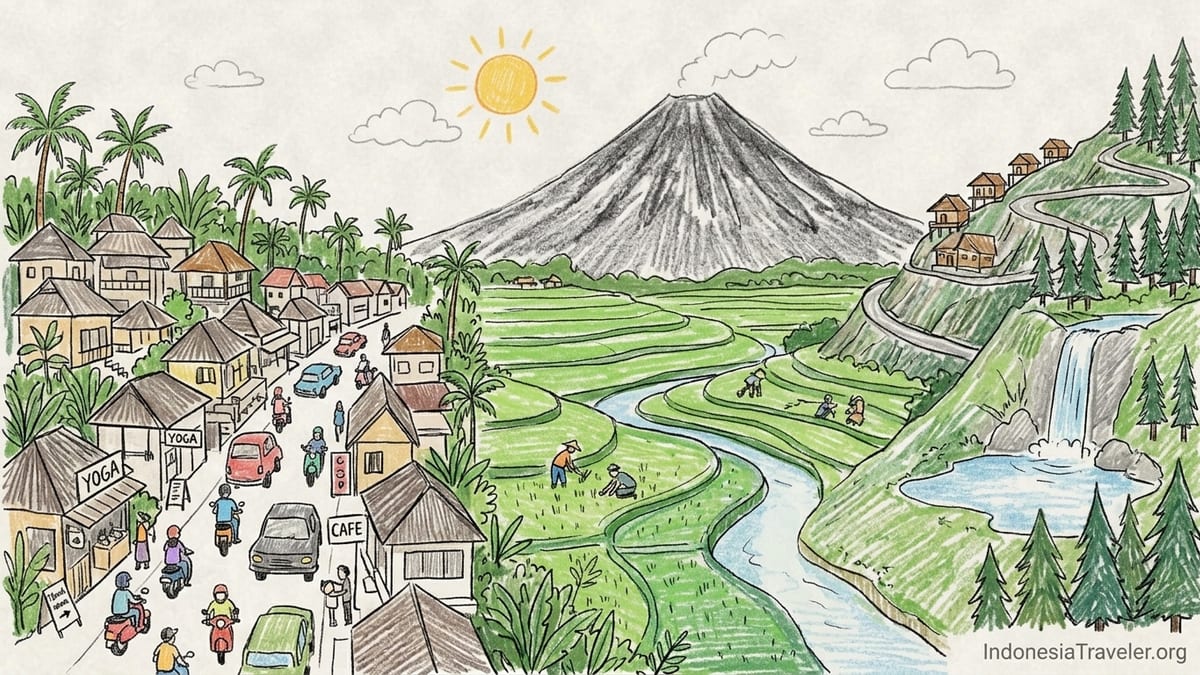
What I Expected vs What I Actually Found
On paper, Ubud, Sidemen and Munduk look like variations on the same green fantasy. Travel agents describe them with the same phrases: jungle views, rice fields, local culture, yoga, waterfalls. Sitting at my desk in January, it was easy to assume I could just pick one, or hop between them every couple of days, and the experience would blur together into a gentle, leafy whole.
In reality, the contrast hit me as soon as I tried to move between them. Ubud was noisy, congested and dense with tourism businesses in a way the other two simply are not. Sidemen felt like the volume had been turned down, both in good and bad ways. Munduk was not a jungle valley at all but a cool highland village strung along steep mountain roads in coffee and clove country. The mood, climate, logistics and day-to-day practicalities were completely different in each place.
Across two trips I kept accommodation roughly equivalent, in the 60 to 120 US dollars per night bracket for two people with breakfast, private bathroom and a pool. In Ubud that meant a mid-range guesthouse on a side street off Jalan Hanoman and later a quiet villa just outside town. In Sidemen it meant small valley-view hotels with shared infinity pools. In Munduk it meant compact mountain lodges with terraces facing the hills. That parity of budget made the trade-offs much clearer and exposed how romantic the online clichés can be.
The biggest surprise was simple. I enjoyed Ubud far less as a place to sleep than I expected. The infrastructure that makes it so easy to eat, visit temples and catch performances also brings congestion, noise and hard edges that undermine the “retreat in nature” image. Meanwhile, Sidemen and Munduk gave me much more of the slow, quiet inland Bali I had imagined, but at the cost of isolation, patchier services and a near-total dependence on drivers.
Ubud: Culture Capital and Congested Base
I started, like most people, in Ubud. From the airport my Grab car took just under 90 minutes in late afternoon traffic to reach central Ubud, roughly within the published range of 75 to 105 minutes that local transport guides quote for this route. Traffic thickened from the outskirts and by the time we reached Jalan Raya Ubud the car was crawling behind motorbikes, tour buses and delivery vans. That heavy traffic never really let up during my stays, either in 2025 or when I returned in 2026.
The upside of Ubud’s tourism boom is obvious the moment you step out. Within a 15 minute walk from my guesthouse I found more than twenty restaurants, from warungs selling plates of nasi campur for around 3 to 4 US dollars to mid-range spots charging 8 to 12 dollars for a main. I had a latte on Jalan Goutama one morning, walked five minutes to the Saraswati Temple for its lotus pond, then another ten minutes to the Museum Puri Lukisan to see Balinese paintings. That density of culture is real: you can stack a day with a cooking class, a yoga session at studios like the Yoga Barn or Radiantly Alive, a visit to Goa Gajah or Tirta Empul, and an evening kecak performance without ever negotiating long transfers.
The catch is that Ubud’s central streets now feel more like a small city than a rural retreat. My “quiet” guesthouse off Jalan Hanoman still had the constant soundtrack of scooters and car horns drifting in. Walking the main streets means dodging traffic and uneven pavements while scanning for the occasional aggressive dog. In high season, crossing the road outside the Monkey Forest became a negotiation with a stream of taxis, Gojek motorbikes and tour buses inching forward. The well-known “Ubud traffic” is not an exaggeration; it is a daily tax on your time and attention.
From a practical standpoint, Ubud worked well. Ride-hailing apps like Grab and Gojek were easy to use for short hops to Penestanan or Tegallalang, although some central streets still have uneasy truces with local taxi cooperatives that may push you toward prearranged drivers instead of app pickups. Internet in town was the best of the three bases. Cafes advertised speeds around 30 to 100 Mbps, my guesthouse Wi-Fi was stable enough for video calls, and co-working spaces clustered towards Penestanan. Medical care was also reassuring; I saw several small clinics along Jalan Raya and Pengosekan, and larger hospitals are within an hour’s drive toward Denpasar. If you want a base where you can improvise day by day, Ubud makes that easy.
Sidemen: Quiet Valley and the Cost of Isolation
Sidemen is often described as “what Ubud was twenty years ago” and in some ways that is accurate. My driver from Ubud took just over 80 minutes in mid-morning traffic to reach my first Sidemen stay in the village of Tabola, tracking closely with several driver services that now quote around 1 to 1.5 hours for the 35 to 45 kilometre journey. The key detail is that almost none of that road is fast. The route drops into river valleys and climbs out four or five times; the distance suggests a quick hop, but the reality is a winding, stop-start drive that would be stressful on a scooter for a first-time visitor.
Once in the valley, the atmosphere changed completely. From my balcony I could hear mostly cicadas, roosters and the occasional motorbike echoing across the rice fields. At sunrise, clouds would lift to reveal Mount Agung in the distance. I could walk straight from my hotel down small concrete lanes into the rice terraces, passing farmers in conical hats and children in school uniforms. One morning I followed an unmarked path along a narrow irrigation channel with no one else in sight for an hour, a level of uncurated quiet that Ubud’s main trails have mostly lost.
The price of that quiet was practical isolation. On my first evening, my partner and I walked along the main village road to see what we could find for dinner. Within a 20 minute stroll in Ubud I could pass dozens of options; in Sidemen we counted perhaps five restaurants that were open, most attached to guesthouses. Menus were simpler, with mains in the 3 to 6 dollar range, and by 9pm the village felt almost fully asleep. For one lunch we tried to reach a recommended warung across the valley by foot, only to realise the steep descent and climb back would take close to an hour in the midday heat. We ended up eating at the hotel restaurant again.
Transport reality bit even harder in Sidemen. Grab and Gojek do not operate as reliably in the valley for pickups, and several properties explicitly warned in pre-arrival emails that guests should arrange drivers through the hotel. One driver list I saw in 2026 priced a one way Sidemen to Ubud transfer at around 400,000 rupiah for the car, which matches several hotel transfer sheets I was shown on both trips. That cost may be fair for the distance and time, but the important point is lack of alternatives. If your driver gets stuck, there is no backup taxi rank or bus. Early airport departures meant pre-booking a 4am pickup days in advance and trusting that the car would materialise out of the dark.
Munduk: Highlands, Waterfalls and Relentless Gradients
Munduk was the biggest mental reset. The village sits in the highlands of North Bali, strung along a ridge road above coffee and clove plantations, with views down towards the twin lakes of Buyan and Tamblingan. Getting there from Ubud on my first visit took just over two hours by private car via Bedugul, which lines up with several local driver listings that now state 2 to 2.5 hours for the 58 to 60 kilometre route, despite some optimistic mapping apps still suggesting closer to one hour. The final stretch is steep, with tight curves and occasional fog.
Stepping out of the car, the first shock was the temperature. Ubud had been warm and humid; Sidemen felt similar, tempered by breezes along the river. Munduk in the late afternoon required a light jacket and long sleeves, especially in July and again in the shoulder months when showers drifted through almost daily. It was a relief at first, but also meant that the “infinity pool with jungle views” marketing sometimes clashed with reality. At one lodge the pool was chilly enough that no one went in after 4pm, despite the beautiful setting.
The waterfalls and walking were superb but physically demanding. From my lodge near central Munduk, the popular Munduk and Melanting waterfalls were accessible via signed paths that dropped steeply into the valley. The descent took around 30 minutes; the climb back up took closer to 45 and left more than a few people on the trail breathing hard. Paths were concrete or stone in places, muddy in others, and slick after rain. On one day a midday downpour turned the steps into small streams, and a couple in trainers struggled to keep their footing. The idea of Munduk as a gentle forest stroll badly underestimates how tough the gradients can feel, especially for travellers with knee issues.
Rain itself shaped my days more than in the other two bases. Both on my July and shoulder season visits, Munduk saw showers on at least half the afternoons. They were rarely all-day washouts but tended to arrive fast, disappear and leave everything glistening and cool. From a photographer’s perspective it was glorious, with shifting clouds rolling over the plantations. As a traveller trying to schedule long scooter rides or trekking, it meant building in more flexibility and accepting some forced downtime under eaves with a hot coffee or cloves drying in racks nearby.
Transport Reality: Distances vs Door-to-Door Time
The most misleading thing I heard repeatedly before these trips were slick estimates like “50 minutes from Ubud to Sidemen” or “1 hour 45 from Ubud to Munduk.” Not once, across four transfers between these bases at different times of year, did I see anything that short. Door to door, with luggage, real traffic and a cautious driver, my times were consistently longer.
From Ubud to Sidemen I clocked between 75 and 90 minutes on three separate runs, departing between 9am and 11am. That mirrors more conservative local guides that now advise planning for about 1 to 1.5 hours, depending on which end of Ubud and Sidemen you start from. From Sidemen back to Ubud one afternoon, school traffic around Klungkung added enough congestion that we were in the car for close to 100 minutes. These are not life-ruining journeys, but they are long enough that “just popping over to Sidemen for lunch from Ubud” quickly becomes at least half a day in a car.
For Ubud to Munduk, my two transfers took a little over 2 hours and about 2 hours 20 minutes, leaving around 10am from central Ubud. That aligns with several Munduk guesthouses and driver services that now quote 2 to 2.5 hours and stands in stark contrast to some third-party travel sites still listing a drive time of around one hour for the 58 to 60 kilometre route. It might be possible very early in the morning with almost no traffic and aggressive driving, but that is not a realistic baseline for most visitors hauling suitcases.
Then there is cost. In 2026, private car transfers between Ubud, Sidemen and Munduk commonly cluster around 400,000 to 700,000 rupiah one way for a car for up to four people with luggage, depending on negotiation and the exact route. Doing a three stop loop Ubud to Sidemen to Munduk and back to the south at those rates can easily add 40 to 60 US dollars in driver costs to a short inland itinerary. That is money many travellers do not factor in when they plan to “sample all three” for two nights each. The fantasy of hopping between rice-field views has a real price tag in both time and cash.
Walkability, Dining, Internet and Medical Access Compared
Day-to-day convenience varied sharply. In Ubud I could cover most of my needs on foot within the inner grid bounded roughly by Jalan Raya Ubud, Monkey Forest Road and the side streets in between. Sidewalks were far from perfect but I could walk to cafes, minimarts, yoga studios and laundries in flip-flops. When I needed to go further, a 10 minute Gojek bike ride to Penestanan was inexpensive and usually available within minutes, barring the occasional local restriction at specific pickup points.
In Sidemen, walking felt more like wandering through a rural village than urban strolling. Short walks from my hotels took me through rice fields and along quiet lanes, which was exactly what I had come for. But anything beyond that usually required a driver. The valley roads are narrow, with blind curves and no pavements, and distances between clusters of accommodation and independent warungs can be longer than they look on the map. Night-time walking felt unsafe in the sense of visibility and traffic rather than crime. Most guests at my hotels defaulted to eating all dinners on site, not because the food was extraordinary but because getting elsewhere without a scooter was awkward.
Munduk sat somewhere in the middle. The village itself is essentially one long road along the ridge, with lodges, homestays and a handful of cafes strung out. From my lodge I could walk 10 to 15 minutes in either direction and find a small restaurant serving mie goreng, simple curries and locally grown coffee. The road, however, carries trucks and local traffic and narrows in places, so walking after dark required a phone light and care. For any of the headline sights beyond the central waterfalls, like the twin lakes viewpoints or Sekumpul waterfall further away, I relied on a private driver or an organised tour.
Connectivity and services also tilted the balance. Ubud was the only one of the three where I felt comfortable planning remote work with video calls. Mobile data and Wi-Fi speeds were mostly solid, and when a storm one night knocked out my guesthouse connection, I simply decamped to a nearby cafe. In Sidemen, internet quality varied significantly between properties. One valley-view hotel boasted 50 Mbps speeds and delivered; another struggled in the evenings when multiple guests were streaming. In Munduk, both of my lodges provided usable but less robust connections, fine for email and browsing but not for heavy uploading during storms. If connectivity is non-negotiable, Ubud’s density of options is a major advantage.
Medical access was also markedly different. In Ubud I walked past several clinics offering everything from routine care to traveller check-ups. When a minor stomach issue hit one trip, I popped into a nearby clinic, waited 20 minutes and walked out with medication. From Sidemen, reaching a well equipped hospital meant at least an hour’s drive back towards Gianyar or Denpasar. The same was true from Munduk, where a serious issue would likely require going down to Singaraja or back toward the south. It is a low probability concern, but for families with young children, older travellers or anyone managing chronic conditions, basing in Ubud or at least starting and ending the trip there can make a lot of sense.
Five Hard Trade-offs I Could Not Ignore
Across both trips, five disappointments or trade-offs kept recurring and forced me to question the standard “split your time between all three” advice. The first was the sheer unpleasantness of Ubud’s central traffic. I had pictured slow scooters winding through greenery; instead I found snarled intersections, impatient horns and crossing the street as a minor daily stressor. If you book a supposedly peaceful villa off a main artery without checking its exact location, you may find your pool time accompanied by exhaust fumes and engine noise.
The second was how isolated Sidemen can feel once the initial rice-field euphoria fades. After three nights on my first visit I realised I had eaten almost every meal at my hotel, not because I wanted to but because getting anywhere else without a scooter meant organising a driver for what felt like trivial distances. The valley is gorgeous and village walks are exactly as romantic as they sound, but if you like to choose dinner spontaneously or bar-hop, Sidemen will frustrate you.
The third was Munduk’s weather and gradients. I enjoyed the cool air and drifting mists, but several fellow guests arrived expecting a gentle, warm jungle experience and instead spent evenings in fleeces watching rain bead on the balcony. One couple with knee issues had to abandon plans to visit more than one waterfall after discovering how steep the paths were. The romantic marketing does not lie about the views, but it certainly underplays the physical effort and the number of days when the horizon disappears into cloud by mid-afternoon.
The fourth was the cumulative cost of private drivers. Stringing Ubud, Sidemen and Munduk together, with a return to the coast at the end, ended up costing me the equivalent of several nights of mid-range accommodation, especially on the second trip when fuel prices had nudged transfer rates upward. Ride-hailing helped within Ubud itself, but for almost every inter-town journey I needed a pre-booked car. For budget-conscious travellers, that money might be better spent on a slightly nicer room in one or two bases rather than constant moves.
The fifth was the dawning sense that changing hotels just to secure another angle on a rice-field or jungle view was not always worth the disruption. On one trip I did two nights in Ubud, two in Sidemen, two in Munduk and then back to the south. Looking back, at least one of those moves felt pointless. The rooms blurred together, the packing and unpacking ate time, and each relocation demanded half a day of logistics for what amounted to modest variations on the same green scenery. I would have been happier with longer stays in two bases, with day trips or overnight excursions if needed.
The Takeaway
After using all three as bases, I no longer see Ubud, Sidemen and Munduk as interchangeable “quiet inland” options. Ubud excels as a cultural and logistical hub, with unmatched access to museums, dance performances, temples, restaurants, yoga studios and medical care. It is a strong start and end point for a Bali trip, especially if you want to move around spontaneously or need reliable internet. The cost is noise, traffic and a thinning illusion of being in a tranquil jungle town.
Sidemen is for travellers who genuinely want to slow down. If your ideal day is a long breakfast overlooking rice fields, followed by village walks, a massage and dinner at your hotel, you will be very happy here. It works best if you are comfortable being semi-isolated for two or three nights, booking drivers ahead for any excursions, and accepting limited dining and nightlife. For nervous scooter riders, I would treat Sidemen as a retreat rather than a touring base.
Munduk suits hikers, photographers and anyone who prefers cool air to beach heat. Give it at least two nights, three if you want to explore multiple waterfalls and the nearby lakes without rushing. Pack a jacket, expect rain on some afternoons, and be honest about your knees before committing to steep trails. Do not plan Munduk as a rapid day trip from Ubud unless you are prepared for four to five hours in a car for a short window of exploration.
When is it genuinely worth splitting nights between them? With a week inland, I would choose either Ubud and Sidemen or Ubud and Munduk, for example three nights in Ubud and four in one of the others, rather than trying to do all three. With ten or more nights, a 3-3-4 split could work, but only if you accept the driver costs and build in low-activity afternoons to recover from transfers. The common thread is this: treat each move as a meaningful shift in pace and landscape, not a quick hop between identical jungle scenes. That mindset will save you both money and frustration.
FAQ
Q1. Is Ubud still worth staying in if it is so busy?
Yes, if you value easy access to restaurants, cultural sites, classes and clinics, Ubud remains the best inland hub, but you should expect heavy traffic and little real sense of seclusion in the centre.
Q2. How many nights should I spend in Sidemen?
Two nights is the minimum that makes the transfer time worthwhile, but three nights allows you to slow down, take at least one long valley walk and fit in a day trip without feeling rushed.
Q3. Is Munduk too remote for a first trip to Bali?
Munduk is more remote and cooler than Ubud or Sidemen, but with a private driver and a bit of planning it works well for first timers who enjoy hiking and do not mind rain or steep paths.
Q4. Can I rely on Grab or Gojek in Sidemen and Munduk?
Ride-hailing apps are generally reliable in and around Ubud, but in Sidemen and Munduk pickups are patchy or unavailable, so you should plan on arranging private drivers through your accommodation.
Q5. Is it safe to ride a scooter between Ubud, Sidemen and Munduk?
Experienced riders with proper licences and helmets can manage the routes, but traffic around Ubud and steep, winding mountain roads near Munduk make a private car a safer choice for many visitors.
Q6. Which place is best if I need strong internet for work?
Ubud has the broadest choice of accommodations and cafes with reliable fast Wi-Fi, so it is the safest inland base if you need to work online or make frequent video calls.
Q7. What if I have a medical issue while in Sidemen or Munduk?
For anything more serious than minor ailments you will likely need to travel at least an hour or more to better equipped clinics or hospitals toward Gianyar, Denpasar or Singaraja, so allow extra time.
Q8. Is it worth changing hotels just for another rice-field view?
Often no. Each move between inland bases consumes money and half days in cars, so it can be wiser to book a slightly nicer room in one or two places instead of constantly relocating.
Q9. Which base is best for nightlife and bar-hopping?
Of the three, only Ubud offers anything resembling nightlife, with bars and live music that run later. Sidemen and Munduk are quiet after dark, with most guests eating at their hotels.
Q10. How should I split a week between these three inland areas?
For seven nights inland, a practical split is three nights in Ubud and four in either Sidemen or Munduk, using day trips if desired, rather than trying to squeeze in all three bases.