


On my first trip to Ubud I booked a “charming villa in Ubud” and assumed I could wander everywhere on foot. It turned out my villa was in a rice-field hamlet a 15-minute drive north of town, and my evenings became a routine of negotiating drivers, checking ride-hailing apps and calculating how much my “bargain” stay was really costing. That experience pushed me to inspect and stay in several different parts of “Ubud” on later visits and to pay close attention to what daily life is actually like in each area, not just how it looks in photos.
Understanding What “Ubud” Really Means on Booking Sites
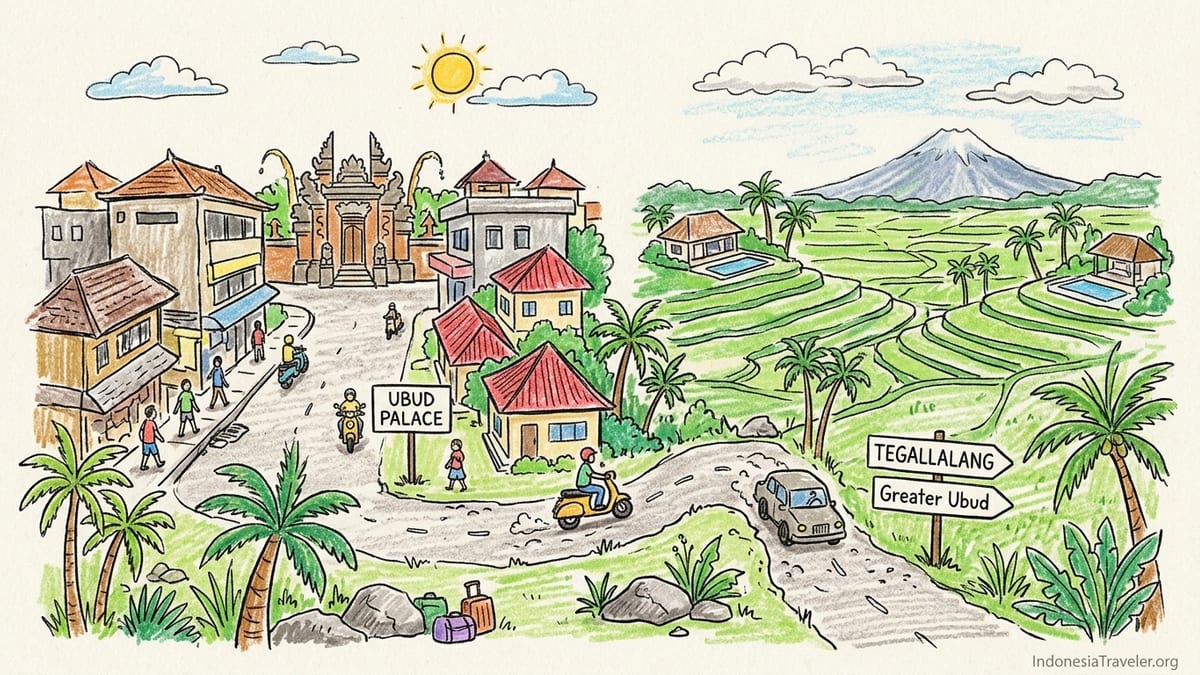
One of the first things I learned is that the word “Ubud” on accommodation platforms covers a far larger area than the walkable town around Ubud Palace and the market. Officially, Ubud is part of a wider district that stretches into villages like Kedewatan, Payogan, Sayan, Peliatan, Mas, Pejeng and all the way north toward Tegallalang, about 10 to 11 kilometers from the center. Many villas in these outlying areas correctly use “Ubud” in their address, but for a traveler that label can easily blur the line between being a ten-minute stroll from a dance performance and a thirty-minute journey back from dinner in the rain.
To make sense of it, I started judging locations by their real-world relationship to Ubud Palace, which sits on Jalan Raya Ubud directly opposite the market and a short walk from the Saraswati Temple. From that intersection the densest web of restaurants, galleries, yoga studios and performance venues spreads along Jalan Raya, Monkey Forest Road, Jalan Hanoman, Dewisita and up and down the side streets like Jalan Bisma. If I can reach the palace on foot within 10 to 15 minutes along lit streets with at least some pavement, I mentally class the property as “central.” Once a ride is needed for most trips to dinner or a performance, I treat the location as “greater Ubud,” no matter what the booking platform calls it.
Over several stays I slept or inspected rooms in central streets around Jalan Raya and Hanoman, in quieter lanes off Jalan Bisma, in Penestanan and Nyuh Kuning, and at more remote villas north and west of town. I used those nights, plus deliberate daytime walks between areas, to understand not just the views and pool designs, but the very practical questions that shape a stay in Ubud: can a regular car reach the door, will a driver actually accept a pickup here at 10 p.m., what is the walk back to my room like in tropical rain, and is that “evergreen” rice-field view still rice at the end of the dry season.
Along the way I also learned what questions to ask before I booked. I now always ask if a normal car can reach the entrance, whether the final access lanes are paved or dirt, where drivers can legally stop, whether the pool is fenced if children are involved, and whether a promised rice-field view is seasonal or already partly blocked by new construction. Those details rarely appear in the glossy photos, but in Ubud they shape your days and nights as much as the thread count on the sheets.
Central Ubud Around Jalan Raya and the Palace
My most “urban Ubud” stays have been within a few hundred meters of Ubud Palace and the market, just off Jalan Raya. Here the upside is obvious: I could walk to multiple museums, temples and performance venues in under ten minutes. The Puri Lukisan Museum sits a few minutes west along Jalan Raya, while the Saraswati Temple is barely a block from the palace. Most evenings I would linger at a Legong dance in the palace courtyard, then stroll out into a crush of warungs, gelato counters and late-opening shops without thinking about transport at all.
The trade-off is traffic and noise. Jalan Raya, Monkey Forest Road and nearby streets carry almost continuous streams of scooters, cars and tour buses from mid-morning to late evening. Pavements exist in patches but are narrow and uneven, with sudden drop-offs and missing sections. I often found myself walking in the edge of the road, especially around parked vehicles and shop front displays, and crossing the street means picking a moment and committing with confidence. Road noise can easily reach upper floors, especially in older buildings where windows do not seal tightly, and ceremonial processions with gamelan music can pass at unexpected hours.
App-based ride services such as Grab and Gojek are common around central Ubud, but there are local restrictions on pickups in the very core of town. In practice, cars and bikes from the apps would drop me near my hotel but could not always collect me from the same door, so I sometimes walked a block or two to an agreed pickup spot or used one of the many local drivers who quote fixed fares for short trips. Short journeys around town typically fell in the range of 20,000 to 40,000 rupiah for a car or motorbike ride, with negotiation needed if I waved down an unofficial taxi after a performance.
In terms of late-night life, central Ubud is not Kuta or Seminyak but there are plenty of kitchens and small bars open until around 10 or 11 p.m., and a few stay later. I never struggled to find food after a dance show that finished around 9 p.m., and walking back to my guesthouse meant passing a steady flow of people on the sidewalks. For a first-time visitor without a scooter, this tight radius around the palace is the easiest way to experience Ubud’s temples, markets and performances without constantly watching the clock for a driver.
Hanoman, Dewisita and the Classic Central Guesthouse Strip
South of Jalan Raya, Jalan Hanoman and nearby Dewisita have given me some of my most convenient mid-range stays. These streets feel distinctly more human-scaled than Jalan Raya itself. Buildings are lower, traffic is heavy but mostly local, and the pavements, while still patchy and uneven, offer more continuous stretches where I could actually walk side by side with a friend. From a mid-block guesthouse on Jalan Hanoman I could reach Ubud Palace in around 12 to 15 minutes at an easy walking pace, and the Monkey Forest entrance in a similar time heading south.
This area is dense with small hotels, family-run homestays and simple warungs alongside more polished cafés and yoga studios. A basic but clean fan room with breakfast at a traditional compound guesthouse tucked just off Hanoman cost not much more than a dorm bed elsewhere in Bali, while more upmarket boutiques with pools sit behind tall walls further along Dewisita and the quieter side lanes. Because streets here run almost perpendicular to the main roads, traffic noise varies dramatically: a room fronting Hanoman or Dewisita will hear scooters late into the night, while a room set back one compound deep can feel surprisingly quiet even a minute from the bustle.
For walking, this is where Ubud feels most like a compact town. I regularly walked a triangle of Ubud Palace, the yoga studios near Juwuk Manis rice fields, and the Monkey Forest, stopping for coffee or a snack without thinking about distance. The main challenges were sudden steps in pavements, open drains and the need to share road space with vehicles in a few pinch points. During heavy rain the gutters can overflow, so waterproof sandals and a small torch made those evenings less stressful.
Late-night dining here is reliable. Even at 10 p.m. I could find warungs with simple Indonesian dishes still serving on Hanoman, and several international restaurants and cafés stayed open at least that late. Because I was within a 15-minute walk of most venues, I rarely needed a ride after dark unless I had been out elsewhere and was returning with shopping bags. For central convenience without quite the intensity of Jalan Raya, this strip is the compromise I now recommend to friends who want to walk almost everywhere.
Jalan Bisma and the Edge of the Rice Fields
When I wanted more greenery but still to sleep within walking distance of central Ubud, I moved over to a small hotel on Jalan Bisma. This lane runs roughly parallel to Monkey Forest Road but one block west and feels like a bridge between town and countryside. From my hotel driveway, Ubud Palace was about a 10-minute walk north, and the Monkey Forest entrance about 15 minutes south, with a mix of narrow pavement, open roadside and short inclines along the way.
Accommodation here tilts toward small boutique hotels and villas with half a dozen to a few dozen rooms. Many sit back from the main lane down short paved driveways that end in sudden rice-field or ravine views. At the property I stayed in, the breakfast terrace looked straight out over a strip of sawah with a single palm and distant coconut trees, a scene that felt far from town until I heard scooter horns on Raya in the background. Another place I inspected further south on Bisma had already lost much of its rice view to a new villa complex. That was the stay that taught me to ask whether a advertised “rice-field view” is actually a working field or already partly earmarked for construction, and whether the field stays green year-round or is sometimes dry stubble after harvest.
Traffic on Bisma has increased in recent years as more accommodation opens here. During the day I saw a solid flow of scooters and the occasional car or minibus, but the lane still felt quieter than Monkey Forest Road. The surface changes from smooth asphalt to patched concrete in sections, with some potholes after heavy rain. Walking at night required a torch or phone light because street lighting is intermittent and some stretches lack pavement entirely, forcing me into the edge of the lane.
From a cost perspective, my Bisma hotel room with pool access was slightly cheaper than comparable places on Monkey Forest Road, but I did not save money on transport because I usually walked. Where the numbers change is if you compare Bisma to a “Ubud” villa well outside town. On one trip I weighed a Bisma room at around 900,000 rupiah per night against a villa north of Petulu for about 600,000 per night. On paper the villa saved roughly 300,000 rupiah each night. In practice, two return car trips a day at 40,000 to 60,000 rupiah each quickly ate that gap, and the time lost sitting in traffic meant the central location felt like better value overall.
Penestanan, Nyuh Kuning and Life in the Villages
West of Ubud across the Campuhan bridge, Penestanan was my first taste of “Ubud but not quite Ubud.” From the palace I would walk 15 to 20 minutes along Jalan Raya, descend toward the Campuhan Ridge walk, then climb back up into a maze of narrow lanes lined with cafés, yoga shalas and quiet guesthouses. Cars can reach some parts of Penestanan, but many properties sit down lanes that are only just wide enough for motorbikes, with steps or steep ramps involved. At one cottage I inspected, the final approach involved a five-minute walk up a sloping, paved footpath from the nearest point where a car could legally stop.
This restricted access gives Penestanan a distinctly calmer feel. Once I was on one of the main footpaths near cafés like Yellow Flower or Alchemy, scooter noise dropped and the soundscape shifted to roosters, distant gamelan practice and the clink of cutlery in small warungs. At night the area is noticeably darker than central Ubud. Some paths have solar lamps, others rely on light spilling from houses and cafés, so I quickly got into the habit of carrying a torch and wearing shoes with grip for the short but sometimes slippery climbs after rain.
On the south side of town, Nyuh Kuning and neighboring Padangtegal sit just beyond the Monkey Forest. When I stayed in a homestay there, I could walk from my room through the trees and emerge near the forest sanctuary in about 5 to 10 minutes, or around 20 minutes to reach Ubud Palace by foot using Monkey Forest Road. Nyuh Kuning felt more residential and less intensely commercial than the main streets, with wide, relatively quiet roads, a mix of family compounds and guesthouses, and a cluster of cafés and small restaurants that stayed open into the evening but rarely late at night.
Both Penestanan and Nyuh Kuning share similar transport quirks. Ride-hailing apps will drop you there, but drivers are not always keen to accept late-night pickups deep inside the lanes, especially after dance performances finish in the center. In practice I often walked 10 to 15 minutes to or from a main road where local taxis and app drivers had an easier time stopping. That worked fine when I was comfortable and lightly loaded, but it is less appealing in heavy rain or with small children. These are the areas where I now ask very specifically: can a normal car reach the exact entrance, or does the driver stop at a landmark and I complete the last stretch on foot.
Sayan, Kedewatan, Payogan and the Resort Belt
When people picture Ubud as a place of jungle and river valleys, they are often thinking of the Ayung River corridor around Sayan, Kedewatan and Payogan, west and northwest of town. My stays here have been in a mix of more affordable villas and day visits to the grounds of higher-end resorts. The appeal is obvious: dramatic drops from ridge-top gardens down to the river, infinity pools facing layers of jungle, and a sense of being wrapped in green that the busy streets near the palace cannot match.
Sayan itself sits roughly 10 to 15 minutes’ drive from central Ubud in normal traffic. From a small villa up on the ridge it took closer to 20 minutes to reach the palace at busy times, partly because of the narrow, winding access roads leading back to the main route. There is little to no pavement for pedestrians along these roads, and the hills are serious. I tried walking part of the route once and turned back after a steep climb with no shoulder for safety. In this area I treat walking as something to do within the property grounds or on guided walks, not as a realistic way of getting to and from town.
Kedewatan and Payogan lie a little further north but share similar characteristics: quiet local villages along ridge lines, wide views, and large resort-style properties that sprawl over several levels. At one resort I visited in Kedewatan, a buggy was needed simply to move between reception, villas and the pool terrace because of the gradient. That topography also affects road access. Many driveways here are narrow, steep and end in tight turning circles, so I make a point of asking where drivers can safely stop, whether there is space for a standard car to turn without reversing down the hill, and how the staff handle luggage in heavy rain.
Daily logistics from these resort areas are straightforward but car-dependent. Hotels often run scheduled shuttles into central Ubud several times a day. When I stayed at a villa in Payogan without such a shuttle, I relied on local drivers and ride-hailing apps. A single trip into town typically cost in the range of 40,000 to 70,000 rupiah depending on time and negotiation. Over a four-night stay where I went into town most days for lunch or a performance, transport added the equivalent of another night’s accommodation to the bill. If your main goal is to rest by a pool with a jungle view, that can be a good trade-off. If you want to explore central Ubud on foot every day, it may feel like a barrier.
Peliatan, Mas, Pejeng and the Working Villages
East and southeast of the palace, villages like Peliatan, Mas and Pejeng offer a different vision of “Ubud.” Here the character is more overtly residential and artistic. In Peliatan I visited a guesthouse across the road from a gamelan rehearsal space, and in the evenings the clatter of instruments drifted over the compound walls. The roads here are paved but narrower than the main routes into Ubud, and pavements are rare, so most movement is by scooter or car. The palace area is still reachable by vehicle in roughly 10 to 15 minutes from closer parts of Peliatan and Mas, and 20 minutes or more from parts of Pejeng depending on traffic.
Mas is known for woodcarving studios, and Pejeng has long associations with traditional dance and temple complexes. When I stayed in a simple homestay near Mas, my days naturally shifted toward local rhythms: watching carvers at work, stopping at roadside warungs that served only a handful of dishes, and organizing private drivers for longer day trips. Nights were quieter than central Ubud, with fewer cafés open after 9 p.m. If I wanted dinner back in town followed by a performance, I had to plan for a ride home and accept that returning on foot was not an option.
Guesthouses and small villas here often offer more space for the price than in the center. On one trip I compared a homestay in Peliatan that cost several hundred thousand rupiah less per night than a central guesthouse I had used earlier. Over a four-night stay I saved roughly the cost of three or four short taxi rides per day. Because I was already hiring a car with a driver for countryside visits, those savings felt real. For travelers primarily interested in workshops, retreats or cultural immersion rather than spontaneous café-hopping, these villages can be an excellent base.
Transport services are present but thinner on the ground than in central Ubud. Ride-hailing apps will usually deliver a car to the main village roads, but late-night pickups are less predictable, and some drivers may decline trips into smaller lanes. I learned to arrange return rides with the same driver who dropped me off, especially after temple performances or evening workshops that ended later than regular restaurant hours.
Tegallalang and the Reality of “Rice-Field Ubud”
My most memorable but logistically challenging stay came in a villa north of Tegallalang, the district famous for its terraced rice fields set about 10 to 11 kilometers north of Ubud. The view from my pool was the sort of stepped green that fills social media feeds: ridges of rice paddies, palm trees and a narrow river valley. The villa cost significantly less than central Ubud rooms with no view, and at first glance it seemed like a clear upgrade.
The daily realities were different. The drive into central Ubud usually took 25 to 35 minutes each way in moderate traffic. At busy times or after heavy rain, when slow trucks and tour buses clogged the winding road, the journey pushed closer to 45 minutes. That meant dinner in town became a small expedition rather than a casual wander. After a performance at the palace or a late meal on Jalan Hanoman I had to factor in calling a driver, waiting for them to fight through traffic from wherever they were, and then the long return in the dark.
Ride-hailing apps did serve the area, but drivers were more selective and there were fewer of them. Some nights the wait estimate stretched to 20 minutes or more, which felt long after 10 p.m. in light rain. I quickly found it more reliable to hire a driver for the entire afternoon and evening, agreeing a flat rate to cover multiple stops, dinner and the journey back. That worked out to a few hundred thousand rupiah for the outing. Over a three-night stay, those transport costs more or less erased the nightly savings compared with a simpler, viewless room within walking distance of the palace.
The stay also taught me to interrogate “rice-field view” claims. In my case the fields were stunningly green during my visit just after planting, but a neighbor explained that later in the year, after harvest, the same terraces become brown stubble for weeks before replanting. New villas and cafés were also creeping up the slopes. When I returned to the area some months later to inspect another property, a fresh row of buildings had already appeared in what had been an uninterrupted panorama. Now, when a host advertises a rice-field view, I ask whether the field is actively farmed year-round, whether new construction is planned nearby, and how the view changes through the planting and harvest cycle.
What I Now Ask Before Booking in Ubud
After cycling through central rooms, village homestays and remote villas, I have settled on a simple framework for comparing properties. The first is to pin down the true relationship between the accommodation and Ubud Palace in minutes by car and minutes on foot, not just distance in kilometers. I ask hosts how long it actually takes to reach the palace in normal daytime traffic and whether walking is realistic or advisable, especially at night or in heavy rain. If their answer involves crossing narrow shoulders with no pavement or steep climbs, I treat walking as a bonus activity rather than a daily plan.
Access for vehicles matters just as much. Because so many lanes in Ubud were designed for village life rather than holiday SUVs, I always ask explicitly whether a normal car can reach the entrance, whether there are steps or steep ramps, and where drivers can safely stop without blocking traffic or angering neighbors. I ask if the final lane is fully paved or partly dirt, because unpaved stretches quickly turn slippery in the wet season. If the answer is that cars must stop at a landmark and luggage is then carried along a footpath, I picture doing that at 11 p.m. in tropical rain before I commit.
Facilities questions are equally concrete. For private villas with pools, I ask whether the pool is fenced if children are involved and how close the water is to bedroom doors or living areas. In parts of Penestanan and Tegallalang I have seen beautiful pools that drop straight to terraces or ravines, wonderful for adults but stressful for families. Finally, I ask about late-night dining within easy reach. In central streets like Hanoman and Dewisita I know I can usually find food up to 10 or 11 p.m., but in Sayan, Kedewatan, Mas or Pejeng, kitchens may close earlier, and relying on village warungs means adjusting expectations about variety and opening hours.
Running rough transport calculations has become second nature. When comparing a central guesthouse at perhaps 900,000 rupiah a night with a more distant villa at 600,000, I mentally add 80,000 to 120,000 rupiah per day in transport if two return trips are likely. Over a four-night stay, that can narrow or erase the price gap. For people who plan to stay put most of the time, those rides may be occasional and the savings real. For those who imagine popping into town for lunch, a class and dinner each day, the reality is more time in cars than on foot.
The Takeaway
Looking back across my stays, I would choose different parts of Ubud for different kinds of trips. For first-time visitors without scooters, I now lean strongly toward central Ubud within a 10 to 15 minute walk of the palace along streets like Jalan Hanoman, Dewisita and the quieter stretches near Jalan Bisma. From there you can absorb Ubud’s temples, markets and performances without learning the transport system on your first day or paying for constant short rides. Yes, there is traffic and noise, but for a first impression of Ubud it is a manageable trade.
Couples who prioritize privacy and scenery over constant restaurant-hopping are often happiest around Sayan, Kedewatan or Payogan, where spacious villas and Ayung Valley views justify the dependence on cars. For them I would accept a 20 to 30 minute ride into town for selected meals or performances and treat the resort as the real destination. I would just be honest about the extra cost. What looks like a cheaper room rate on paper can quickly match a central stay once you add shuttles or private drivers over several days.
Solo travelers and people who like social energy, cafés and yoga studios within easy reach may gravitate toward Penestanan, Nyuh Kuning, Jalan Bisma or the Hanoman and Dewisita area. Each of these offers different balances of quiet, greenery and access. Penestanan requires comfort with dark, hilly footpaths and occasional steps, but rewards you with village calm. Nyuh Kuning gives a softer, residential feel and quick Monkey Forest access. Jalan Bisma straddles center and edge, while Hanoman puts you firmly in the heart of things with enough side lanes to retreat into.
For wellness guests, retreat centers in Peliatan, Mas, Pejeng or the outskirts near Tegallalang can be ideal, precisely because they sit away from constant traffic and late-night noise. The key is to arrive knowing that your days will be structured around on-site classes, treatments and scheduled excursions rather than spontaneous dashes into town. Longer stays of a week or more also change the calculation. Over that timeframe I am more willing to accept a 20-minute shuttle in exchange for calmer surroundings, especially if the property offers reliable transport at set times. For a short two- or three-night visit, central walkability still wins for me.
FAQ
Q1. Is it worth paying more to stay within walking distance of Ubud Palace?
For short stays and first-time visits, I have found that paying more to be within a 10 to 15 minute walk of the palace often makes sense. You avoid frequent short taxi rides, can linger at performances without watching the clock, and can easily pop back to your room between activities. Over several nights the extra room cost can feel smaller than the combined transport expense and time lost commuting from a cheaper but distant villa.
Q2. How long does it really take to get from Tegallalang to central Ubud in the evening?
From villas around the famous Tegallalang rice terraces, my evening trips into central Ubud usually took about 30 minutes each way in normal conditions. In heavier traffic or after rain, the drive sometimes stretched closer to 45 minutes, especially if slow trucks and tour buses were on the road. That time commitment turns a simple dinner into a longer outing compared with walking from a central guesthouse.
Q3. Are ride-hailing apps like Grab and Gojek reliable everywhere in Ubud?
In and around central Ubud, I have generally found Grab and Gojek reliable for drop-offs and for many pickups, although there are informal no-pickup zones where drivers may ask you to walk a short distance. In smaller villages and areas like Tegallalang or deep inside Penestanan lanes, cars are fewer and drivers more selective, especially late at night. I often arrange return rides directly with a local driver or ask my accommodation to coordinate pickups when staying outside the core.
Q4. Can I realistically walk between Penestanan and central Ubud at night?
I have walked between Penestanan and central Ubud in the evening, but it is not the same as strolling along a city sidewalk. Parts of the route include steep sections, narrow or absent pavements and dark stretches with limited street lighting. With a torch and appropriate footwear it is manageable for reasonably fit adults comfortable in that environment, but I would be cautious with young children, heavy luggage or during heavy rain. Many guests in Penestanan prefer short scooter or car rides after dark.
Q5. How family-friendly are villas and guesthouses around Sayan and Kedewatan?
The Sayan and Kedewatan areas have many beautiful villas and resorts, but from what I have seen, not all are designed with young children in mind. Some pools sit very close to living spaces without fencing, and properties may be spread across steep levels with steps and drops. Families should ask specifically about pool barriers, room layouts and stair railings, and may want to favor larger resorts that advertise family facilities over small, romantic hideaways.
Q6. Do rice-field views stay the same all year in Ubud and Tegallalang?
Rice fields around Ubud and Tegallalang change appearance with the planting and harvest cycle. On some stays my view has been lush green, while at other times similar terraces have been brown stubble or partly flooded. Construction can also alter a panorama within months. When rice-field views matter to me, I ask hosts when the last planting took place, how the view looks in the period I plan to visit, and whether any nearby building work is underway or planned.
Q7. Is Nyuh Kuning a good base if I want quiet but still need access to town?
During my stay in Nyuh Kuning, the village felt quieter and more residential than the streets directly north of the Monkey Forest, with enough cafés and small restaurants for simple evenings close to home. Walking through or around the forest, I could reach central Ubud in about 20 minutes. For travelers who prefer a softer atmosphere and do not mind that walk or occasional short rides, Nyuh Kuning can be an excellent compromise between calm and access.
Q8. How late do restaurants and cafés stay open in central Ubud?
In the streets around Jalan Raya, Hanoman, Dewisita and the upper part of Monkey Forest Road, I have usually found a good number of places still serving food until about 10 or 11 p.m., with a few bars and venues open later. Options thin out somewhat after 10 p.m., especially on quieter nights, but I have not had trouble finding dinner after evening dance performances that end around 9 p.m. In villages outside the core, kitchens often close earlier.
Q9. What should I ask a host to understand real walking conditions to town?
I now ask hosts to describe the actual route to Ubud Palace or the market in detail, not only the distance. I ask whether there is pavement for most of the way or if I would be walking on the edge of the road, whether there are steep hills or steps, how long it takes them personally to walk it, and how well lit it is at night. Their description usually reveals whether the walk is a pleasant 15-minute stroll or a more demanding journey best avoided after dark.
Q10. For a longer stay in Ubud, is it better to move between areas or pick one base?
For stays of a week or more, I have enjoyed splitting time between a central base and a quieter retreat. A few nights near Hanoman or Bisma let me explore Ubud’s cultural core on foot, followed by several nights in Sayan, Nyuh Kuning or a village like Peliatan for rest and scenery. Moving once breaks up the stay without too much packing, and it lets you experience both sides of “Ubud” that are often bundled together in a single listing description.