


I arrived in Ubud thinking I was reasonably well prepared. I had read about sarongs, the Sacred Monkey Forest and the famous rice terraces, but the details of what actually mattered only became clear once I was on the ground. From the paperwork at the airport and Bali’s new tourist levy to the unspoken rules inside temple courtyards and the way macaques watch every loose water bottle, the reality was more nuanced than any quick checklist I had skimmed beforehand.
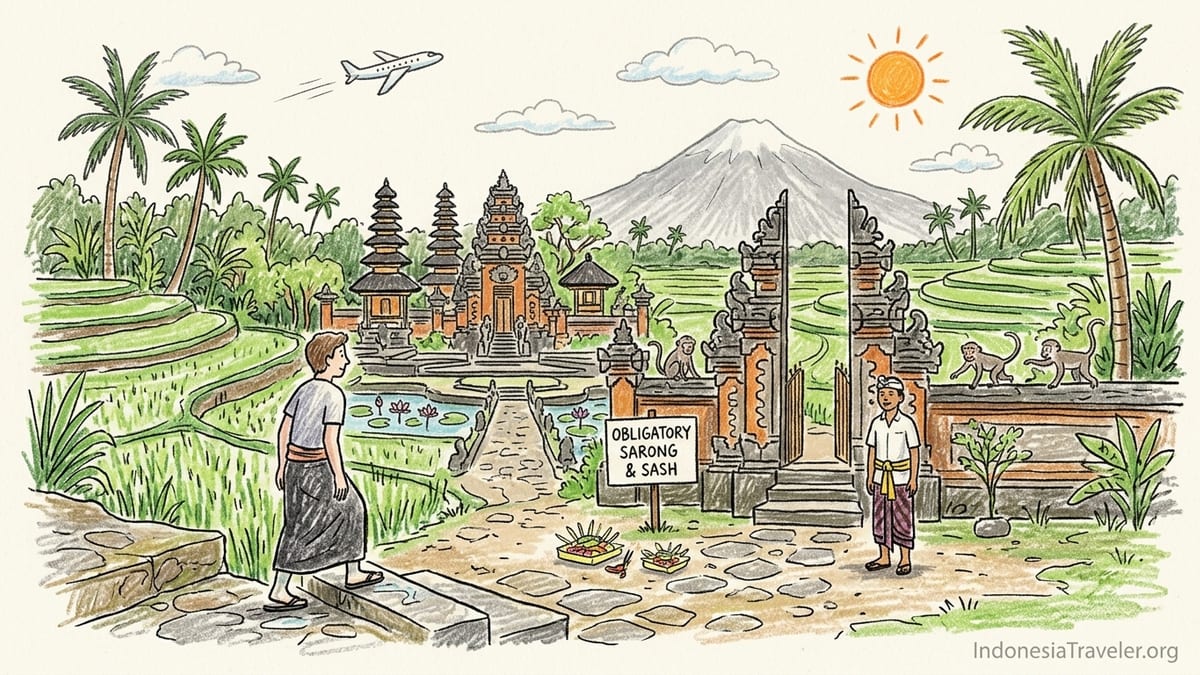
Clearing Indonesia’s Entry Requirements Before Ubud
Before I even set foot in Ubud, I had to clear Indonesia’s national requirements, which are separate from anything Bali or Ubud might ask of you. Ubud does not have its own tourist visa, and there is no special permit just for staying in town. What matters is that you enter Indonesia correctly. On my trip, I flew into Denpasar with a passport that had more than six months validity beyond my arrival date and at least one blank page. At immigration I joined the line for visitors using Indonesia’s short stay option, which for many nationalities is either visa exemption or a visa on arrival. The exact rules change often, and some countries that once enjoyed visa-free entry now need a visa on arrival or an e-visa, so I checked my nationality on official immigration and foreign ministry sources a few days before departure rather than trusting old blog posts.
The other step I am glad I handled before landing was the All Indonesia electronic customs declaration. On the flight I watched people frantically trying to scan QR codes in the arrival hall while juggling bags. I had already completed the declaration on the All Indonesia website for my entire travel party, listing items like electronics and small amounts of alcohol and cigarettes. At Ngurah Rai airport the customs officer only needed to scan my QR code, and I was waved through in under a minute. If I could do it again, I would screenshot the final QR page and save it offline, because airport Wi-Fi was patchy and the app did not always reload quickly for other passengers.
What surprised me was that the most noticeable new rule in 2026 was not about visas, but about Bali’s provincial tourist levy. Starting in February 2024, Bali began charging foreign tourists 150,000 rupiah per visit, roughly the price of a mid-range restaurant meal in Ubud. I paid online before departure using the official provincial system and received a QR confirmation. Immigration did not check it, but in the arrivals area there were clear signs and a counter for people who still needed to pay, with staff scanning QR codes and directing visitors to card terminals. It is a one-time levy per trip to Bali, not a daily tax, and it is separate from any visa fee you might pay to the central government.
At no point in this process did anyone ask where in Bali I was staying. Whether you go to Ubud, Canggu or the Gili islands afterward, the national immigration rules and this provincial levy are the same. That is the first thing I wish I had understood earlier: there is no such thing as a “Ubud visa,” and Ubud itself does not impose separate entry fees or registrations. Once you are in Indonesia legally and have paid Bali’s levy if required, you are free to move up into the hills.
Learning Temple Etiquette the Hard Way
My real education in Ubud started at its temples. I had seen countless photographs of ornate gateways and tranquil courtyards, but the unspoken rules that govern those spaces only clicked once I walked through them. The first lesson came at Pura Taman Saraswati, the water temple in central Ubud with lotus ponds in front of the main shrine. I wandered in wearing long linen trousers and a T-shirt, assuming that was modest enough. A local attendant politely stopped a couple next to me and asked the man to put on a sarong because his shorts were above the knee, while I was waved through. It was my first real reminder that the dress code is not symbolic. It is enforced, gently but clearly.
At Tirta Empul, north of Ubud, the expectations became even more obvious. At the entrance, the ticket counter included the option to borrow a sarong, which was included in the admission price. Here, everyone was expected to wrap a sarong around the waist, regardless of gender, and many locals also wore a temple sash tied above the hips. I followed staff instructions to wrap the sarong over my existing clothes and then put on a sash offered near the changing area. There were clear signs asking visitors with menstruation to refrain from entering the main purification pools, and several zones were marked as restricted to those who were actually praying. Paying the entrance fee covered the privilege of being in the outer and middle courtyards, but it did not open every gate.
Inside, I watched tourists drift toward the priests conducting blessings and offerings. A guard gently redirected someone who was trying to step over a low barrier to “get a better photo” of the inner shrines. That moment fixed an important rule in my mind. Admission is a contribution for access, not a ticket that guarantees you can stand wherever you like. I kept to the stone paths and stayed behind any lines or rails, and if a courtyard seemed to be full of locals in ceremonial dress with no other visitors around, I took that as a quiet sign that I should observe from a distance.
Goa Gajah, the Elephant Cave temple closer to Ubud, reinforced this lesson in a different way. The site feels more compact, with an atmospheric cave, a bathing pool and a few shrines. Here, an attendant at the entrance automatically handed me a sarong even though my trousers technically covered my knees. When I asked if I needed it, he smiled and said it was better for the temple. I tied it on and noticed that the few people not wearing one stood out immediately. That contrast made me self-conscious enough that I kept the sarong on until I had exited the main complex, even when walking up the steps toward the small stalls. The etiquette is as much about making the local community comfortable as it is about any strict rule you might read ahead of time.
Sarongs, Sashes, Shoes and Where You Cannot Go
By the time I reached Gunung Kawi, a temple complex of rock-cut shrines set along a river valley, I had finally internalised the practical side of what to wear. I brought my own lightweight cotton sarong in a daypack and slipped it on as soon as I saw the “Obligatory Sarong” sign at the start of the path. The staff were still offering loaner sarongs for those who did not have one, but I appreciated having fabric that fit me well and was easy to tie. At the top of the stairs, a woman renting sarongs approached me with a practiced smile. Because I was already wrapped, she simply nodded in approval and turned her attention to other visitors. That experience taught me that “rental” offers are not always mandatory; if you are already dressed properly, you can politely decline.
Sashes were more situational. In some temples like Tirta Empul, I was specifically directed to wear one when entering the main courtyard, and they were available free or for a small donation. In others, like Pura Dalem Taman Kaja in central Ubud, I saw that locals arriving for evening ceremonies wore both sarongs and sashes, while visiting foreigners mostly managed with just sarongs in the outer areas. If I was invited to sit for a performance or to join a small offering ritual, I would ask someone nearby whether I should wear a sash as well. Saying “Is this okay?” with a slight gesture toward my waist and letting a local nod or shake their head turned out to be much easier than guessing from afar.
Shoes were simpler but easy to get wrong if you rushed. In every temple I visited, I watched what locals did at the threshold to inner courtyards and prayer platforms. If they stepped out of sandals and left them at the base of steps, I did the same. On one occasion at a smaller family compound where I had been invited to see the shrines, I accidentally started up a platform still in my sandals. The homeowner gently pointed to my feet without saying anything. I backed down, removed them and tried again. It felt like a small mistake, but it reminded me that footwear is taken seriously, particularly the idea that shoes carry dust and impurity into sacred spaces.
Restricted courtyards were sometimes marked clearly with signs stating that the area was reserved for worshippers or for ceremonies. At other times, the only indication was a rope, a low stone barrier or simply the flow of people. I learned to ask “Can tourists go there?” if I was unsure, even at well-known sites like Saraswati and Goa Gajah. In every case, staff or vendors nearby were happy to point out how far I could go. The most helpful advice often came from the sarong attendants themselves, who knew which inner gates would be opened that day and which remained off-limits except during specific Hindu festivals.
Why Paying Admission Does Not Buy You Every Photograph
One assumption I had to unlearn quickly was that a ticket automatically allowed me to photograph anything inside. At Tirta Empul, the purification pools are filled with people pressing their foreheads under temple spouts, some tourists and some Balinese families carrying offerings. Many visitors treat it as a scenic backdrop, but watching through my own lens felt different once I saw older Balinese women quietly protecting their privacy, turning slightly away from the heaviest camera setups. I took general wide shots of the pools and the architecture, then put my camera away when I was close enough to make out individual faces at prayer.
The same logic applied at Saraswati. From the street-facing side, you get iconic views of the lotus ponds and temple gate, and there is even a cafe terrace that looks directly onto the water. It would be easy to sit there snapping zoomed-in shots of worshippers arranging offerings, but after a few minutes I realised I was essentially pointing my camera into somebody’s temple courtyard. On subsequent visits I kept my photos to the general scene and the details of carvings and flowers, and when I wanted a closer look I stepped down from the cafe and entered as any other visitor would, paying attention to where staff suggested I stop.
At Pura Dalem Taman Kaja, which is known for its evening trance and kecak performances, I arrived one late afternoon when preparations for a ceremony were underway. A group of women was carefully placing canang sari, small offerings, along the edge of a raised platform. A guide nearby reminded his group, “Please, no flash and no standing on the platform.” I realised that my own desire to capture the colours could easily have pushed me into the restricted zone if I had not listened. I kept to the ground level, took one discreet photo side-on, and then simply watched. Nothing in the admission price gave me the right to interrupt their work.
These experiences shifted the way I think about temple tickets in Bali. The small fees you pay at sites like Goa Gajah or Gunung Kawi mainly support maintenance, waste management and local banjar (village council) funds. They are not performance fees that guarantee staged scenes for your content. The most respectful mindset I found was to treat any active ceremony as off-limits for close-up photography unless I had explicit permission from the people involved, and even then, to keep my equipment modest. A phone or small mirrorless camera drew fewer stares than a large DSLR with a telephoto lens on a monopod.
Monkey Forest: Rules, Macaques and Everything in Your Pockets
The Sacred Monkey Forest Sanctuary in Ubud was the part of my trip where written rules mattered the most in a very practical way. At the entrance, after paying my ticket in rupiah at the official counter, I paused to read the large board of dos and don’ts. It spelled out that feeding, touching, teasing or staring directly into the monkeys’ eyes was discouraged, and that food and drinks were not allowed inside. Staff repeated the same messages as they checked bags, asking visitors to finish or discard takeaway coffees and visible snacks.
Before stepping through the gate, I reorganised everything I was carrying. I zipped my daypack fully and moved it to my front, took my sunglasses off my head and put them inside, and slipped my phone into a trouser pocket that could be fully closed. The reason became obvious within minutes. Long-tailed macaques sat on railings and temple walls watching the flow of people, but their eyes were fixed not on faces, but on anything that looked like food or a dangling object. A zip left half-open or a crisp packet poking out of a side pocket was enough to trigger sudden interest.
For my entire walk through the sanctuary I resisted the temptation to reach out to any monkey, even when one scrambled onto a nearby railing and seemed unbothered by my presence. I saw an attendant gently but firmly intervene when a visitor tried to coax a monkey closer with a water bottle, and another tourist who lifted a child toward a branch was told to bring the child back down immediately. Staff were present along the paths and around the main temples, which helped reinforce that this was more than a casual park. It is a sanctuary with religious significance and a living population of semi-wild animals that can scratch and bite.
Before visiting I had read conflicting online comments about rabies in Bali’s monkeys. On the ground, the message from both signage and my guesthouse owner was straightforward. Avoid contact. If you are scratched or bitten anywhere on the island, head for medical assessment as soon as possible. The point is not to panic, but to get a professional to evaluate your risk and decide on post-exposure vaccination if needed. I did not have any close calls myself, but watching a monkey successfully grab an unzipped pouch from another visitor and chew through it on a branch was enough to convince me that there is no harmless “play” with these animals. Treat the rules about feeding, touching and confronting macaques as non-negotiable, and your visit becomes a calm walk among temples and trees rather than a string of near misses.
Walking Ubud’s Countryside: Heat, Steps and Slippery Stone
Some of my most vivid memories of Ubud are not from temples or the Monkey Forest at all, but from the walks that connect them: Campuhan Ridge, the nearby rice terraces and the approaches to places like Gunung Kawi and local waterfalls. The physical reality of these walks is rarely captured in the glossy images. On my first morning on Campuhan Ridge, I started too late, leaving around 9.30 a.m. The sun was already high and the concrete path along the ridge had absorbed hours of heat. Within 15 minutes I was sweating through my shirt, and there was almost no shade along the central portion of the trail. The views of palm trees and valleys were beautiful, but I found myself focusing more on staying hydrated than on taking photographs.
The same pattern held at the rice terraces outside Ubud. On one visit I took a shared taxi to a set of terraced fields where a small admission fee was collected at the roadside. From there, a narrow dirt and stone path wound down into the valley. After a night of rain, some sections were slick with mud and algae, especially on shaded concrete steps. I watched one visitor in smooth-soled fashion sandals slip slightly on a sloped edge. It was a minor moment, but it reminded me that the green moss in photos corresponds to real moisture underfoot. Closed shoes or sandals with genuine grip made a difference, particularly when crossing small irrigation channels over improvised bridges of bamboo or stone.
Gunung Kawi combined both elements. To reach the main shrines, I descended a long staircase of stone steps lined with stalls selling sarongs, drinks and snacks. Going down felt easy, surrounded by souvenir shops and occasional resting platforms. The challenge came later, when climbing back up in humid afternoon air. I stopped twice at shaded points to catch my breath and drank most of the water I had carried. If I had set off at midday instead of mid-morning, the climb would have been significantly more draining. A similar story played out at a small waterfall near Ubud, where the final approach was down steep, wet steps carved into rock with only a basic handrail. I slowed down deliberately, planted each foot and accepted that arriving slightly later was better than taking a fall.
Rain added an extra layer of unpredictability. One afternoon shower swept across Ubud while I was halfway along a village path between rice paddies. Within minutes, the narrow earth track turned into a slick strip of clay, and the shallow irrigation channels swelled. My compact travel umbrella was almost useless in the crosswind, but a lightweight rain jacket kept my pack dry enough to protect my camera. The return walk took twice as long as the outgoing leg, largely because I shortened my stride and avoided rushing. If I had assumed that “easy walk” in a blog post meant “safe in any weather,” I would have been badly caught out.
Money, Guides, Donations and What You Really Pay For
Spending money around Ubud’s temples and countryside walks was another area where reality turned out to be more nuanced than I had expected. At major temples like Tirta Empul, Goa Gajah and Gunung Kawi, there were clearly posted admission prices at official counters, payable in rupiah either in cash or, increasingly, by card. These tickets usually included access to the main complex and, in some cases, the loan of a basic sarong. Anything offered beyond that was either a rental convenience or a voluntary service, even if it did not always feel that way in the moment.
On more than one occasion, as I approached a temple gate, someone in a sarong and sash introduced themselves as a local guide and offered a tour for a fixed price. The amounts varied, and some quoted a figure per person while others suggested a total for the group. There was never any suggestion that guiding was mandatory to enter. At Pura Dalem Taman Kaja, for example, I politely declined a guide, paid my entrance fee at the official table and walked in alone. Inside, I later chose to tip a local who spent ten minutes explaining the layout of the family shrines during a quiet moment before the evening performance. That interaction felt much more like a genuine exchange than a pre-arranged tour would have.
Donation boxes were a frequent sight near temple exits and within some shrines. They ranged from locked metal trunks with printed labels to small wooden boxes with handwritten notes. I contributed small amounts when I felt that I had lingered longer in a particular corner, or when a priest or attendant had answered my questions in detail. One time at a village temple ceremony, a man with a receipt book approached me about contributing to the banjar fund. When I asked whether it was obligatory for visitors, he smiled and said that any amount was appreciated, then moved on when I hesitated. It taught me that saying “No, thank you” or offering a smaller sum in rupiah notes was acceptable as long as I did it respectfully.
Transport to and from these sites also came with its own set of informal negotiations. In central Ubud, local drivers waited near temple entrances and popular cafes, offering set prices to places like Tirta Empul or the rice terraces. I found it helpful to agree on the full round-trip price in advance, including waiting time, rather than assuming the driver would automatically stay. At Gunung Kawi, my driver suggested a certain window before he would return to the car park area, and I made sure to be back slightly early. The key lesson was that clear, friendly communication up front prevented awkward conversations later, particularly when language gaps and different expectations about time were involved.
The Takeaway
By the time I left Ubud, I realised that what had made the biggest difference to my trip were not the glossy attractions themselves, but the small, grounded details in how I moved through them. Completing Indonesia’s immigration requirements and the All Indonesia declaration ahead of time kept my arrival simple. Paying Bali’s tourist levy once, understanding that Ubud did not require anything additional, let me stop worrying about surprise fees. Inside temples, wearing a sarong and, when asked, a sash, watching where locals removed shoes, and respecting ropes and low barriers shaped a calm way of visiting rather than rushing for the closest view.
In the Monkey Forest, zipping my bag, hiding loose objects and refusing to treat macaques as props kept the visit peaceful and safe. Out on Campuhan Ridge, the rice terraces and the long staircases to Gunung Kawi, acknowledging the heat, slippery stone and sudden rain showers changed “simple walks” into manageable but real exertions. With money, recognising the difference between official entrance fees, optional guides and donation requests meant that I could support local communities without feeling pressured into every offer.
If I were planning a return visit, I would build my days around these lessons. On temple days, I would start early, dress appropriately, carry small rupiah notes for tickets and donations, and treat any ongoing ceremony as something to witness politely from the margins, not a backdrop for close-up shots. On countryside days, I would prioritise early starts, good footwear, at least one and a half liters of water, a compact rain layer and the humility to turn back if a path felt too slippery. For bad weather, I would set aside time for Ubud’s indoor spaces and smaller in-town temples, accepting that not every valley or waterfall is worth the risk in heavy rain.
Above all, I would remember that Ubud’s temples and landscapes exist first for the people who live there, and only second as places for visitors to experience. When I adjusted my expectations and behavior accordingly, the rewards were richer than any photograph I could carry home.
FAQ
Q1. Do I need a separate visa specifically for Ubud?
There is no separate visa for Ubud. You only need to meet Indonesia’s national entry requirements, which may include a visa exemption, visa on arrival or e-visa depending on your nationality.
Q2. What is the 150,000 rupiah Bali tourist levy and when do I pay it?
The Bali provincial government charges foreign tourists a one-time levy of 150,000 rupiah per visit. You can usually pay it online before travel or on arrival at the airport or seaport.
Q3. Do I have to wear a sarong at every temple in Ubud?
At many temples, including Tirta Empul, Goa Gajah and Gunung Kawi, wearing a sarong is required, especially if your legs are exposed. Some sites provide loaner sarongs, but bringing your own is more comfortable.
Q4. Can I photograph ceremonies if I have paid the temple admission fee?
Paying admission does not guarantee permission to photograph ceremonies or worshippers. Wide architectural shots are usually fine, but close-up photos of people at prayer should only be taken with explicit consent.
Q5. Are the monkeys in Ubud’s Monkey Forest safe to touch if staff are nearby?
No. Official guidelines advise visitors not to touch, feed or tease the monkeys. Staff are there to manage safety, but you are expected to keep your distance and secure all loose items.
Q6. What should I do if a monkey bites or scratches me in Ubud?
If you are bitten or scratched by a monkey anywhere in Bali, seek immediate medical assessment. A doctor or clinic can evaluate your risk and advise on post-exposure rabies vaccination if needed.
Q7. How difficult are the walks at Campuhan Ridge and Gunung Kawi?
Campuhan Ridge is a relatively gentle paved walk but very exposed to sun and heat. Gunung Kawi involves a long staircase with many steps, which can be demanding in humid conditions and slippery after rain.
Q8. Are all guide offers and donations at temples mandatory?
No. Official entrance fees are usually posted at ticket counters. Guide services and most donation requests are optional, although contributing modestly helps support local communities.
Q9. What should I wear on a full day of temple visits and countryside walks?
Lightweight, modest clothing that covers shoulders and knees, a packable sarong, sturdy sandals or shoes with good grip, a hat and a light rain jacket work well for most days.
Q10. How can I prepare for sudden rain and slippery paths around Ubud?
Carry a compact rain layer, protect electronics in dry bags or zip-locks, slow your pace on mossy stone or mud, and be prepared to shorten or abandon walks if conditions deteriorate.