


Ubud is often imagined as a quiet jungle village of private pools and misty rice terraces. In reality, it is Bali’s busy cultural capital set in a patchwork of historic villages, deep river valleys and rapidly expanding tourism development. This guide for 2026 explains how Ubud really looks and feels on the ground, how to navigate its art and temples respectfully, and what first-time visitors should know about visas, the Bali tourist levy, transport and realistic stay lengths.
Setting Expectations: What Ubud Is (and Is Not)
The first misconception to correct is simple: Ubud has no beach. Bali’s popular sand and surf areas such as Kuta, Seminyak, Canggu, Sanur, Nusa Dua and Jimbaran all lie on the coast. Ubud sits inland in Gianyar Regency amid river gorges, rice fields and villages. If you want daily ocean swims and sunset bars on the sand, you will either need a coastal base or be prepared for long transfers between Ubud and the shore.
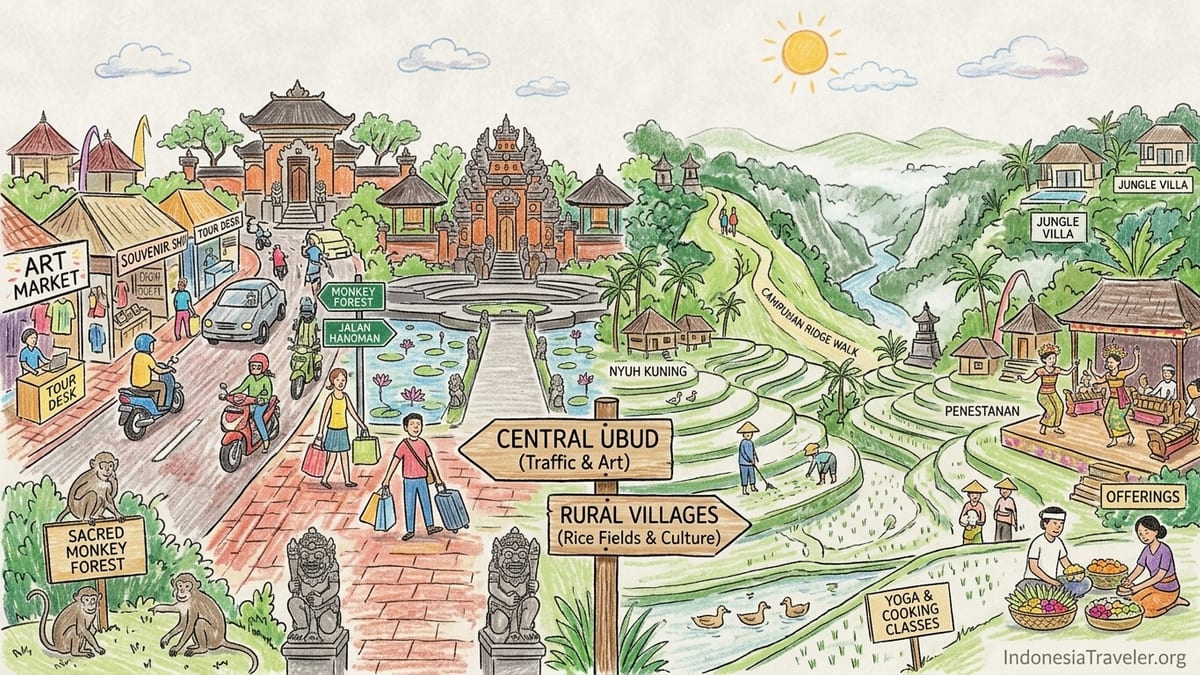
The second misconception comes from social media imagery of tranquil “jungle villas.” Many of these properties are several kilometers from central Ubud in quieter valleys. The town center itself revolves around the crossroads of Jalan Raya Ubud, Jalan Monkey Forest and Jalan Hanoman, and this area is often choked with traffic, motorbikes, souvenir shops, tour desks and cafes. Sidewalks can be narrow or uneven and the noise level is closer to a small city than a retreat center.
Understanding Ubud as a dense regional hub helps you plan better. You might, for example, choose a hotel near Ubud Royal Palace if you value walking to performances and restaurants, even if that means accepting street noise. Or you may prefer a guesthouse in Nyuh Kuning village south of the Monkey Forest, where you can stroll among family compounds and warungs, then take a short taxi ride into the center when needed.
Ubud lies in Gianyar Regency roughly 35 to 40 kilometers by road from I Gusti Ngurah Rai International Airport in southern Bali. Depending on traffic and weather, transfers usually take about 75 to 120 minutes, and journeys can stretch longer at rush hour or during peak holiday periods. Pre-booked private cars are common, with recent airport-to-Ubud fares often in the range of 300,000 to 400,000 rupiah for a standard car, though rates vary by operator and season.
Orientation: Central Ubud and Its Surrounding Villages
When people say they are “staying in Ubud,” they may actually be based in very different areas. Central Ubud is the walkable grid around Ubud Royal Palace, Ubud Art Market, Saraswati Temple, Jalan Monkey Forest and Jalan Hanoman. Here you can walk between cafes, yoga studios, mini-markets and performance venues, but you will also contend with heavy traffic, limited parking and frequent taxi touts.
To the west, Penestanan village has long attracted painters and expatriates. It features narrow lanes, art studios and small guesthouses, plus a growing crop of cafes serving smoothie bowls and sourdough. Penestanan is technically walkable to central Ubud for some travelers, but the route involves steep shortcuts or busy roads, so many visitors rely on scooters or short taxi rides.
Further southwest along the Ayung River are Sayan and Kedewatan, home to several of Ubud’s most famous luxury properties perched on the valley rim. These areas offer dramatic river views and a sense of seclusion; you might wake to mist over the gorge and hear only birds and distant roosters. The trade-off is that you cannot simply step out to a choice of dozens of restaurants. Most guests eat at their hotel or arrange cars into town, and walking after dark along unlit roadside sections can be uncomfortable.
On the southern side of town, Nyuh Kuning forms a compact, village-like neighborhood behind the Sacred Monkey Forest, with homestays, yoga studios, plant-based restaurants and family temples. East and southeast lie Peliatan and Mas, historically known for legong dance and woodcarving respectively, with many traditional family-run workshops. To the northeast, Pejeng is a quieter rural area with archaeological significance, while Tegallalang, farther north, is associated with famous rice terraces and increasingly busy roadside cafes and swing attractions. Each of these zones has a distinct feel and very different levels of walkability and transport convenience.
Artistic Heartland: Royal Patrons, Pita Maha and Living Traditions
Long before Ubud appeared in international guidebooks, this area was a center of Balinese court culture and village-level artistic life. The local royal family, based at Puri Saren Ubud (Ubud Royal Palace), historically acted as patrons for painters, sculptors, dancers and musicians. Nearby banjar, or village community organizations, supported temple building, dance troupes and gamelan ensembles that performed during religious ceremonies.
In the 1930s, Ubud became an influential node in global art networks through the Pita Maha movement. Balinese artists such as I Gusti Nyoman Lempad, along with foreign residents including German-born painter Walter Spies and Dutch artist Rudolf Bonnet, encouraged new approaches to painting and sculpture. They worked with local artists to refine composition, adopt new materials, and present Balinese work in galleries abroad. It is important to stress, however, that sophisticated Balinese artistic traditions in carving, dance, textiles and ritual had already flourished for centuries. European involvement helped market and reinterpret these traditions rather than invent them.
Today, visitors can see this layered history in Ubud’s institutions. Museum Puri Lukisan near the palace focuses on Balinese modern and traditional painting and woodcarving, including works linked to the Pita Maha period. The Neka Art Museum in Sanggingan presents curated collections that trace stylistic developments in Balinese art alongside works by foreign artists inspired by Bali. The ARMA (Agung Rai Museum of Art) complex combines a serious art museum with landscaped grounds, performance spaces and a cultural center hosting gamelan rehearsals and festivals.
Blanco Renaissance Museum, set on a ridge above the Campuhan River, showcases the flamboyant studio-residence of the late Philippine-born painter Antonio Blanco, whose romanticized portraits and eclectic architecture offer a very different mood from Ubud’s more traditional museums. Together, these institutions form a compact circuit where visitors can see that Ubud’s art story is not just one of souvenirs but of evolving, debated and curated cultural expression.
Key Sights: Palace, Saraswati Temple and Living Culture
Ubud Royal Palace remains a central landmark, both politically and symbolically. People still live in parts of the compound, and ceremonial events take place here, particularly during major Hindu festivals. Visitors can walk through designated courtyards during the day to see elaborately carved doorways and pavilions. Many evenings, ticketed dance performances are staged in the outer courtyards, featuring legong, barong and other dance-drama forms accompanied by gamelan.
Just behind the main street lies Pura Taman Saraswati, often simply called Saraswati Temple, distinguished by its lotus ponds and richly carved red-brick and sandstone gates. The temple is dedicated to the goddess of knowledge and the arts, making it symbolically fitting in Ubud. The outer section of the complex is accessible to casually dressed visitors who come for photographs of the pond and facade. However, entry into inner temple areas is restricted to those wearing appropriate attire and observing ritual rules.
Elsewhere in town, smaller temples, banjar halls and family compounds give Ubud its rhythm. In the early morning, travelers may see women placing offerings of flowers and rice at shrines, shop entrances and scooters. In the late afternoon, the sound of gamelan rehearsals drifts from community halls as performers practice for the next odalan, or temple anniversary. For visitors, choosing a homestay in a family compound in areas such as Nyuh Kuning, Peliatan or Mas can offer insight into this daily religious life beyond the main tourist streets.
Respectful observation is welcomed when done discreetly. For example, if your homestay family invites you to attend part of a ceremony at their village temple, they may help you borrow or rent a sarong and sash and explain when photographs are appropriate. Participating in this way supports the local institutions that keep Ubud’s cultural life vibrant.
Sacred Monkey Forest: More Than a Selfie Spot
The Sacred Monkey Forest Sanctuary, or Mandala Suci Wenara Wana, sits at the southern edge of central Ubud. It is not just a tourist attraction but a combination of sacred temple grounds, riverine rainforest, and community-managed conservation area. Within its boundaries are several temples important to local villagers, stone guardian statues wrapped in cloth, and towering trees that shelter Balinese long-tailed macaques.
As of 2026, published information indicates that the sanctuary is open daily from 9 a.m. to 6 p.m., with last entry around 5 p.m., to allow visitors enough time to complete a circuit before closing. Current sources report an adult entrance ticket of about 130,000 rupiah for foreign visitors, with a lower price for children. Families should budget this in addition to transport, as walking from some guesthouses can involve steep roads, while those staying in Nyuh Kuning can reach one of the side entrances on foot.
The sanctuary is managed by the local village, and part of the ticket revenue goes toward temple upkeep and forest conservation. Visitors will see clear paths, bridges over the stream and staff monitoring interactions between people and monkeys. The macaques are wild yet habituated to humans and can be assertive around food and loose items. To minimize risks, you should avoid bringing plastic bags, visible snacks or dangling accessories such as sunglasses on your head. Examples from recent travelers include monkeys unzipping backpacks to search for food and grabbing water bottles out of side pockets.
It is crucial to remember that this is a sacred landscape for local residents. Some temple courtyards are closed to foreign visitors or may require ceremonial dress, and even in general areas, shouting, chasing monkeys or stepping on shrines is considered highly disrespectful. If you want photographs, stay calm, avoid attempting to touch the animals, and follow instructions from sanctuary staff. Handwashing stations near the exits are a good place to clean small scratches or simply wash after contact with railings and surfaces frequented by wildlife.
Beyond the Rice Terraces: Walks, Valleys and Rural Life
Ubud is closely associated with rice terraces, but not all of them are equal in atmosphere or protection. The Campuhan Ridge Walk begins near the small bridge west of central Ubud and follows a grassy ridge between two river valleys. It offers open views, especially at sunrise and late afternoon, and passes small cafes and guesthouses along the way. Although it feels semi-rural, development is creeping along the ridge, and sections can be hot and exposed during midday.
Juwuk Manis, sometimes called the Sweet Orange Walk, starts from a small lane off Jalan Kajeng and quickly enters a patchwork of rice fields and village houses. This route gives more of a sense of agricultural life, with farmers tending irrigation channels, ducks herded along paths, and shrines standing among the paddies. Parts of the path can be muddy in the rainy season, and occasional motorbikes use the lanes, but overall it remains more intimate than larger tourist sites.
Tegallalang, several kilometers north of Ubud, is the most photographed rice terrace area in the region. Terraces step down steep slopes beside the main road, lined with cafes, souvenir shops and “Bali swing” attractions. While the landscape is impressive, the site has become heavily commercialized. Visitors typically pay small fees at various entry points or to access viewpoints and swings, on top of spending in cafes. It is common to share the terraces with crowds taking photos on woven nests and heart-shaped platforms.
By contrast, the Pakerisan Valley, stretching toward Tampaksiring and Pejeng, is part of a wider cultural landscape associated with ancient temples and water management. Some areas within this valley are recognized by UNESCO as part of Bali’s subak (irrigation) system, but it would be inaccurate to describe every rice terrace around Ubud as UNESCO-listed. Walks near archaeological sites such as Goa Gajah or around lesser-known village paths can reveal temples cut into rock faces, bathing pools and shrines shaded by forest, though signage and formal trails remain limited.
Temple Etiquette, Performances and Hands-On Culture
Visiting temples is a highlight of time in Ubud, but etiquette matters. At most Balinese temples that accept visitors, you must wear a sarong covering your legs and a sash tied around your waist. Some temple entrances include a simple rental counter where a modest fee provides both items. Shoulders should be covered in inner courtyards; a lightweight shirt or scarf is usually sufficient. Women who are menstruating are traditionally asked not to enter sacred inner areas, though this rule is not always signposted.
When ceremonies are in progress, it is polite to observe from a respectful distance and avoid standing higher than priests or worshippers. Do not walk in front of people who are praying, and silence mobile phones. Photography is often allowed in outer courtyards, but flash and close-up shots during rituals can be intrusive. If in doubt, ask your guide or a temple attendant; many will happily explain the significance of what you are seeing if approached respectfully.
Evening dance performances around Ubud provide structured opportunities to experience Balinese performing arts. Typical venues include the courtyard of Ubud Palace for legong and barong programs, temples in Peliatan known for refined legong, and village stages hosting kecak (vocal chant) and fire dances. Tickets are usually sold from small stands near the venue or via your accommodation, with printed programs listing the time and dance types. Prices vary but remain relatively affordable for international visitors and provide income for local troupes and organizations.
Hands-on activities round out Ubud’s cultural offerings. Art workshops in villages like Mas and Penestanan introduce travelers to woodcarving, batik dyeing or painting, often in family-run studios. Yoga studios in the central area and in Nyuh Kuning offer daily drop-in classes in vinyasa, hatha and yin styles, with English-language instruction and mats included in the fee. Cooking classes, frequently run by local families, start at morning markets before moving to open-air kitchens where participants learn to make sambal, satay or lawar using traditional utensils. Each of these experiences provides a concrete way to engage with living Balinese culture rather than only observing it.
Eating, Transport and Traveling in the Rainy Season
Food in Ubud ranges from simple warungs to high-end tasting menus. Local warungs often serve nasi campur, a plate of rice with small portions of vegetables, tempeh, meat and sambal, or specialties like babi guling (roast pork) and bebek betutu (slow-cooked duck). A meal at a family-style warung can still be inexpensive by international standards, particularly away from the most touristed streets. At the other end of the spectrum, contemporary restaurants experiment with Indonesian flavors in multi-course menus, often paired with cocktails or natural wines.
Vegetarian and vegan travelers are well catered for, especially in central Ubud and Nyuh Kuning, where cafes highlight plant-based versions of Indonesian dishes alongside smoothie bowls, salads and espresso. Coffee culture is strong, with local roasteries offering single-origin Balinese beans and international brewing styles. For a concrete example, you might spend your morning at a small warung eating nasi campur for breakfast, then later sit in a specialty cafe drinking a hand-poured filter coffee while planning your afternoon walk.
Transport can be one of the more frustrating aspects of staying in and around Ubud. There is no integrated public transport system in town. Most visitors rely on a mix of walking, ride-hailing apps where they are allowed, local taxis, and motorbike rentals. In parts of Ubud, community transport groups restrict app-based pickups, so your driver may ask you to walk to an agreed location. If you rent a scooter, consider recent rainfall, your comfort with steep, narrow lanes, and the fact that traffic police occasionally run checks on licenses and helmets.
Ubud’s rainy season generally runs from about November to March, with the heaviest downpours often in December and January. Showers can be intense but brief, turning streets into streams, making stone steps slick and swelling rivers. For example, a late afternoon cloudburst can flood low-lying patches of the Campuhan Ridge path and turn the Juwuk Manis track muddy. Travelers visiting in these months should pack light rain jackets, quick-drying clothing and footwear with good grip, and be prepared for some itinerary flexibility if storms coincide with planned outdoor activities.
Visas, Bali Tourist Levy and Practical Formalities
Most short-stay leisure travelers to Bali in 2026 enter Indonesia using either visa-free access or a paid visa category, depending on their nationality. For many nationalities, the common option is a Visa on Arrival or its electronic equivalent. Recent official and consular sources indicate that the Visa on Arrival fee is 500,000 rupiah for a stay of up to 30 days, counted from the day of arrival, and that it can usually be extended once for another 30 days at an immigration office for an additional fee. Travelers are advised to check whether they are eligible for visa-free entry or must obtain a visa and to verify the latest rules shortly before departure, as policies can change.
Indonesia also offers an electronic version of the Visa on Arrival that can be applied for in advance through the official immigration platform. Some travelers prefer this to reduce queuing time upon arrival, although lines at Bali’s airport vary by time of day and flight volume. Regardless of the method, passports are expected to be valid for at least six months beyond arrival, and visitors are generally required to show proof of onward travel.
Separately from national immigration rules, the Province of Bali introduced a foreign tourist levy in February 2024. This levy is set at 150,000 rupiah per person per visit and is collected by the provincial government to fund cultural and environmental programs and tourism-related services. Payment can be made online in advance or through designated counters or partners once in Bali. The levy is distinct from any visa fee, and paying one does not replace the legal requirement for the other.
On arrival at Ngurah Rai International Airport, a typical sequence for a Ubud-bound traveler might involve passing through immigration, collecting baggage, clearing customs, paying or confirming payment of the Bali tourist levy if not yet settled, and then meeting a pre-booked driver in the arrivals hall. Having small denomination rupiah cash or a card that works consistently in Indonesia helps when paying for visas, levies, snacks and phone SIM cards. Because rules and payment processes are subject to revision, travelers should confirm the latest procedures through official government or embassy channels before traveling.
How Long to Stay in Ubud, and Who It Suits Best
The ideal length of stay in Ubud depends on what you hope to experience and whether you will also spend time on the coast or elsewhere in Indonesia. A two-night stay works for travelers who primarily base themselves at the beach but want a short inland side trip. In this period, you can reasonably explore the palace area, visit Saraswati Temple, walk Campuhan Ridge or Juwuk Manis, spend a few hours at the Sacred Monkey Forest, and attend one evening performance, though your days will be full and transfers may feel rushed.
Three nights give a more relaxed introduction. With this time, you might schedule museum visits at Museum Puri Lukisan and ARMA, join one art or cooking workshop, and still have space for slow mornings in a cafe or warung. A half-day excursion to Tegallalang or to temples and sites in the Pakerisan Valley becomes easier to fit in without compressing your days too tightly. Many couples and solo travelers find that three nights provide a good balance between culture, rest and moving on to other parts of Bali.
Five nights allow you to experience both the busy town center and quieter village surroundings. You could, for instance, split your stay between a guesthouse within walking distance of the palace and a more secluded villa in Sayan, Kedewatan or Pejeng. This timeframe supports a mix of yoga classes, multiple performances, several museum visits, at least one full-day excursion to outlying temples or waterfalls, and downtime by a pool or in rice-field cafes. Travelers who work remotely sometimes choose five nights or longer to test Ubud as a short-term base, combining laptop hours with evening cultural events.
A seven-night stay turns Ubud into a genuine base rather than a brief stop, well suited to visitors particularly interested in Balinese dance, visual arts, yoga or long walks. In a week, you can attend different styles of temple performances, experiment with several workshops, revisit favorite warungs, and venture further afield on day trips to places like Tampaksiring, Kintamani or coastal areas. You also gain flexibility to adjust for rainstorms, energy levels and local event calendars, such as village ceremonies or special exhibitions at museums.
Choosing Ubud as your primary base suits travelers who prioritize culture, food, wellness and cooler evenings over daily access to the ocean. Artists, photographers, yoga practitioners and those intrigued by temple life often thrive here. Families who value walkable access to restaurants and activities may prefer to stay in or very close to central Ubud, accepting traffic as part of the experience. On the other hand, surfers, beach-lovers and nightlife seekers may be happier anchoring themselves in coastal hubs and treating Ubud as a focused two or three-night inland stay. Many itineraries sensibly combine both: a few days absorbing Ubud’s artistic and religious landscape, followed by time on the shore to decompress by the sea.
The Takeaway
Ubud in 2026 is a complex destination: an historic Balinese royal and artistic center, surrounded by working agricultural villages and forests, layered with intense tourism development and international wellness trends. It has no beach, and its busy central streets contrast sharply with the serene imagery used to market many jungle villas. Yet for travelers who arrive with realistic expectations, respect for local customs and a flexible schedule, Ubud offers unusually rich access to living culture, from temple ceremonies and gamelan rehearsals to contemporary galleries and village rice walks.
By understanding Ubud’s geography, from walkable central streets to outlying areas like Penestanan, Sayan, Mas and Tegallalang, you can choose accommodation that fits your needs instead of relying on generic “Ubud area” labels. By learning basic temple etiquette, budgeting for sites like the Sacred Monkey Forest, and preparing for visas, the Bali tourist levy and rainy-season downpours, you can focus more on meaningful encounters and less on logistics. Above all, approaching Ubud as a working Balinese community rather than a backdrop for social media helps support more thoughtful, mutually beneficial travel.
FAQ
Q1. Does Ubud have a beach, and can I swim in the sea nearby?
Ubud is inland and has no beach. The nearest coastal areas, such as Sanur or Canggu, are well over an hour away by road in typical traffic, so sea swimming requires a day trip or a separate beach stay.
Q2. How long does it really take to get from Bali’s airport to Ubud?
The distance from Ngurah Rai International Airport to Ubud is roughly 35 to 40 kilometers, but traffic often makes the journey take between 75 and 120 minutes, and occasionally longer at peak times or in heavy rain.
Q3. Is central Ubud walkable, or do I need a scooter?
Central Ubud around the palace, market and main streets is walkable for many visitors, though sidewalks can be narrow and uneven. For outlying areas like Sayan, Kedewatan or Tegallalang, you will usually need a scooter, taxi or hotel shuttle.
Q4. What should I wear when visiting temples in and around Ubud?
Most temples require a sarong covering your legs and a sash around your waist. Shoulders should be covered in inner courtyards, and it is polite to avoid tight or revealing clothing and to follow any additional instructions posted at the gate.
Q5. How much does it cost to visit the Sacred Monkey Forest, and what are the hours?
Recent information for 2026 indicates an adult ticket of about 130,000 rupiah for foreign visitors, with opening hours from roughly 9 a.m. to 6 p.m. and last entry around 5 p.m., though you should confirm current details just before your visit.
Q6. Are all the rice terraces around Ubud part of a UNESCO World Heritage Site?
No. Some areas in the broader region, particularly within the Pakerisan Valley’s traditional irrigation landscape, are recognized by UNESCO, but not every terrace or viewpoint near Ubud is individually listed.
Q7. Do I need a visa to visit Ubud, and how much does it cost?
Visa rules depend on nationality. Many travelers use a Visa on Arrival or electronic equivalent for stays up to 30 days, with a fee of about 500,000 rupiah, but some nationalities have visa-free access. Always check the latest official requirements before traveling.
Q8. What is the Bali tourist levy, and when do I pay it?
The Province of Bali charges a foreign tourist levy of 150,000 rupiah per person per visit, intended to fund cultural and environmental programs. It is usually paid online in advance or on arrival in Bali and is separate from any immigration visa fee.
Q9. Is Ubud a good base for families with children?
Yes, many families enjoy Ubud, particularly for its cultural activities, cafes and sites like the Sacred Monkey Forest. Families often choose accommodation near central Ubud or in Nyuh Kuning to reduce time in traffic and ensure easier access to food and services.
Q10. Should I base myself in Ubud or at the beach if I only have one week in Bali?
If you prioritize culture, temples, art, yoga and cooler evenings, Ubud is a strong base. If daily sea swimming, surfing and sunset bars are more important, a coastal area may suit you better. Many travelers split a week between Ubud and a beach destination to experience both.