


Ubud rewards travelers who look beyond its swings and Instagram decks. At its heart are an active royal palace, family temples, serious art museums, walkable rice landscapes and living Hindu sanctuaries. This guide focuses on those core experiences, starting in the compact town center then fanning out to museums, countryside walks, temples, waterfalls and evening performances that still feel rooted in Balinese life.
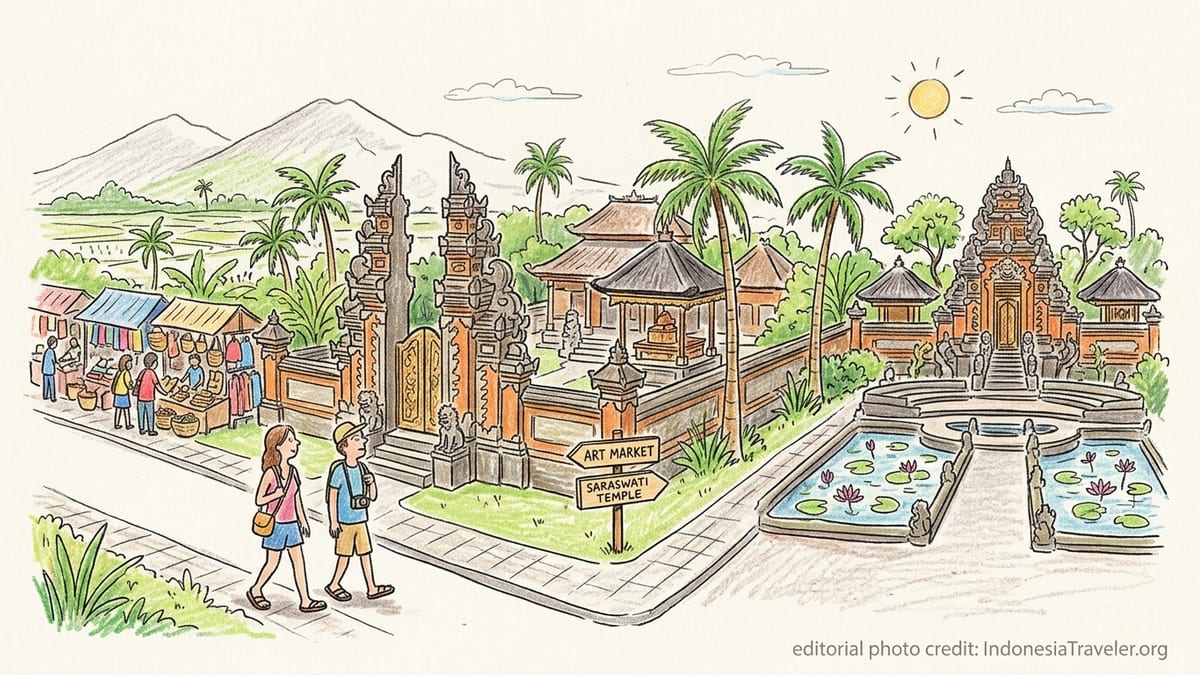
Ubud’s Walkable Center: Royal Palace, Saraswati Temple and Art Market
Most visitors will start in central Ubud, where the main sights sit within a few hundred meters. Ubud Royal Palace, or Puri Saren Agung, stands on the corner of Jalan Raya Ubud and Jalan Monkey Forest, with the Art Market opposite and Saraswati Temple a short stroll west. You can see all three in about an hour if you are efficient, or stretch to two hours if you linger over details and photographs.
During the day, visitors are allowed into the outer courtyards of Ubud Palace to see the ornate split gates, carved pavilions and shrines, but not the private residential wings of the royal family. There is no general daytime admission fee reported as of late 2026, although donation boxes are common. You can expect to spend 20 to 30 minutes walking the accessible courtyards, looking closely at stone guardians, painted wooden beams and the bale pavilions that form the stage for nightly dance performances.
Slightly west, Saraswati Temple, or Pura Taman Saraswati, is reached via a path across twin lotus ponds. The temple itself is a working place of worship, so visitors without ceremonial purpose are usually restricted to the outer area and not all inner shrines will be open. The appeal here is the combination of a compact, richly carved facade and the reflecting pools filled with lotus and waterlilies. It pairs naturally with the palace on the same visit, and you can see both compounds in under an hour on foot.
Ubud Art Market, opposite the palace, is a dense grid of stalls selling textiles, baskets, carvings, paintings and souvenirs. Prices are rarely fixed and bargaining is expected. The market is less about curated art and more about everyday commerce, but it gives a sense of how closely Ubud’s tourism economy presses against its royal and religious spaces. A pragmatic approach is to walk the palace and temple first, then cross into the market if you want to shop or simply observe the trading atmosphere.
All three sites are easily reached on foot if you are staying in central Ubud or arriving by taxi or ride-hailing service to the palace corner. Walking surfaces are mostly paved but can be uneven, so sandals with a strap are more comfortable than loose flip-flops. A guide is helpful if you want deeper stories about royal lineages and temple symbolism, but casual visitors can navigate alone. An alternative central stroll for those who dislike crowds is to follow Jalan Kajeng north from the main road to see family compounds and small shrines without entering the market bustle.
Understanding Ubud’s Major Art Museums
Ubud’s reputation as Bali’s cultural center rests heavily on its art museums. Four stand out for visitors who want to see Balinese painting and sculpture in context: Museum Puri Lukisan, Neka Art Museum, Agung Rai Museum of Art (ARMA) and the Blanco Renaissance Museum. Each offers a different angle on Balinese and Indonesian art, as well as different visiting conditions, admission prices and time commitments.
Museum Puri Lukisan, on Jalan Raya Ubud near the palace, is the oldest art museum in Ubud, established in the 1950s with support from the royal family to keep important Balinese artworks on the island. Its compact pavilions hold traditional Balinese paintings and woodcarvings that trace the evolution of local styles through the twentieth century. It is central, relatively quiet compared with the street outside, and can be appreciated in 60 to 90 minutes. Admission is usually in the range of 85,000 to 100,000 rupiah for adults, often including a welcome drink in the garden café, but you should confirm the exact price on arrival as museums review their fees periodically.
Neka Art Museum sits north of town along Jalan Raya Sanggingan, reached by taxi, motorbike or a 10 to 15 minute drive from the center, depending on traffic. It focuses on Balinese and Indonesian painting from the 1930s onward, with strong coverage of the so‑called Ubud and Young Artists schools, as well as work by Indonesian modernists. The complex is larger than Puri Lukisan, spread across several buildings and gardens, so you should allow at least two hours if you enjoy reading wall texts and comparing styles. Adult admission is typically a bit higher than Puri Lukisan, and the location means you will want motorized transport unless you are staying in the Sanggingan area.
ARMA, south of central Ubud near Jalan Raya Pengosekan, combines a museum with a cultural center and resort grounds. Its collections span traditional Balinese painting, works produced under colonial influence and pieces by important Indonesian and foreign artists. Visitors often describe ARMA as a place where you can spend half a day, since the landscaped grounds, rice plots and quiet pavilions invite slower exploration. Ticket prices are comparable to or slightly above other Ubud museums and may be bundled with temporary exhibitions or performances. Taking a taxi or ride-hailing car from central Ubud takes around 10 minutes, and walking from the main crossroads is possible but involves narrow sidewalks and traffic.
The Blanco Renaissance Museum occupies the flamboyant former home and studio of the late painter Antonio Blanco on a hill above the Campuhan River. The collection centers on his romantic, often theatrical paintings, as well as personal memorabilia from his life in Bali. Visitors come as much for the architecture, rooftop views and photo opportunities in the courtyard as for the paintings themselves. Allow about 60 to 90 minutes, and keep in mind that some of the imagery is sensual, so this museum may not suit all families with young children. Admission is broadly in line with other Ubud art institutions. A taxi from central Ubud takes less than 10 minutes, or you can walk via a steep approach from the main road near the Campuhan bridge.
Across these museums, walking difficulty inside the grounds is moderate, with some stairs and sloping paths but no extreme climbs. A guide is optional, as exhibits generally provide English descriptions, yet art-focused travelers may benefit from a specialist guide who can connect works to specific Balinese stories and rituals. For visitors who want a single alternative art experience, a smaller private gallery such as I Nyoman Jendra Gallery or a visit to an artist’s studio in Penestanan can offer a more personal encounter with contemporary Balinese work.
Ridge Walks and Rice Fields: Campuhan vs Juwuk Manis
Ubud’s surroundings are famous for rice terraces and gentle walks, but the two most accessible routes from town offer different landscapes. The Campuhan Ridge Walk follows a grassy spine between two river valleys west of the center, while the Juwuk Manis, or Subak Juwuk Manis, route weaves through working rice paddies directly behind the northern lanes of town. Knowing the differences helps you choose the experience that suits your time, fitness and photography interests.
The Campuhan Ridge Walk starts near Warwick Ibah Villas, just off the main road at the western entrance to Ubud. After a short slope past a temple complex, the path climbs to a clear ridge with open views on both sides, lined with tall grass and occasional coconut palms. The main stretch of the walk is paved but exposed, with little shade, so it can feel hot by mid-morning. Many people walk about 1.5 to 2 kilometers along the ridge to small cafés in the village of Bangkiang Sidem, then turn back the same way. The round trip takes 60 to 90 minutes at an easy pace, and while the path is not technically difficult, the heat and some inclines mean it may be tiring for visitors with limited mobility. Early morning and late afternoon offer softer light for photography and cooler air.
The Juwuk Manis rice-field route begins much more quietly off Jalan Kajeng, a narrow lane north of Ubud’s main street. Within minutes, concrete alleys give way to narrow paths between irrigated plots where farmers plant, tend and harvest rice. Unlike the elevated feel of Campuhan, here you walk at field level beside the paddies, passing shrines, small homestays and warungs that look directly over the subak irrigation channels. The sense is less dramatic but more intimate: you may encounter ducks being herded along the levees or farmers burning rice straw at the end of a harvest. The loop can be as short as 45 minutes or extended by connecting to other paths in the area.
Transport for both walks is minimal if you are staying centrally. The trailheads are within 10 to 20 minutes on foot from Ubud Palace, or a short ride by taxi or scooter if your accommodation is further out. Neither route has an entrance ticket, though small donations at shrines or for use of toilets in cafés are appreciated. The main ethical consideration in the rice fields is to respect that you are walking through workplace and community land: stay on paths, avoid stepping into paddies for staged photos, and ask before photographing people up close. As a meaningful alternative for those who want a longer rural walk, consider hiring a local guide from a village such as Pejeng or Taro to lead you through less visited subak systems, where tourism is lighter and agricultural life continues largely unchanged.
Temples and Archaeological Sites: Goa Gajah, Gunung Kawi and Tirta Empul
Three key sites within easy reach of Ubud illustrate different layers of Balinese spiritual and historical life. Goa Gajah, often called the Elephant Cave, is a compact archaeological complex with a carved demon mouth entrance and relics from the 11th century. Gunung Kawi, northeast of Ubud, features monumental funerary shrines carved into a river valley, while Tirta Empul is among Bali’s most important water temples and remains an active place for Hindu purification rituals.
Goa Gajah lies about 15 minutes by car southeast of Ubud. Visitors descend a short flight of steps from the parking area to reach the central courtyard with its bathing pools, cave entrance and shrines. The number of stairs is manageable for most visitors, and handrails are present in key sections. Entry fees for overseas adults have historically been modest compared with larger temples, often under 100,000 rupiah, and sarong rental is usually included or available for a small donation. Around an hour is enough for a thorough visit, including time to explore the small riverside path and gardens beyond the main structures. As at all temples, shoulders and knees should be covered, and visitors should avoid walking in front of Balinese worshippers who are praying.
Gunung Kawi, located near Tampaksiring, demands more effort. The temple complex sits in a deep valley, and reaching the shrines involves descending and later climbing several hundred steps from the ticket booth at the top of the ravine. Recent counts place the staircase at roughly 300 steps each way, which can be strenuous, especially in midday heat. The reward is a landscape of towering rock-cut candi shrines, rice terraces and river views that feel far removed from central Ubud. You should allow at least 90 minutes to two hours on site to walk down, explore the shrines and climb back at a comfortable pace. This site is not ideal for visitors with knee or heart problems, and hiring a guide can add depth by explaining the legends associated with the royal figures commemorated here.
Tirta Empul, also near Tampaksiring, centers on a large rectangular pool fed by a sacred spring, with stone spouts where Balinese Hindus perform cleansing rituals. While many foreign visitors come for the chance to bathe, it is important to understand that this is first and foremost an active temple. Out of respect, anyone who wishes to enter the water should follow local guidance on dress, ritual sequence and behavior. Sarongs and sashes are often included in the entry fee or rented on site, and most visitors spend between 60 and 90 minutes at the complex. Those who prefer to observe from the sidelines without bathing are welcome, provided they stay outside areas reserved for prayer.
All three sites are best reached by car or organized tour from Ubud, often combined into half-day itineraries that also include nearby rice terraces or villages. Walking difficulty is lowest at Tirta Empul, moderate at Goa Gajah and high at Gunung Kawi due to the stairs. Ethical considerations include modest dress, avoiding drone use without permission, and resisting the urge to turn rituals into photo props. A meaningful alternative for travelers who want a quieter temple visit is Pura Kehen near Bangli, a historic complex with towering meru shrines that sees fewer tour buses than Tirta Empul.
Nature, Temples and Macaques: Sacred Monkey Forest Sanctuary
South of central Ubud, the Sacred Monkey Forest Sanctuary is often described as an animal attraction, but it is also a temple complex and a protected patch of riverine forest. Paths wind beneath tall trees past stone bridges, mossy statues and three key temples that are spiritually significant to the local community. Long-tailed macaques move freely through the grounds, interacting with each other and, at times, with visitors.
From 1 April 2026, entrance fees for overseas visitors increased, with adult tickets rising to roughly 130,000 rupiah and child tickets set lower. The ticket is valid for the entire day between about 9 am and 6 pm, allowing visitors to enter in the morning, leave for lunch and return later if they wish. An average visit lasts 60 to 90 minutes, though photographers and families sometimes stay longer. The sanctuary is within walking distance of many hotels in the central and Monkey Forest Road areas, or reachable by short taxi ride from the palace vicinity. Paths are mostly paved with some steps and slopes, so the walk is moderate rather than strenuous.
Behavior inside the sanctuary is guided by clear rules designed to protect both humans and macaques. Visitors are asked not to feed or touch the monkeys, to avoid bringing food and loose items such as plastic bags, and not to hold objects close to the animals’ faces. Sunglasses, phones and unsecured bags are common targets for curious macaques. Stories of bites and scratches usually involve people breaking or pushing the boundaries of the rules. By maintaining distance, keeping calm if a monkey approaches and following staff instructions, most visitors report positive experiences.
The temples within the forest are not fully open to tourists, and some areas are reserved for ceremonies. Even from the outside, the carvings, moss-covered steps and banyan roots give a sense of an older, heavily layered sacred landscape. Ethical considerations include respecting closures, not shouting or playing music on portable speakers and recognizing that the forest is also a workplace for many local staff. For those who would rather see monkeys in a more natural and less touristed setting, Bali’s central highlands and some rural temple complexes host wild macaques, but these encounters are unpredictable and should be approached cautiously without attempts to attract the animals.
An alternative nature experience for travelers who prefer fewer monkeys and more views is the Tegalalang area north of Ubud, where rice terraces and coconut trees step down steep hillsides. Many drivers in Ubud offer half-day trips that combine the Monkey Forest with Tegalalang and a temple or waterfall, but it is also easy to dedicate separate days to avoid rushing.
Rice Terraces and Tourism: Tegallalang’s Ceking Area
The best-known rice terraces near Ubud are at Tegallalang, particularly the Ceking area about 20 minutes’ drive north of town. Here, steep slopes have been carved into tight steps, filled with rice paddies that create the layered green scenery seen in countless brochures. Visiting Ceking means encountering both this impressive agricultural landscape and an intensive commercial tourism zone that has grown around the main viewpoints.
On arrival, visitors typically pay a small parking or area contribution, then find a row of cafés and terraces along the main road overlooking the valley. Many of the most popular photo angles are taken from these restaurant decks or from platforms along the slopes below. Access to the terraces themselves often involves crossing small donation posts maintained by local farmers or subak groups, who ask for contributions to maintain paths and irrigation. In addition, swings and “nest” photo platforms are scattered across the hillsides, usually operated as separate businesses that charge extra per person for a short session and photos.
This layering of fees can surprise travelers expecting a single ticket. It is common to pay one amount to park, nothing or a small donation to walk into the terraces, and then optional, clearly posted prices at individual swings or platforms. To keep the experience relaxed, it helps to decide in advance whether you are visiting primarily to walk and observe rice farming or to spend on staged photos and adrenaline swings. Walking down into the terraces involves steep, sometimes muddy paths and narrow steps; sturdy sandals or shoes are safer here than flip-flops, especially in the wet season.
Crowding is an important factor at Ceking. Mid-morning and mid-afternoon see the densest mix of bus tours, private drivers and independent visitors, and the most popular swings can have queues. Early morning visits often offer softer light and fewer people, though not all cafés or swings will be open. For travelers who want a quieter terrace experience, many drivers can suggest alternative subak landscapes around Tegallalang, Pejeng or Sidemen where there are fewer commercial platforms and more space to watch daily agricultural work.
Waterfalls Near Ubud: Access, Atmosphere and Swimming
Four waterfalls stand out within roughly an hour’s drive of Ubud: Tegenungan, Kanto Lampo, Tibumana and Manuaba. Each offers different scenery, access and crowd levels. Entrance fees for foreign adults at popular central Bali waterfalls are often in the range of 20,000 to 30,000 rupiah as of late 2026, based on published price lists, although operators can update these seasonally.
Tegenungan, south of Ubud in Gianyar, is among the most developed waterfalls on the island. A wide cascade drops into a pool beside a river bend, viewed first from a raised platform near the entrance. From there, concrete stairs lead down to the river level, where visitors can approach the water and take photos. There are multiple cafés, photo decks and occasionally temporary installations such as heart-shaped frames or swings, some with extra charges. Swimming is allowed when river conditions are calm, but currents can be strong after heavy rain and lifeguards may restrict access. Expect significant crowds from mid-morning onward, including large tour groups, and allow 60 to 90 minutes for the visit including the walk down and back.
Kanto Lampo, closer to Gianyar town, feels more enclosed, with water fanning over a sloping rock wall into a shallow river. Visitors descend a staircase then often wade on slippery stones to stand in the curtain of water for photos. Local guides at the base sometimes offer to hold phones or help position people for shots in exchange for tips. The atmosphere is playful but space is limited, so it can feel crowded quickly. Sandals with grip and a willingness to get wet up to the knees make the experience easier. It is not ideal for those who prefer to stay dry or have balance issues.
Tibumana, east of Ubud near Bangli, is often described as calmer. A single, vertical fall pours into a circular pool at the end of a forested path. The walk from the parking area follows a gentle trail with bridges and minimal stairs, making it more accessible for visitors who struggle with the long staircases at places like Tegenungan. Swimming is usually allowed in the pool when conditions are safe, and there is more space along the bank to sit and watch the water without joining photo queues. Many travelers find 60 minutes sufficient, though photographers may stay longer to capture the fall without people in the frame.
Manuaba waterfall, sometimes combined with other sites on village tours, sees fewer visitors than the better-known trio. Access paths can be steeper or less formal here, with sections that are rocky or muddy, and facilities are simpler. The reward is a more tranquil river setting with less artificial decoration. For all waterfalls, transport is by private driver, scooter or organized tour, as there is no practical public transport from Ubud. Ethical considerations include packing out rubbish, avoiding soaps or shampoos in natural pools and dressing modestly when passing village compounds near trailheads. As a meaningful alternative for travelers who prefer riverside relaxation without climbs, several eco-lodges near Ubud offer access to small natural pools and streams on their grounds.
Evening Performances: Ubud Palace and Pura Dalem Taman Kaja
Balinese dance and gamelan are as central to Ubud’s character as its temples and rice fields. The most accessible performance venue is Ubud Palace, where traditional dance shows are staged in the front courtyard on most nights, and tickets for adults are widely reported at around 100,000 rupiah as of October 2026. Programs rotate through Legong, Ramayana Ballet, Barong and Legong Trance over the week, typically starting at 7.30 pm and lasting about 90 minutes. Schedules can shift for ceremonies or special events, so it is sensible to confirm the evening’s program at the ticket booth during the day.
Pura Dalem Taman Kaja, north of the main crossroads, hosts a well-known Kecak and Fire Dance performance that blends chanted rhythms with dramatized scenes from the Ramayana. Ticket prices here are generally comparable to the palace, often between 100,000 and 150,000 rupiah for adults, with shows commonly starting around 7.30 pm. Seating is simpler, often on low benches or plastic chairs within the outer temple courtyard. Arriving 20 to 30 minutes early improves your chance of a good spot, especially in high season, and tickets are usually sold on-site in the late afternoon and early evening.
Both venues are easily walkable from central guesthouses and restaurants, and many travelers plan an early dinner nearby, then stroll to the performance. Walking difficulty is low, though uneven pavements and occasional rain puddles suggest closed shoes over delicate sandals. A guide is not essential for enjoying the dance, but reading a short explanation of the story beforehand, or taking a printed program if offered, deepens understanding of gestures and character masks. Photography is allowed, yet visitors are asked not to use flash, to remain seated and to avoid blocking others’ views.
Because Ubud has several community temple stages and museum courtyards that also host performances, it is entirely possible to see different styles over successive nights: a refined Legong at the palace, a dramatic Kecak at Pura Dalem Taman Kaja and perhaps a smaller show at an institution like ARMA or Pura Saraswati. For those with limited time or budget who prefer a single concentrated experience, Ubud Palace in particular offers a strong combination of live gamelan, historic setting and predictable scheduling. As an alternative for travelers who will also visit coastal temples, the Kecak performance at Uluwatu near sunset offers an ocean backdrop, though it involves a longer drive from Ubud.
Choosing What To Do: A Practical Selection Matrix
With so many possibilities clustered around Ubud, it helps to match activities to interests and constraints. Art lovers who want to understand Balinese painting should prioritize Museum Puri Lukisan and either Neka or ARMA, allowing at least half a day split between them. Starting at Puri Lukisan after a morning visit to Ubud Palace lets you see how royal patronage shaped local art, then heading to Neka in the afternoon adds modern and international perspectives. Those more curious about individual artistic personalities and bold self-presentation may gravitate to the Blanco Renaissance Museum instead of a second traditional collection.
Photographers will find prime early light on the Campuhan Ridge and in quieter corners of the Juwuk Manis fields, as well as at Tibumana waterfall and Tegalalang terraces just after sunrise. Ubud Palace and Saraswati Temple are more forgiving of midday light, thanks to shaded courtyards and reflected surfaces, though they are similarly popular. For history enthusiasts, combining Goa Gajah and Gunung Kawi on one day reveals the shift from compact rock-cut sanctuaries to monumental funerary architecture, while a separate visit to Tirta Empul demonstrates how water temples anchor living ritual rather than remaining as static ruins.
Walkers who enjoy gentle distances can build a day around Campuhan Ridge in the morning, a museum in the heat of the day and Juwuk Manis fields before sunset, all without leaving the Ubud area. Families may prefer a mix of shorter segments: Monkey Forest in the morning, when macaques are being fed and crowds are manageable, followed by an afternoon waterfall with easier access such as Tibumana, then an early evening dance where children can experience gamelan and costumes. Travelers with limited time, such as two nights in Ubud, will likely gain most from focusing on the walkable center one day and a single cluster of out-of-town sites the next, such as Tegallalang with Tirta Empul, or Goa Gajah with Tegenungan.
Ethical travel choices cut across all categories. Dressing modestly for temples, keeping distance from macaques, respecting farmers’ space in rice fields and questioning whether you really want to pay for animal-feeding or disruptive photo props all influence how Ubud’s cultural and natural heritage will be preserved. When hiring guides or drivers, favor those who show awareness of local customs and environmental impact rather than just promising faster itineraries packed with viewpoints and swings.
As a broad selection matrix: choose palaces, Saraswati and a dance night for a compact cultural overview; add Puri Lukisan, Neka or ARMA for deeper art immersion; pick Campuhan and Juwuk Manis for landscape and village textures; layer in Goa Gajah and Gunung Kawi for archaeology; reserve Monkey Forest and Tibumana or Tegenungan for family-friendly nature; and treat Ceking’s terraces and waterfall circuits as optional extras depending on your tolerance for crowds and commercial setups.
The Takeaway
Ubud rewards visitors who pace themselves and lean into its living culture rather than chasing as many viewpoints as possible. A well-structured visit can move from the carvings and courtyards of Ubud Palace to the narrative panels of Museum Puri Lukisan, then out to rice fields and temples where the same stories play out in ritual and daily work. Even popular sites like Monkey Forest and Tegalalang become more meaningful when you see them as parts of a broader landscape of subak irrigation, village temples and forest corridors, not only as backdrops for photos.
There is no single correct list of “must-do” experiences here. Instead, think in layers: heritage spaces, art collections, ritual sites, walks and water. Combining one or two places from each of these categories, with time to sit, watch and listen, gives a better sense of Ubud than any checklist of waterfalls and swings. Whether you arrive for a brief stopover or a longer stay, approaching Ubud with curiosity and respect will reveal far more than the images on postcards.
FAQ
Q1. How much time should I spend in Ubud to see the main cultural sights?
Most travelers need at least two full days to see the central palace, Saraswati Temple, one or two museums, a rice walk and an evening dance, but four to five days allows for temple and waterfall trips without rushing.
Q2. Do I need a guide to visit temples and museums around Ubud?
You can visit all of the places in this guide independently, but a licensed local guide is valuable at larger temples like Gunung Kawi and Tirta Empul, where stories and rituals are not always explained on signboards.
Q3. What should I wear when visiting temples near Ubud?
Wear clothing that covers shoulders and knees, and use a sarong and sash when required; these are often included in the ticket or available to borrow or rent at the entrance.
Q4. Is the Campuhan Ridge Walk suitable for young children or older travelers?
The path is paved and not technically difficult, but it is exposed to the sun with some slopes, so it suits reasonably fit visitors; very young children and those sensitive to heat may prefer the shorter, flatter Juwuk Manis rice-field route.
Q5. Can I swim at waterfalls near Ubud like Tegenungan and Tibumana?
Swimming is usually allowed at both when river conditions are safe, but lifeguards sometimes restrict access after heavy rain; always follow posted signs and local staff instructions before entering the water.
Q6. Are the monkeys in Ubud’s Monkey Forest dangerous?
The macaques are wild animals and can bite or scratch if provoked, but most incidents happen when visitors ignore rules, bring food or try to touch them; keeping distance and securing belongings greatly reduces risk.
Q7. How much do evening dance performances cost in Ubud?
As of late 2026, most central Ubud performances at venues like Ubud Palace and Pura Dalem Taman Kaja charge around 100,000 to 150,000 rupiah for adult tickets, payable in cash at the venue.
Q8. What is the difference between Ubud Art Market and the art museums?
Ubud Art Market is a place to buy handicrafts and souvenirs, with quality that varies and bargaining expected, while museums like Puri Lukisan, Neka and ARMA present curated collections that show the history and development of Balinese art.
Q9. Is Gunung Kawi suitable for travelers with limited mobility?
Gunung Kawi requires descending and climbing several hundred steps in a steep valley, which can be challenging; visitors with knee, heart or mobility issues are usually better choosing flatter sites such as Tirta Empul or Goa Gajah.
Q10. How can I avoid the worst crowds at Tegalalang’s Ceking rice terraces?
Arriving soon after sunrise or later in the afternoon reduces crowding, and you can ask your driver to stop at less commercial viewpoints or alternative terraces nearby if you prefer fewer swings and photo platforms.