


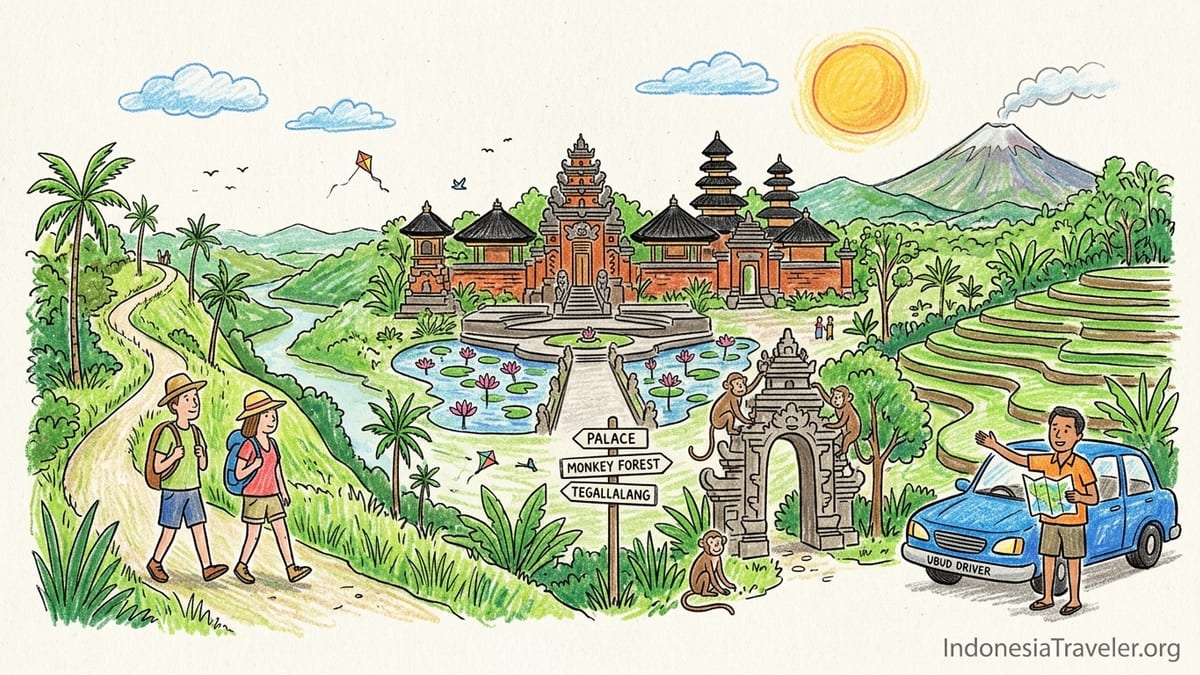
On the map, Ubud looks compact. In reality, narrow village roads, one-way systems, ceremonial processions and ride-hailing pickup restrictions can turn a five-kilometre hop into a forty-minute crawl. The key to a satisfying Ubud visit is not squeezing in the maximum number of sights, but choosing one well-located base and grouping experiences by area so that you spend more time walking through rice fields and courtyards than sitting in traffic. The following three and five day itineraries use realistic driving times, verified opening hours where available, and room in the day for rest, rain showers and the occasional temple ceremony that pauses everything.
Choosing a Practical Ubud Base and Getting Around
For a short stay it is far easier to pick one base in central Ubud and explore outwards, rather than changing hotels every night. A practical compromise is anywhere within about a fifteen-minute walk of Ubud Royal Palace, bounded roughly by Jalan Raya Ubud, Jalan Monkey Forest and the quieter lanes such as Jalan Bisma or Jalan Kajeng. From here you can walk to Campuhan Ridge, the palace, Saraswati Temple and the Monkey Forest on different days, and meet drivers easily on the main roads when you head out to the countryside.
Traffic is the main reason to cluster your days by direction. A straight-line distance of 6 kilometres from central Ubud to Tegallalang can take fifteen minutes at 7.30 a.m., but forty-five minutes or more after 10 a.m. when tour buses and motorbikes crowd the single-lane roads. Similar delays happen on the way to Goa Gajah or the southern workshops around Batuan. When planning, assume average driving speeds of about 20 to 25 kilometres per hour around Ubud and less on market days or during big ceremonies.
For the inner Ubud area, walking and short taxi hops are sufficient. For outer temples and terraces, most visitors hire a private driver with car. Recent checks with Ubud-based operators and long-term residents suggest a fair rate in late 2026 for an 8 to 10 hour private driver day is around 600,000 to 900,000 rupiah per car, depending on vehicle size and distance, with fuel and parking usually included. You still pay your own entrance fees and meals. It is common to book a driver for at least two countryside days if you are staying three to five nights.
Ride-hailing apps such as Grab and Gojek technically operate in Ubud, but local regulations and community agreements mean pickups inside certain streets, particularly around the central market and palace, can be restricted. Many hotels will explain where the designated pickup points are. For early starts or evening performance returns it is more reliable to arrange a specific driver through your accommodation or a recommended local contact than to rely on on-demand rides.
Day 1: Central Ubud on Foot – Ridge, Palace and Evening Dance
Begin your first morning with the Campuhan Ridge Walk before the heat builds. The trail starts near the small bridge by the Warwick Ibah area on Jalan Raya Ubud and follows a paved path across a low ridge flanked by valley views and tall grass. There is no entrance fee, and walking a gentle out-and-back section of about four kilometres takes roughly 60 to 90 minutes at a relaxed pace with photo stops. Bring water, sun protection and good shoes; there is little shade in the middle section, but a handful of cafes near the village end offer coffee or a light breakfast.
Late morning, walk back into town for Museum Puri Lukisan, one of Ubud’s most established art museums a few hundred metres west of the Royal Palace. Recent information from Indonesian cultural authorities indicates the museum opens daily around 9 a.m. and closes mid-afternoon; admission for international visitors is typically in the range of 80,000 to 100,000 rupiah, sometimes including a simple drink in the garden cafe. Inside, galleries showcase Balinese painting and woodcarving from the 1930s onwards, with calm courtyards that are a welcome break if a tropical rain shower passes through.
From the museum, it is a short walk to Ubud Royal Palace, still the symbolic heart of the town. Entry to the outer courtyards is generally free during the day unless preparations are underway for a ceremony, when access can be restricted and the family compound becomes busy with offerings and gamelan rehearsals. Directly behind the palace on the north side is Pura Taman Saraswati, commonly called Saraswati Temple, with its lotus pond framed by carved red-brick gateways. Visitors usually enter the outer area of the temple complex without charge, though inner sanctums remain off-limits except during prayer, and respectful dress covering shoulders and knees is expected.
Plan an unhurried lunch in central Ubud rather than rushing in and out of multiple attractions. Within a five to ten minute walk of the palace, you will find everything from inexpensive warungs serving nasi campur for under 60,000 rupiah per plate to midrange cafes where a main course and drink run closer to 150,000 rupiah. This midday pause also builds in space for unpredictable events, such as a brief street procession when a family carries offerings to a nearby temple, which can momentarily block traffic but offer a memorable glimpse of local life.
In the evening, return to the palace area or Saraswati Temple for a traditional dance performance. Several troupes perform Legong, Barong or other dances on a rotating schedule, typically starting between 7 p.m. and 7.30 p.m. Tickets are usually sold in the afternoon and early evening at simple desks near the venue gates for around 100,000 rupiah per person. Programmes and nights can change at short notice if the temple is needed for a ceremony, so check the current schedule with your accommodation that morning or consult the ticket sellers in person earlier in the day. For a stress-free evening, arrive 20 to 30 minutes before the show to choose a seat, then walk back to your hotel through the cooler night streets.
Day 2: Tegallalang, Tirta Empul and Gunung Kawi
Day two focuses on the northeast, using a private driver for the day to connect Ubud with Tegallalang rice terraces and the ancient temples of the Tampaksiring area. Ask your driver to pick you up by 7.30 or 8 a.m. at your hotel so that you reach Tegallalang before the busiest period. Driving time from central Ubud is usually around thirty minutes in light traffic, but it can lengthen after 9 a.m. when tour buses arrive.
Entrance fees at Tegallalang are collected at small booths along the road and can vary slightly depending on the section you access. Recent reports in 2026 suggest formal entrance charges around 20,000 to 25,000 rupiah per person at main access points, with farmers or local guardians sometimes requesting smaller contributions of 10,000 to 20,000 rupiah at certain paths and bridges. You can spend an hour or more walking down into the terraces and across to the quieter far side. Wear shoes you do not mind getting muddy, and be prepared for uneven steps and short climbs on the way back up. Early morning light is soft, and cafes along the ridge serve simple breakfasts and coffee overlooking the paddies.
From Tegallalang, continue by car toward Tirta Empul, a major water temple in Tampaksiring. The drive is about thirty minutes along narrow, winding roads. At the entrance, international visitors currently pay in the region of 50,000 rupiah per adult, which includes the use of a simple sarong if you plan to enter the temple or take part in the purification pools. The core of Tirta Empul consists of clear spring-fed pools where Balinese Hindus and visitors line up to bathe under stone spouts in sequence. If you choose to participate, allow at least 60 to 90 minutes to change, queue, and complete the ritual respectfully. If you prefer to observe, pathways around the pools and inner courtyards still offer a rich cultural experience.
After Tirta Empul, many visitors continue ten minutes down the road to Gunung Kawi Temple, the 11th century royal memorial complex carved into steep cliffs above a river. Parking is above the site, and you descend by stone stairs lined with souvenir stalls. Guides and recent guides to the site agree that you should expect around 300 steps down to the main temple area and then back up, which can be taxing in midday heat. Entrance for foreign visitors is usually similar to Tirta Empul, around 50,000 rupiah, with a sarong included or required. Allocate at least ninety minutes for the visit, more if you take frequent breaks or explore side paths along the river.
Lunch can fit in either between Tirta Empul and Gunung Kawi at one of the simple local warungs along the road, where you might pay 30,000 to 60,000 rupiah for a plate of mie goreng and a cold drink, or after completing both temples at a countryside cafe as you head back toward Ubud. Eating between stops keeps your schedule flexible in case a ceremony temporarily restricts access at one of the temples; in such cases, your driver will normally suggest adjusting the order or spending extra time at the other sites.
Adding Goa Gajah, the 9th century complex with its carved demon-mouthed cave and bathing pools, is only realistic if you leave Ubud early and move efficiently through the earlier stops. Goa Gajah lies southeast of Ubud; detouring there from Gunung Kawi adds around forty minutes of driving plus at least forty-five minutes on site. By late afternoon, traffic between the Goa Gajah area and Ubud can be slow. As a rule of thumb, if it is already 3 p.m. when you finish Gunung Kawi, it is wiser to skip Goa Gajah for another trip and return directly to Ubud, perhaps stopping for a coffee or early dinner on the outskirts rather than arriving exhausted after dark.
Day 3: Monkey Forest, ARMA and Village Calm
Day three returns to a slower rhythm within and just south of Ubud. Start with the Sacred Monkey Forest Sanctuary at the southern end of Jalan Monkey Forest. It opens from morning until late afternoon, and current ticket prices for international adults are generally in the 80,000 to 100,000 rupiah range, payable at official ticket booths near the entrance. The sanctuary is both a nature reserve and temple complex, home to hundreds of long-tailed macaques. Staff regularly remind visitors to secure loose items such as sunglasses and phones; feeding the monkeys with outside food is not allowed, but you may see staff-controlled feeding in dedicated areas.
A loop through the forest’s three main temple courtyards and ravines typically takes 60 to 90 minutes if you stop for photos and watch the macaques’ social behavior. The paths are paved but can be slippery after rain. Light showers are common in the greener months, and the canopy often provides enough cover to keep walking. If a heavy downpour starts, small shelters near the bridges and temples offer short-term refuge until it passes.
From the Monkey Forest, either walk or take a short ride to the ARMA Museum and resort complex, located a few minutes’ drive further south. The Agung Rai Museum of Art houses traditional and contemporary Balinese works in a lush garden setting and often hosts gamelan rehearsals or dance lessons in its open pavilions. Entrance fees for visitors are usually above those of smaller museums, roughly in the range of 150,000 rupiah, reflecting the size of the grounds and the inclusion of occasional cultural activities. Plan at least ninety minutes here to wander the galleries, watch any practice sessions happening that day, and enjoy a coffee in the on-site cafe while listening to the soundtrack of fountains and distant traffic.
In the afternoon, shift from central attractions to a quieter rice-field or craft-village experience. One easy option from central Ubud is to walk out along one of the semi-rural lanes, such as Subak Juwuk Manis from Jalan Kajeng or the Sayan terraces west of town, where you can stroll between paddies, stop at small organic cafes, and watch farmers tending their fields. If you prefer crafts, consider hiring a driver for a half-day to visit a genuine painting workshop in Batuan village south of Ubud, known for its detailed black-and-white and color paintings. Many family compounds display works in simple galleries attached to the home; you can observe artists at work, discuss commissions and purchase directly, usually without the pressure of large tourist buses.
Whichever option you choose, aim to be off the roads before the busiest early evening period when commuters, school pickups and ceremonies all converge. A relaxed dinner back in central Ubud, perhaps followed by a stroll along Jalan Hanoman or Jalan Dewi Sita, rounds off your three-day core experience.
Extending to 5 Days: Western Countryside or Shorter Agricultural Route
If you have five nights, add one countryside day that explores Ubud’s western and northwestern landscapes. The more ambitious option is a full-day loop north toward Jatiluwih, the UNESCO-recognized rice terraces. From Ubud, expect a drive of about ninety minutes to two hours each way, depending on traffic through the Bedugul region. At Jatiluwih, a village-run ticket system manages entry; recent official information indicates foreign visitor fees in the vicinity of 40,000 to 50,000 rupiah per person, plus a small parking charge for cars. In return you get access to a network of well-marked walking trails across a vast, living rice landscape with far fewer crowds than Tegallalang.
Plan to spend at least three hours at Jatiluwih walking one of the medium-length circuits, stopping at simple warungs for fresh coconut or fried rice. Paths are a mix of paved and earthen tracks, and the area can be misty or rainy in the afternoons, so a light waterproof jacket is useful. From here, many drivers route back toward Ubud via Taman Ayun Temple near Mengwi, which sits about an hour south of Jatiluwih. Taman Ayun’s manicured gardens and moat-surrounded shrines make it a pleasant late-afternoon stop. Entrance fees for international visitors are reported in the 30,000 to 50,000 rupiah range. Allow about an hour on site before continuing back to Ubud, which can take another 45 to 60 minutes.
If Jatiluwih feels too far for your energy levels or you are traveling with younger children, a shorter agricultural loop can deliver a similar sense of Bali’s working countryside without the long drive. One route heads west from Ubud through small villages and cocoa or coffee plantations, stopping at a local coffee garden rather than a high-pressure tasting complex. Another possibility is to ask your driver to combine a low-key terrace walk in the Payangan area with a stop at a community-run agro-tourism project where you can see how spices, fruits and rice are grown. Expect total driving times of 60 to 90 minutes spread across the day, leaving more room for long lunches in family-run warungs overlooking the fields.
For either version of the countryside day, hiring a private driver is the most practical option. Because the routes involve steep secondary roads, infrequent public transport and patchy mobile coverage, self-driving is not recommended for first-time visitors. Confirm with your driver in advance whether the day rate covers all tolls and parking, and clarify how long you will have the car. It is polite to offer to pay for the driver’s simple lunch if you are stopping at a restaurant that does not provide staff meals.
Day 5 Options: Kintamani Views or a Slower Cultural Day
By day five you may either be ready for a dramatic volcanic landscape or prefer to slow down and enjoy Ubud’s gentler cultural side. Treat these as alternatives rather than trying to fit both into one day.
For a Kintamani and Mount Batur viewpoint day, arrange an early pick-up, especially if you hope to catch clearer morning views before clouds gather. From central Ubud to the standard Kintamani ridge viewpoints overlooking Mount Batur and its crater lake usually takes 60 to 90 minutes by car. Upon entering the Kintamani area, visitors are often asked to pay a regional ticket at roadside checkpoints. Charges can vary and are sometimes bundled into cafe or restaurant minimum spends, so it is worth asking your driver in advance where they plan to stop and how payments work at that viewpoint.
Most travelers combine a Kintamani viewpoint with a relaxed lunch at a restaurant on the ridge, where buffet or a la carte meals with lake views might cost between 150,000 and 250,000 rupiah per person excluding drinks. If you are not hiking Batur at dawn, you can spend a late morning and early afternoon here, then descend via quieter back roads, perhaps stopping at a coffee plantation or small temple on the way back to Ubud. The higher altitude means temperatures are cooler than Ubud, so bring a light layer.
The slower alternative is to keep day five entirely within the Ubud area and focus on museums, cooking and crafts. You might revisit Museum Puri Lukisan if you skimmed some galleries on day one, or add another small museum such as the Neka Art Museum north of town, which houses painting collections in leafy grounds. Late morning or afternoon can be devoted to a Balinese cooking class, many of which include a short visit to the local market followed by a hands-on session preparing dishes like sate lilit and gado-gado. Prices for group classes often fall somewhere between 400,000 and 700,000 rupiah per person depending on duration and what is included.
In between, leave unstructured time for browsing small independent shops, booking a short massage or simply sitting in a cafe that looks out over a ravine. This deliberately slower fifth day can be valuable if earlier countryside days were full and you are preparing for onward travel.
One-Day Version from Sanur: What You Must Omit
Not everyone can spare three or five nights in Ubud. If you are based in Sanur and considering a single day trip, it is important to be realistic. Driving between Sanur and central Ubud generally takes around 60 to 90 minutes each way, longer in peak hours or if roadworks and ceremonies divert traffic. That means a full-day excursion still gives you perhaps five to six useful hours in the Ubud area, which is not enough to cover every highlight described above.
For a one-day Sanur to Ubud outing, choose either a central Ubud and culture focus or a rice-terrace and temple focus, but not both. A central focus could combine the Campuhan Ridge Walk in the cooler part of the day, a visit to Museum Puri Lukisan, time at the Royal Palace and Saraswati Temple, and an early dinner before returning to Sanur. You would omit the Monkey Forest, outer temples like Tirta Empul and Gunung Kawi, and any western countryside routes. This option involves more walking and less time in the car once you reach Ubud, which can be more satisfying if you dislike long road segments.
The alternative is to concentrate on Tegallalang and one major temple area, typically Tirta Empul, with just a short stop in central Ubud for a meal. In this configuration, you would likely leave Sanur by 7 a.m., reach Ubud around 8.30 a.m., continue directly to Tegallalang and Tirta Empul with a simple countryside lunch, then make a brief late-afternoon stop near the palace for a look at the town before driving back to Sanur. You would miss Gunung Kawi, Jatiluwih, Kintamani and most inner-Ubud cultural sites. Because evening traffic returning toward the south can be dense, many drivers prefer to leave Ubud by 4 or 5 p.m. for a same-day round trip.
Whichever focus you choose, arrange a private driver from Sanur for a clear flat day rate that covers all the driving required, and confirm in advance that they are comfortable navigating Ubud’s central restrictions and parking rules. A multi-stop itinerary on mixed main and village roads will generally cost more than a simple airport transfer but less than booking multiple separate tours for each attraction.
The Takeaway
Ubud rewards the traveler who slows down. Staying three to five nights in or near the center allows you to walk to key sites, return to your room during midday heat or sudden rain, and adjust your day when a local ceremony briefly closes a temple or a dance troupe changes their schedule. Instead of treating Ubud as a photo checklist, you have time to notice small things: the pattern of offerings along a lane, the way mist rolls over a ridge at dusk, or how daily life continues just behind the tourist-facing storefronts.
Repeated long-distance day trips, by contrast, often mean starting and ending the day in traffic, eating rushed meals at highway restaurants and bundling several major temples or terraces into one exhausting blur. By choosing one practical base, hiring a driver only for the days when you genuinely need one, and clustering your routes sensibly, you balance the famous sights of Tegallalang, Tirta Empul and the Monkey Forest with less heralded but equally meaningful experiences in galleries, workshops and quiet rice fields.
A thoughtfully planned three-day stay covers central Ubud, the northeast temples and a taste of village calm. A five-day visit adds either wide western landscapes or volcanic vistas and a full cultural or culinary day. In both cases, you leave Ubud with memories of early-morning ridges and evening gamelan rather than the feeling of having commuted through your holiday. That is the real advantage of treating Ubud as a short stay base rather than a distant day-trip target.
FAQ
Q1. How many days should I spend in Ubud for a first visit?
Three full days is enough for central Ubud, the main rice terraces and at least one major temple day, while five days lets you add a western countryside loop or Kintamani without rushing.
Q2. Is it better to hire a private driver or rely on ride-hailing apps?
For countryside days to Tegallalang, Tirta Empul, Gunung Kawi, Jatiluwih or Kintamani, a private driver is more reliable and often better value than multiple ride-hail journeys, especially given pickup restrictions in central Ubud.
Q3. How much should I budget per day for transport in Ubud?
For days mostly on foot in central Ubud, local taxis and occasional short rides may cost the equivalent of 100,000 to 200,000 rupiah. On countryside days, expect 600,000 to 900,000 rupiah per car for a full-day private driver, shared among your group.
Q4. What are typical entrance fees for major Ubud-area temples and sites?
In late 2026, most larger temples and attractions around Ubud charge foreign visitor fees in the range of 30,000 to 100,000 rupiah per adult, with the Monkey Forest and ARMA at the higher end and sites like Taman Ayun and some smaller temples at the lower end.
Q5. Are there dress codes I should follow at Balinese temples?
Yes. Both men and women should cover shoulders and knees, and wear a sarong and sash where required. Many temples provide or rent sarongs near the entrance, sometimes included in the ticket price, but carrying your own lightweight sarong is convenient.
Q6. How physically demanding is Gunung Kawi, and can I skip it if I have mobility concerns?
Gunung Kawi involves roughly 300 stone steps down to the river and back up, which can be challenging in heat or if you have knee issues. If that sounds too demanding, you can focus on Tirta Empul, Goa Gajah or flatter temple complexes and still enjoy rich cultural experiences.
Q7. What is the best way to avoid crowds at Tegallalang Rice Terrace?
Arrive early, ideally before 9 a.m., and walk beyond the main viewpoint into the deeper terraces, where foot traffic thins out. Late afternoon is another option, but light showers are more likely then, especially in wetter months.
Q8. Can I visit Kintamani and Jatiluwih on the same day from Ubud?
It is technically possible, but the combined driving and time on site usually make for a long, tiring day. Most travelers are better off dedicating one day to Jatiluwih and Taman Ayun, and treating Kintamani and Mount Batur viewpoints as a separate option if they have an extra day.
Q9. Is a one-day trip from Sanur to Ubud worthwhile?
A single day from Sanur can be rewarding if you focus either on central Ubud or on one rice terrace and temple combination. You will need to accept that many highlights, such as Jatiluwih, Kintamani or several museums, will not fit into the schedule.
Q10. What should I do if a temple or performance is closed for a ceremony?
If you arrive to find a closure or performance cancellation due to a ceremony, treat it as part of Ubud’s living culture. Ask your driver or a staff member for an alternative plan for that afternoon, whether another nearby temple, a museum, or a quieter village walk, and consider returning another day if your schedule allows.