


I went to Ubud for what Instagram promises everyone: a week of affordable yoga, gentle rice field walks, maybe a melukat water blessing, and a reset that would cost less than a Western city retreat. What I found instead was a polished wellness machine where spiritual language and soft-lit photos often masked hard commerce, and where the difference between a simple guesthouse-plus-classes and an all-inclusive retreat could mean hundreds of unnecessary dollars.
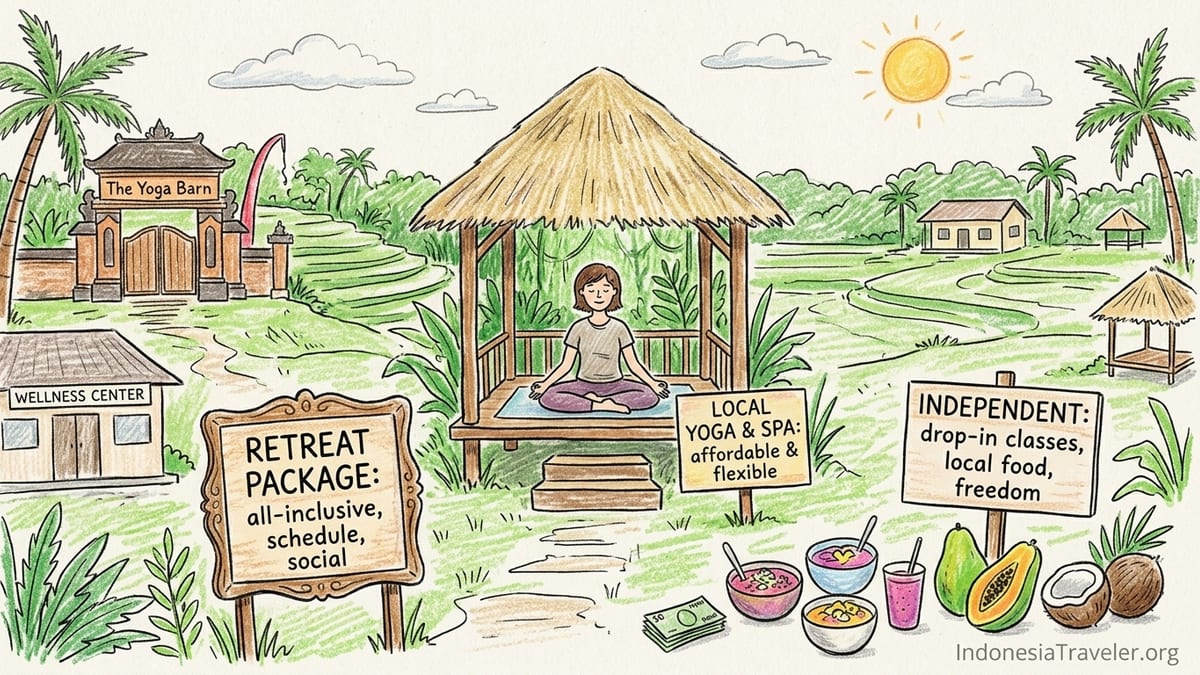
Why I Chose Ubud, And What I Thought I Was Buying
Ubud’s reputation reaches far beyond Bali. Friends back home talked about it as a global center of yoga and healing, somewhere you could practice twice a day, eat well, meet people, and still spend less than a mid-range city break. Guidebooks repeat the same story: smoothie bowls, ecstatic dance, jungle spas, and a feeling that life is lived at a more conscious pace. With that image in mind, I booked a modest guesthouse in Nyuh Kuning, walking distance to central Ubud, and set aside a clear budget to see what Ubud’s wellness scene actually delivers once you are on the ground.
My plan was simple. I would structure my days around The Yoga Barn, Ubud’s biggest and most marketed yoga complex, then fill the gaps with other studios and one-off treatments. I did not sign up for anything I did not personally attend. Every price here is either what I paid in Indonesian rupiah (IDR) or what was quoted to me when I walked in or messaged the venue. Where the price lists changed during my stay, I use the most recent posted rate at the time of writing.
What I wanted was not a spiritual awakening so much as clarity. Does Ubud still offer good-value yoga and meditation, or has spiritual branding simply become the latest way to charge Western resort prices in Southeast Asia?
Not All Yoga Is Comparable: Classes, Passes, Retreats And Trainings
One of the first traps in Ubud is treating all yoga offers as interchangeable. A drop-in class, a multi-class pass, a residential retreat, a teacher training, a meditation course, and a private treatment sit on the same bulletin boards, but they are not the same product. Comparing them by a simple per-night or per-day price misleads travelers and quietly benefits the higher-margin packages.
At The Yoga Barn, a single regular group class is currently listed at 180,000 IDR, with multi-class options at 495,000 IDR for three classes, 780,000 IDR for five, 1,500,000 IDR for ten, and 3,300,000 IDR for a 30-day unlimited pass. These rates are publicly posted and widely referenced in recent price comparisons across Bali. That sliding scale works out to roughly 165,000 IDR per class on a three-class card, 156,000 on a five-class card, and as low as the equivalent of a few tens of thousands of rupiah per class if you attend twice daily on an unlimited month.
Now place that beside other real studios. Soul Yoga Bali, tucked among rice paddies not far from central Ubud, was charging 150,000 IDR for a drop-in as of this month. Radiantly Alive, another of Ubud’s large hubs just off Jalan Jembawan, lists drop-ins in the same 160,000 to 170,000 IDR band that island-wide price trackers now treat as standard. Smaller studios in Penestanan and along the western ridge, such as Alchemy Yoga Center and Intuitive Flow, cluster in a similar zone according to recent neighborhood guides, often quoting the equivalent of roughly 130,000 to 180,000 IDR depending on the length and type of class.
These are all group classes you walk into in your own clothes, with your own accommodation and meals handled separately. Once you step into residential territory, the equation changes completely. Retreats roll in a bed, two or three daily meals, occasional excursions, workshops, and soft items such as “intention setting” or “sharing circles.” Teacher trainings add accreditation requirements and at least 200 hours of contact time spread over three to four weeks. Meditation courses may have no asana at all, but strict daily schedules. Individual treatments sit apart again: 90 minutes with a bodyworker or healer at a price that can exceed an entire day of group classes.
Ubud’s marketing culture often compresses all of this into the vague phrase “from 150 dollars per night” without clarifying the percentage that actually buys you time on the mat. My week made it clear that if you want yoga itself, the most efficient way to buy it in Ubud is still as individual classes or modest passes, not bundled into glossy residential packages.
Using The Yoga Barn As A Benchmark, And How Other Studios Compare
Because The Yoga Barn dominates so many online searches and influencer posts, I used it as my pricing benchmark. I attended three regular yoga classes there: an all-level vinyasa, a yin session in the afternoon, and a large morning flow packed with more than forty people. I paid 495,000 IDR for a three-class card, matching the publicly advertised rate. Per hour of instruction, this felt fair by international standards, but the extra charges started as soon as I looked beyond straight yoga.
The same venue’s wellness menu features everything from deep tissue massage to “energy healing” and premium named sessions that run into the millions of rupiah. A standard one-hour massage or body treatment often sat in the 600,000 to 1,000,000 IDR bracket before tax and service, while specialist two to three-hour healing experiences could reach several million rupiah per session. This is spa-level pricing in a country where an independent therapist a short walk away might charge less than a quarter of that for a solid, no-frills massage.
In contrast, Soul Yoga Bali’s offering the morning I visited was stripped back: simple shala, good teacher, no vast wellness complex around it. I paid 150,000 IDR in cash at the desk and left without being offered any packages framed as “transformational.” Intuitive Flow, above the village of Penestanan, charged a similar amount for a gentle hatha class in an airy upstairs space open to the valley. Radiantly Alive, closer to the center and clearly aiming for a polished international feel, was again in the 160,000 to 170,000 IDR bracket for group classes, with multi-class passes bringing the unit cost down in the same way as at The Yoga Barn.
The pattern emerged quickly. Across Ubud, a single regular yoga class at an established studio currently costs somewhere in the region of 130,000 to 180,000 IDR. Fancier branding, more central locations and large wellness campuses push you toward the top of that band. Intimate neighborhood studios and places a ten or fifteen minute walk from the main roads drift toward the lower end. When I compared those prices with the per-class cost baked into several Ubud retreat packages, the markup was hard to ignore.
What Residential Retreats Really Include, And Where The Numbers Hide
During the same week, I priced up a series of residential options I could hypothetically have chosen instead of my guesthouse-plus-drop-ins approach. Several Ubud yoga retreat operators promote 5 to 7 day programs with two daily yoga sessions, meditation, a spa treatment or two, and airport transfers, starting from what worked out at the equivalent of 2,000,000 to 3,500,000 IDR per night once converted from foreign currency quotes.
Looking at what those fees included, the core elements were similar. Accommodation was almost always in mid-range rooms with air conditioning and private bathrooms, sometimes in small boutique resorts, sometimes in upgraded guesthouses. Meals ranged from “daily breakfast” to “three plant-based meals per day,” with juices, coffee, or tea more commonly available at extra cost. Most programs offered one or two excursions, often to nearby rice terraces or a temple, along with an included massage and at least one group workshop that might be framed as breathwork, sound healing, or a talk about Balinese culture.
Group sizes were rarely spelled out clearly. One retreat advertised “intimate groups” while acknowledging in the fine print that peak weeks could run with up to 18 or 20 participants, a very different dynamic from the image of a small circle sharing feelings by candlelight. Cancellation policies, too, varied widely. A handful of operators offered partial refunds up to 30 days before arrival, others held on to deposits completely unless they managed to resell the bed. Several required 50 percent or more of the fee in advance, with balance due weeks before you ever stepped on a plane.
Teaching qualifications were another gray area. Some programs were transparent, listing lead teachers with Yoga Alliance-registered 500-hour training, clear specializations, and links to longer bios. Others leaned on the language of “intuition” and “natural born healers” without giving verifiable training history. On at least two retreat websites, I had to dig deep to find out whether meditation sessions were led by experienced practitioners or simply the same asana teacher reading aloud from a script after class.
None of this is inherently exploitative. People need to be paid for their work, and a retreat with a limited number of rooms must cover fixed costs. The problem is how often Ubud marketing glosses over the breakdown. You see a headline price per night and soft-focus images, but not how much of that fee you are effectively paying for a bed, a simple vegetarian buffet, and logistics that a reasonably confident traveler could arrange in ten minutes with a messaging app.
Hidden Geography Costs: Hanoman Versus The Hills
Where you stay in and around Ubud quietly shapes the true price of wellness. My guesthouse in Nyuh Kuning cost 400,000 IDR per night for a clean room with breakfast, fan, and Wi-Fi. From there I could walk to The Yoga Barn in about fifteen minutes and reach several central studios or cafes within twenty. A simple local lunch rarely cost me more than 40,000 to 60,000 IDR, and when I took a taxi across town, standard fares for short hops clustered around 40,000 to 60,000 IDR one way.
Compare that to resorts in Sayan, Payogan, or Tegallalang that heavily market yoga and wellness escapes. These areas are beautiful, with jungle ravines and rice terraces, but they are not practical bases if you hope to attend multiple independent classes per day without riding a scooter. From one hillside property I visited in Sayan, it took nearly twenty minutes by car to reach central Ubud. The resort’s own shuttle ran at limited times. Outside those windows, guests relied on private drivers or ride-hailing apps starting at about 80,000 to 120,000 IDR per trip depending on traffic and timing.
One wellness hotel north of Tegallalang quoted me 1,800,000 IDR per night for a package that included daily yoga in-house, breakfast, and a single 60-minute massage during a three-night stay. There was no walkable access to independent studios or budget food stalls. Every extra class or cafe meal meant another car ride down and up the hill. Over a week, those trips would quietly add at least several hundred thousand rupiah in transport alone, on top of already elevated room rates.
In other words, a guesthouse just off Jalan Hanoman or in Nyuh Kuning keeps your real costs closer to the sticker price of classes and meals. A remote jungle villa with spectacular views but no sidewalks turns yoga into a premium product not because classes are inherently better, but because every step outside becomes a paid journey. Retreat marketing rarely highlights this. My own experience made me suspicious of any “secluded sanctuary” language that did not mention whether you could safely walk anywhere or if you were effectively tethered to the in-house schedule and restaurant.
Guesthouse Plus Drop-Ins Versus Retreat Package: My Actual Spend
Over seven nights, I spent 2,800,000 IDR on accommodation at my Nyuh Kuning guesthouse. I used The Yoga Barn’s three-class pass plus three additional drop-ins at other studios, bringing my total yoga class bill to just over 1,300,000 IDR. I booked two mid-range massages at small independent spas, paying 200,000 to 250,000 IDR each. Local meals, coffee, and occasional rides across town added roughly another 1,500,000 IDR over the week.
All in, my wellness-focused week came to around 5,800,000 IDR before flights. That bought me six yoga sessions at high-quality studios, two massages, daily cafe time, and the flexibility to skip classes when I was tired without feeling I was wasting prepaid credits. If I doubled my class attendance by purchasing a ten-class card at The Yoga Barn and filling the rest of my week at Soul Yoga Bali or Intuitive Flow, the total would still likely land under 7,500,000 IDR.
By contrast, a seven-day Ubud yoga retreat I considered before traveling advertised prices equivalent to roughly 21,000,000 to 24,500,000 IDR for a shared room in a mid-range property near central Ubud. The program included twice-daily yoga, daily breakfast and lunch, one group dinner, an airport pickup, one excursion, and a 60-minute massage. On paper, that seemed reasonable compared with Western retreat prices. When I mapped it onto what I had just lived through on my own terms, the math became stark.
Even if I matched their daily yoga volume by taking twelve studio classes instead of six, added several more massages, and upgraded my meals to higher-end restaurants every day, my independent budget would likely still come in several million rupiah under the retreat price. What the extra money truly buys is curation and structure: a fixed group, a set schedule, and the removal of decision-making. That has value for some travelers. My concern is that in Ubud, this is routinely wrapped in the language of “transformation” and “ancient wisdom” in ways that obscure the simple fact that you are paying several hundred dollars for organization and social comfort, not for a higher caliber of yoga instruction.
Questionable Claims: Detox, Healing And The Melukat Myth
Beyond pricing, Ubud’s wellness economy has a more serious problem: health claims that float well beyond what evidence supports. In my week on the ground, I saw multiple flyers, blackboards, and websites promising “cellular detox,” “trauma release,” and help with chronic illnesses through sound healing, intense breathwork, or short-term fasting. Some venues were careful to present these as supportive practices and clearly stated that they were not substitutes for medical care. Others were much looser, casually implying that a few sessions with a healer or a particular ceremony might resolve complex conditions.
At one popular center, a detox program framed itself around colonics, juices, and very low-calorie days, accompanied by yoga and meditation. Nowhere on the marketing material did I see clear mention of potential risks for people with metabolic issues, eating disorders, or certain medications. Several testimonials quoted on the walls described relief from serious diagnoses in ways that would never pass scrutiny in a regulated medical setting. As a visitor, you could easily be forgiven for thinking that “Bali detox” has a proven track record against illnesses that, in reality, require long-term care.
Sound healing and breathwork sessions were another gray area. I attended one group sound bath that was soothing and beautiful, with gongs and crystal bowls filling a packed wooden shala. The facilitator spoke about stress reduction and nervous system regulation, which is fair enough. But I also heard other practitioners around town speak casually about “curing depression” or “releasing trauma from the cells” in a single afternoon made up of intense breathing techniques. There is no credible scientific basis for such sweeping claims. Movement, breath awareness, and community can support mental health, but they do not replace therapy, medication, or professional treatment.
The line blurs further when it comes to melukat, the Balinese Hindu water purification ritual often performed at Pura Tirta Empul. Melukat is first and foremost a living religious practice for Balinese Hindus, part of a complex spiritual system with its own theology and etiquette. Local pilgrims visit Tirta Empul and other holy springs to cleanse and pray, not to tick off a wellness bucket list item. Tourism materials increasingly frame melukat as a “healing” or “detox” experience for visitors, sometimes sold as part of retreat packages with promises of energetic cleansing and life resets. During my visit, I was uncomfortable watching groups of foreigners treating the ritual primarily as a photo opportunity, lining up for selfies in the pools.
It is entirely possible to participate respectfully, guided by a local priest or knowledgeable facilitator who explains the religious meaning and sets realistic expectations. What it is not is a guaranteed wellness treatment that washes away trauma or disease. Any retreat that markets melukat as a kind of spiritual spa service, without centering its Balinese Hindu context or acknowledging that its main purpose is religious, is not just overselling. It is participating in a form of cultural packaging that turns a sacred practice into a consumable product.
Five Clear Drawbacks I Found, And Who Deserves Credit
After a week of classes, treatments, and retreat shopping, I came away with at least five solid reasons for travelers to be cautious. The first is price inflation. Once yoga is bundled with semi-luxury accommodation, artisanal meals, and wellness branding, nightly rates move far beyond the underlying cost of delivering classes. Where a regular class at an Ubud studio might average around 150,000 IDR, residential retreats can easily work out to the equivalent of ten times that per day in effective class cost once you strip away room and board.
The second drawback is vague credentials. Too many programs introduce “healers” and “space holders” with poetic biographies but no clear training history or code of ethics. Even some yoga teachers on large retreat rosters had only completed a basic 200-hour training very recently, yet were suddenly positioned as experts in trauma-sensitive work, meditation, and lifestyle counseling. By contrast, I appreciated studios that published teacher bios with verifiable training and specific experience rather than mystical job titles.
Third, transport and geography costs creep up quickly in the hills around Ubud. Resort-based retreat guests I spoke with in areas like Sayan and Tegallalang reported feeling effectively trapped within their compound once the shuttle stopped running, or resigned to paying for multiple daily car rides to reach independent cafes and classes. What appears as tranquil seclusion in marketing copy can translate into practical dependence and extra expense in reality.
Fourth, overscheduling is common. Sample retreat itineraries I reviewed squeezed in two yoga classes, meditation, a workshop, an excursion, and sometimes evening sharing circles into a single day. Several past participants I met at cafes admitted they had skipped large parts of their paid program because they were exhausted, but still felt guilty about “wasting” the money. My unbundled week, in contrast, allowed me to rest and adjust my schedule without mental accounting every time I chose not to roll out a mat.
Fifth, cultural packaging sits uncomfortably at the heart of some offers. Balinese rituals, architecture, and dress become aesthetic backdrops for imported wellness trends, sometimes with minimal involvement from local communities beyond service roles. Not all retreat centers fall into this pattern, but enough do that it is worth reading their material closely to see whether Balinese Hinduism and local knowledge holders are engaged as living traditions or merely as props for a global spiritual brand.
To be fair, I also met providers who were transparent and worth supporting. One mid-sized studio I practiced at clearly labeled which classes were led by senior teachers, which by newer ones, and priced them accordingly. Soul Yoga Bali’s straightforward drop-in system and modest studio felt refreshingly unpretentious. A small guesthouse-run shala at the edge of town offered donation-based evening meditation without any grand claims, simply inviting people to sit quietly together. In these pockets, Ubud’s wellness scene felt grounded, affordable, and honest.
A Five-Day Beginner-Friendly Plan That Avoids Common Pitfalls
For travelers eyeing Ubud for the first time, here is a practical five-day structure based on what actually worked for me, designed to sidestep the most common traps. Start by booking a walkable guesthouse near Nyuh Kuning, Jalan Hanoman, or around the southern part of central Ubud. Aim for a nightly rate that leaves room in your budget for classes and food; comfortable options with breakfast can be found around the equivalent of 350,000 to 600,000 IDR per night if you book outside peak holiday dates.
On day one, take a single beginner-friendly class at a major hub like The Yoga Barn or Radiantly Alive to orient yourself. Pay for a three or five-class pass rather than committing to unlimited. Spend the afternoon wandering on foot to locate smaller studios that appeal to you visually; stepping through the shala and checking how staff interact with students tells you more than glossy photos ever will.
On days two and three, build a gentle rhythm: one morning class at a larger center and one later session at a smaller studio such as Soul Yoga Bali, Intuitive Flow, or a guesthouse shala you have scoped out. Leave the midday hours open for rest, reading, or exploring Ubud’s art and food scene. If you want a spa treatment, book a single massage at an independent spa rather than a full detox package. Look for menus that avoid exaggerated health language and present treatments as relaxation or complementary care, not cures.
On day four, if you feel drawn to melukat or another local ritual, prioritize cultural understanding over wellness marketing. Arrange to go with a Balinese guide or through a provider that emphasizes religious context, dress codes, and respectful behavior ahead of time. Treat the experience as a guest entering a place of worship, not as another box on a healing itinerary. In the evening, choose a restorative or yin yoga class instead of chasing another intense transformation workshop.
On day five, let your body, not the schedule, lead. Take whichever class you still feel curious about, then spend the rest of the day digesting your experience rather than rushing to buy more. If a retreat tempts you, sit down with your actual weekly expenses and compare them honestly to the package price. Ask what specific added value you would receive beyond what you have already accessed independently.
The Takeaway: When A Retreat Is Worth It, And When To Walk Away
By the end of my week, I understood both why Ubud keeps drawing wellness travelers and why so many leave feeling slightly overpromised. There is excellent yoga here, accessible teachers, friendly local guesthouses, and spacious shalas open to the breeze. There are also sharply priced retreats, vague health claims, and a tendency to fold religious practices into glossy healing narratives aimed squarely at Western wallets.
Paying for a retreat in Ubud can genuinely add value in some situations. If you are extremely short on time, overwhelmed by planning, or craving the container of a small, well-held group, the right program can remove logistical friction and social awkwardness. If a retreat clearly lists its inclusions and exclusions, publishes teaching credentials, keeps group sizes reasonable, avoids medical claims, and collaborates respectfully with local communities, then its price reflects real extra work behind the scenes.
But if the nightly rate is several times higher than what you can piece together with a guesthouse and drop-ins, if the schedule feels packed to justify the cost, if healing claims creep into territory best left to doctors, or if Balinese culture is reduced to costume and ceremony without context, then you are not paying for wisdom. You are paying for marketing. In those cases, your body, your wallet, and quite possibly your hosts will be better served by simpler choices.
Ubud does not require a lanyard, a bracelet, or a branded retreat tote bag to work its quiet medicine. A clean room within walking distance of a few good studios, a handful of well-chosen classes, one or two honest treatments, and a respectful visit to a temple or spring are enough. The real practice here is not learning a new pose or collecting ceremonies. It is noticing when spiritual language is being used to sell you something you do not need, and having the confidence to walk away barefoot, mat under your arm, into the warm evening air.
FAQ
Q1. Is Ubud still an affordable place to practice yoga?
It can be, if you focus on guesthouses and individual classes. Drop-in prices at reputable studios cluster around 130,000 to 180,000 IDR, which is reasonable for the quality offered, but retreat packages and spa-style treatments can push your daily spend far higher.
Q2. How many yoga classes should I book per day as a beginner?
For most beginners, one class per day is plenty, especially in the heat and humidity. If you feel strong and rested, you might add a second gentle or restorative class, but overscheduling often leads to fatigue and frustration rather than growth.
Q3. Are yoga retreats in Ubud worth the price?
They can be worth it if they clearly break down what is included, use qualified teachers, keep group sizes manageable, and avoid exaggerated healing claims. If a retreat simply bundles standard classes with mid-range accommodation at a large markup, you may get better value by organizing your own stay.
Q4. How do I choose a trustworthy studio or teacher?
Look for studios that publish teacher training backgrounds, explain class levels clearly, and welcome questions about injuries or experience. Visiting in person, noticing how staff greet you, and checking whether adjustments and safety cues are offered in class are often more telling than online reviews alone.
Q5. What hidden costs should I watch for around Ubud’s wellness scene?
Key hidden costs include transport from remote resorts into town, mandatory service charges on treatments at high-end venues, overpriced in-house restaurants when nothing is walkable, and non-refundable deposits for retreats or trainings that you may not be able to recoup if plans change.
Q6. Is melukat at Tirta Empul a wellness activity or a religious ritual?
Melukat is a Balinese Hindu purification ritual and should be approached as a religious practice first. It can feel personally meaningful, but it is not a guaranteed wellness treatment or a substitute for medical or psychological care.
Q7. Are “detox” and fasting programs safe in Ubud?
Short-term fasting or juice programs can feel lightening for some people, but they are not risk-free and should never be treated as cures for serious illness. If you have any medical conditions, you should consult a healthcare professional before joining such a program and be wary of providers that make sweeping health claims.
Q8. Can I experience Ubud’s wellness side without doing a full retreat?
Yes. Staying in a walkable guesthouse, buying a small class pass at a major studio, trying one or two treatments at independent spas, and joining a free or low-cost meditation session will expose you to the heart of Ubud’s wellness scene without locking you into a rigid schedule or large package fee.
Q9. What area should I stay in if I want to walk to yoga studios?
Neighborhoods near Jalan Hanoman, Monkey Forest, and Nyuh Kuning place you within walking distance of several major studios and many cafes. Hillside areas like Sayan, Payogan, or Tegallalang offer beautiful views but usually require paid transport for nearly every class or meal outside your accommodation.
Q10. How can I avoid cultural insensitivity while joining wellness activities?
Dress modestly at temples and rituals, follow local guidance, ask before taking photos, and choose providers who center Balinese voices and explain the cultural context. Treat religious practices as living traditions rather than entertainment or background scenery for your wellness journey.