


I spent seven nights in Seminyak in October 2026 and kept every receipt. What follows is my real-world spending diary, from a simple hotel near Double Six Beach to splurges at Petitenget beach clubs, plus how much I could have saved by choosing different locations and stays.
Where I Actually Stayed and Why Location Mattered
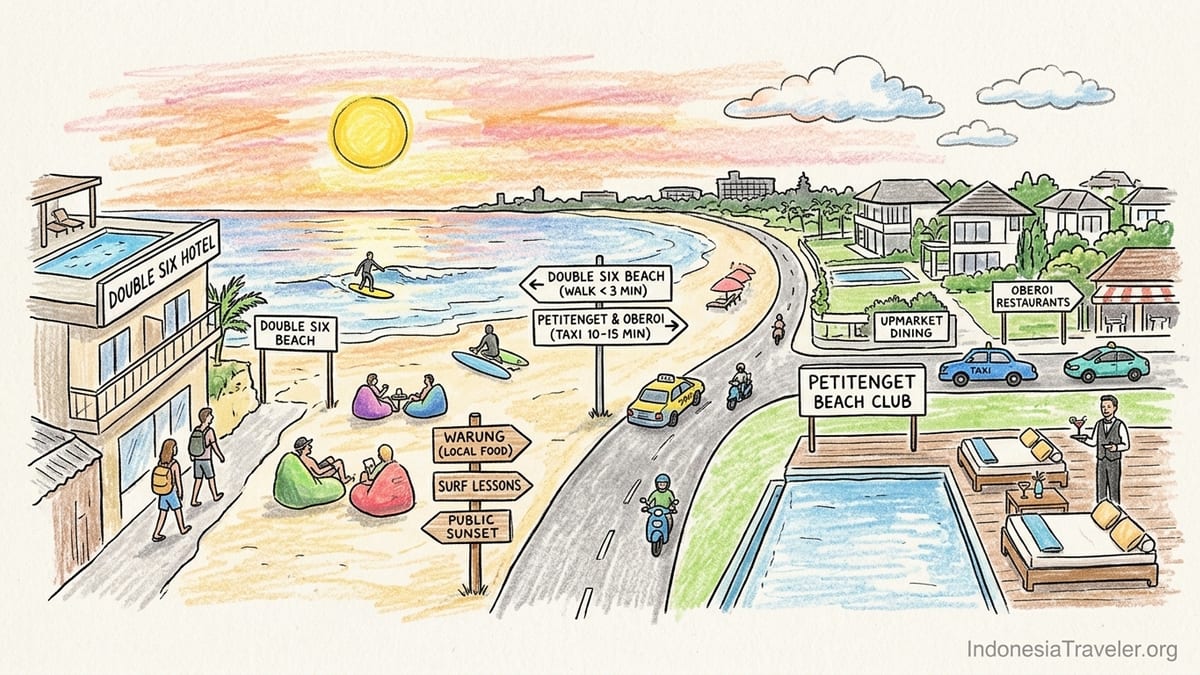
For this Seminyak trip I based myself in the Double Six area, just behind Double Six Beach on a small lane off Jalan Arjuna. It is technically in the wider Seminyak zone but feels like its own pocket, with Legian to the south and Oberoi and Petitenget to the north. I chose it because I could walk to the beach in under three minutes, but I knew it would mean longer taxi rides to Petitenget’s more upmarket restaurants and beach clubs.
I booked a simple but modern mid-range hotel with a small pool and basic breakfast included. For late October 2026, I paid about 1,150,000 rupiah per night for two people, including taxes and service. That was booked on a major online platform about three weeks before arrival. Checking the same dates closer to arrival, walk-in and last-minute app rates were usually 10 to 20 percent higher for comparable Double Six properties.
On 23 October 2026, I ran a fresh search for Seminyak stays for a random set of dates in February 2027 and saw the platform’s median “all-in” nightly rate at roughly 2,491,000 rupiah, once taxes and fees were added back in for the sample of around 400 properties. That figure was clearly labeled as a median of that specific search snapshot rather than an official market-wide average, but it was still useful for context: my 1.15 million rupiah Double Six hotel was sitting well below that mid-range benchmark.
The trade-off showed up in transportation. Being in Double Six meant cheap walks to the sand and Legian restaurants, but most of my dinners and nights out were in Oberoi and Petitenget. That translated into repeated 35,000 to 60,000 rupiah rides in blue Bird taxis or local online ride hailing cars, each only 10 to 15 minutes but adding up over a week.
Understanding the Visa, Levy and Arrival Costs
Before I even reached Seminyak, there were two unavoidable line items that belong in any 2026 Bali budget. The first was the Visa on Arrival. I chose the standard B1 Visa on Arrival, paid at the airport, which in October 2026 cost 500,000 rupiah per person for a 30-day stay, as indicated by Indonesian immigration guidance and recent traveler reports. The second was the Bali foreign tourist levy, introduced in 2024, fixed at 150,000 rupiah per person and payable once per visit to the island, either online through the provincial government system or at a payment desk after landing.
In my case I arrived on a regular tourist passport that required both. I pre-paid the 150,000 rupiah levy online a few days before arrival, then paid the 500,000 rupiah Visa on Arrival fee at Ngurah Rai Airport. That meant 650,000 rupiah in government-related charges before I even cleared immigration. I am including these in my Seminyak budget because virtually every first-time holidaymaker in a similar situation will face the same two costs.
From the airport to Double Six I took an official fixed-fare taxi from the arrivals area. In October 2026, the posted fare to the Seminyak / Double Six area was roughly 200,000 rupiah, including the airport surcharge. An online ride hailing app would have been closer to 120,000 to 150,000 rupiah at that hour of the afternoon, but I chose the simplicity of the taxi counter after a long flight. Door to door, it took about 35 minutes in moderate traffic.
Summing up my “arrival day” costs that actually came out of my wallet, before I had even seen Seminyak Beach I had spent approximately 1,050,000 rupiah: 500,000 for Visa on Arrival, 150,000 for the Bali levy and 200,000 for the taxi, plus a small 200,000 rupiah ATM withdrawal fee charged by my home bank when I took out cash at the airport.
My Real Accommodation Spend vs the Seminyak Median
Over seven nights in Double Six I spent a total of about 8,050,000 rupiah on my mid-range hotel, which breaks down to roughly 1,150,000 rupiah per night. That rate covered a 26-square-metre room, air-conditioning, a small balcony, daily housekeeping, a compact rooftop pool and a simple buffet breakfast of eggs, noodles, fruit and coffee. There was no gym, spa or beachfront access, and the property sat about 250 metres inland along a narrow gang.
Comparing my real costs to the platform snapshot from 23 October 2026, which showed a median all-in nightly rate of approximately 2,491,000 rupiah across Seminyak for mid-February 2027 dates, my spend felt restrained. The sample’s median included everything from simple guesthouses and three-star hotels through five-star beachfront resorts and private-pool villas. It was also just a single-platform median, not an official tourism board statistic or a weighted market average. Still, that 2.49 million rupiah reference number made it clear that my Double Six hotel cost sat closer to the lower half of the mid-range corridor rather than the top.
If I had wanted to match that median, I could easily have moved to a one-bedroom private-pool villa in Petitenget or Oberoi. During my stay I checked two such villas of friends. One Petitenget one-bedroom villa with a small pool and daily breakfast was priced at about 2.6 to 2.9 million rupiah per night for similar October dates. A larger villa closer to Oberoi’s main strip showed rates around 3.3 to 3.7 million rupiah per night, depending on length of stay and cancellation rules.
At the other extreme, I walked past several guesthouses and homestays in the Double Six backstreets that were advertising walk-in rooms from about 350,000 to 550,000 rupiah per night for a fan or basic air-conditioned room with cold or lukewarm showers and no pool. Online searches for similar properties in Seminyak and Legian near Double Six in late 2026 generally showed beds in that same range, sometimes dipping just below 300,000 rupiah outside peak weekends. Staying at that level instead of my 1.15 million rupiah hotel could have cut my accommodation budget by more than half.
Daily Food: From Warung Counters to Sunset Dinners
My food spending swung widely between simple nasi campur and Petitenget sunset dinners, and the location gap mattered. On most days, breakfast was included at the hotel. On the first morning I skipped it and walked to a local warung just inland from Double Six, where a plate of rice, vegetables, tempeh and one chicken skewer cost 35,000 rupiah, with a hot black coffee for 15,000. Including a small tip, breakfast came to 55,000 rupiah, or about a quarter of what I would later spend on a single cocktail at the beach.
Lunches were usually casual. One day I ate at a local Indonesian warung off Jalan Werkudara, where a generous mie goreng with vegetables and egg was 35,000 rupiah and a bottled water 10,000. On another, I tried an international café closer to Oberoi, where an avocado toast with poached eggs cost 95,000 rupiah and a flat white 45,000, plus 15 percent tax and service. That Oberoi brunch came out to roughly 160,000 rupiah once everything was added, about three times my Double Six warung lunch.
For dinner, I alternated between mid-range Indonesian restaurants and more polished Petitenget places. One night on Jalan Camplung Tanduk I ordered chicken satay, a vegetable side and rice at a sit-down Indonesian restaurant. With a large Bintang beer, taxes and service, the bill was around 210,000 rupiah. By contrast, a sunset dinner in Petitenget at a contemporary Indonesian restaurant ran to just over 600,000 rupiah for two mains, one shared starter, a dessert and two cocktails, after service and tax.
Across seven nights, my average daily food spend (excluding breakfast when I used the hotel buffet) landed around 250,000 to 450,000 rupiah on simpler days and closer to 700,000 rupiah on the two evenings when I combined a premium Petitenget dinner with multiple drinks. In total, I spent approximately 3.4 million rupiah on lunches, dinners, snacks and café coffee across a week, not counting the complimentary hotel breakfasts.
Beach Clubs, Sunsets and Real Bar Tabs
Like most first-time Seminyak visitors, I wanted at least one big beach club afternoon. I chose Potato Head in Petitenget for one visit and a more low-key sundowner at a simple beanbag bar near Double Six on another day. The price difference was stark, although both experiences were memorable.
At Potato Head, current information in late 2026 indicated that entry was free earlier in the day, with a redeemable cover charge of roughly 200,000 to 250,000 rupiah introduced in the late afternoon peak window, typically between about 4 pm and sunset, and then higher or separate charges for special events. When I visited for sunset on a weekday, there was a 200,000 rupiah cover at the gate, redeemable against selected drinks. I arrived just after 4 pm and stayed until dark. I used the cover for a gin-based cocktail priced at 185,000 rupiah plus tax and service, paying the small difference in cash. Later I ordered a second cocktail at similar pricing and shared a light snack platter, bringing my personal total, after tax and service, to just under 500,000 rupiah for the evening.
I did not reserve a daybed at Potato Head, as the quoted minimum spend for a prime poolside bed for two people ran to several million rupiah for the afternoon and evening. Those minimum spends are not additional charges but rather the required amount you agree to spend on food and drink to use the reserved seating. Skipping that and using the general seating area kept my outlay closer to what I would have spent at any upmarket bar.
At KU DE TA, another Seminyak institution toward Oberoi, I opted for ordinary walk-in dining rather than booking a minimum-spend daybed. The restaurant was offering sunset-facing tables without a separate entry fee, but cocktails ranged between roughly 170,000 and 220,000 rupiah before tax, with mains at 200,000 to 350,000 rupiah. My individual tab for one main, one shared starter and two drinks came to about 650,000 rupiah including tax and service. Friends who had booked a front-row daybed quoted minimum spends in the low millions of rupiah for a couple, which they could reach easily over an afternoon of food and drinks but which would have pushed my own budget higher than I wanted.
For contrast, I spent one sunset on the beanbags at Double Six Beach, at a basic bar with live acoustic music. There was no admission and no minimum spend. A large Bintang was 45,000 rupiah, a simple cocktail 80,000 rupiah and a plate of fried noodles 45,000 rupiah, all before a modest service charge. My bill that night, with one beer, one cocktail and dinner, was under 200,000 rupiah. It was not as polished as Petitenget’s big-name venues, but it delivered a very similar sky and an arguably more relaxed feel at roughly one-third of the price.
Transport, Spa and Small Extras I Actually Paid For
Because I stayed in Double Six but kept going up to Oberoi and Petitenget, local transport turned into a noticeable line item. Over seven nights I took 11 paid rides around the Seminyak area. Short hops from Double Six to Oberoi or Petitenget were usually between 35,000 and 50,000 rupiah in a metered blue Bird taxi and 30,000 to 45,000 rupiah on an online ride hailing app, depending on traffic and demand. Late-night returns from Petitenget bars to Double Six tended to be closer to 55,000 to 60,000 rupiah as drivers factored in heavier traffic or informal flat fares.
In total I spent roughly 520,000 rupiah on local taxis and app-based cars over the week, including two trips to Canggu and back that each ran close to 90,000 rupiah from Double Six in mild traffic. Someone staying within walking distance of Petitenget’s main restaurants and beach clubs would cut much of that, while someone basing in Legian or Kuta and still eating in Seminyak would probably spend a similar amount or more.
On activities, I paid for one 2-hour surf lesson at Double Six Beach, with a local surf school that set up boards and rash vests directly on the sand. The rate was 450,000 rupiah for a one-on-one lesson including board rental. I tipped an extra 50,000 rupiah to my instructor, bringing the spend to 500,000 rupiah. I also booked a 90-minute Balinese massage at a mid-range spa just off Jalan Raya Seminyak, which cost 230,000 rupiah plus tax and a 10 percent tip, totalling around 280,000 rupiah.
Shopping was modest. I bought a sarong for 120,000 rupiah from a fixed-price boutique and a cotton shirt from a small Petitenget shop for 350,000 rupiah. In the convenience stores around Double Six I picked up bottled water, sunscreen and snacks over the week, which together came to approximately 220,000 rupiah. These small extras do not dominate the budget, but they added about 970,000 rupiah on top of my core accommodation, food and entertainment costs.
Three-Night vs Seven-Night Totals and What Felt Worth It
Looking back at my receipts and notes, I can break my Seminyak spending into a three-night “short break” version of the trip and the full seven-night stay. Over three nights in Double Six, if I average my real daily spending, the main categories stack up roughly as follows per person: about 3,450,000 rupiah for three hotel nights, around 1,400,000 rupiah for food and drink, approximately 350,000 rupiah for local transport, and roughly 900,000 rupiah for one Potato Head afternoon and one nicer Petitenget dinner plus a few simpler beach drinks. Adding the 650,000 rupiah Visa on Arrival and Bali levy and a share of airport taxi and incidentals, a realistic three-night Seminyak budget for this style of trip came to around 6.8 to 7.3 million rupiah per person.
Stretched to my full seven-night stay, the totals naturally grew but not quite in a straight line, because some costs are one-offs. Accommodation reached about 8,050,000 rupiah for the room across the week, or roughly 4,025,000 rupiah per person when split between two people. Food and drinks over seven nights, including two higher-end Petitenget dinners and both beach club and Double Six sunsets, totalled around 3.4 million rupiah personally. Local transport including rides to Canggu and back and late-night taxis landed near 520,000 rupiah. Activities, spa and shopping added another 1.45 million rupiah or so. Including the 650,000 rupiah visa and levy combination, my seven-night Seminyak spend per person came out close to 10 million rupiah.
Some expenses felt fully justified. The 500,000 rupiah surf lesson was one of the most enjoyable afternoons of the week. The Balinese massage at under 300,000 rupiah felt like good value compared to spa pricing in many other countries. I did not begrudge the 200,000 rupiah redeemable cover at Potato Head because I used it entirely on drinks I would have ordered anyway and the setting delivered exactly the sunset atmosphere I wanted.
Other costs surprised me on the high side. The Petitenget dinners, while excellent, made it easy to spend 600,000 to 700,000 rupiah in a single sitting if cocktails were involved. The difference between warung lunches at 40,000 rupiah and café brunches at 150,000 to 200,000 rupiah quickly added up when I chose the latter two days in a row. And the repetition of 40,000 to 60,000 rupiah taxi rides between Double Six and Petitenget made me rethink the true cost of not staying closer to where I was eating and going out.
How Much I Could Have Saved With Different Choices
Running the numbers on the week, it is clear I could have lowered my Seminyak budget significantly with a handful of realistic tweaks, without turning the trip into a shoestring exercise. The easiest saving would have come from more central accommodation in Petitenget or Oberoi, closer to where I actually spent my evenings. A similar-level hotel a few blocks inland from Petitenget Beach was quoting rates only slightly higher than my Double Six hotel for some dates, and cheaper for others, and would have cut my local taxi spending by well over half simply by allowing me to walk home from dinner and bars.
Alternatively, dropping one or two premium dinners and replacing them with local Indonesian restaurants or warungs would have saved roughly 500,000 to 800,000 rupiah over the week. If I had limited myself to just one big Petitenget dinner and one beach club sunset, my seven-night food and entertainment spend could have fallen from around 3.9 million rupiah to closer to 3 million rupiah while still feeling indulgent.
On accommodation, if I had chosen a clean guesthouse or homestay in the Double Six or Legian backstreets at approximately 450,000 rupiah per night rather than my 1.15 million rupiah hotel, my seven nights would have cost about 3.15 million rupiah instead of 8.05 million rupiah. Even allowing for slightly higher spending on café breakfasts and the occasional pool day at a paid venue to compensate for the simpler lodging, I could reasonably have shaved 3 to 4 million rupiah off the total week’s budget.
The final area of potential savings lies in beach seating. In Seminyak, the sunset is free and so is the sand. My evenings at Double Six’s beanbag bars and public beachfront felt just as atmospheric as the branded beach clubs in Petitenget, yet cost a fraction of the price. Swapping one high-spend afternoon at a club for three more modest sunset sessions on the public beach could easily save 600,000 to 1 million rupiah over a week, especially when factoring in drinks and snacks priced for a broader local crowd.
The Takeaway
Looking back, my 2026 Seminyak budget landed somewhere in the middle of the spectrum. I did not match the roughly 2.491 million rupiah median nightly rate from that October 23, 2026 hotel search snapshot, since my Double Six hotel averaged closer to 1.15 million rupiah a night, but I also did not aim for the leanest possible stay. I said yes to a beach club sunset, a contemporary Petitenget dinner, a private surf lesson and a proper spa treatment, and accepted that each yes nudged the total higher.
For a three-night taste of Seminyak that looks like my first days on this trip, I would now suggest budgeting around 7 million rupiah per person, including the 500,000 rupiah Visa on Arrival and 150,000 rupiah tourist levy where applicable, a mid-range hotel, a mix of warung and restaurant meals, one premium sunset dinner and local transport. For a week, something in the 9 to 11 million rupiah range per person feels realistic for this style of travel, sitting below the top end of Seminyak’s offerings but far above the minimum required to get by.
The most important lesson from keeping a detailed spending diary is that location and venue choices in Seminyak matter more than they first appear. Moving a hotel a kilometre north or south can change how often you reach for a taxi. Swapping a daybed with a multi-million rupiah minimum spend for a simple seat on the sand can free up budget for a surf lesson or massage. And knowing that a single platform’s median nightly rate is a snapshot, not a fixed reality, helps keep expectations and budgets flexible as Seminyak’s hotel market continues to evolve.
FAQ
Q1. How much did you personally spend in total for seven nights in Seminyak in 2026?
Across accommodation, food, nightlife, local transport, one surf lesson, a spa treatment, small shopping and the required 500,000 rupiah Visa on Arrival plus 150,000 rupiah Bali levy, my own spending for seven nights in Seminyak came to roughly 10 million rupiah per person, staying in a mid-range Double Six hotel and sharing the room cost with one other person.
Q2. How did your hotel cost compare to the 2,491,000 rupiah Seminyak median you mention?
My Double Six hotel was about 1,150,000 rupiah per night including taxes and breakfast, which sat well below the approximately 2,491,000 rupiah all-in median nightly rate that appeared in a single hotel platform search sample on 23 October 2026 for mid-February 2027 dates, a snapshot rather than an official market average.
Q3. Is it cheaper overall to stay in Double Six or closer to Petitenget?
Double Six offered slightly lower mid-range room prices in my case and easy beach access, but because I kept going to Oberoi and Petitenget for dinners and beach clubs, the repeated taxi rides narrowed the saving; a similar-level hotel nearer Petitenget’s main strip could have reduced my local transport spending while keeping food and nightlife costs roughly the same.
Q4. How much should I budget per day for food in Seminyak if I eat like you did?
With a mix of cheap local warungs, mid-range Indonesian restaurants, a few café brunches and two premium Petitenget dinners plus drinks, my daily food and drink spending usually landed between about 400,000 and 700,000 rupiah, with the higher end of that range occurring on days that involved cocktails or a beach club sunset.
Q5. What did a visit to Potato Head Beach Club actually cost you?
On my weekday sunset visit, I paid a 200,000 rupiah redeemable cover at the gate, used that against a cocktail, then ordered a second cocktail and shared a snack, bringing my own total to just under 500,000 rupiah including tax and service, without booking a daybed or meeting a large minimum spend.
Q6. Could I experience Seminyak on half of what you spent?
Yes, by choosing a clean guesthouse around 400,000 to 500,000 rupiah per night, eating mostly at local warungs, skipping premium beach clubs and limiting cocktails, it would be realistic to bring a seven-night Seminyak budget for one person closer to 5 to 6 million rupiah, not counting international flights or unusually expensive activities.
Q7. Are the 500,000 rupiah Visa on Arrival and 150,000 rupiah Bali levy always required?
In 2026 many nationalities entering Bali as tourists on a 30-day stay still pay a 500,000 rupiah Visa on Arrival or the same fee as an e-VOA plus the separate 150,000 rupiah provincial tourist levy once per visit, although some visitors may qualify for different visa categories or exemptions, so it is essential to check the latest official information for your passport and travel purpose before flying.
Q8. How expensive are sunset dinners in Petitenget compared with local warungs?
In my diary a simple warung meal around Double Six cost between 35,000 and 70,000 rupiah before drinks, while contemporary Petitenget restaurants serving sunset dinners with cocktails tended to produce personal bills in the 400,000 to 700,000 rupiah range once tax and service were added, sometimes higher for multiple drinks or premium dishes.
Q9. Is it worth paying for a private-pool villa instead of a mid-range hotel?
Friends staying in one-bedroom private-pool villas in Petitenget and Oberoi were paying roughly 2.6 to 3.7 million rupiah per night, roughly double or triple my 1.15 million rupiah Double Six hotel rate, and felt the higher cost was justified for privacy and space, but from a budget point of view it raised their overall Seminyak spending above both my level and the sample median nightly rate I referenced.
Q10. What would you do differently next time to improve value for money?
On a future Seminyak trip I would either choose a slightly more central hotel in Oberoi or Petitenget to cut back on taxis, commit to more local warung lunches instead of café brunches, limit myself to one big beach club afternoon instead of two, and consider a longer stay in a well-priced guesthouse, using the money saved to fund additional activities like another surf lesson or a day trip beyond Seminyak.