


Seminyak works best when you treat it as more than a place to sleep between long, exhausting tours. With good planning you can spend most of your time in a compact beachside triangle around Kayu Aya, Double Six and Petitenget, then add one or two well chosen excursions rather than racing between distant temples. This guide sets out practical 3-day and 5-day Seminyak itineraries, plus a one-day sampler and a slower 7-day coastal plan, with concrete advice on transport, budgets, tides, beach clubs and what to do when heavy rain or ceremonies change your plans.
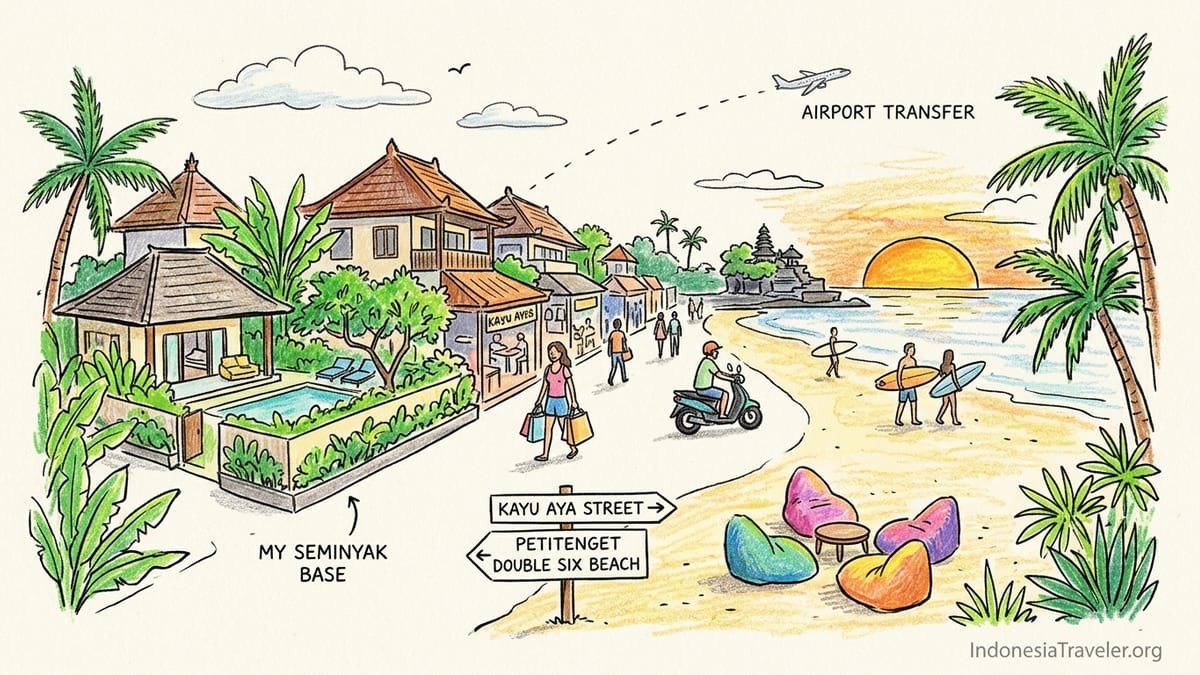
Where To Stay And How To Organise Your Seminyak Base
For these itineraries, it is simplest to use one accommodation base in the Kayu Aya and Petitenget area. This rectangle, bordered roughly by Jalan Kayu Aya (also signed as Oberoi or Eat Street), Jalan Petitenget and the beachfront, lets you walk to most dining, shopping and sunset spots described here. It is also a practical starting point for day trips west to Tanah Lot and inland towards Ubud without spending half your day in traffic.
If nightlife and being able to walk home from sunset drinks matter most, look at small hotels or villas near Kayu Aya, Laksmana and the lanes leading to Seminyak Beach. Travellers who prefer quieter nights but still want to be able to walk to KU DE TA or Potato Head often pick side streets off Jalan Petitenget or the Batu Belig border. Budget conscious visitors may choose locally run guesthouses slightly inland toward Jalan Raya Seminyak and use ride-hailing apps for the 5 to 10 minute trip to the beach.
From this base, airport transfers to Seminyak typically take 30 to 60 minutes depending on traffic, with fixed price taxi or car-hire desks inside the arrivals hall charging in the range of 200,000 to 350,000 rupiah per car. In-app services from the airport pick-up zone can be cheaper but rules change occasionally and drivers may prefer to meet slightly outside the main terminal area. From Seminyak to Legian or central Canggu, normal daytime ride-hail fares are often between 30,000 and 80,000 rupiah for a car, depending on distance and demand.
Daily budgets vary widely, but for planning it is reasonable to allow around 800,000 to 1,200,000 rupiah per person per day for mid-range travellers who want café breakfasts, simple Indonesian lunches, some shopping, one spa treatment over the stay and occasional cocktails. Couples choosing daybeds at high profile beach clubs or private drivers for excursions should expect some days to exceed this range.
Day 1: Central Seminyak, Kayu Aya And Your First Beach Sunset
Start your first morning close to home so you can get your bearings. Around Jalan Kayu Aya, many cafés open from about 7:00 or 7:30. A typical breakfast plate of eggs, toast and coffee in this area is often priced between 80,000 and 140,000 rupiah before tax and service. Smoothie bowls or avocado toast with a fresh juice usually fall in a similar range. If you have just landed from a long flight, choosing a spot with air conditioning and indoor seating can make the adjustment to Bali’s humidity more comfortable.
After breakfast, walk the length of Jalan Kayu Aya from the inland end down toward the beach. This street concentrates many of Seminyak’s small boutiques, from locally designed resort wear and linen pieces to silver jewellery and homewares. Prices in independent boutiques can vary from around 300,000 rupiah for simple cotton dresses to several million rupiah for designer pieces, so it is worth browsing a few shops before committing. Because sizing and stock can be inconsistent, buying items you love early in the trip makes sense in case you do not pass the same stores again.
For lunch on Day 1, consider Indonesian food in a warung or mid-range restaurant near Kayu Aya or on the small streets leading to the beach. A plate of nasi campur, mie goreng or ayam betutu in a modest local place can still be found in the 40,000 to 80,000 rupiah range, while polished sit-down restaurants with cocktails and air conditioning may charge 120,000 to 220,000 rupiah for main dishes. Eating Indonesian meals at lunchtime, when you are already nearby, keeps your evening free for sunset without complicated transfers.
In the late afternoon, walk to Seminyak Beach at the end of Kayu Aya for your first sunset. For a very affordable experience, head to one of the beanbag bars on the sand near La Plancha and similar venues. These usually do not require a reservation or minimum spend; you simply order drinks and snacks at menu prices and sit on colourful beanbags while watching the sky change. A coconut or beer in this setting is often around 35,000 to 70,000 rupiah, with simple snacks slightly higher.
If you would prefer a more structured beach club atmosphere, you can aim for KU DE TA or Potato Head in the Petitenget direction. KU DE TA, beside the end of Kayu Aya, operates more like a restaurant and bar, with no compulsory minimum spend on regular tables and lounge seating. Daybeds are sometimes offered with minimum spends which can reach into the low millions of rupiah for several people, especially around sunset, and advance booking is strongly advised in high season. Potato Head, a little further north in Petitenget, allows free general entry in the earlier part of the day. Recent reports indicate that in peak late afternoon periods a modest cover charge in the low hundreds of thousands of rupiah per person may apply, commonly redeemable as a credit on food and drinks. For front-row daybeds directly by the pool, expect significantly higher minimum spends and a need to reserve several days ahead during holidays.
Day 2: Double Six, Surf Lessons, Shopping And Casual Dining
Day 2 focuses on the Double Six and southern Seminyak area. Double Six Beach, reached by walking or a short ride south from Kayu Aya, has long, sandy waves that are suitable for beginner and intermediate surfers. Many beach operators and schools cluster in front of the main access road, and several publish their rates for transparency. Recent checks show two-hour beginner group lessons often priced from about 400,000 rupiah per person, including board and rash vest, with semi-private or one-on-one instruction around 500,000 to 650,000 rupiah.
Wind, swell and tides matter for safe and enjoyable surf lessons. Local schools generally recommend morning or late afternoon times when winds are lighter and the sun is less intense. It is worth asking the school to suggest a time based on the tides for the specific day you plan to surf, since shallow low-tide conditions can be uncomfortable for beginners. October falls near the start of the rainy season, and beaches may have more debris after storms. If the sea looks dirty or conditions are rough, postpone your lesson rather than trying to keep to a fixed timetable.
After surfing, plan a simple lunch around Jalan Double Six itself or the nearby streets. There are many warungs with Indonesian staples under 80,000 rupiah per dish, plus beach-view cafés serving salads, burgers and Western-style plates that can range from 120,000 to over 200,000 rupiah. This is also a good time for a foot massage or basic spa treatment, with walk-in parlours on Jalan Double Six and Jalan Werkudara advertising one-hour Balinese massages in the region of 120,000 to 220,000 rupiah. Prices climb in hotel spas and more design-led wellness spaces but often come with quieter rooms and stronger hygiene controls.
Later in the afternoon, continue inland to Jalan Dhyana Pura and Jalan Raya Seminyak for more shopping. This area blends surf shops, mid-market clothing chains, tailor shops and homeware stores. Tailoring timelines vary from two days for simple alterations to several days for custom garments, so if you wish to have items made, use this Day 2 window to discuss fabrics and measurements. Evening options include casual restaurants along Jalan Raya Seminyak, where you can find both Indonesian and international menus, or a return to Double Six Beach for sunset beanbags at a lower-key pace than Petitenget’s big-name clubs.
Day 3: Petitenget, Pura Petitenget And Batu Belig Choices
On Day 3, shift your focus north from Kayu Aya into Petitenget and Batu Belig. Begin with a relaxed breakfast on or just off Jalan Petitenget, where cafés open from around 7:30. Many follow similar pricing to central Seminyak, with coffee around 35,000 to 60,000 rupiah and breakfast mains generally between 90,000 and 160,000 rupiah plus taxes. This area sees slightly less foot traffic than Kayu Aya, which can suit travellers who prefer quieter mornings.
From Jalan Petitenget, walk or ride toward Pura Petitenget, a sea temple set a short distance inland from the sand. Visitors are requested to dress respectfully, covering shoulders and knees, and to wear a sarong and sash which are often available to borrow or rent at the entrance for a small fee. Access to the inner parts of the temple can be restricted during ceremonies and major Balinese holy days. If you arrive to find preparations underway, expect to be directed to the outer courtyard or asked to return later. This is a normal part of travel in Bali, and temple staff will usually communicate clearly about what is appropriate.
Once you have visited Pura Petitenget, you have several directions to take the rest of the day. Travellers interested in design shopping can continue along Jalan Petitenget and the connecting lanes, where interior stores sell rattan furniture, textiles, ceramics and décor pieces. Larger items can often be shipped internationally, with quotes depending on size and destination. Take time to confirm packing methods and insurance for delicate pieces.
Alternatively, you might choose a cooking class within the Seminyak area. A number of operators run half-day classes that include market visits, basic introductions to Balinese ingredients such as galangal, candlenut and kaffir lime leaf, and hands-on preparation of classics like sate lilit and lawar. Prices for group classes commonly range somewhere within the mid-hundreds of thousands of rupiah per person, excluding transfers. If you prefer to stay by the sea, Batu Belig Beach just north of Petitenget offers a slightly quieter strip of sand with a mix of local warungs and mid-range venues. Spending the late afternoon there can be a gentler alternative to the busier central Seminyak stretch.
For your third sunset, you can either repeat a favourite spot or try a different atmosphere. Families often appreciate the space and facilities at Potato Head in Petitenget, while couples who enjoy a quieter scene might return to the beanbags north of Double Six. Remember that sunset in Bali typically falls between shortly after 6pm and about 6:45pm throughout the year, so being seated with a drink by 5pm usually secures a better view without rushing.
Extending To Five Days: West Bali Heritage And A Choice Day
To extend the core Seminyak itinerary to five days in a way that is geographically reasonable, focus on a single west Bali heritage day and one flexible day rather than trying to combine multiple far-flung highlights. Day 4 can sensibly link Taman Ayun and Tanah Lot, both located in Tabanan Regency to the northwest of Seminyak. From the Kayu Aya and Petitenget area, a private car and driver usually take about 60 to 90 minutes to reach Taman Ayun, depending on traffic around Kerobokan. Hiring a driver for a six to eight hour outing typically costs in the range of 600,000 to 900,000 rupiah per car, including fuel but excluding entrance fees and parking.
Taman Ayun is a historic royal temple surrounded by landscaped gardens and canals. Entrance fees for international visitors have risen in recent years, with current checks suggesting adult prices in the tens of thousands of rupiah rather than just a few coins. Exact figures can change with little notice, so it is best to verify at the gate, but travellers should expect to pay more than a token amount for upkeep of the complex. Modest dress, including covered shoulders and knees, is required and sarongs are often provided.
After visiting Taman Ayun for an hour or so, continue on toward Tanah Lot, roughly another 30 to 45 minutes by road. Tanah Lot sits on a rock outcrop, and much of its appeal lies in the broader coastal scenery rather than entering the inner temple, which remains reserved for worshippers. Recent local reporting indicates that foreign adult entry now costs around 100,000 rupiah per person, with lower fees for children and Indonesian citizens. Within the complex there are several viewpoints, small shrines and a dense belt of souvenir stalls around the main path. To avoid the most intense crowds and heat, some travellers visit in the mid-afternoon and then choose between staying for sunset or returning toward Seminyak before dark.
Day 5 is deliberately flexible, offering three main paths: a limited Ubud cultural taster, a slow Seminyak wellness and food day, or a creative activity. A realistic Ubud day from Seminyak might involve leaving around 7:30 or 8:00 in the morning, visiting one or two cultural sites such as the main art museum or the rice terraces north of town, taking a short walk along Campuhan Ridge if conditions are dry, and returning to Seminyak by early evening. Traffic between Ubud, Denpasar and the coastal areas is heavy during peak times, so trying to combine Ubud, Tirta Empul, Tanah Lot and Uluwatu in a single day leads to long hours in a car and very limited time at each stop. It is better to focus on one region and accept that some sights will wait for another trip.
If you prefer to stay local on Day 5, treat it as a wellness and food day. Book a longer spa session in a mid-range Seminyak spa, where a two-hour package might cost between 400,000 and 900,000 rupiah depending on inclusions, and combine this with leisurely café hopping, a long lunch and a final sunset at your favourite beach spot. Creative alternatives include jewellery making workshops, batik painting sessions or photography walks, many of which are based within Seminyak or in nearby Kerobokan and do not require long transfers.
One-Day Seminyak Sampler From Legian Or Canggu
Travellers already staying in Legian or Canggu often want to devote just one day to Seminyak without changing hotels. Thanks to the short distances, this works well if you narrow your objectives. From Legian, a taxi or ride-hail to central Seminyak or Kayu Aya generally takes 10 to 20 minutes in regular traffic. From Canggu, journey times vary more, usually somewhere between 20 and 40 minutes depending on where you start and the state of the shortcuts through Berawa and Batu Belig.
A practical one-day Seminyak plan from either base would include a mid-morning arrival in the Kayu Aya area for browsing boutiques and an Indonesian or modern Asian lunch, then an afternoon on Seminyak or Double Six Beach with the option of a two-hour beginner surf lesson if conditions allow. Pricing for such lessons is similar whether you book from Seminyak or Legian, generally in the low to mid-hundreds of thousands of rupiah per person, with some schools offering small discounts for groups.
After surfing or relaxing, you can move north on foot or by short ride to Petitenget for sunset at a beach club or on the public sand. If you are staying in Canggu, it can be convenient to finish at Batu Belig, which lies roughly between Petitenget and Berawa. This makes for a shorter return ride in the evening, often 15 to 25 minutes outside peak rush hour. Those based in Legian will find it easiest to end the night at Double Six or central Seminyak so that the trip back to their hotel is quick and inexpensive.
To keep this one-day sampler comfortable, allow a total per-person budget in the range of 700,000 to 1,500,000 rupiah, depending on whether you book surf lessons and choose a high-spend beach club experience or stick with local warungs and beanbag bars. Setting expectations in advance, especially with groups, prevents tension around how much of the day will be devoted to shopping or structured activities.
A Relaxed Seven-Day Coastal Version
If you have a full week and want a slower rhythm, you can stretch the three- and five-day outlines into a more relaxed seven-day coastal stay. Days 1 to 3 remain devoted largely to central Seminyak, Double Six and Petitenget, but you can insert more downtime between activities. For example, on Day 1 you might simply walk Kayu Aya, have an Indonesian lunch, rest at your hotel during the heat of the afternoon and then watch sunset from the public beach without committing to a long evening.
On Day 2, instead of pairing a surf lesson with heavy shopping, you might surf in the morning, nap after lunch and reserve a mid-range spa treatment in the late afternoon. Day 3 could then become a half-day around Pura Petitenget or Batu Belig and a half-day of unstructured wandering, café visits or pool time. This pattern of one focus activity and one block of free time per day reduces fatigue, which is especially important in Bali’s heat for families with younger children or older travellers.
For Days 4 and 5 in the seven-day version, you can still include the west Bali heritage outing to Taman Ayun and Tanah Lot and one flexible day, but you might add a full rest day in between. For example, Day 4 could be a quiet Seminyak-only day, Day 5 the Taman Ayun and Tanah Lot trip, and Day 6 a free recovery day spent around your pool, local cafés and the beach. This arrangement allows you to avoid back-to-back long car rides.
Day 7 then becomes your personal choice day. Some travellers revisit their favourite shops to make final purchases and arrange shipping. Others book one more surf session or spend hours at a single beach club, using the minimum spend to cover several leisurely meals. If heavy rain arrives late in the trip, Day 7 is the buffer you can shift indoor activities into, such as cooking classes, art workshops or extended spa visits. This flexibility is particularly helpful during the wetter months from November to March, when downpours may be intense but usually pass within a couple of hours.
Weather, Ceremonies, Safety And Budget Planning
Bali’s weather and religious calendar influence any itinerary, so it is important to plan for both. The dry season from roughly April to October usually brings more stable sunshine and clearer seas, especially on the west coast around Seminyak. The rainy season from November to March can see heavy afternoon or evening downpours and more rubbish washed up along some beaches after storms. On wet days, move beach and surf plans to mornings if skies are clearer, and use the rainiest mid-afternoon window for indoor activities such as spa treatments or café stops.
Nyepi, the Balinese Day of Silence, takes place once a year, usually in March, and affects all visitors. From sunrise to the following sunrise, people must stay within their hotel or villa compounds. The airport closes, streets go quiet and even hotel outdoor lighting is reduced. Some properties allow quiet pool use and serve meals indoors, but you should treat Nyepi as a full rest day. Arriving or departing on Nyepi itself is not possible, so check the exact date for the year you plan to travel and avoid scheduling transfers or excursions then.
Ceremonies are frequent at temples such as Pura Petitenget and village shrines between Denpasar and Tabanan. When a ceremony is in progress, access for visitors may be restricted or re-routed. Accepting these limitations and observing respectfully from a distance is part of responsible travel. Dress codes at major temples usually require sarongs and sashes and modest tops, and menstrual restrictions for women may be communicated on signs at the entrance.
In terms of overall budgets, many mid-range couples report average daily spending in Seminyak of 1.5 to 3 million rupiah, including meals, some drinks, occasional taxis and activities but excluding accommodation and high-end shopping. Days with private drivers, surf lessons or beach club minimum spends can climb above this range. On heritage day trips, remember to account for entrance fees for each person at Taman Ayun and Tanah Lot, parking or local village contributions, and any optional activities such as short boat rides or photo services.
The Takeaway
Seminyak can stand alone as a satisfying beach and lifestyle base for three to five days if you structure your time geographically and avoid trying to see the whole island in one sweep. A focused itinerary built around Kayu Aya, Double Six, Petitenget and Batu Belig gives you beach sunsets, varied cafés, Indonesian meals, design shopping, surf lessons and one well chosen heritage excursion without constant packing and unpacking. For many first-time visitors who want relaxation more than temple counts, this is enough.
Adding a second Bali base becomes more valuable if you want deeper cultural immersion, trekking, serious diving or early-morning experiences that are impractical from Seminyak, such as sunrise on Mount Batur or dawn rituals in the Tirta Empul area. In those cases, splitting your trip between Seminyak and Ubud or another inland town lets you reduce daily driving and experience different sides of the island. The key is to be honest about your priorities: if sunsets, surfing, spa time and good food are at the top of your list, then a well planned Seminyak stay already offers most of what you came for.
FAQ
Q1. Is three days in Seminyak enough time?
Three full days are enough to explore central Seminyak, Double Six and Petitenget, enjoy two or three sunsets, fit in a surf lesson and sample local food without rushing, especially if you are not planning major excursions.
Q2. How much should I budget per day in Seminyak excluding accommodation?
Mid-range travellers often spend between 800,000 and 1,500,000 rupiah per person per day on meals, local transport, small activities and drinks, with higher spending on days that include private drivers, surf lessons or beach club daybeds.
Q3. Do I need to book Seminyak beach clubs in advance?
For general entry and bar seating at places like Potato Head or KU DE TA, walking in earlier in the day is usually fine, but daybeds and prime sunset tables in high season often require advance reservations and higher minimum spends.
Q4. What is the best time of day for a surf lesson at Double Six Beach?
Local schools usually recommend morning or late afternoon sessions when the wind is lighter and the sun less intense, and they will suggest times based on the day’s tides to avoid overly shallow or rough conditions.
Q5. How long does it take to get from Seminyak to Tanah Lot and Taman Ayun?
From the Kayu Aya and Petitenget area, it typically takes about 60 to 90 minutes to reach Taman Ayun, then another 30 to 45 minutes from there to Tanah Lot, with similar times in reverse when returning to Seminyak.
Q6. Can I visit Ubud, Tanah Lot and Uluwatu all in one day from Seminyak?
Trying to combine Ubud, Tanah Lot and Uluwatu in one day from Seminyak involves long hours in traffic and only brief stops at each place, so it is not recommended if you want meaningful time at the sites.
Q7. What should I wear to Pura Petitenget and other temples?
Wear clothing that covers shoulders and knees, and be prepared to use a sarong and sash, which are often provided or rented at temple entrances; sandals are fine, but modest behaviour and quiet voices are important.
Q8. What happens in Seminyak during Nyepi, the Day of Silence?
On Nyepi, usually in March, everyone must stay inside their hotel or villa compound for 24 hours, the airport closes and streets empty, so you should treat it as a full rest day and avoid planning travel.
Q9. Is Seminyak or Canggu better as a base for first-time visitors?
Seminyak suits first timers who prioritise walkable dining, shopping and beach access in a compact area, while Canggu tends to spread out more, with stronger surf culture and slightly more challenging traffic for pedestrians.
Q10. When does it make sense to add a second base like Ubud to a Seminyak trip?
If you want several days of rice terrace walks, temple visits, cooking classes or yoga in a quieter inland setting, staying a few nights in Ubud or another upcountry base in addition to Seminyak reduces daily travel times and deepens your experience.