


I spent fourteen nights in Canggu in October 2026, basing myself close to Batu Bolong in a surf hostel and then upgrading to a private villa. Instead of tracking generic Bali averages, I wrote down every real rupiah I spent on rooms, surf lessons, brunches, scooters, beach clubs and late-night drinks. This is my actual Canggu budget, what it bought me on the ground, and where costs ballooned fastest.
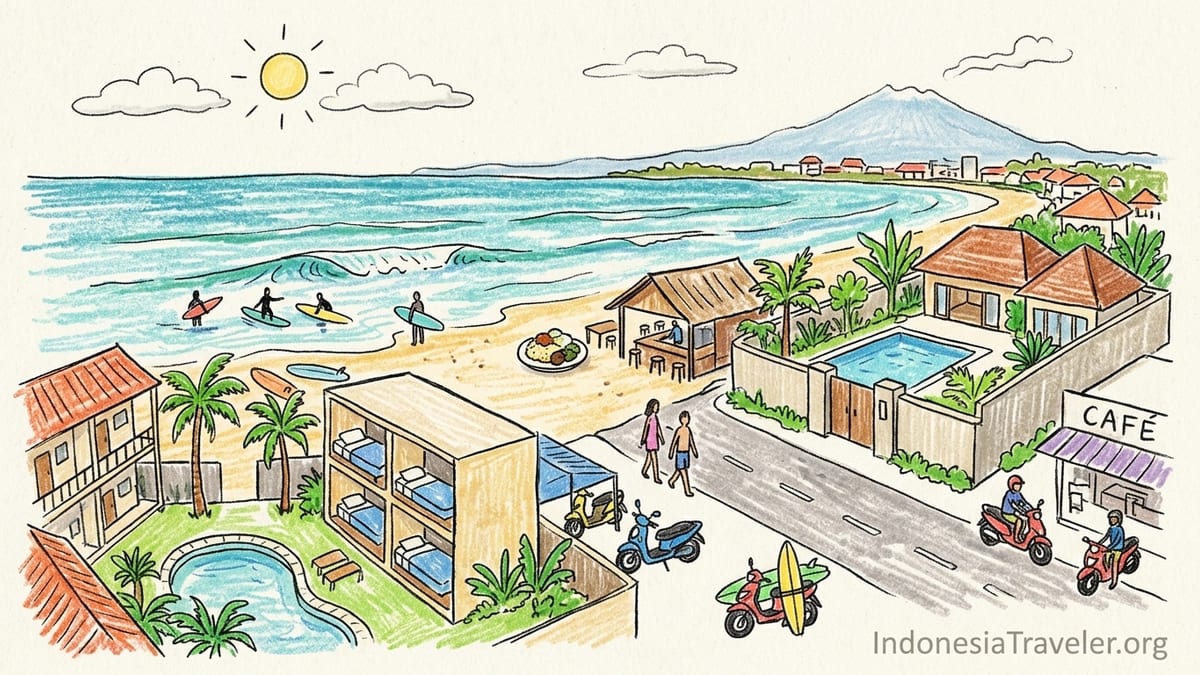
Where I Stayed: Batu Bolong As My Base
I chose to stay in the Batu Bolong area, on a small lane about a ten-minute walk from Batu Bolong Beach and Old Man’s. This location mattered a lot for my budget because it kept my daily transport costs low. I could walk to the beach for surf lessons, to dozens of cafés and warungs on Batu Bolong and Jalan Pantai Batu Bolong, and to several cowork-friendly spots without needing a taxi. For trips to Berawa, Pererenan or Seminyak, I rented a scooter by the day instead of relying on constant ride-hails.
For the first seven nights I booked a bed in a surf hostel dorm with a pool. In October 2026, similar dorm beds around Canggu were widely advertised from roughly IDR 100,000 to 300,000 per night depending on location and facilities, with cheaper options set back from the beach and more expensive ones on Batu Bolong itself. I paid IDR 210,000 per night for a four-bed mixed dorm that included air-conditioning, a simple breakfast of toast and fruit, and board storage. That put me toward the upper middle of the hostel range but still well below what I would have paid for a private guesthouse room in the same area.
For the last seven nights I moved into a one-bedroom private villa with plunge pool about five minutes inland by scooter, between Batu Bolong and Babakan. I booked it at IDR 1,350,000 per night including taxes. Based on October 2026 listings across Batu Bolong, Berawa and Pererenan, I observed that very basic guesthouses and simple private rooms in Canggu tend to run around IDR 300,000 to 700,000 per night, midrange comfortable hotel or boutique rooms cluster around IDR 800,000 to 2,000,000, and higher-end villas and hotel suites with private pools often range from about IDR 2,500,000 up to 8,000,000 per night. Those are broad price bands I saw while searching, not formal averages, but they framed my own spending: my hostel dorm was below the basic private-room range, and my villa sat firmly in the comfortable tier, not yet in the high-end luxury bracket.
Over fourteen nights I spent IDR 1,470,000 on the hostel (seven nights at 210,000) and IDR 9,450,000 on the villa (seven nights at 1,350,000), for a total accommodation cost of IDR 10,920,000. That came to an average of roughly IDR 780,000 per night across the whole stay. Had I stayed entirely in a dorm, my lodging would have been less than one quarter of what I actually paid. Switching areas to somewhere cheaper such as deeper Babakan or Seseh might have lowered the villa rate, but would have increased my ride-hail and scooter distances to the main Batu Bolong surf break and most nightlife.
Surfing Batu Bolong: Lessons, Rentals and Reality
I came to Canggu to surf, so a noticeable share of my budget went straight into the water. I took three surf lessons at Batu Bolong during my first week. The beach is lined with local surf schools and freelance instructors who quote similar prices. In October 2026, I saw group lesson boards advertising around IDR 350,000 to 400,000 for roughly two hours, and private lessons mostly between IDR 400,000 and 490,000 per session, which matches the commonly discussed Batu Bolong benchmarks for that month.
My first lesson was a group session with a small surf school operating from a gazebo directly on Batu Bolong Beach. I paid IDR 380,000 for two hours including soft-top board rental, Lycra, theory on the sand and water time with two instructors shared among five students. For my second and third sessions I upgraded to one-on-one instruction with a local coach recommended by the hostel. We agreed on IDR 450,000 per private lesson of about 90 minutes, which included a better-quality board and some video feedback on his phone afterward. In total I spent IDR 1,280,000 on three lessons: one group session at 380,000 and two private sessions at 450,000 each.
Once I felt a bit more comfortable, I switched to renting boards without a lesson. Along Batu Bolong and Old Man’s I repeatedly saw prices of around IDR 50,000 to 80,000 per hour for a basic soft-top or funboard rented directly from beach stands. I negotiated a half-day deal at IDR 120,000 for one board that let me surf both morning and late afternoon. Over the full two weeks I rented boards on six additional days without instruction, averaging IDR 80,000 per surf day, for a rental total of about IDR 480,000. Combined with my lessons, my surfing spend reached roughly IDR 1,760,000.
Because I stayed within walking distance of Batu Bolong, I avoided the need to strap a board to a scooter daily or pay for rides with a board fee attached. Friends staying farther out in Babakan who surfed every day often ended up either paying for a long-term board rental near their accommodation or accepting repeated ride-hail charges to and from the beach. My base in Batu Bolong kept my surf-related transport spend effectively at zero for the days I was in the water.
Transport: Walking, Scooters and Late-Night Ride-Hails
Transport spending in Canggu can quietly eat into a budget because distances between Batu Bolong, Berawa, Pererenan and Seseh are walkable only in theory. The roads are narrow, pavements are inconsistent and traffic is heavy, especially in October when dry season is still going strong. Staying in Batu Bolong reduced my reliance on motorbikes for everyday errands. I could walk to the beach, a supermarket, pharmacy and many cafés in under fifteen minutes.
For the first week I did not rent a scooter and relied on online ride-hailing. Typical short rides within Canggu in October 2026, such as from Batu Bolong to Berawa or to Pererenan, usually appeared on my screen between IDR 15,000 and 30,000 on a motorbike and between IDR 35,000 and 70,000 for a car depending on time of day and demand. On nights when rain hit or after big events, prices spiked. Over seven days I took an average of two short rides per day, splitting some with friends, and my ride-hail spend came to about IDR 420,000 for the week.
For the second week, once I moved slightly inland to the villa and started hopping more frequently between Batu Bolong and Berawa, I rented a scooter from a small rental shop off Jalan Pantai Batu Bolong. The signboard advertised monthly, weekly and daily rates. We settled on IDR 90,000 per day including a basic helmet but excluding fuel, cheaper than the IDR 100,000 to 120,000 daily rates I saw at more polished shops in Berawa and in front of popular cafes. I kept the scooter for seven days, spending IDR 630,000 on the rental and around IDR 70,000 on petrol bought in roadside glass bottles and at a local fuel station, which brought my second-week transport total to about IDR 700,000.
Over fourteen days, my transport spend was about IDR 1,120,000, or an average of 80,000 per day. Had I stayed in a quieter but more distant area such as Seseh or deeper Pererenan, I would have treated a scooter as non‑optional and likely rented it for the full two weeks, which would have pushed my transport spending well above what I actually paid. The choice to stay near Batu Bolong Beach, where I surfed most days and went out at night, kept my distances short and my rides cheap.
Food and Coffee: Warungs vs Canggu Brunch Culture
Food was the category where I most clearly saw the difference between a budget‑friendly Canggu and an inflated one. On days when I ate local, my spend was modest. On days when I joined friends for Western brunches and third‑wave coffee, my budget shot up quickly. Because breakfast was included at the hostel only in a very basic form, and not included at the villa at all, nearly every meal I ate outside showed up in my notes.
At small local warungs near Batu Bolong and Babakan, I repeatedly paid between IDR 25,000 and 40,000 for a generous plate of nasi campur or a serving of mie goreng or nasi goreng with an egg. A bottle of water added about IDR 5,000 to 10,000, and iced tea or a simple juice ranged from 10,000 to 18,000. On my cheapest full food day, when I ate warung nasi campur at lunch and dinner and skipped coffee outside, I spent about IDR 70,000 in total.
The moment I followed Canggu’s café culture, my costs jumped. At popular brunch spots along Batu Bolong and in Berawa, I saw smoothie bowls, avocado toast, shakshuka and similar dishes generally priced between IDR 80,000 and 140,000, with specialty coffees around 35,000 to 55,000 and fresh juices roughly 35,000 to 60,000. One representative brunch was a flat white at IDR 42,000, a smoothie bowl at IDR 95,000 and a service charge that brought the total bill close to IDR 150,000. Dinner at an international restaurant in Canggu, such as a modern Asian or Italian place along Batu Bolong, commonly cost me around IDR 140,000 to 220,000 for a main and a drink.
Over the full stay, I averaged one café coffee on most days and a Western brunch on about half of them. My rough tally came out to approximately IDR 3,360,000 across fourteen days in Canggu for food and coffee. That averaged to around IDR 240,000 per day, skewed by about four indulgent days when I had both café brunch and a mid‑range international dinner. If I had eaten mainly at warungs, skipped daily coffees and treated Western brunch as a rare treat, my daily food spend could have been closer to IDR 120,000.
Beach Clubs, Nightlife and Coworking
Beach clubs and nightlife are where Canggu can become expensive very quickly. I visited two well‑known beach clubs during my stay. At one oceanfront venue that operates with a mix of free‑entry zones and daybeds, I arrived late afternoon and walked in without paying an entrance fee, then ordered two beers at roughly IDR 55,000 each and a small snack at about IDR 80,000. My total spend that afternoon, including tax and service, was a little over IDR 200,000. There was no minimum spend imposed because I did not reserve a dedicated sunbed.
On another day I joined friends who had pre‑booked a shared daybed at a larger club between Berawa and Canggu that was operating a minimum‑spend policy. For our group of four, the quoted minimum spend for a standard poolside bed was IDR 2,000,000 for the day, which worked out to IDR 500,000 per person once split. We easily met that with a couple of cocktails each priced between 150,000 and 190,000 and shared snacks around 120,000 to 160,000. My personal total at that beach club day ended up near IDR 650,000 including my share of the minimum and extra snacks I ordered. The key budget difference was that one club allowed a near‑free visit if I only ordered a couple of drinks in the walk‑in area, whereas a reserved daybed elsewhere imposed a substantial minimum commitment from the outset.
For more casual nightlife I went out to bars on Batu Bolong and nearby streets about five evenings across the two weeks. Typical prices I paid in October 2026 were around IDR 40,000 to 55,000 for a local beer, 90,000 to 130,000 for a simple cocktail, and about 40,000 to 60,000 for a non‑alcoholic mocktail. On a modest night out with two beers and a snack my spend would sit around IDR 150,000. On my biggest night, with several cocktails and late‑night food, I spent close to IDR 500,000. Over the trip, nightlife excluding beach clubs cost me roughly IDR 1,800,000.
I also tested out Canggu’s coworking culture by buying one day pass at a well‑known cowork space off Batu Bolong. The walk‑in day rate was IDR 250,000 and included high‑speed Wi‑Fi, hot desk space and access to the air‑conditioned lounge, but no drinks. A cappuccino at the attached café cost me 45,000. Including tax and service my coworking day ran to just over IDR 300,000. I chose not to buy additional passes because I could work acceptably from quieter cafés for the price of a coffee and a snack.
Visas, Levies and Other Fixed Costs
There are a few fixed costs that sit outside the Canggu day‑to‑day budget but still matter when you are working out how much your stay really cost. As a tourist entering Indonesia in 2026, I paid for a Visa on Arrival of IDR 500,000 at Ngurah Rai International Airport. Official information from Indonesian immigration confirms this fee for the B1 Visa on Arrival and its electronic equivalent. The visa allowed me 30 days in the country, which comfortably covered my two weeks in Canggu and some time elsewhere on the island.
In addition to the visa, every foreign visitor to Bali must pay a provincial tourist levy of IDR 150,000 per person, introduced by the Bali government and still in effect in 2026. I paid this once using a card at an official payment point, then showed the receipt QR code upon arrival. These two payments together added IDR 650,000 in unavoidable entry costs for the trip. Because I spent a total of 14 nights in Bali on this visit, that worked out to about IDR 46,000 per night when averaged across my stay.
I did not need to extend my visa, so I avoided any extra immigration fees. Other fixed costs that sat at the edges of my Canggu budget were a local SIM card package and a few basic pharmacy purchases. I paid around IDR 200,000 for a prepaid data SIM that included several tens of gigabytes of data, and roughly 120,000 on sunscreen and small toiletries. While these numbers are relatively small compared with accommodation or dining, they still nudged my overall total upward.
What My Three, Seven and Fourteen Nights Actually Cost
Putting the numbers together, my first three nights in Canggu, all in the surf hostel dorm, looked like this. Accommodation cost 630,000 (three nights at 210,000). I took one group surf lesson at 380,000 and rented a board once without instruction for 80,000, bringing surf costs to 460,000. I spent about 600,000 on food and coffee, averaging roughly 200,000 per day with a mix of warungs and one café brunch. Transport over those three days amounted to around 90,000 in short ride‑hails. I went out one evening, spending nearly 250,000 on drinks and snacks. All in, those three nights cost me about IDR 2,030,000, or roughly 677,000 per night, not including the visa and levy that I count over the full two weeks.
Looking at the first full seven‑night stretch in the hostel, my spend stacked up as follows. Accommodation was 1,470,000. Surfing, including one group and two private lessons plus a couple of simple board rentals, came to around 1,280,000. Food and coffee over seven days totaled about 1,540,000. Transport via ride‑hail added around 420,000. Nightlife expenses including one beach club afternoon without a minimum spend and a couple of bar nights added about 900,000. My cowork day pass and coffee came to just over 300,000. Adding smaller discretionary items like snacks and a SIM card, the seven‑night total landed near IDR 6,000,000. On a per‑night basis, that period averaged around 857,000 excluding visa and levy, or just under 900,000 if I allocate a share of those entry fees.
Across the full fourteen nights, including the more expensive villa week, my numbers climbed. As noted earlier, accommodation totaled 10,920,000. Surfing including lessons and nine days of board access added up to roughly 1,760,000. Food and coffee for two weeks cost about 3,360,000. Transport, combining ride‑hails and scooter rental with fuel, came to approximately 1,120,000. Beach clubs and nightlife together reached around 2,450,000 across both weeks. My single cowork day and other small expenses like pharmacy items and laundry added about 650,000. When I average in the visa and tourist levy, my fourteen‑night total in and around Canggu ends up near IDR 20,265,000, which works out to roughly 1,447,000 per night all‑inclusive.
In simple terms, my nightly cost almost doubled when I upgraded from a dorm bed to a private villa and leaned harder into paid nightlife and a beach club daybed. A traveler willing to remain in hostel dorms or simple guesthouses, eat mostly at warungs and skip minimum‑spend beach clubs could live a much cheaper Canggu life than the one I recorded.
The Takeaway
Looking back over my spending diary, several Canggu costs felt genuinely worthwhile. Paying more for a well‑located base near Batu Bolong saved me hours of sitting in traffic and kept my surf access simple. The private surf lessons, while more expensive than group sessions, accelerated my progress enough that I felt confident paddling out without an instructor by the end of the second week. The private villa, though a clear step up in price, gave me quiet space to work and recover from crowded days in town, and it sat inside the comfortable range of Canggu accommodation prices rather than at the highest end.
The easiest expenses to trim were Western‑style brunches, craft coffees and high‑commitment beach club days. Eating at warungs and grabbing local snacks kept my daily food budget low without feeling deprived. I did not miss the coworking passes either; one test day there confirmed that, for my needs, a quiet café with good Wi‑Fi and a single coffee purchase was sufficient. If I returned to Canggu with a tighter budget, I would keep the Batu Bolong location, stick to one or two surf lessons at the start, choose basic guesthouses rather than villas, and treat beach clubs with minimum spends as an occasional indulgence rather than a staple.
Canggu in 2026 is not the ultra‑cheap surf village that older travelers remember, but it still offers a wide spectrum of spending levels. My two‑week diary demonstrates how quickly daily costs climb when you opt for premium cafés, reserved daybeds and private villas, and how much you can save by walking more, surfing with rented boards instead of endless lessons, and eating where locals do. With a clear sense of what you care about most, it is still possible to shape a Canggu budget that matches your priorities without losing the core pleasures of Bali’s west coast.
FAQ
Q1. How much should I budget per day for Canggu in 2026 if I stay near Batu Bolong?
If you stay in a dorm or basic guesthouse around Batu Bolong, eat mostly at local warungs, surf with occasional board rentals and avoid beach clubs with minimum spends, a realistic daily budget can sit around IDR 500,000 to 900,000. This would cover a simple room, food, a scooter or a few short ride‑hails, and one or two modest drinks in the evening.
Q2. What are the current price ranges for accommodation in Canggu?
From what I observed in October 2026, simple guesthouses and basic private rooms usually fall in the IDR 300,000 to 700,000 per night range, more comfortable hotel or boutique rooms tend to sit between 800,000 and 2,000,000, and higher‑end villas or hotel suites with private pools typically run from about 2,500,000 up to 8,000,000 per night. Hostel dorm beds are cheaper, commonly around 100,000 to 300,000 depending on location and amenities.
Q3. How much does a surf lesson cost at Batu Bolong now?
In October 2026 I repeatedly saw group lessons at Batu Bolong priced around IDR 350,000 to 400,000 for roughly two hours, while private one‑on‑one sessions tended to run between 400,000 and 490,000. I personally paid 380,000 for a group lesson and 450,000 for private instruction, which aligned with these on‑the‑sand benchmarks.
Q4. Is it cheaper to stay farther from the beach in places like Babakan or Seseh?
Staying in Babakan, Seseh or deeper Pererenan often means lower nightly rates for villas and guesthouses compared with Batu Bolong or central Berawa, particularly for larger properties with pools. However, you will likely rely more on scooters or ride‑hails to reach the main surf breaks and cafés, so your transport spending tends to increase. Whether it is cheaper overall depends on how often you move around and how much time you spend near the beach.
Q5. How much should I expect to pay for food each day in Canggu?
If you eat mostly at local warungs, a full day’s food can be as low as IDR 70,000 to 130,000, especially if you skip Western coffee drinks. Once you add in café brunches, specialty coffees and dinners at international restaurants, daily food and drink spending can easily rise to 250,000 to 400,000 or more. My own average over fourteen days was around 240,000 per day because I mixed both styles.
Q6. What do beach clubs in Canggu actually cost?
Some beach clubs allow free entry if you sit in general areas and simply pay for what you order, with drinks often in the IDR 50,000 to 200,000 range and snacks from about 80,000 upward. Others operate on a reserved‑seating model with minimum spends for daybeds that can start around 1,000,000 and reach 2,000,000 or more per bed, which you can usually share between several people. My own day with a shared daybed cost around 650,000 once I included my share of the minimum spend and extra food and drinks.
Q7. How much are scooters and ride‑hails in Canggu in 2026?
In October 2026 I saw daily scooter rentals commonly quoted around IDR 90,000 to 120,000 including a basic helmet, with petrol extra. Short app‑based rides within Canggu on a motorbike often cost 15,000 to 30,000, while cars usually ran from 35,000 to 70,000 for typical hops between Batu Bolong, Berawa and Pererenan, more when traffic was heavy or late at night.
Q8. What is the cost of the Bali Visa on Arrival and tourist levy?
As of late 2026, the standard Visa on Arrival or its electronic equivalent for many nationalities costs IDR 500,000 and permits a 30‑day stay, with the option to extend for another 30 days for an additional fee. Separate from the visa, Bali charges a provincial tourist levy of IDR 150,000 per person that must be paid once per visit. Together, these added IDR 650,000 to my trip before I even reached Canggu.
Q9. Is coworking in Canggu worth the extra cost compared to working from cafés?
Day passes at established coworking spaces around Canggu are typically in the IDR 200,000 to 300,000 range and provide reliable Wi‑Fi, air‑conditioned work areas and a community of other remote workers. I paid about 250,000 plus coffee for a single day. For focused work or if you need meeting rooms, the cost can be worthwhile. If you only need a few hours of laptop time, working from quiet cafés for the price of a drink is often enough.
Q10. How much did you personally spend for fourteen nights, and what would you change next time?
Over fourteen nights based mostly around Batu Bolong I spent roughly IDR 20,265,000 including accommodation, surf lessons and rentals, food and coffee, transport, nightlife, a cowork day and a share of visa and levy costs. This worked out to about 1,447,000 per night. Next time I would keep the convenient location and a couple of quality surf lessons, but I would skip the villa upgrade, limit brunches and avoid minimum‑spend beach club days to bring my nightly cost much closer to one million rupiah or less.