


When I started planning my most recent trip to Bali in 2026, I kept running into the same confusion: people mixing up three completely different obligations. Indonesia’s immigration visa, the new All Indonesia digital arrival declaration and Bali’s provincial “Love Bali” tourist levy are often talked about as if they were one single fee. They are not. On my latest arrival at Ngurah Rai International Airport I saw travelers in three different queues, each for a different requirement, and more than a few frustrated faces. This guide is my attempt to lay out, in plain language and from first-hand experience, what you really need to do before you fly and when you land.
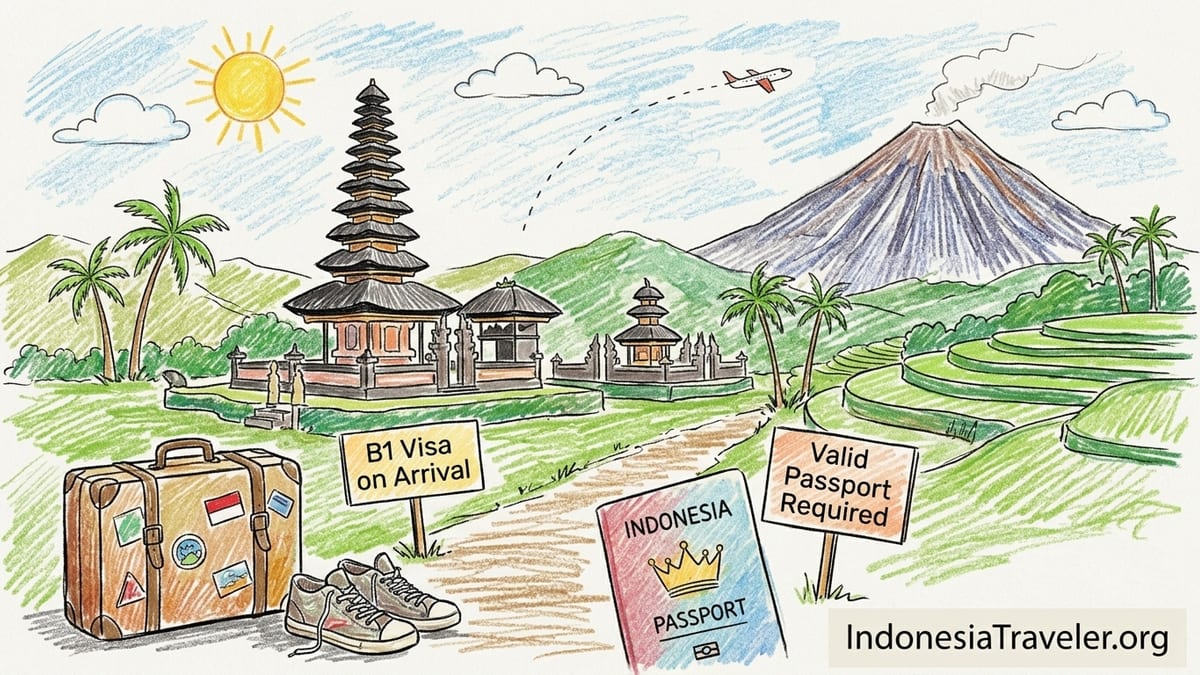
Who Can Use Visa on Arrival and What Your Passport Needs
The starting point for any Bali trip in 2026 is your nationality and passport. Bali is part of Indonesia, so all entry rules are Indonesian national rules, not Bali-specific ones. Indonesia divides visitors into several groups, including those who are visa exempt, those eligible for a B1 Visa on Arrival (VoA) or electronic Visa on Arrival (e-VOA) and those who must arrange another visa type before travel. The list of nationalities eligible for VoA is updated occasionally, so I always cross-check with my own foreign ministry and with Indonesian immigration before buying a ticket. For example, citizens of many European Union countries, the United Kingdom, Australia, New Zealand, the United States, Canada, Japan and South Korea are currently eligible for B1 VoA, while some Southeast Asian neighbors have separate visa-free arrangements.
Regardless of which category you fall into, your passport itself has to meet Indonesia’s technical requirements. At Ngurah Rai airport I watched one traveler turned away from check in in Sydney because his passport was due to expire in less than six months. Most airlines flying to Bali now actively check this before boarding, because Indonesian rules require at least six months’ validity from the date of entry and at least one or two blank pages for stamps and visa stickers. If your passport is close to expiring or almost full, renew it before you even think about visas or flights. It is a lot easier to handle this at home than to argue at a departure gate.
Another non-negotiable is proof you will leave Indonesia. At my last arrival, the immigration officer in Denpasar glanced at the return flight details I had printed and also stored on my phone. Indonesian authorities expect “onward travel” evidence, which can be a confirmed flight back home or to another country such as Singapore, Kuala Lumpur or Bangkok. Some airlines will not let you board without it, even if immigration officers at the destination do not always ask. I have seen backpackers scrambling in the departures hall to book a cheap onward ticket on their phones just so their airline would issue a boarding pass.
Finally, match your planned stay to the visa type. If you know you only have two weeks off work, a 30 day stay limit is fine. If you are dreaming of slow travel in Bali and nearby islands, you need to plan around the maximum stay allowed on your visa or consider a different visa type in advance. Many headaches start because people arrive on a short-stay permission and then try to stretch it at the last minute.
Understanding the B1 Visa on Arrival: Cost, Duration and Extension
The B1 Visa on Arrival is Indonesia’s standard short-stay visa for eligible nationalities, valid throughout the country from Aceh to Papua. It is not a special “Bali visa.” When I landed at Ngurah Rai in early 2026, large signs near the immigration hall clearly advertised “Visa on Arrival 500,000 IDR.” That fee, around the equivalent of a few dozen US dollars depending on the exchange rate, is set nationally and currently applies for both the physical VoA you buy at the airport and the e-VOA you buy online in advance. Official Indonesian immigration sources and several foreign travel advisories all state that the initial stay granted is up to 30 days, counted from the day you arrive, and that it can be extended one time for another 30 days, giving a maximum of 60 days in total.
In practice, this means that if you land on 1 June, day one of your stay is 1 June, and your initial VoA will carry you through to around 30 June. If you want to stay into July, you must apply and pay for an extension before that first 30 day period ends, usually at an Indonesian immigration office that covers the district where you are staying. On my last trip, the extension fee was the same 500,000 rupiah as the initial visa. Some travelers handle the extension themselves by visiting the immigration office in person several times for fingerprints, photos and document checks. Others use visa agents who charge a service fee on top of the government fee. I met an Australian couple in Canggu who happily paid a local agent roughly the same again in service charges just to avoid queuing in the sun at the immigration office.
The key difference between B1 VoA and longer pre-arranged tourist or social visas is flexibility. With B1 you can simply decide to come for up to 30 days, buy the visa on arrival and then decide later if you want to extend once. You cannot convert it into a long-stay permit or a work visa while you are in Indonesia. If you need more than 60 days, you should talk to an Indonesian consulate at home about a different visa, such as a single-entry 60 day visit visa, well before you fly. Overstaying is an expensive mistake. Current policy includes substantial daily fines for every day you stay past your authorized period, and longer overstays can trigger detention, deportation and bans on re-entering.
One important detail I explain to friends is that the VoA is a permission to stay anywhere in Indonesia, not a “Bali pass.” I have used it to land in Bali, then fly on to Labuan Bajo for a Komodo trip and later to Jakarta, all on the same VoA. If you leave Indonesia, even briefly on a hop to Kuala Lumpur or Singapore, that VoA is finished when you exit. Coming back means going through the same process again and paying again.
e-VOA vs Buying Visa on Arrival at the Airport
On my first post-pandemic trip back to Bali, I stood in the long Visa on Arrival payment queue at Ngurah Rai and promised myself I would never do that again if I could help it. On later visits, I used the official online system to apply for an electronic Visa on Arrival (e-VOA) a few days before flying. Both the e-VOA and the visa-on-the-spot are the same B1 visa for Indonesian immigration purposes. They have the same fee, the same 30 day initial validity, the same option for one 30 day extension and the same national scope. The difference is how and when you pay and how smooth your arrival experience feels.
With e-VOA, I submit my passport details, upload a passport-style photo when requested and pay the 500,000 rupiah fee online with my card. After approval I receive a PDF and a QR code that I either print or save to my phone. When I land at Ngurah Rai, I can skip the visa payment counters and head straight to the immigration booths with “e-VOA” signage. An officer scans the QR code, checks my passport and onward ticket and stamps me in. On my last trip using e-VOA I cleared immigration in under fifteen minutes, while another line of sleep-deprived passengers waited at the payment counter machines.
If you prefer or if you missed the online cut-off, you can still buy the VoA at eligible entry points. In Bali that is Ngurah Rai International Airport and the cruise and ferry ports that handle foreign arrivals. The physical process is simple: you join the visa payment line, pay 500,000 rupiah at a bank or payment counter by card or in cash, receive a receipt and then line up again at immigration where they apply the visa and stamp your passport. At busy times this can add half an hour or more to your arrival. I once arrived on a Sunday afternoon flight from Bangkok and spent nearly an hour in the visa payment line behind several large tour groups.
Whether you use e-VOA or airport VoA, your airline and immigration may ask for the same supporting evidence. I usually keep a printed copy of my e-VOA, my hotel booking for at least the first few nights and my return or onward ticket. Although Indonesian rules do not require you to carry passport-sized photos for VoA, some travelers still travel with a couple of spare photos in case they need them for other permits or local documents, such as long-stay visas in neighboring countries. For Bali and a standard 30 to 60 day trip, a valid passport, completed e-VOA and digital copies of your key bookings are usually enough.
The All Indonesia Digital Arrival Declaration
From 1 September 2025, Indonesia began rolling out a new system that confused almost everyone in my Bali arrival queue. Signs at Ngurah Rai now direct international passengers to complete an “All Indonesia” arrival declaration within three days before arrival. This is not another visa and it is not related to the Bali tourist levy. It replaces and integrates several old paper and digital forms that travelers used to complete separately, including immigration arrival cards, customs declarations and certain health and quarantine forms. The idea is that you fill everything out once, digitally, and present a single QR code or confirmation on arrival.
On my most recent flight into Bali in 2026, the cabin crew reminded us about All Indonesia around an hour before landing. Some passengers had already filled it out at home up to three days before their flight. Others were frantically typing passport numbers and listing electronics on the customs section while the plane taxied to the gate. The rule is that the form should be completed in the three days before your arrival date, not weeks in advance. When you submit, the system issues a QR code that Indonesian officers can scan on arrival to access your immigration, customs and health declarations in one place.
At Ngurah Rai, the practical effect is that you may be asked to show your All Indonesia QR code either just before immigration or at the customs exit where, in the past, officers would collect paper customs forms. On my last arrival, airport staff with tablets were helping passengers whose phones had died or whose QR codes would not load. I strongly recommend taking a screenshot of your completed form and saving it in your photo gallery and printing a copy if you can. Treat All Indonesia as mandatory, the same way you would treat a customs declaration in any other country.
The most important point here is conceptual. All Indonesia is about information and border formalities, not about paying for entry. You do not pay the 500,000 rupiah VoA fee in this app and you do not pay the Bali tourist levy via All Indonesia either. In my case, I completed All Indonesia for a trip that used a long-stay visa from a previous visit, and I still had to pay the separate Bali levy. Think of All Indonesia as the Indonesian government’s digital replacement for the stack of small forms we used to fill out on planes: essential but distinct from any visa and from any local taxes.
Bali’s Love Bali Tourist Levy: A Provincial Obligation
On top of your national visa and your All Indonesia declaration, Bali adds its own layer: the provincial foreign-tourist levy commonly known as the Love Bali levy. This is where many travelers, and even a few check-in agents I have met, get mixed up. The levy is set by Bali provincial regulation and is currently 150,000 Indonesian rupiah per foreign tourist, per entry to Bali. It applies regardless of whether you enter on a VoA, a visa-free arrangement or a longer-stay visa. Indonesian officials describe it as a contribution to protect Balinese culture and the natural environment, and not as an immigration fee.
When I landed in Denpasar shortly after the levy took effect, there were signs in the arrivals corridor explaining that payment should be made electronically, ideally before departure, through the official Love Bali system. In practice, as of 2026, you still have three main options. First, you can pay online before you travel and receive a QR code as proof. I did this on my phone the night before a recent flight from Singapore; the process took about five minutes and generated a voucher in rupiah, which I saved in my photo roll. Second, if you do not or cannot pay online, you can pay on arrival at designated counters at Ngurah Rai International Airport or at Tanjung Benoa port. Third, some hotels, travel agents and cruise lines are registered as collection endpoints and will process the levy for you as part of your booking.
After payment you receive electronic proof, such as a QR code or receipt. The official rules make it clear that proof of payment must be available for inspection and that the levy is valid for the duration of your stay in Bali until you leave Indonesia. In real life, enforcement at the airport has been a little uneven. On one occasion nobody asked to see my Love Bali proof when I exited the airport. On another trip, staff scanned levy QR codes for passengers leaving the baggage hall. Local news outlets and the governor’s office have both reminded tourists that paying the levy is an obligation, even if you are not always physically checked at the airport. I now pay before arrival to avoid having to queue at a payment counter or argue with officers later if on-the-ground checks tighten.
There are some exemptions. Indonesian citizens and domestic tourists from other Indonesian provinces are not subject to the foreign tourist levy. Certain categories of long-term foreigners with official permits, such as diplomatic staff or holders of specific residence permits, may also be exempted under provincial rules, though these exemptions are interpreted on a case-by-case basis. Children who hold foreign passports are generally included and counted as foreign tourists. On my last family trip I paid 150,000 rupiah each for two adults and two school-aged children, which was still less than the cost of a casual dinner in a mid-range Seminyak restaurant.
Local Rules, Sacred Spaces and Governor’s Circular No. 7 of 2025
The Bali provincial government has not stopped at collecting a levy. In response to a series of widely publicized incidents involving foreign visitors behaving badly at temples, on scooters and on social media, the governor issued Circular No. 7 of 2025, setting out detailed guidelines and obligations for foreign tourists. When I checked into a guesthouse in Ubud in 2026, the receptionist handed me a printed leaflet in English summarizing this circular, along with the Wi-Fi password. It covers respect for sacred places, dress codes, behavior in villages, use of licensed tourism services and financial conduct.
For sacred places, such as Besakih Temple, Uluwatu Temple, Tirta Empul or smaller village temples, the circular reminds foreigners that these are living religious sites, not just scenic photo spots. Proper dress is mandatory. That usually means a sarong and sash over clothing that covers shoulders and knees. Local staff or vendors rent sarongs and sashes at temple entrances, but the circular emphasizes modest, respectful clothing rather than fashion sarongs draped over beachwear. A critical point that many visitors miss is that buying a temple ticket does not guarantee access to inner sanctuaries. In Besakih I watched several tourists denied entry past the main courtyard even though they held tickets and wore sarongs, because ceremonies were underway and only worshippers were allowed into the holiest zones.
The circular also stresses that tourism activities should be booked with authorized businesses. That includes licensed guides for trekking Mount Batur, registered dive centers in Amed or Nusa Penida and operators who have safety licenses for white-water rafting on the Ayung River. During one of my stays in Canggu I saw unlicensed tour sellers offering very cheap scooter rentals and sunrise hikes. These may save a little money upfront but they can leave you with no legal protection if something goes wrong. The governor’s guidelines explicitly warn against using services that violate zoning rules, conservation rules or safety standards.
Financial conduct is another focus. Foreign visitors are urged to use licensed money changers and authorized payment channels and to avoid using cryptocurrencies as payment in shops, cafes or rental agencies. I saw signs in several Ubud boutiques and even in some co-working spaces reminding customers that paying with crypto for goods and services is not legal tender in Indonesia. The circular also asks tourists not to engage in work or business activities without the correct visa. That includes things that might feel informal, such as running paid yoga workshops or photo shoots, which technically count as work under Indonesian law if you are being paid.
Driving, Drugs, Drones and Daily Conduct
Driving deserves more attention than many Bali guides give it. The governor’s circular reinforces what Indonesian law already requires: if you ride a scooter or drive a car, you must hold the correct class of driving license and, if you are a foreigner, an international driving permit that matches your home license. For scooters and motorbikes, that is typically a motorcycle endorsement on your license plus an International Driving Permit under the 1949 or 1968 convention, depending on your home country’s agreement with Indonesia. Simply having a car-only license from home is not enough to ride a motorbike in Bali. If police stop you after an accident and you cannot show the right license and permit, your travel insurance company may refuse to cover medical costs.
Helmets are mandatory and not just for show. I regularly see tourists in Canggu and Uluwatu balancing surfboards on scooters while riding in flip-flops and without helmets, even though rental shops almost always offer helmets at no extra charge. The circular explicitly mentions the need to wear helmets and obey traffic rules. In Denpasar I watched a traffic stop where local police pulled over a foreign couple riding without helmets and issued on-the-spot fines. Beyond the fines, road injuries are one of the most common reasons tourists end up in Bali’s hospitals, and riding helmetless can turn a minor fall into a life-changing head injury.
Indonesia’s narcotics laws are extremely strict. Possession, use or trafficking of illegal drugs, including substances that some travelers consider minor, such as cannabis, can lead to long prison sentences or even the death penalty for trafficking. On my last visit, local English-language newspapers reported several high-profile arrests involving foreign visitors with small quantities of illegal drugs in popular nightlife areas. Do not bring any recreational drugs to Bali and do not buy them there, even if a friendly bar worker in Kuta whispers an offer in your ear.
Prescription medications are treated separately but still need care. Common medicines like blood pressure tablets or asthma inhalers are generally fine for personal use. However, certain strong painkillers, ADHD medications or anti-anxiety drugs that contain controlled substances may require a doctor’s letter and a copy of the prescription, and some may be restricted altogether. Before flying I always check my medication names against my home government’s travel advice for Indonesia and carry them in original pharmacy packaging in my hand luggage, along with a letter from my doctor listing generic drug names and dosages.
Drones are another growing issue. Bali’s skies above rice fields and cliffs look perfect for aerial photography, but there are rules. Flying near airports, over crowds, close to temples or over private property without permission can lead to confiscation of your drone or fines. Some popular temples and tourist sites now display explicit “no drone” signs in several languages. During a sunrise visit to Lempuyang Temple I saw security confiscate a small recreational drone from a visitor who launched it near the temple gate despite clear signage and verbal warnings.
Nyepi, Insurance, Health and Natural Hazards
One of the most distinctive aspects of Bali’s annual calendar is Nyepi, the Balinese Day of Silence. On Nyepi, which usually falls in March according to the Balinese Saka calendar, the entire island largely shuts down for 24 hours or more. The airport closes to regular flights, streets are empty, lights are dimmed and even hotels ask guests to stay inside the property grounds and keep noise to a minimum. I once accidentally booked a trip that overlapped with Nyepi and found myself spending a quiet day in a Ubud guesthouse, reading by the pool while staff observed rituals and silence. It was a deeply memorable experience but not the right time to plan a fast-paced sightseeing or diving schedule. If your trip might coincide with Nyepi, build this pause into your itinerary from the start.
Travel insurance is not something Indonesia checks at the border for most tourists in 2026, but from a practical standpoint it is essential. Bali has several good private hospitals and international clinics in areas like Denpasar, Kuta and Ubud, but treatment is not free and serious cases often require costly medical evacuation to Singapore or your home country. A friend of mine broke an ankle on a scooter in Canggu and her hospital bill, imaging and follow-up physiotherapy ran into thousands of dollars. Her travel insurance covered these costs because she wore a helmet and held a valid motorcycle license and international permit, all properly documented. Another traveler I met in a hostel was still paying off credit card debt after an uninsured hospital stay for dengue fever.
General medical care for minor issues is widely available, from small clinics in tourist areas to larger hospitals in Denpasar. Pharmacies stock common medications and over-the-counter remedies, but it is wise to bring any specific medicines you rely on from home, especially if they are brand-specific or have strict dosing. Tap water in most parts of Bali is not considered safe to drink, so plan to use bottled or filtered water for drinking and teeth brushing to reduce the risk of stomach upsets.
Bali’s beaches and volcanoes are beautiful but come with their own safety considerations. Strong currents and rip tides at beaches such as Kuta, Canggu and parts of Uluwatu have caught out many experienced swimmers. I pay close attention to flag systems and local lifeguard advice, and I avoid swimming on unpatrolled stretches at dusk or after drinking. Volcanic and earthquake awareness is also part of traveling in Indonesia. Bali’s Mount Agung and nearby volcanoes have had intermittent activity over the past decade, occasionally disrupting flights or causing ash warnings. Earthquakes in the broader region can affect Bali’s buildings and coastal areas. Hotels usually have basic evacuation maps posted on room doors, and I make a habit of noting exit routes and assembly points when I check in.
Chronological Checklist: One Month Before to First Day in Bali
To pull all of this together, I now follow a simple time-based checklist whenever I plan a Bali trip. About one month before travel, I confirm my passport has at least six months’ validity beyond my planned arrival date and enough blank pages. I double-check whether my nationality is eligible for B1 Visa on Arrival or if I should apply for a different visa in advance through an Indonesian consulate. At the same time, I renew my travel insurance policy, making sure it covers medical treatment, evacuation and any activities I plan to do, such as motorbike riding, surfing or diving.
Two to three weeks before departure, I book or confirm flights and at least the first few nights of accommodation. I make sure my return or onward flight falls within the maximum stay allowed on my visa choice or that I have a clear plan to extend legally once in Indonesia. If I intend to ride a scooter, I check that my domestic driving license includes motorcycle entitlement and that my International Driving Permit is valid for the dates of my trip. I also talk to my doctor or pharmacist about any prescription medications I will carry and ask for a letter that lists them in generic form, then pack them in my hand luggage.
Roughly one week before my flight, I start looking at digital formalities. If I want to use an e-VOA, I apply through the official system, upload any requested photo, pay the 500,000 rupiah fee and save the approval notice and QR code on my phone and as a printout. I also pay the Love Bali tourist levy through the official channel, making the 150,000 rupiah contribution for each member of my traveling party. Again, I save the receipts and QR codes both digitally and on paper. I review Bali’s latest provincial guidelines, including Governor’s Circular No. 7 of 2025, and remind myself of the expectations around dress, sacred sites, driving and financial conduct.
Within three days before arrival, I complete the All Indonesia digital arrival declaration for my flight, entering passport details, flight information, accommodation address and customs and health information as required. I make screenshots of the final QR code and store them in an easy-to-find folder on my phone. On the day of travel, I carry a small folder with printed copies of my passport data page, flights, hotel bookings, e-VOA, Love Bali levy receipt, insurance policy and doctor’s letter, just in case my phone battery fails. On the plane, I listen carefully for the crew’s announcements about All Indonesia and immigration procedures at Ngurah Rai.
On arrival day in Bali, my sequence at the airport is straightforward. I connect to airport Wi-Fi if needed, open my e-VOA or prepare to pay VoA at the counter, and keep my onward ticket handy. I pass immigration with my visa, then follow signs and staff instructions related to All Indonesia checks and customs. After collecting my luggage, I am prepared to show the Love Bali levy QR code if asked. Once outside the terminal, I ignore unlicensed drivers pushing for cash rides and instead look for official taxi counters or reputable ride services. Only after all three obligations have been met in their separate lanes immigration visa, national digital arrival declaration and Bali’s provincial tourist levy do I start to relax and enjoy the air that smells faintly of incense and frangipani.
The Takeaway
By late 2026, getting into Bali has become more structured but not necessarily more difficult. The key is to separate, clearly in your mind, three distinct obligations that operate at different levels of government. First, Indonesia’s national immigration system controls your right to enter and stay, through visas such as the B1 Visa on Arrival and its electronic twin, the e-VOA. Second, the All Indonesia digital arrival declaration integrates immigration, customs, health and quarantine data and must be completed within the three days before you land. Third, Bali’s Love Bali foreign-tourist levy is a provincial contribution that supports culture and the environment and is payable in addition to any visa fees, even if nobody asks to see your receipt at the arrivals exit.
When you plan ahead for all three, check your driving documents and insurance and take local rules such as Governor’s Circular No. 7 of 2025 seriously, Bali rewards you with an experience that goes far beyond beaches and bars. You can stand quietly on the edge of a temple courtyard while a ceremony unfolds, knowing that your presence is respectful. You can ride a scooter through terraced rice fields wearing a proper helmet and license in your pocket, confident your insurance will back you up if needed. And you can look at your Love Bali levy receipt as more than a tax, but as a small, concrete way to support the island that is hosting you.
FAQ
Q1. Is the B1 Visa on Arrival only for Bali or for all of Indonesia?
The B1 Visa on Arrival is an Indonesian national visa that lets eligible travelers enter and stay anywhere in Indonesia, including but not limited to Bali, for an initial 30 days with the option of one 30 day extension.
Q2. How much does the B1 Visa on Arrival cost in 2026 and how long can I stay?
The official fee is 500,000 Indonesian rupiah. It grants an initial stay of up to 30 days from your arrival date and can usually be extended once for another 30 days, giving a maximum of 60 days on that visa.
Q3. What is the difference between e-VOA and getting the visa at the airport?
Both are the same B1 visa with the same fee and rules. e-VOA is obtained and paid for online before travel, so you can usually skip the visa payment queue on arrival, while the airport Visa on Arrival is paid at a counter after you land.
Q4. What exactly is the All Indonesia arrival declaration?
All Indonesia is a digital arrival declaration that combines immigration, customs, health and quarantine information into one online form, which you must complete in the three days before arriving at participating Indonesian entry points such as Ngurah Rai International Airport.
Q5. Do I pay my visa fee or the Bali tourist tax through All Indonesia?
No. All Indonesia is strictly for declarations and does not process visa fees or the Bali tourist levy. You pay the 500,000 rupiah B1 visa fee through the e-VOA system or at the airport visa counter and the 150,000 rupiah Bali levy through the Love Bali system or at designated provincial payment points.
Q6. How much is the Bali Love Bali tourist levy and who has to pay it?
The Bali provincial levy is 150,000 rupiah per foreign tourist per entry to Bali. It applies to most foreign visitors, whether they arrive on a Visa on Arrival, a longer-stay visa or a visa-free arrangement, while Indonesian citizens and certain exempt categories are not charged.
Q7. What are the main dress and conduct rules from Governor’s Circular No. 7 of 2025?
The circular emphasizes respectful behavior at sacred places, including wearing modest clothing, using licensed guides and tour operators, avoiding illegal work or business activities, obeying traffic rules and using licensed money changers and official payment channels.
Q8. Can I enter temple inner sanctuaries if I buy a ticket and wear a sarong?
Not necessarily. Buying a ticket and dressing correctly allows you into general public areas, but inner sanctuaries often remain reserved for worshippers or are closed during ceremonies, regardless of your ticket.
Q9. What driving documents do I need to ride a scooter legally in Bali?
You need a valid motorcycle license from your home country and an International Driving Permit that includes motorcycles. Riding with only a car license or without an international permit can lead to fines and may invalidate your travel insurance.
Q10. Are drugs, prescription medicines and drones tightly controlled in Bali?
Yes. Indonesia has very strict narcotics laws with severe penalties, certain prescription medicines may require documentation and some are restricted, and drone use is regulated, particularly near airports, temples and private property, so you should check the latest official guidance before you travel.