


Bali rewards travelers who look beyond sunset bars and Instagram swings. From sacred water temples and active volcanoes to working rice terraces and coastal villages, the island’s most memorable experiences are rooted in living culture and everyday landscapes. This guide approaches Bali as a place to be understood rather than collected, organizing key experiences by heritage, agriculture, volcano country, marine life, arts and crafts. It focuses on how visitors can engage respectfully while still seeing many of the places that make Bali world famous.
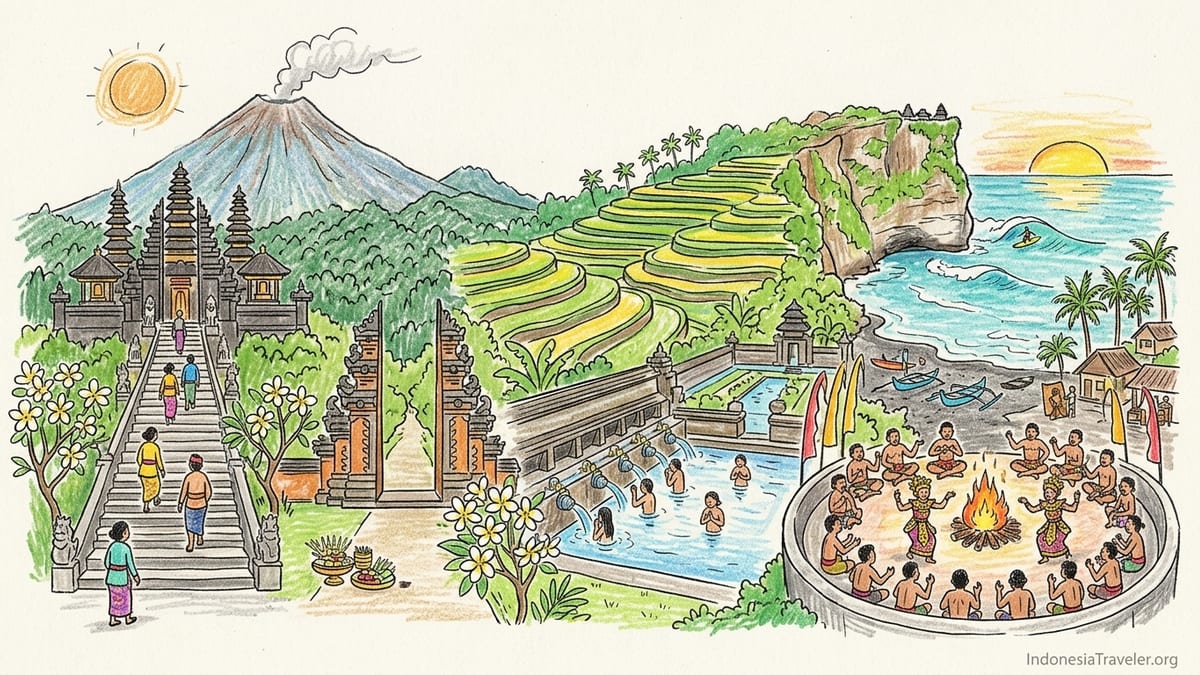
Religious Heritage: Besakih and the Island’s Great Temples
Pura Agung Besakih, often called the Mother Temple of Bali, is the most important Hindu temple complex on the island. It sits on the slopes of Mount Agung in Karangasem, about 1.5 to 2 hours by car from Ubud or Sanur. Foreign visitors currently pay an entrance fee of roughly IDR 60,000 per adult, collected at an organized ticket and parking area at the lower level of the complex. From there, electric shuttles and wide paved paths lead up to viewing terraces that look across dozens of meru shrines and courtyards.
Besakih is a working religious center first and a tourist site second. The complex is organized into zones, with outer courtyards and terraces accessible to ordinary visitors, and inner courtyards reserved for Balinese Hindu worshippers who have come to pray. As a non-Hindu visitor, you are generally welcome in the outer areas, where you can see temple architecture, shrines aligned with Mount Agung, and preparation for ceremonies. Inner gates are often roped off or watched by local guardians; photography across these thresholds is usually acceptable, but entering without invitation is not. Allow at least two to three hours at Besakih, more if a major ceremony is taking place.
The best base for Besakih is central or eastern Bali. Ubud gives you the widest choice of drivers and small-group tours, while Sidemen or Candidasa offer quieter countryside stays with a shorter drive. Access is by car or chartered driver rather than public transport, and slopes are moderately steep but paved, so visitors with limited mobility can still reach several terraces and viewpoints. Crowds peak from mid-morning to early afternoon, especially on days with big ceremonies, so an 8:00 or 8:30 arrival is calmer and often cooler.
If you prefer a quieter temple with clear zoning between visitors and worshippers, Pura Lempuyang in eastern Bali is an alternative. Its “Gates of Heaven” photo frame has become iconic, but the greater complex climbs higher above the road and functions very much as a living temple. As at Besakih, non-Hindu visitors remain in outer courtyards while inner spaces are reserved, giving a similar sense of sacred hierarchy but in a smaller setting.
Water Temples and the Meaning of Sacred Water
Bali’s water temples are central to both religion and agriculture, and they are not interchangeable “photo spots.” Pura Tirta Empul in Tampaksiring, about 30 to 40 minutes from Ubud, is famous for its spring-fed bathing pools. Foreign visitors pay an entrance fee of about IDR 50,000 per adult at the main gate, which includes a basic sarong for walking inside the complex. Those who wish to take part in melukat, the water self-purification ritual, rent a special bathing sarong and often hire a local guide or temple assistant.
Melukat is a serious spiritual practice that many Balinese perform at key moments in life, such as before major ceremonies or after illness. Non-Hindu visitors are welcome to participate if they approach the ritual respectfully: dressing modestly, listening carefully to instructions, moving calmly between the spouts, and avoiding loud conversation or selfies in the bathing line. It should never be sold or consumed as a novelty or amusement. Travelers who only want a quick photograph can remain on the upper viewing terrace and observe quietly rather than entering the pool. Plan around two hours for Tirta Empul, including time to watch offerings being prepared in the outer courtyards.
Pura Taman Ayun near Mengwi, roughly 45 minutes from Seminyak or Canggu and a similar distance from Ubud, shows a different side of Bali’s water temples. Once the royal family temple of the Mengwi kingdom, it is now part of the island’s UNESCO-recognized cultural landscape. Visitors pay an entrance fee that is usually slightly lower than Tirta Empul and walk along a moat and manicured gardens that emphasize the temple’s historical role in royal ceremony and irrigation networks. Here, there is no public bathing pool. Instead, you look across elevated walls into courtyards filled with meru towers that once anchored power and agricultural control.
In practical terms, Tirta Empul involves wetter, more physically active participation, while Taman Ayun is a dry, contemplative walk with a focus on architecture and history. Both can be comfortably visited from Ubud in a single day with a private driver. Crowds at Tirta Empul build mid-morning, particularly with tour groups doing melukat, so an early arrival helps maintain a more reflective atmosphere. As alternatives, travelers seeking quieter water temples might visit Pura Gunung Kawi Sebatu or Pura Ulun Danu Batur, where the link between water, farming and faith is just as deep but daily visitor numbers are lower.
Rice Terraces and Agricultural Culture: Jatiluwih, Tegallalang and Sidemen
Bali’s rice terraces are often treated as backdrops for swings and coffee tastings, yet they are the surface expression of a sophisticated subak irrigation system. Jatiluwih, in Tabanan Regency, is the clearest place to see that system at work. About 1.5 hours from Ubud or Canggu, Jatiluwih charges a modest entrance fee at a central gate, which supports local farmer organizations. Once inside, you find multiple walking and cycling routes marked with colored signs, ranging from short one-hour loops on relatively even paths to half-day walks that descend to the valley floor. Interpretation boards and small warungs along the way emphasize cropping cycles, local rice varieties and community irrigation practice.
Tegallalang, just north of Ubud, is Bali’s most photographed terrace landscape. Its steep amphitheater of paddies drops sharply from the roadside, and the paths are short but often crowded and uneven. Many stretches are controlled by individual landowners, who collect small cash donations at improvised checkpoints. Large swings, nests and “I Love Bali” signs dominate the upper slopes. If you are mainly interested in immersive agricultural culture and clear explanations of how the terraces are worked, Jatiluwih provides a richer experience than Tegallalang, even if Tegallalang produces the classic balcony shot.
Sidemen, in east Bali, provides a third perspective. Spread across a broad valley between rice paddies, cacao trees and rivers, it functions as a living farming region rather than a single viewpoint. Guesthouses sit beside family plots where ducks move through the stubble and farmers still plant and harvest by hand. There is no single entrance fee; instead, you pay for local walking guides or informal trekking routes that pass through fields with the landowners’ consent. Paths can be muddy and involve river crossings, so simple sports sandals or hiking shoes are helpful.
For most visitors, the most informative rice-terrace experience comes from combining locations rather than choosing a single “best” one. A traveler based in Ubud might spend a quick early morning at Tegallalang for the classic view, then take a day trip to Jatiluwih to understand the subak system more deeply. Those staying several nights in Sidemen can complement both with slow walks from their homestay. If you want a quieter alternative to Tegallalang near Ubud, consider the Campuhan Ridge Walk or the village paths around Pejeng and Keliki, where you can watch planting and harvesting at close range with fewer souvenir stalls.
Traditional Villages and Everyday Life: Penglipuran and Beyond
Penglipuran, in Bangli Regency about 45 minutes from Ubud, is one of Bali’s best known traditional villages. Its main lane rises gently along a central axis lined with family compounds, each with a front gate, small garden strip and family shrines further inside. The village has been recognized in recent years for cleanliness and cultural preservation, and it is a popular stop on organized tours. International visitors now pay around IDR 50,000 per adult at a central ticket office, a figure that has risen in recent years as tourism numbers have grown.
Visiting Penglipuran is partly an encounter with everyday residential life and partly a curated experience. Some compounds still function as ordinary homes, where you may quietly observe family members weaving offerings, drying coffee or tending to chickens in the back yard. Others have shifted clearly toward tourism, with homestay rooms, batik stalls or snack counters set up inside the walls. Both are valid responses to the village’s popularity, but travelers should understand they are not walking through a museum. Asking permission before taking close-up photos inside a compound, buying a small snack or handicraft, and accepting tea if offered are ways to honor that this is still a living community.
Penglipuran’s main lane is paved and relatively gentle, which makes it suitable for visitors with moderate mobility limitations. The village can be thoroughly explored in one to two hours, with an additional stop in the adjacent bamboo forest if time allows. Mornings see a mix of independent travelers and minibuses, while late afternoon tends to be quieter as day tours head back to the south. As an alternative or complement, travelers might visit the more dispersed Tenganan Pegringsingan in east Bali, another traditional village known for double ikat textiles, where tourism is present but visitor numbers per day tend to be lower.
Regardless of which village you visit, it helps to think in terms of relationship rather than spectacle. Hiring a local village guide for a short orientation walk, even if you already know the basic history, channels some of your spending into the community and opens doors to questions you might not otherwise feel comfortable asking.
Volcanoes, Lakes and Waterfalls: Bali’s Highland Landscapes
Mount Batur dominates the Kintamani highlands in Bangli Regency, its wide caldera filled by Lake Batur and fringed by black lava fields. Sunrise treks to Batur’s summit are among the island’s most popular active experiences. Most travelers start from Ubud, Sanur or the south around 1:30 to 2:30 in the morning and reach the trailhead by 3:30 or 4:00. Package prices vary depending on what is included, but a typical small-group trip might cost a few hundred thousand rupiah per person and include transport, guide, flashlight and a simple breakfast on the rim. Local guide associations strongly discourage unguided ascents, and multiple checkpoints around the mountain enforce this in practice.
The standard sunrise route takes 1.5 to 2 hours of steady uphill walking for a reasonably fit person, on volcanic sand and rocky steps. It can be slippery in rain or mist, which are common outside the June to September dry season. A light jacket, headlamp and shoes with good grip are essential. Those with knee or heart issues may find the slope demanding, but there are shorter or slower options that reach lower viewpoints rather than the highest crater. For travelers who prefer scenery over exertion, roadside viewpoints around Penelokan or Kintamani village look across Lake Batur and the caldera without any hiking at all.
North of the caldera, Bali’s interior hosts some of its most dramatic waterfalls. Sekumpul, in Buleleng Regency, involves a combination of paved paths, steep staircases and short river crossings to reach the base of multiple tall falls. A ticket office near the parking area sells entry with various packages, commonly including a local guide, both as a safety measure and to manage visitor movement. Expect 30 to 45 minutes of hiking each way and a fairly strenuous climb back up. Banyumala Twin Waterfalls, closer to Bedugul, require a shorter but still steep descent on earth steps that can be muddy after rain. Munduk’s waterfall trails, accessible from guesthouses in the village, offer more moderate walks through clove and coffee plantations, with the option of loop hikes that connect three or four falls in half a day.
Bedugul itself, centered around Lake Beratan, is a cooler highland region about 1.5 hours from Canggu or Ubud. Many travelers combine Pura Ulun Danu Beratan on the lakeshore, the Bali Botanic Garden and nearby strawberry fields in a single day trip. Walking is mostly on paved paths with some gentle inclines, making this one of the more accessible highland experiences. Afternoon fog and showers are common, so an early start improves both visibility and driving safety on the winding road. As an alternative to Batur’s early start, visitors who want views without a night wake-up call might base themselves in Munduk or Bedugul for two nights and explore the lakes and waterfalls on a more relaxed schedule.
Cliffs, Reefs and Beaches: Experiencing Bali’s Coasts
Bali’s coastline contains several distinct marine landscapes, from surf breaks facing the Indian Ocean to quiet shallows protected by reef shelves. In the south around Kuta, Legian and Canggu, long sandy beaches combine consistent waves with dense rows of beach bars and surf schools. These areas are convenient if you want to learn to surf with board rental and instruction bundled into a one- or two-hour lesson, but the environment is busy and commercial. Accommodation and dining options range from hostels to international hotels, and traffic congestion is a real factor when planning sunset outings.
On the Bukit Peninsula, Uluwatu and Pecatu add cliffs and hidden coves to the surfing story. Uluwatu’s main surf break sits below the temple cliffs and is reached by steep stairs and a cave opening onto the water. Padang Padang, Bingin and other Pecatu beaches often require steep concrete steps down the cliff face, which can be challenging for visitors with knee issues or those traveling with very young children. The reward is clear water, limestone headlands and sunsets that feel far removed from city life. A scooter or hired driver is the most practical transport, as public options are limited.
On the east and northeast, Amed and Tulamben have built reputations on snorkeling and diving rather than surfing. Black-sand beaches on this coast slope into clear water with coral gardens and, in Tulamben, the well-known USAT Liberty wreck accessible from shore. Many guesthouses here partner with dive operators, so a visitor might book a package that includes two morning dives and equipment with hotel pickup. Conditions can vary with waves and visibility, but in calm weather, shore entries are straightforward. Compared with the busy south, the villages feel slower paced, with fishing boats lining the shore and fewer large resorts.
Sanur, on Bali’s southeast side, offers one of the island’s most forgiving coastal environments for swimmers and families. A reef offshore calms the water along a long beach path lined with modest hotels and cafes. At mid to high tide, sections of the lagoon are suitable for gentle swimming and stand-up paddleboarding, while low tide exposes seagrass and requires footwear to avoid stepping on sharp coral fragments. Sanur is also a jumping-off point for boats to Nusa Lembongan and Nusa Penida, though those trips involve separate safety considerations. As an alternative for those wanting a quieter version of Kuta’s broad sands, Jimbaran Bay combines swimmable water with evening seafood cafes and less intense nightlife.
Cliffside Ritual and Performance: Uluwatu Temple and Kecak
Pura Luhur Uluwatu, perched on cliffs at Bali’s southwestern tip, offers both a powerful sacred landscape and one of the island’s best-known performing arts experiences. Foreign adults currently pay around IDR 60,000 at the temple gate, as confirmed by information checked in September 2026. This includes the required sarong and sash for modest dress. A separate ticket for the evening Kecak and fire dance costs about IDR 150,000 for adults, with seats in a cliff-edge amphitheater that looks out over the ocean at sunset.
The temple gates open from morning to early evening, but the most crowded time is late afternoon, when visitors arrive for both sunset views and the dance. The Kecak performance usually starts around 18:00, timed to coincide with the setting sun, and lasts roughly one hour. Seating is unassigned in many sections, so arriving 45 to 60 minutes early improves your chances of getting a spot with a clear view, particularly during holiday peaks. Online booking portals and local tour desks sell dance tickets in advance, while the temple entrance fee is paid in person at the gate.
Physically, Uluwatu involves walking on paved but sometimes uneven cliff paths with a few stairs. The main viewpoints are accessible to reasonably fit visitors, but those with limited mobility may prefer to focus on the central courtyard and the nearest lookouts. Long-tailed macaques live around the temple and are known for grabbing unsecured sunglasses, hats or phones, so it is worth keeping loose items inside a bag. As with all temples in Bali, shoulders and knees should be covered, and menstruating women are traditionally asked not to enter.
If you want a similar combination of sea views and cultural performance with fewer people, consider sunset at Tanah Lot followed by a Legong dance show in Ubud’s palace or village banjar. The setting is less dramatic than Uluwatu’s amphitheater, but the chance to watch dance in a courtyard space that still serves community ceremonies provides deeper context for the art.
Performing Arts and Crafts: Meaning, Context and Fair Pay
Balinese performing arts and crafts are both religious offerings and sources of livelihood. Kecak, often associated with Uluwatu, developed in the early 20th century from trance rituals and Ramayana storytelling. There is no gamelan orchestra; instead, a chorus of men chant rhythmic “cak” patterns around a central fire while dancers portray Rama, Sita and Hanuman. Ticket revenue supports not only the performers but also temple upkeep and local banjar organizations. When you pay for a seat, you are supporting an ecosystem that maintains costumes, rehearsals and community obligations.
Legong, by contrast, is a delicate court dance usually accompanied by a full gamelan ensemble. In places like Ubud Palace, Peliatan or Batuan, evening shows are often presented in temple or palace courtyards, with young dancers whose families have passed down the repertoire for generations. Programs typically last one to one and a half hours and cost a modest entrance fee paid at a simple ticket table near the gate. Some groups clearly list which banjar or village troupe you are supporting, allowing visitors to choose shows affiliated with specific communities.
Batik, woodcarving and silverwork function similarly as both cultural expression and economic support. In areas around Mas and Kemenuh near Ubud, carving families open their workshops to visitors, showing rough blocks of suar or crocodile wood gradually becoming masks, Garuda figures or everyday utensils. Prices may seem higher than mass-produced items in beach markets, but they reflect the time and skill invested in each piece. When shopping, it is useful to ask whether the carver works on-site and whether wood is sourced legally, especially for protected species. In coastal areas and village markets, handwoven textiles or small batik studios provide a chance to buy directly from makers rather than anonymous stalls.
Travelers concerned about fair compensation can look for performances and galleries where ticketing or sales are clearly organized by local groups rather than distant agencies. For example, paying a dance ticket at the door in a village banjar, or buying a woodcarving that is signed by the artisan in Mas, usually keeps a larger share of the income in the community. As an alternative to large souvenir complexes on main roads, consider small co-operative shops in Ubud, Sidemen or Penglipuran that cluster work from several artisans under one community-managed roof.
The Takeaway: Matching Experiences to Different Travelers
Bali’s most rewarding experiences rarely sit in isolation. Temples are linked to rice terraces through shared water systems, and dances performed for visitors on Tuesday nights often reappear in softer form during village ceremonies at full moon. Approaching the island as an interconnected landscape rather than a checklist unlocks deeper understanding, no matter how long you stay.
Cultural travelers might anchor their itinerary in Ubud or Sidemen, using Besakih, Tirta Empul, Taman Ayun and Penglipuran as primary excursions. Allocating time to linger at each site, perhaps with a local guide, gives space to ask questions about offerings, irrigation or the stories behind Legong and Kecak. Choosing homestays or small guesthouses in traditional villages further embeds you in the rhythms of prayer, planting and preparation for ceremony.
Hikers and outdoor enthusiasts can combine a Mount Batur sunrise trek with multi-fall walks in Munduk, Sekumpul or Banyumala and a few days in Bedugul’s cooler air. Those preferring lower-impact walking might swap the Batur summit for caldera viewpoints, Munduk day hikes and lakeside strolls in Bedugul, keeping daily exertion at a comfortable level. Always factor in Bali’s humidity and changeable mountain weather when planning, and leave margins in your schedule rather than stacking demanding hikes on consecutive dawns.
Beach-focused travelers may choose to split time between the high-energy south and the quieter northeast. A week could include several nights in Seminyak or Canggu for restaurants and beginner surfing, followed by three or four nights in Amed or Tulamben for snorkeling and diving, and a closing stay in Sanur or Jimbaran for gentle swimming and easy airport access. Visitors with limited mobility can prioritize Sanur’s flat beachfront path, Bedugul’s paved lakeside park and outer terraces at Besakih and Taman Ayun, while skipping steep waterfall descents or cliff stairs at Uluwatu and Pecatu.
Whatever your interests, the same principles apply. Choose a manageable number of areas instead of racing around the island. Engage with guides and artisans who can interpret what you are seeing. Respect zones marked as sacred, whether that is an inner temple gate, a shrine on a volcano rim or a family altar in a Penglipuran courtyard. In doing so, you will find that Bali’s best things to do are not single moments for the camera, but layered experiences that stay with you long after the trip ends.
FAQ
Q1. How much should I budget for visiting Uluwatu Temple and the Kecak dance in 2026?
For a foreign adult, plan roughly IDR 60,000 for temple entrance at the gate and about IDR 150,000 for the Kecak and fire dance ticket, paid either on-site or booked in advance through a reputable seller.
Q2. Can non-Hindus take part in the melukat purification ritual at Tirta Empul?
Yes, non-Hindus are generally welcome to join melukat as long as they dress modestly, follow the instructions of temple staff or a guide, behave quietly and treat the ritual as a serious spiritual practice rather than entertainment.
Q3. Is Penglipuran Village an authentic community or mainly a tourist show?
Penglipuran is a real Bali Aga village where many compounds remain lived-in homes, though some households now focus partly on tourism. Visitors see both everyday life and curated elements, so it is best approached as a living community that has chosen to host guests.
Q4. Do I need a guide to hike Mount Batur?
Local guide associations and village organizations expect visitors to use a guide, and multiple checkpoints around the mountain enforce this in practice. Booking a guided trek through an operator or your accommodation is the most straightforward and respectful option.
Q5. Which rice terrace is best if I care more about culture than photos?
Jatiluwih usually offers the most informative experience, with marked walking routes and clear links to the subak irrigation system. Tegallalang gives iconic balcony views but is more commercial, while Sidemen provides immersive everyday farming landscapes without a single central viewpoint.
Q6. Are Bali’s major temples suitable for travelers with limited mobility?
Many key temples, including Taman Ayun, Tirta Empul’s outer courtyards and parts of Besakih, have paved paths and gentle slopes. Steep staircases at some inner areas and at cliffside temples like Uluwatu can be challenging, so planning routes and using a driver who can drop close to entrances helps.
Q7. Where is the best place in Bali for gentle swimming rather than surfing?
Sanur’s reef-protected coastline is one of the most comfortable areas for relaxed swimming and wading, especially at mid to high tide. Sections of Jimbaran Bay and parts of Nusa Dua’s beaches also provide relatively calm water compared with surf beaches on the west coast and Bukit Peninsula.
Q8. How much time should I allow to visit Sekumpul or Banyumala waterfalls?
From a base in Ubud or Bedugul, visiting Sekumpul usually takes most of a day once you factor in driving, ticketing and a 30 to 45 minute descent and climb. Banyumala can be combined with other nearby sights, but you should still allow several hours for travel, the steep walk and time at the pool.
Q9. How can I make sure my spending supports local performers and artisans?
Buying tickets at temple or village gates, hiring local guides, attending dances hosted by identifiable banjar groups and purchasing crafts directly from workshops or co-operatives all help keep a larger share of your spending in the community that creates the experience.
Q10. What is a realistic first-time Bali itinerary if I want both culture and coast?
For a 10 to 12 day trip, many travelers split time between a cultural base such as Ubud or Sidemen, several nights in a highland area like Munduk or Bedugul, and a coastal stay in Sanur, Jimbaran or Amed, allowing at least three nights in each area to avoid constant packing and long transfer days.