


Bali in 2026 is busier than ever, yet it is still far more than beaches, bars and infinity pools. With almost 7 million direct international arrivals in 2025, the island is under real pressure, but the core of Balinese life remains intact: a Hindu-majority society in a Muslim-majority country, organised around temples, rice fields and tightly knit village communities. To enjoy Bali without adding to the problems, it helps to understand the island’s geography, culture and current rules long before your plane touches down.
Where Bali Sits in Indonesia, and Why the Nusa Islands Matter
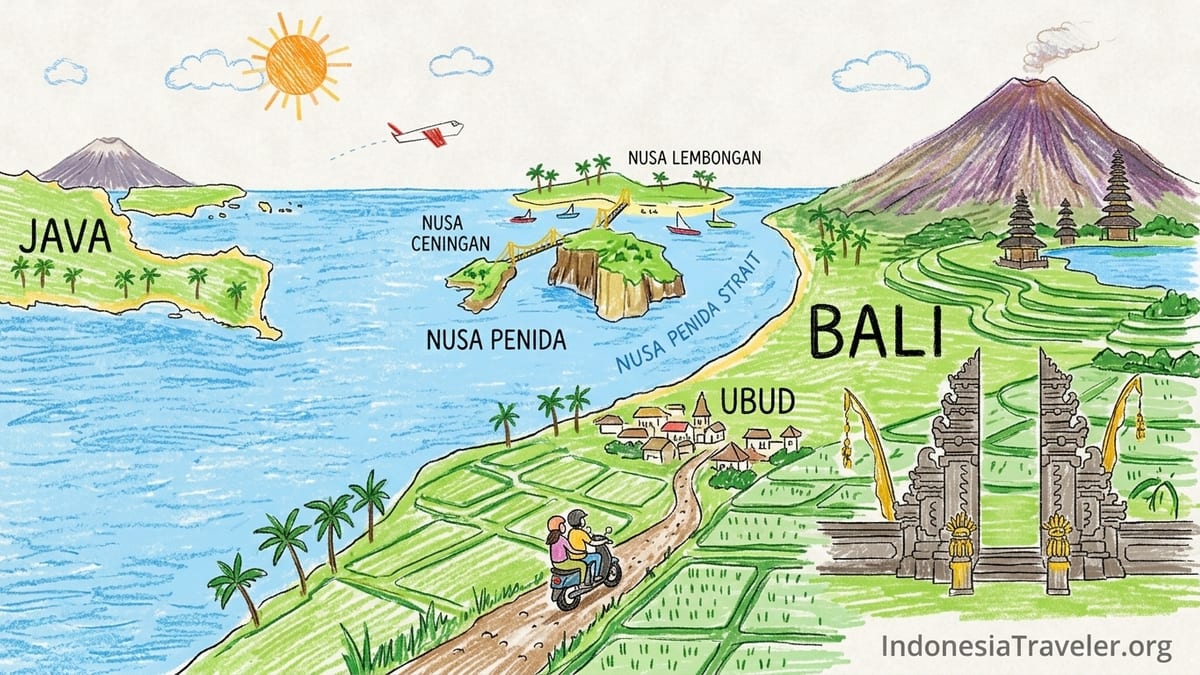
Bali is one of Indonesia’s 38 provinces and sits almost exactly in the middle of the country’s long island chain, between Java to the west and Lombok to the east. On the ground this matters more than on a map: most international visitors arrive at I Gusti Ngurah Rai International Airport in the south and rarely register that Bali is only one small island within an archipelago that stretches thousands of kilometres. Java’s lights are visible from Bali’s western beaches on a clear night, while the volcanic ridges of Lombok and the Gili Islands rise to the east.
South of the main island sit three smaller but increasingly important islands: Nusa Penida, Nusa Lembongan and Nusa Ceningan. Administratively they belong to Klungkung Regency, but for travellers they feel like a separate mini-archipelago. Fast boats from Sanur and Serangan now shuttle hundreds of visitors a day to Penida’s towering cliffs and Lembongan’s gentler surf breaks. Many people book these as day trips, but the limited roads, small power grid and basic water supply mean staying overnight, especially on Penida, still feels more remote than most of south Bali. If you imagine the Nusa islands as extensions of Kuta or Seminyak you will be surprised by the rougher roads, lower-key nightlife and stronger sense of village life.
Within Indonesia, Bali is distinctive not only for its Hindu majority but also for its economy’s dependence on foreign visitors. National statistics show Bali taking almost half of Indonesia’s direct international arrivals in 2025, which means one small province hosts an outsized share of the country’s tourism footprint. That imbalance explains both the sophisticated airport infrastructure around Denpasar and the sense, especially during peak months, that Bali is carrying more visitors than its roads and waste systems were ever designed to handle.
Yet even at these volumes, tourism is concentrated in particular pockets. If you travel two hours north from the airport into the highlands around Munduk or east to the rice valleys of Sidemen, traffic thins, hotel clusters break up and you begin to see Bali less as a resort destination and more as a patchwork of working villages, temples and farms spread across dramatically different landscapes.
Regencies as Travel Regions: South, Central, North and East
Bali is divided into nine regencies plus Denpasar city, but those names are not very helpful until you translate them into what they mean on the ground. For most visitors, the practical split is between the highly developed south, the cultural and agricultural centre, the volcanic east and highland north. Understanding these regions makes it easier to pick realistic bases instead of trying to see everything from one hotel in Seminyak.
Southern Bali, covering Badung Regency and Denpasar, concentrates the international airport, toll road, and most of the large hotel and villa stock. This is where you find Kuta, Legian, Seminyak, Canggu, Jimbaran, Nusa Dua and the cliff-backed Bukit Peninsula around Uluwatu. Decades of investment here have created reliable power, relatively good mobile coverage, plentiful ATMs and an almost endless spread of restaurants, beach clubs and boutiques. A single street in Canggu might serve flat whites at Australian-style cafes in the morning, then host DJs at a beach club at night, with digital nomads working from laptop-friendly coworking spaces in between.
Central Bali, largely Gianyar and Bangli regencies, is anchored by Ubud and the rice-growing uplands around Tegallalang and Tampaksiring. Here the infrastructure is lighter: narrow village roads, fewer large hotels, more homestays and small villas tucked behind family compounds. You still get espresso bars, yoga studios and vegan restaurants in central Ubud, but a 15-minute scooter ride puts you among working rice terraces and village temples where ceremonies rather than sunset cocktails dictate the day’s rhythm.
To the east, Karangasem feels more rugged. The coastline from Padangbai through Candidasa, Amed and Tulamben sits in the shadow of Mount Agung, Bali’s highest and most sacred volcano. Outside the small dive and homestay clusters, roads run through arid, lava-strewn slopes and terraced valleys. Water and power can be less predictable than in the south, but in exchange you get black-sand beaches with small clusters of fishing boats instead of wall-to-wall resorts. Further east again, the steep green valley of Sidemen offers one of Bali’s most photogenic rice landscapes with views to Agung, still only lightly built up with boutique eco-lodges and homestays.
Northern Bali, mainly Buleleng Regency, is a long arc that feels almost like another island. The coastal strip from Lovina to Pemuteran fronts the relatively calm Bali Sea instead of the Indian Ocean, which shapes both the climate and the style of tourism. Here you find small beach hotels, early morning dolphin-spotting trips, and gateway access to Menjangan Island’s reefs. Inland, villages like Munduk and Bedugul sit among coffee plantations, waterfalls and crater lakes. Public transport is limited and roads over the central mountains are steep, but this very isolation nudges many visitors to slow down and stay put for a few days rather than racing between sights.
Why the South Is So Built Up, and What the Rest of Bali Offers
The dense tourism strip in southern Bali is not an accident. The area between Kuta and Nusa Dua is flat, close to the airport and faces west or south, which means year-round sunsets and reliable surf breaks. The early international hotels in the 1970s and 1980s clustered around Kuta and Sanur, followed by Nusa Dua’s gated resort complex, then later waves of villa and restaurant development in Seminyak, Canggu and Uluwatu. Every new road improvement made it easier for investors to carve rice fields into villa plots, and for visitors to treat the south as a single continuous resort belt.
By 2025 this belt hosted a large share of Bali’s 6,948,754 direct international arrivals. That pressure shows up in very practical ways. In Canggu at 5 p.m. you might wait through several traffic-light cycles at the short shortcut road as delivery drivers and ride-hail scooters squeeze past SUVs. On popular nights, ride-hail fares from Seminyak to Uluwatu beach clubs can surge above 200,000 rupiah, even though the distance is only about 25 kilometres, because so many people are trying to travel the same roads at once.
In contrast, central, eastern and northern Bali offer different landscapes and a thinner layer of tourism infrastructure. Ubud’s central streets can be congested, but a guesthouse in nearby Penestanan or Nyuh Kuning might back directly on to rice paddies still irrigated by traditional canals. In Sidemen, drivers still set their own informal timetables between villages because there is no fixed public bus system. In Amed, the busy parts are a string of small bays where divers and snorkellers walk into the water to see coral and the USAT Liberty wreck off nearby Tulamben, while a few kilometres between those bays are lined mainly with fishing families’ houses.
In the north, Lovina’s seafront promenade feels low-key compared with Legian, with small warungs selling nasi campur for the same prices locals pay and simple beach bars replacing late-night clubs. Pemuteran’s hotels sit back from the road behind trees and coral restoration projects rather than giant sound systems. These places are not “undiscovered” but they carry a different energy: slower evenings, darker skies, and more contact with people going about non-tourism work, from harvesting cloves around Munduk to tending vegetable fields around Bedugul.
Balinese Hinduism, Village Life and Living Rice Landscapes
What makes Bali feel profoundly different from much of the rest of Indonesia is not simply that most residents are Hindu, but that religion, community organisation and land management are tightly interwoven. In a single neighbourhood in Ubud you might see a priest leading morning offerings at the family shrine, women weaving palm-leaf decorations for a temple festival, and a banjar (neighbourhood council) organising traffic diversions for a cremation ceremony.
Most Balinese live in family compounds rather than standalone houses. A compound will usually contain several buildings for different branches of the family, a raised bale pavilion for social gatherings, and a small household temple in the most sacred corner. These compounds belong to a desa adat, or customary village, which has its own council, temple network and rules that sit alongside the official government village structure. The banjar functions as the local organising unit within the desa adat, handling everything from temple clean-ups and gamelan rehearsals to mediating neighbour disputes.
Balinese Hinduism itself is shaped by the concept of Tri Hita Karana, often translated as the “three causes of harmony”: between people and the divine, people and nature, and people and each other. You see this principle at work in everyday details. A rice terrace is not simply a field, but part of a temple-linked water-sharing network. A hotel that wants to run events late into the night needs banjar approval because it affects the social balance. Even a surf competition or music festival is likely to open with a prayer ceremony to seek balance and permission from local spirits.
The most visible expression of this balance for visitors is the subak irrigation system, recognised by UNESCO as a World Heritage cultural landscape. When you stand at the viewing platforms over Tegallalang or Jatiluwih, it can be easy to treat the terraces as scenic backgrounds for drone shots. In reality, each narrow dike and water channel is part of a cooperative system governed by water temples and farmer meetings. Decisions about when to flood and drain paddies, which crops to plant and how to share water are made collectively to keep the whole system in balance. This means that when travellers walk off designated paths or drones buzz low over shrines, they are disturbing not just a view but a working agricultural and spiritual system.
Beaches and Bases: What Ubud, Canggu, Sanur and Others Really Offer
If you think of Bali as one continuous resort, you will almost certainly be disappointed. Each main base has a distinct feel, shaped by geography, waves, road access and the communities that live there. Choosing the right one or combination for your trip is far more important than finding the perfect villa on a booking site.
Ubud, inland and without a beach, has grown into Bali’s cultural and wellness capital. Here you find art museums, traditional dance performances at temples like Pura Dalem, yoga studios ranging from simple drop-in shalas to polished retreat centres, and cooking schools that start with early-morning visits to the market. Accommodation ranges from homestays inside family compounds, where breakfast might be served on your veranda by the host’s grandmother, to high-end jungle resorts overlooking river gorges. Traffic on the main streets can feel intense, but a base on the edges of town allows you to walk or cycle out to rice fields, then come into the centre for performances and dining.
Canggu, by contrast, is a coastal sprawl of beaches, rice fields and new villas west of Seminyak. It is shaped by surf and social media. Between Batu Bolong and Echo Beach you will find surfboard-rental stands charging in the region of 100,000 rupiah for a couple of hours, beach clubs with minimum spends that can run into several hundred thousand rupiah per person on weekend sunset sessions, and cafes offering smoothie bowls and oat-milk lattes priced closer to Sydney than to rural Indonesia. It works well if you want waves, nightlife and coworking in one place, but less so if your idea of Bali is quiet temples and traditional markets.
Seminyak and Legian bridge older and newer tourism. Seminyak’s long flat beach, lined with loungers and beanbags, is backed by boutiques, mid-range hotels and a few luxury villas, while Legian and neighbouring Kuta retain a more budget, backpacker and family hotel mix. Kuta’s beach is one of Bali’s classic surf-training grounds, with sandy bottoms and manageable beach breaks, but the area is heavily commercialised with malls, bars and traffic around the main intersections.
On the quieter side, Sanur on the southeast coast offers a very different beach experience. A reef offshore creates a sheltered lagoon, and a paved promenade runs for several kilometres along the sand. Here you see families renting bicycles and small pedal cars, older visitors walking at sunrise, and traditional jukung fishing boats pulled up along the shore. The sea is generally calmer than Kuta or Canggu, which makes it popular with stand-up paddleboarders and parents with younger children. Sanur also acts as a harbour for fast boats to Nusa Penida and Nusa Lembongan, so it works well as a base if you plan island day trips but prefer to sleep on the main island.
Jimbaran Bay, just south of the airport, is known for its long curve of sand and beachfront seafood restaurants where fresh fish is priced by weight and grilled over coconut husks. It suits travellers who want easy airport access, sunsets and seafood rather than nightlife. Nusa Dua, further round the peninsula, is Bali’s enclave of large gated resorts with manicured gardens, security checkpoints and conference facilities. Beaches here are clean and well managed, with calm swimming and water sports, but the feel is international resort more than local village.
Uluwatu and the wider Bukit Peninsula sit on high limestone cliffs, with narrow roads leading down to small white-sand coves such as Padang Padang, Bingin and Suluban. Access often involves walking down steep staircases with boards under your arm or catching local shuttle vans from clifftop parking. The pay-off is world-class surf, dramatic sunsets and quieter nights once the beach bars close. This area suits confident scooter riders and people who are comfortable with cliff stairs; for families with strollers or anyone with mobility issues, daily beach access can be challenging.
Away from the south, Sidemen provides a quiet base among rice paddies and rivers, ideal for gentle hikes, weaving workshops and simply watching clouds roll over Mount Agung. Amed and Tulamben on the east coast appeal most to divers and snorkellers. Simple guesthouses line the black-pebble beaches, and early mornings see fishing boats returning with their catch. In the north, Lovina is a long string of small villages rather than a single town, with black-sand beaches and early-morning dolphin tours, while Pemuteran makes sense for travellers heading to Menjangan Island for snorkeling and diving or to explore Bali Barat National Park on land.
In the highlands, Munduk offers cool temperatures, waterfall trails and coffee plantations, often with simple guesthouses that serve home-grown coffee on terraces facing the valleys. Bedugul, near Lake Beratan and Lake Buyan, has a more functional feel, with markets selling strawberries and vegetables alongside small hotels and villas. Kintamani and the area around Mount Batur, meanwhile, draw hikers for sunrise treks on the volcano and visitors to the caldera lake. Many visitors come on day trips; staying overnight lets you see the mountains quieten in the evening once the buses leave.
Surf, Sand and Cliffs: Understanding Bali’s Different Coasts
Bali’s coasts are not interchangeable. The character of each beach is largely defined by ocean exposure and reef structure, which has big implications for anyone planning to surf, swim with children or simply walk easily to the water each day. Confusing them can lead to both safety risks and frustration.
On the west coast between Kuta and Canggu, beach breaks and reefs pick up swells from the Indian Ocean. This is where you find the surf-heavy atmosphere many people associate with Bali. Kuta’s long sandy stretch offers gentle, rolling waves suitable for first-timers taking lessons from beach instructors, while further north at Berawa and Echo Beach, surfers tackle heavier waves over reef at low tide. Strong currents and shifting sandbars mean red flags are common during big swell days, and swimmers need to pay attention to lifeguard advice rather than assuming all sections of the beach are equally safe.
Sanur’s southeast-facing shore, protected by an offshore reef, offers a very different experience. Inside the reef, the water is generally shallower and calmer, with small waves that lap more than crash. Families with younger children often prefer Sanur because paddling and beginner-level stand-up paddleboarding are possible much of the year within the lagoon. Outside the reef, however, the same swells that hit Nusa Dua and Uluwatu can produce serious surf, so boat operators time their departures and returns around tide and wind conditions.
Around Uluwatu and the wider Bukit Peninsula, access is the biggest difference. Many of the best-known surf breaks, such as Uluwatu, Padang Padang and Suluban, are tucked into steep-walled coves at the base of cliffs. Reaching the sand often means descending long flights of narrow stairs carved into rock, sometimes passing through warungs and surfboard racks on the way. This setup creates striking scenery and relatively uncrowded beaches compared with Kuta, but it also means beach trips are not as simple as stepping out of a hotel and onto the sand. During high tide or large swells, some coves become effectively inaccessible, so planning around tide charts and local advice matters.
On the north and east coasts, beaches are often black sand or pebbles, sloping more steeply into the water. In places like Amed and Tulamben, this steep drop is exactly what makes shore diving possible: within a few metres of the waterline you can be floating over coral gardens or descending to the Liberty shipwreck. For casual swimmers, though, the sensation is quite different from the gradual shallows of Nusa Dua or parts of Sanur.
Temples in Daily Life: Besakih, Uluwatu, Tirta Empul and More
Bali’s major temples are not just scenic backdrops, but active religious centres layered into a dense network of village shrines and family temples. Understanding their roles helps explain both why rules can seem strict and why some days you will find parts of a temple closed for ceremonies.
Besakih, often called the “mother temple” of Bali, sits on the southern slope of Mount Agung. It is actually a complex of many temples serving different clans and functions, most importantly as a central point for island-wide rituals. When major ceremonies are underway, streams of villagers arrive dressed in ceremonial white and gold, carrying offerings on their heads. Foreign visitors are welcome but are expected to wear sarongs and sashes and to respect cordoned-off inner courtyards reserved for worshippers. Guides and donation stalls cluster around the entrance; arranging a guide through a reputable agency or your hotel can reduce the pressure sometimes reported by independent visitors.
Uluwatu Temple, perched on cliffs on the Bukit Peninsula, plays a dual role as a key sea temple and one of Bali’s busiest cultural venues. Its main religious function is to guard the island’s southwestern flank from negative forces of the ocean, but for visitors it is also known for sunset kecak dance performances held in an open-air amphitheatre. Monkeys roam the paths, and staff regularly warn visitors to secure sunglasses, hats and phones. The clifftop setting is spectacular, but it remains a working temple, so dress codes and behaviour expectations apply even if many people come primarily for the view and performance.
Tirta Empul, near Tampaksiring in central Bali, is famous for its holy spring pools where Balinese Hindus come for ritual cleansing. The water bubbles up from an inner spring and flows through stone spouts into bathing pools. Visitors who join the purification line are expected to follow local custom, which usually includes wearing a special bathing sarong, entering the water respectfully, and moving from spout to spout in order, skipping those reserved for specific rituals such as funerary cleansings. Balinese families might travel hours to perform these rituals, so patience and deference are essential.
Tanah Lot and Taman Ayun, both in Tabanan Regency, are part of Bali’s coastal temple network. Tanah Lot sits on a tidal rock offshore, making it one of the island’s most photographed sites, especially at sunset. At high tide the rock becomes an island, and visitors view it from surrounding cliffs and terraces. Taman Ayun, inland, is a former royal temple complex surrounded by a moat and landscaped gardens. Its meru pagoda shrines are particularly striking, and while visitors cannot enter the inner courtyards, the elevated walkways provide clear views of the temple layout.
Ulun Danu Beratan in Bedugul, another postcard favourite, sits on the shores of Lake Beratan and is dedicated to the lake and water goddess who sustains surrounding crops. Mist often drifts over the lake in the afternoon, giving the temple a cooler, sometimes eerie feel compared with coastal sites. This temple is closely linked to the subak irrigation system, underlining how religious life and water management are entwined. Visiting these temples with a guide who can explain offerings, calendar cycles and restrictions often transforms a quick photo stop into insight into how Balinese Hinduism actually operates.
Entry Rules 2026: B1 Visa on Arrival, Bali Levy and All Indonesia
As of late 2026, most short-stay visitors entering Bali for tourism rely on Indonesia’s B1 Visa on Arrival regime. Nationals of dozens of countries, including most of Europe, Australia, New Zealand, much of Asia and several others, can obtain this visa either on arrival at the airport or in advance as an electronic visa (e-VOA) through Indonesia’s official immigration portal. The fee is 500,000 rupiah, payable in local currency or equivalent foreign currency at the airport, and grants an initial stay permission of up to 30 days. It can usually be extended once for an additional 30 days through immigration offices or authorised online channels, but overstay fines are strict and charged per day.
Many travellers now apply for the B1 e-VOA before they fly. Doing so can shorten queues at Ngurah Rai airport, since you bypass the payment counter and proceed directly to immigration with your QR code or printout. However, scams and unofficial agency websites selling overpriced visas remain a problem, so checking carefully that you are using a government-operated portal and not intermediary services is critical. If you prefer to pay on arrival, carrying at least 500,000 rupiah per person in cash or a payment card that works reliably overseas can prevent delays if airport card terminals are busy or offline.
In addition to the B1 visa fee, foreign visitors to Bali must pay a provincial tourist levy of 150,000 rupiah per visit. This “Love Bali” contribution, introduced in February 2024, is collected by the Bali provincial government to fund cultural and environmental protection and improvements to tourism management. The levy is typically paid electronically before arrival through an official app or website, with travellers receiving a QR code or digital receipt that officers may scan at the airport. Some visitors still report being able to pay at a dedicated counter in the arrivals hall, but paying in advance reduces queueing and avoids confusion between the levy and national-level visa formalities.
On top of visa and levy requirements, all arriving passengers are now expected to complete Indonesia’s integrated arrival declaration, widely known as the All Indonesia Arrival Card. This digital form consolidates immigration, customs, health and quarantine declarations into one process. Travellers usually complete it within 72 hours before arrival via a web portal or mobile application, then present the resulting QR code on their phone or a printout at customs. Airlines and airport signage increasingly reference All Indonesia rather than older standalone customs forms, but some ground staff and smaller airports may still refer informally to the “e-CD” or customs declaration.
Regulations can and do change, and proposals to increase visa fees or modify levy rules have surfaced periodically. Before travelling, checking the latest guidance from Indonesia’s immigration authorities and Bali’s provincial government is essential. As a practical example, travellers planning a 35-day yoga course in Ubud should verify whether a single B1 visa plus extension suffices or if a different visa category is now recommended. Booking flights without confirming visa options, or arriving without having budgeted for both visa and levy, can lead to frustration at the start of your trip.
It is also important to recognise that none of these fees entitle visitors to ignore local regulations or cultural norms. Police in Bali have, in recent years, stepped up enforcement around traffic offences, drone use, and behaviour at temples and on sacred mountains. A respectful approach that treats visa and levy payments as the start of a relationship rather than a ticket to do as one pleases will not only keep you out of trouble but also align more closely with Balinese expectations of guests.
Tourism Pressure, Crowds and Where Bali Still Feels Quiet
Statistics from Bali’s provincial office show 6,948,754 direct international arrivals to Bali in 2025, a record that exceeds pre-pandemic peaks. On a busy evening around Canggu’s Batu Bolong intersection or outside major beach clubs in Seminyak, you can feel those numbers in the exhaust fumes and queues alone. Yet it would be misleading to treat every part of Bali as equally overrun.
The bulk of visitors sleep, eat and party in a surprisingly small number of areas. Hotel and villa density in Canggu, Seminyak, Kuta, Legian, Nusa Dua and central Ubud far exceeds that of Sidemen, Amed, Tulamben, Munduk, Lovina or Pemuteran. That means two visitors standing on the same island can have strikingly different experiences on the same day. One might be stuck in traffic between a beach club brunch and a sunset bar, while another spends the morning walking terrace paths with only farmers and ducks for company.
Practical example: during the July and August high season, room rates for mid-range hotels in Seminyak and Canggu often climb sharply, and popular restaurants may require reservations days in advance. At the same time, a family guesthouse in Lovina might still have walk-in availability, and warungs there continue to serve full meals for prices closer to what locals pay. Even in Ubud, where tourism has spread far beyond the original town centre, booking a villa in nearby villages such as Pejeng or Sayan can offer quiet evenings with views of rice fields rather than traffic lights.
Pressure is not only about people. Waste management and water use are major concerns in southern Bali. Large resorts, beach clubs and villas draw heavily on groundwater and generate substantial rubbish, some of which ends up in rivers and on beaches. In contrast, areas with lesser tourism pressure often combine traditional waste practices with newer recycling projects, such as village-based waste banks. Choosing locally owned accommodation that supports such initiatives and being mindful of water and plastic use makes a small but real difference, especially outside the heavily built-up south.
For travellers, the key is to be honest about what you want. If you are excited by busy cafes, nightlife, social events and easy access to Western-style amenities, there is no shame in basing yourself mainly in Canggu or Seminyak, as long as you engage respectfully with local rules and people. If you prefer slower rhythms, then structuring your trip around Ubud plus at least one quieter base such as Sidemen, Amed, Munduk or Pemuteran will likely deliver a very different, less crowded Bali without needing to seek “hidden gems” that locals would rather keep to themselves.
Sample 7-, 10- and 14-Day Frameworks
No single itinerary fits everyone, but a few frameworks can help you balance coasts, culture and nature while respecting travel times. Distances on Bali are short on a map yet often long in practice because of narrow, congested roads. As a rule of thumb, treat any cross-island transfer as half a day once packing, check-out, driving and check-in are included.
A seven-day first-timer’s framework might devote three nights to a southern base and four nights to Ubud. For example, start with Seminyak or Sanur for arrival, primarily because both offer easy transfers from the airport and a soft landing with plentiful dining options. Spend two full days adjusting to the time zone, exploring nearby beaches and perhaps taking a half-day trip to Tanah Lot or Uluwatu Temple with a driver. Mid-trip, move to Ubud for four nights, using one full day for touring central temples such as Tirta Empul and Taman Ayun, one for a rice terrace walk and cooking class, and one flexible day for a short hike, spa visit or cycling through nearby villages.
With ten days, you can add a coastal or highland extension. One option is five nights in Ubud, three nights in Amed or Tulamben for snorkeling and diving, and two nights in Sanur to wrap up with calmer beaches and easier access to the airport. Alternatively, spend four nights in Canggu for surf and cafes, three nights in Ubud for culture, and three nights in Munduk or Bedugul to experience waterfalls, crater lakes and cooler air. Such a framework allows you to sample the main landscapes without spending every second day in a car.
A fourteen-day trip opens the possibility of a more balanced, slow-travel circuit. For example, plan four nights in Canggu or Sanur, five nights in Ubud or a nearby village base, and five nights split between Sidemen and Pemuteran. In practice, this might look like arrival and decompression by the sea, then a deep dive into central Bali’s arts, yoga and food scene, followed by quiet days among rice terraces in Sidemen and coral reefs and national park hikes near Pemuteran. Another realistic two-week circuit combines Uluwatu (for cliffs and surf), Ubud (for culture), Amed (for underwater life) and Munduk (for waterfalls and coffee) with three to four nights in each.
Whichever length you choose, building in unstructured days is crucial. Bali’s ceremonies, weather patterns and traffic jams do not always match tidy plans. A temple you hoped to visit might be closed for a private ceremony, or heavy afternoon rain in the wet season could wash out a planned volcano trek. Leaving space means you can shift a rice terrace walk to the following morning, accept a last-minute invitation to watch a village gamelan rehearsal, or simply rest when the combination of heat and humidity catches up with you.
The Takeaway
Seen from beach clubs and traffic-choked shortcuts, Bali in 2026 can look like a victim of its own success. Yet underneath the surface, it remains a living Hindu-majority society whose rhythms are set by temple calendars, rice-planting cycles and village meetings as much as by flight schedules. Approaching the island as a series of distinct coastal, agricultural and mountain regions, rather than a single all-inclusive resort, is the first step toward a more rewarding trip.
Understanding where and why tourism is concentrated, how desa adat and banjar organisations hold communities together, and how concepts like Tri Hita Karana and the subak system shape land use helps explain both the beauty and the fragility of the landscapes you move through. It also suggests practical choices: staying some nights outside the southern belt, walking carefully on rice terrace paths, dressing respectfully at temples, and budgeting time as generously as you budget money.
Bali’s 6,948,754 direct international arrivals in 2025 underline that you will not have the island to yourself. What you can have is a grounded, thoughtful experience that respects the pressures locals face and the values that keep the island’s culture alive. With the right bases, realistic itineraries and an open attitude, Bali can still offer far more than beaches and tourist crowds, even in its busiest years.
FAQ
Q1. Is Bali still worth visiting in 2026 given the crowds?
Bali is busy, especially in the south, but much of the island remains relatively calm. If you combine one of the main hubs like Canggu, Seminyak or Ubud with quieter bases such as Sidemen, Munduk, Lovina or Pemuteran, you can still find space, local hospitality and functioning village life away from the busiest strips.
Q2. How much should I budget for visas and mandatory fees when entering Bali?
Most eligible visitors pay 500,000 rupiah for the B1 Visa on Arrival or e-VOA, plus a 150,000 rupiah provincial Bali levy per visit. These amounts are in addition to your flight ticket and any airport taxes included in your fare. You should also allow a small buffer for potential changes and currency fluctuations before your trip.
Q3. Do I need to complete the All Indonesia arrival declaration before flying?
Yes, Indonesia is moving toward universal use of the All Indonesia Arrival Card, a digital form that combines immigration, customs, health and quarantine declarations. Travellers are generally expected to complete it online within 72 hours before arrival and present the QR code at the airport, although on-the-spot assistance is usually available if systems fail.
Q4. Which Bali base is best for families with young children?
Sanur and Nusa Dua are particularly family friendly thanks to their relatively calm, reef-protected waters, long promenades and easier access to the beach. Many hotels there offer family rooms, kids’ clubs and shaded pools. Ubud can also work for families interested in culture, provided you choose accommodation with good on-site space and accept that you will rely on cars or vans rather than walking everywhere.
Q5. Where should surfers base themselves in Bali?
Intermediate and advanced surfers often choose Canggu, Kuta, Uluwatu or nearby Bukit Peninsula beaches to be close to consistent Indian Ocean swells. Absolute beginners may prefer the sandy beach breaks of Kuta and Legian, where surf schools operate directly from the sand, or to book structured lessons that include transport to suitable spots and boards.
Q6. Are Bali’s rice terraces just for tourists now?
No. The most photographed sites, such as Tegallalang and Jatiluwih, have visitor facilities and ticket booths, but they remain working parts of the subak irrigation system. Local farmers still plant, tend and harvest rice there, and water flows according to temple-governed schedules. Walking only on marked paths and respecting crops helps keep these landscapes viable for agriculture as well as tourism.
Q7. How should I dress when visiting temples in Bali?
At major temples such as Besakih, Uluwatu, Tirta Empul, Tanah Lot, Taman Ayun and Ulun Danu Beratan, visitors are expected to wear a sarong and sash, with shoulders reasonably covered. Many sites lend or rent these items at the entrance, but carrying your own lightweight sarong is practical. You should also avoid entering inner courtyards that are clearly reserved for worshippers and follow staff or guide instructions.
Q8. Is it safe to rent a scooter to get around Bali?
Scooter rental is common, but road conditions and traffic can be challenging, especially in the south. If you do not already ride regularly at home, it is safer to rely on licensed drivers or ride-hailing services. If you decide to ride, you should hold a valid licence that covers motorcycles, wear a helmet at all times, and ensure your travel insurance explicitly covers scooter use.
Q9. How many days do I need to experience more than just Bali’s beaches?
With seven days you can split time between a beach base and Ubud. Ten days allows you to add either a highland or east-coast base, while fourteen days gives enough room for a fuller circuit taking in south Bali, central rice landscapes, a quieter coastal area and possibly a highland region. Trying to cover all corners of the island in less than a week usually leads to rushed days and long car rides.
Q10. Would another Indonesian island suit me better than Bali?
If your main interest is remote trekking, world-class diving with few other visitors, or entirely different cultures, other islands might suit you more. Lombok offers quieter beaches and hikes on Mount Rinjani, Java has major temples like Borobudur and Prambanan plus big-city culture, and islands such as Flores and Raja Ampat are renowned for diving. If you want a mix of Hindu culture, food, surf, wellness and relatively easy logistics, Bali remains a strong choice, but it is not Indonesia’s only option.