


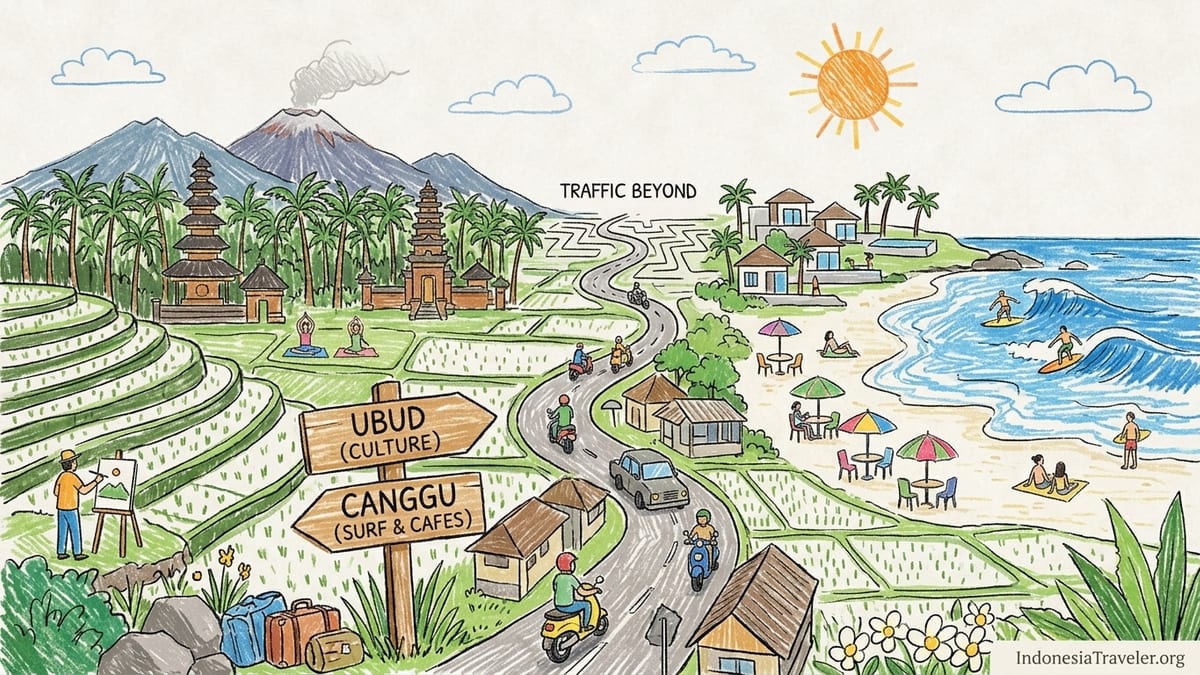
Choosing the wrong base in Bali rarely ruins a trip, but it can quietly drain your time, budget and patience. Properties are often marketed with aspirational labels that only loosely match reality: a villa advertised as “Ubud” can sit 25–40 minutes’ drive from the walkable center near the palace and Monkey Forest, while a stylish “Uluwatu” cliff room may actually be in Pecatu near Bingin or Padang Padang, with no safe pavement and a steep scooter climb from the beach. Map pins can hide broken back roads and traffic bottlenecks, and photos rarely reveal how long you will spend in a car getting anywhere. This guide compares Bali’s main bases in practical, on-the-ground terms using October 2026 price sampling, real driving times and specific locations, so you can match your base to how you actually want to spend your days.
How Bali’s Bases Really Work on the Ground
Online, Bali looks compact. In practice, narrow roads, village traffic and scooters turning in all directions mean that a 25 kilometer journey can take an hour or more. In October 2026, a mid-morning drive from central Canggu (around Batu Bolong) to central Ubud has commonly taken 70 to 100 minutes by car, even though mapping apps may optimistically suggest under an hour. Airport to Canggu or Ubud transfers that look like a simple 20–30 kilometer hop can easily stretch beyond 90 minutes if your arrival collides with school pick-up or weekend beach traffic.
The second catch is location naming. Many booking sites treat entire subdistricts as one destination. A villa labeled “Ubud area” might be in Tegallalang or Mas, 9–15 kilometers from the palace and main restaurant streets. That feels remote if you imagined strolling to dinner. Around Uluwatu, the official village name is Pecatu; accommodation marketed as “Uluwatu” spans a wide area that includes Bingin, Padang Padang and Balangan. Getting between these beaches usually means 10–20 minutes by scooter or car each way, often on unlit, uneven roads. For some travelers that is part of the charm; for others it is an unwelcome surprise.
The final piece is price. As of October 2026, you can still find simple homestay rooms from roughly the lower end of the double digits in US dollars per night across Bali and smart midrange hotels commonly fall in the mid double digits to low triple digits, but the same budget buys very different experiences depending on location. A family-friendly beachfront room in Sanur can be comparable in price to a stylish but landlocked villa in Canggu, while Uluwatu’s clifftop boutique properties and Nusa Dua’s branded resorts usually sit higher. Understanding what each base actually delivers in walkability, access to beaches and excursions is more important than shaving a few dollars per night.
Ubud: Culture Hub With No Beach and Real Distance Penalties
Ubud is marketed as Bali’s cultural heart, and that description still holds. In and around the center you find the palace, traditional dance performances, temples like Saraswati, galleries, yoga studios, cooking schools and access to rice terraces and river valleys. The property stock is mixed. In central areas like Monkey Forest Road, Hanoman and Jalan Gootama you see compact guesthouses and boutique hotels. Just outside town, deep-valley resorts line the Ayung River and ridges toward Kedewatan and Payangan, with infinity pools looking into forest rather than ocean.
In October 2026, simple but comfortable guesthouses within a 10 to 15 minute walk of Ubud’s main crossroads often price in the mid to upper double digits in US dollars for a double room including breakfast. Well-reviewed boutique hotels with pools, walkable to restaurants, tend to fall from the low hundreds upward. High-end jungle resorts with villas and private pools in Kedewatan, Sayan or Payangan typically start in the low to mid hundreds and climb sharply from there, especially under international brands.
Walkability depends completely on how central you book. Around the palace and Monkey Forest you can walk between dozens of restaurants, cafes and spas, although pavements are narrow and uneven. A property marketed as “Ubud” but actually near Tegallalang rice terraces can be 25–35 minutes by car from this walkable core. There is no beach close to Ubud. The nearest usable swimming beaches are around Sanur or the southeast coast, usually 60–90 minutes each way by car in current traffic. Daily beach trips from Ubud are possible, but they cost real time and transport money.
As a base, Ubud works very well if you care more about temples, craft villages, yoga and inland excursions like rafting or Mount Batur sunrise hikes. Many tour operators will pick up from central hotels; if you stay outside town, they may charge extra or require earlier wake-up times. Families appreciate the pool-and-view resorts and the calmer evenings compared with the coast, although traffic in the town center can be dense. Environmental drawbacks include regular congestion on the approach roads, exhaust fumes, limited pedestrian crossings and, in the rainy season, occasional flooding on smaller lanes. Choosing Ubud as your only base makes less sense if your mental picture of Bali is long days on the sand.
Canggu: Surf, Cafes and Congestion
Canggu has evolved from a sleepy surf area into a dense patchwork of villas, cafes, beach clubs and coworking spaces stretching from Berawa through Batu Bolong to Pererenan. The typical property here is a private or semi-private villa tucked down a gang (side lane), often with a plunge pool and kitchen, or a small design-forward hotel near one of the main beach access roads. Beachfront rooms exist but are far outnumbered by backstreet stays that are walkable to cafes but not literally on the sand.
In October 2026, modest guesthouses and homestays in Canggu often sit in the mid double digits in US dollars for a double room, while one-bedroom pool villas can commonly price in the low to mid hundreds depending on exact location and finish. Larger multi-bedroom villas and luxury hotels near the water or with strong branding push higher, particularly around Berawa and Echo Beach. Many places include breakfast and strong Wi-Fi as standard, reflecting the remote-work crowd that has taken root here.
Walkability is mixed. If you base yourself near Batu Bolong or Berawa Beach, you can walk to coffee shops, casual restaurants, beach bars and supermarkets, though pavements are patchy and scooters weave through. From farther inland streets, even simple errands may require a scooter or ride-hail. The nearest swimming beach is essentially on your doorstep, but surf conditions tend toward beach breaks with notable currents and shore power. Good for intermediate surfers and up, less comfortable for small children or nervous swimmers when the swell is up. Red flags are a common sight, and there are no protected calm lagoons like Sanur.
The main downside is congestion. Travel times that look short on the map stretch out as cars and scooters funnel through a handful of bridges and intersections. A late afternoon drive from Canggu to Seminyak in October 2026 has often taken 40–70 minutes for under 10 kilometers, and Canggu to the airport can be anywhere from 45 minutes to well over 90. The nightlife and live music scene are lively, with beach clubs and bars running late. That suits younger couples, surfers and remote workers, but can feel intense for families seeking quiet. Environmental issues include traffic noise, dust from ongoing construction and periodic flooding on low-lying roads during heavy rain.
Seminyak and Jimbaran: Established Coast vs Airport Convenience
Seminyak remains one of Bali’s classic upmarket coastal bases, running roughly from the northern end of Legian up toward Petitenget. The shoreline is a long, grey-sand surf beach rather than a flat turquoise lagoon. Property styles include older low-rise hotels close to the sand, modern villa compounds and branded luxury resorts near Petitenget and the beach clubs. You find some of the island’s most established restaurants and boutiques here, plus high-profile day clubs along the water.
In October 2026, central Seminyak hotel rooms suitable for couples often cluster between the mid double digits and low hundreds in US dollars for reputable midrange options, with larger or beachfront properties rising into the mid hundreds and above. Private villas with pools in walkable pockets usually command per-night rates similar to or higher than those in Canggu, reflecting the area’s long-standing popularity and limited space close to the shore. Walkability here is significantly better than in more dispersed areas. From a hotel near Eat Street or Petitenget, you can walk to multiple dinner options and reach the beach in 5–15 minutes, though pavements are still uneven and traffic is busy.
Surf conditions in Seminyak resemble those in Canggu, with beach breaks and some rip currents. Confident swimmers can enjoy the water on calmer days, but parents need to watch children carefully. Nightlife is developed, from sunset cocktails to late-night clubs, and road noise is part of the ambiance. Seminyak is a practical base if you want a mix of eating, shopping and sunsets without committing to the heavier congestion and construction zones further north in Canggu. The drive from the airport to central Seminyak typically ranges from 25 to 50 minutes, depending on time of day.
Jimbaran, by contrast, is quieter and closer to the airport. The bay offers a long, gently curving stretch of sand with generally calmer waters than the west coast surf spots to the north, making it more appealing for younger children on many days. Classic seafood restaurants line parts of the beach, setting up barbecues in the sand at sunset. The accommodation mix includes large international resorts directly on the bay, hillside pool-villa properties above the water and smaller midrange hotels tucked along the main road. In October 2026, midrange beachfront or near-beach hotels in Jimbaran typically sit in the low to mid hundreds in US dollars for double occupancy, with hillside villas and branded five-star resorts pricing higher.
Jimbaran’s strengths are bay access and proximity to the airport. A private transfer to most bay-front resorts can often be as short as 15–25 minutes outside peak traffic, which matters after a long flight or before an early departure. Walkability is moderate: you can stroll the beach and nearby warungs, but the main road is busy, and exploring farther usually involves a car. Nightlife is limited compared with Seminyak or Canggu, which many families view as an advantage. Environmental drawbacks include aircraft noise audible in some areas and patches of litter on the sand after busy evenings, though resort staff make efforts to keep their frontages clean.
Sanur, Nusa Dua and Uluwatu: Calm, Contained and Clifftop
On the southeast coast, Sanur provides a very different feel. A long paved promenade runs behind a series of beach sections, with a mix of older resorts, small hotels and local cafes facing the water. The reef offshore helps create relatively sheltered swimming conditions, especially at mid to high tide, and paddleboards and small boats dot the lagoon. Families appreciate the combination of softer waves, shade trees and the ability to walk or cycle along the promenade without navigating traffic.
In October 2026, basic but pleasant Sanur hotels set just back from the beach often price from the mid double digits in US dollars per night, while midrange beachfront or just-off-beach properties with pools cluster around the low to mid hundreds. Large established resorts on prime frontage can move higher, though still often under the prices found in equivalent rooms at Nusa Dua or some Seminyak luxury properties. Sanur is also the main jumping-off point for fast boats to Nusa Lembongan, Nusa Penida and the Gili Islands, with early morning departures. Staying here the night before a boat trip avoids a pre-dawn transfer from elsewhere.
Nusa Dua, farther along the same peninsula, is different again. This is Bali’s most purpose-built resort enclave, with guarded gates, broad planned roads, manicured gardens and a series of large international hotels. Many visitors here spend most of their holiday within the resort or strolling between properties along the beachfront path. The beaches are generally calm, with some tidal variation, and are well maintained by the resorts. In October 2026, nightly rates for international-brand properties in Nusa Dua often begin in the low to mid hundreds in US dollars and rise into the high hundreds or beyond for club access, suites or villas. Walkability inside the enclave is good, but if you want local warungs or non-resort nightlife, you will be using taxis or ride-hail to reach neighboring areas.
On the Bukit peninsula’s western side, Uluwatu and the wider Pecatu area center on cliffs, viewpoints and surf rather than gentle family beaches. Accommodation spreads across hilltops and ridges, from simple surfer guesthouses near Padang Padang and Bingin to high-end clifftop resorts overlooking the breaks below. Many of the most photogenic stays involve steep paths or long staircases down to beach level. In October 2026, guesthouses and small hotels in the Bingin and Padang Padang area often run in the mid double digits in US dollars, with midrange boutique properties and pool villas usually around the low to mid hundreds. Iconic clifftop resorts with direct views of the Uluwatu break command higher rates, particularly in peak seasons.
Walkability in Pecatu is poor by city standards. There are few continuous pavements, and distances between beaches and restaurants are longer than they appear on the map. Most visitors rely on scooters or private drivers. The beaches themselves are beautiful but often involve steep access, currents and shore power. Surf is world class for experienced riders at Uluwatu, Padang Padang and Bingin, but conditions are rarely ideal for small children or weak swimmers. The drive from the airport to central Uluwatu or Bingin can be around 45–70 minutes depending on traffic. Nightlife focuses on sunset bars and occasional events rather than dense club streets. Environmental considerations include cliff erosion, narrow roads, ongoing construction dust and limited parking near popular viewpoints.
Quieter Alternatives: Sidemen, Amed, Tulamben, Munduk, Bedugul, Lovina and Pemuteran
Beyond the main south Bali belt and Ubud, several quieter regions offer more rural or under-the-radar stays at the cost of longer airport transfers and reduced restaurant choice. Sidemen, east of Ubud, is a lush valley of rice terraces and villages, with views toward Mount Agung on clear mornings. Accommodation ranges from simple homestays to elegant boutique resorts with infinity pools looking over terraced hillsides. In October 2026, many midrange Sidemen stays fall in the mid double digits to low hundreds in US dollars, offering strong value for spacious rooms and dramatic scenery. Driving time from the airport often runs two and a half to three hours, and there is no nearby beach, so Sidemen is best paired with a coastal base rather than used alone for a first-time Bali trip.
Farther northeast, Amed and neighboring Tulamben line stretches of black-sand coast with views across to Lombok. This area is known for snorkeling and diving rather than broad sandy beaches. Shore entries over pebbles and coral are common, and currents can vary. Tulamben is famous for the USAT Liberty shipwreck, which is reached directly from the pebble beach. Accommodation stock here runs from basic dive lodges priced around the lower double digits in US dollars to comfortable seaside hotels and villas in the mid double digits to low hundreds. The drive from the airport takes around three to three and a half hours by car in typical traffic as of late 2026, so using Amed or Tulamben as your only base can mean long days on the road for inland excursions.
In the north-central highlands, Munduk and Bedugul bring cool air, lakes and waterfalls. Properties tend to be small lodges, homestays and boutique retreats with mountain or valley views. Nights are cooler than the coast, and some rooms lack air conditioning, which is a plus for some guests and a drawback for others. October 2026 prices for comfortable rooms in Munduk and Bedugul often fall around the mid double digits to low hundreds in US dollars. Driving times from the airport are generally two and a half to three hours. This region suits travelers who want hikes, waterfalls and a quieter pace rather than nightlife or beach time.
On Bali’s far north coast, Lovina and Pemuteran offer yet another experience. Lovina is a spread-out area of villages along a calm black-sand bay, historically known for early morning dolphin-watching trips. Pemuteran, closer to the West Bali National Park, has coral restoration projects and access by boat to Menjangan Island, a well-regarded snorkel and dive spot. Accommodation ranges from very simple guesthouses to relaxed seaside resorts with gardens and pools, again generally priced in the mid double digits to low hundreds in US dollars during October 2026. These areas are three to four hours from the airport by car, depending on route and traffic. They work well as part of a longer itinerary that loops around the island but feel remote if you want frequent restaurant variety or late-night options.
Choosing Your Base: Practical Trade-offs and Itinerary Ideas
When you zoom out, each of Bali’s main bases trades something away. Ubud trades immediate beach access for culture and inland excursions. Canggu trades quiet and easy driving for surf, cafes and nightlife. Seminyak trades some sense of seclusion for walkable dining and shopping. Sanur trades big-swell drama for a calmer lagoon, a promenade and early boat departures. Jimbaran trades nightlife density for bay swimming and short airport runs. Uluwatu and Pecatu trade walkability and family-friendly water for cliff views and world-class waves. Nusa Dua trades “local feel” for self-contained resort comfort. The quieter outliers trade convenience for space and nature.
For a five-night trip, moving hotels once can improve the experience if it reduces backtracking. A common pairing is three nights in Ubud followed by two on the coast. For instance, stay within walking distance of Ubud’s palace area so you can eat out without transfers, then move to Sanur or Jimbaran for easier access to the airport and some beach time. Switching bases in the middle, such as splitting five nights between Canggu and Seminyak, often yields less benefit because you remain within the same congested zone and lose time packing and checking in.
On a seven-night trip, two bases work well. A practical layout is four nights in Ubud and three in a coastal base that matches your style. Surf-focused travelers might choose Canggu or Uluwatu; families might favor Sanur or Nusa Dua; couples wanting dining and shopping could pick Seminyak. The key is to minimize big drives on intermediate days. It usually makes sense to travel Ubud to coast once in the middle, then coast to airport at the end. Adding a third base in only seven nights, such as Ubud plus Canggu plus Uluwatu, tends to eat time without delivering proportionate rewards unless you are very keen on sampling multiple surf breaks.
With ten nights, a three-base itinerary can justify the moves if carefully planned. One example is three nights in Ubud, three nights in Sidemen or Munduk for quieter scenery, and four nights on the coast at Sanur, Seminyak or Jimbaran. Another approach is four nights in Ubud, three in Canggu for cafes and surf, and three in Uluwatu for cliffs and sunset bars. In each case, check driving times and avoid placing your most distant base just before you fly out. If your final night is in Nusa Dua, Sanur or Jimbaran, you reduce the stress of last-day traffic.
On a fourteen-night stay, you can reasonably circle part of the island. For example, start with three nights in Sanur to decompress and take a day trip to Nusa Lembongan, then move to four nights in Ubud, three in Munduk or Bedugul, and finish with four in Pemuteran or Lovina before looping back via Ubud or the south for your final night near the airport. Another version focuses on diving by linking Ubud, Amed or Tulamben, and Pemuteran. In all longer itineraries, moving hotels is worth it when each new base changes what you can comfortably do in a day without long transfers. If two planned bases would serve mainly the same restaurants, beaches and day trips, you usually gain more by choosing the better-located one and staying put.
The Takeaway
Where you stay in Bali matters less for ticking sights off a list and more for how your days feel. The marketing label on your hotel is only the starting point. A central Ubud guesthouse lets you walk to dinner and dip in and out of galleries, but leaves you far from the sea. A Canggu villa gives you surf and cafes near at hand, but folding chairs of traffic every time you want to explore. Sanur and Nusa Dua simplify family beach days and early boats, at the cost of rougher edges and some sense of local street life. Jimbaran softens arrival and departure days with a sheltered bay. Uluwatu, Sidemen, Munduk and Pemuteran reward travelers willing to trade convenience for scenery and space.
There is no single best base, only a best match to how you imagine using your time. If you hate packing and unpacking, choose one well-located area that roughly matches your priorities and use day trips for variety. If you enjoy the feeling of “shifting chapters” on a trip, plan two or three bases that clearly differ in setting and activities, and string them together in an efficient line rather than criss-crossing. Grounding your decision in drive times, neighborhood maps and realistic walking expectations will help ensure that Bali feels like the easygoing island escape you hoped for rather than a week spent sitting in traffic.
FAQ
Q1. Is it realistic to stay only in Ubud for a first Bali trip?
It is possible, but you will not have an easy beach day. Expect around 60 to 90 minutes each way by car to reach swimmable beaches from central Ubud, and factor in the extra transport cost. Many first-time visitors prefer to split between Ubud and one coastal base so they experience both the inland culture and the sea without long transfers.
Q2. Where should families with young children stay in Bali?
Sanur, Nusa Dua and parts of Jimbaran generally work best because of calmer water, easier beach access and more family-oriented resorts. Sanur’s promenade is helpful for stroller walks, while Nusa Dua offers self-contained complexes with kids’ clubs. Checking room configurations and pool fencing in advance is important, especially in private villas.
Q3. Which area is best if I want to surf and work remotely?
Canggu and parts of Uluwatu are strong choices. Canggu has several coworking spaces, many cafes with reliable Wi-Fi and consistent beach breaks, though traffic can be heavy. In Uluwatu and Bingin, connections have improved at many guesthouses and boutique hotels, but you are more dependent on scooters and private drivers for errands and meals.
Q4. How far is Uluwatu from the airport, really?
In typical October 2026 conditions, the drive from Ngurah Rai International Airport to central Pecatu or Bingin usually takes between 45 minutes and just over an hour by private car, depending on time of day and traffic. Heading there exactly at sunset or during big events can add more time, so allowing a buffer is wise, particularly on departure.
Q5. Is Seminyak still worth it, or should I just stay in Canggu?
Seminyak and Canggu now blend into each other, but they feel different. Seminyak offers more established restaurants, easier walkability in central pockets and a slightly more polished atmosphere. Canggu skews younger and more informal, with heavier congestion and more construction but a deeper cafe and coworking scene. If you value being able to walk to dinner easily, Seminyak often wins.
Q6. Are the quieter areas like Sidemen or Munduk too far for a short trip?
For stays under a week, basing solely in Sidemen, Munduk or the north can mean long initial and final transfers. They are better as part of a ten or fourteen-night itinerary, especially when combined with a night closer to the airport before you fly out. If you have only five nights, pairing Ubud with a south-coast base is usually more efficient.
Q7. What is the most convenient area for early boat trips to Nusa Penida or the Gilis?
Sanur is usually the most practical choice because many fast boats to Nusa Penida, Nusa Lembongan and some Gili routes depart early from its beaches. Sleeping in Sanur the night before your crossing allows a later wake-up and avoids the risk of traffic delays from Canggu, Ubud or Uluwatu at dawn.
Q8. Do I need to rent a scooter, or can I rely on cars and ride-hailing?
In most bases you can rely on taxis, hotel cars and ride-hailing services arranged through apps where permitted, though prices and availability can fluctuate. A scooter provides flexibility in spread-out areas like Canggu and Uluwatu but carries safety risks if you are inexperienced, especially with Bali’s traffic and road conditions. Many travelers choose walkable locations to minimize any need for two-wheel transport.
Q9. How many bases are ideal for a two-week stay?
For fourteen nights, two or three bases usually balance variety and rest. A common pattern is one inland (such as Ubud or Sidemen) plus one or two coastal bases (for example Sanur and Pemuteran, or Canggu and Uluwatu). Adding a fourth base often fragments the trip unless you particularly enjoy short stays and packing frequently.
Q10. When is it better to choose one base and do day trips instead of moving?
If the places you want to visit are within 60 to 90 minutes of each other and share similar landscapes and activities, a single well located base often makes more sense. For example, staying in Seminyak and visiting Canggu, Tanah Lot and Uluwatu as separate day trips can be easier than changing hotels three times, particularly if you dislike packing and check-ins.