


Bali’s traffic, tropical rain and unpredictable road conditions make scooters look far less carefree once you actually land. The good news is that in 2026 you can explore almost all of Bali without ever renting a motorbike. This guide starts at Ngurah Rai International Airport and follows the routes most visitors actually travel, comparing taxis, Grab and Gojek, shuttle buses, full-day drivers, self-drive cars and fast boats to Nusa Penida and Nusa Lembongan.
Arriving at Ngurah Rai Airport: From Immigration to the Curb
Most international visitors land at I Gusti Ngurah Rai International Airport, usually just called Bali Airport or DPS. After disembarking, you follow a long corridor to immigration. Queues fluctuate sharply through the day, with late afternoon and late evening often the busiest. If you are eligible for visa on arrival, you first pay at the visa counters, then join the immigration line. Keep your passport, boarding pass and completed arrival card ready to speed things up.
After immigration you pass through a duty-free area before reaching baggage claim. There are trolleys and several baggage belts, and it is common for bags to take 20 to 40 minutes to appear when multiple flights arrive together. While you wait you will see ATMs along the wall and, on the way out, official money changers and mobile phone counters. If you plan to rely on Grab or Gojek, buying a local SIM card or confirming that your roaming data works here is practical, because both apps rely on data and SMS verification.
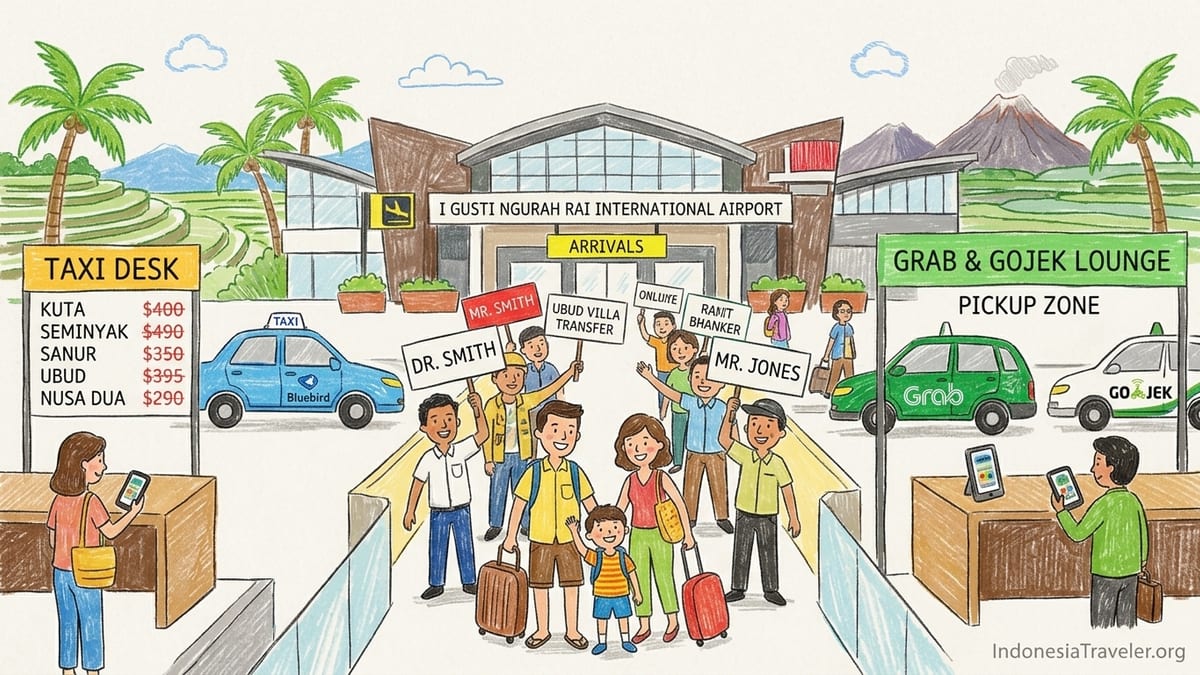
Once you clear customs, sliding doors open into the arrivals hall. This area can feel intense: hotel representatives and private drivers hold name signs, while freelance taxi touts call out offers. Walk past this crowd rather than accepting the first price you hear. Official airport taxis, ride-hailing lounges and prebooked transfer meeting points are all located just beyond the initial bottleneck, and using them will give you clearer prices and better recourse if something goes wrong.
If you have prebooked a hotel transfer or a driver through a tour company, your confirmation email usually describes a specific meeting point, such as near a particular café or numbered column. Drivers are used to flight delays and normally monitor arrival times, but it is still wise to ensure your booking includes a clear “wait time” policy so you are not charged excessive overtime if immigration is slow.
Official Airport Taxis, Grab and Gojek Pickup Zones
Ngurah Rai Airport has an official taxi cooperative with a desk just outside arrivals. Staff quote fixed prices by zone, for example a one-way ride to Kuta, Seminyak, Canggu, Sanur, Nusa Dua or Ubud. These fares are often higher than ride-hailing apps, but you get a licensed vehicle and you pay at the counter or in the car with a printed or handwritten slip that lists your destination. As of late 2026, typical official desk quotes for a small car are in the range many travelers describe online as roughly what mid-range hotels charge for private transfers, while ride-hailing apps often come in noticeably cheaper for the same destination.
Grab and Gojek are allowed to pick up at Bali Airport, but they cannot stop directly at the arrivals curb used by the airport taxis. Instead, both operate from designated pickup lounges set slightly away from the main exit. After customs you turn left and follow signs for Grab or Gojek, passing the line of drivers with name boards. Recent traveler reports describe staffed lounges with seating and counters where you can wait for your assigned car, away from freelance touts. App bookings to and from the airport are now routine, including late at night.
When comparing GrabCar and GoCar (the car services) for your first ride, look at three practical factors: price, estimated arrival time and vehicle type. At busy times dynamic pricing can push a short trip like airport to Kuta above what the official taxi desk charges, while at quieter times app rides can be half the price of a hotel’s quoted transfer. Both apps show the driver’s name, plate number, photo and past ratings, and you can share your live trip with friends or family, which many solo travelers find reassuring.
One caveat is waiting time. In peak evening hours or during heavy rain, you might see 10 to 20 minutes for a car to reach the airport pickup zone. If you are traveling with young children or a lot of luggage and prefer to leave immediately, the higher but predictable price of an official taxi or prebooked transfer can be worth it. If budget matters more and you have the energy to navigate the pickup area, Grab or Gojek usually win on value, especially for destinations within 30 to 60 minutes of the airport.
Short Trips on Bali: Grab, Gojek and Metered Taxis
Once you settle into Kuta, Seminyak, Canggu, Sanur or Ubud, most short trips are easily covered by Grab, Gojek or metered taxis. GrabCar and GoCar work similarly to other ride-hailing apps: you set your pickup and drop-off points on a map, see an upfront price estimate, and pay by card or cash. Gojek also offers GoRide motorcycle taxis, which can be quicker and cheaper in congested traffic, but this article focuses on car-based options because it is written for travelers who prefer not to ride scooters themselves.
In central tourist areas you rarely wait more than a few minutes for a car. For example, a mid-afternoon GrabCar between Petitenget in Seminyak and central Canggu might show an estimated price in the low tens of thousands of rupiah, with a five to ten minute wait. At night or in heavy rain, prices can rise sharply as demand spikes, and waits can stretch closer to twenty minutes. If the price surge looks unreasonable, wait a few minutes and refresh, or try the other app to compare.
Both Grab and Gojek verify drivers, but quality varies. Some drivers are long-time residents who know back roads and parking spots; others rely entirely on navigation. Check the rating and read a few recent comments before accepting a ride, especially for longer distances. Because you choose the destination in-app and the fare is set, there is little incentive for a driver to “take the long way,” in contrast with some traditional taxis where you must watch the meter or discuss the route.
Metered taxis still play a role, particularly Bluebird taxis that can be hailed on the street in southern Bali. These use a visible meter and have a reputation among many visitors for more consistent pricing than unmetered local taxis. In practice, ride-hailing apps have become the main short-trip option for most tech-comfortable travelers, while metered taxis remain a useful backup when your phone battery dies, mobile data is weak or app drivers cannot find your small guesthouse.
Full-Day Private Drivers and Rural Sightseeing
As soon as you want to string several stops together, such as waterfalls, rice terraces and temples in central or northern Bali, hiring a car with a driver for the day becomes very attractive. Travelers in 2025 and 2026 frequently report rates around a few hundred thousand rupiah for roughly eight to ten hours in a comfortable air-conditioned car, often with space for four passengers plus luggage. Fuel is normally included, but tolls and parking fees might be extra.
The key to a smooth day is to agree on details before you set off. Confirm the itinerary in writing, including approximate departure and return times, and list all main stops. Clarify how long you expect to spend at each major attraction, such as Tegalalang rice terraces, Tirta Empul water temple, or Ulun Danu Beratan near Bedugul. Ask explicitly about parking charges, detours, entrance fee stops where the driver might earn commission, and how overtime will be calculated if you return late.
This clarity matters because traffic can be unpredictable. A loop such as Ubud to Kintamani, on to Tirta Empul, then back via rice fields and a coffee plantation might look short on a map but still turn into a ten-hour day once you add photo stops and café breaks. Some drivers are content to wait in the car while you explore; others may act as informal guides, walking with you at certain stops. Tips are appreciated but not compulsory, and it is easier to judge an appropriate tip when you agreed the base price clearly beforehand.
For rural sightseeing, you can technically chain together multiple Grab or Gojek rides, but this quickly becomes inefficient. An app driver will not usually wait while you explore a temple for two hours, and you may find there are few cars in remote villages when you are ready to move on. In contrast, a private driver stays with you for the day, keeps your belongings safe in the car between stops, and can suggest time-saving route changes if heavy rain or road works appear ahead.
Public Transport Reality: Buses, But No Trains
Bali does not have an intercity rail system, despite long-discussed proposals for a metro or light rail. As of late 2026, there is still no operational island-wide train for visitors, and the much-publicized Bali Metro remains at the planning stage with no confirmed opening date. This means that for medium and long distances you are choosing between private vehicles, shared shuttle buses and a limited but developing network of public buses in the Denpasar area.
The Kura-Kura Bus is a privately operated shuttle aimed at tourists, running minibuses on a small number of fixed routes. Current information from the operator shows services such as a Kuta to Ubud and Kintamani line, with one-way tickets priced in the low hundreds of thousands of rupiah depending on the route and ticket type. Seats are limited and departures are scheduled, so you need to plan around their timetable rather than simply turning up. For budget-conscious solo travelers who are not in a rush, Kura-Kura can be a cost-effective way to reach Ubud or join a Kintamani day circuit without hiring a private driver.
Trans Metro Dewata is a government-backed bus system serving the Denpasar metropolitan area. After a pause in early 2025 it was reactivated and, by 2026, operates several color-coded routes using modern, air-conditioned buses on dedicated and mixed-traffic lanes. These buses connect areas like Denpasar, Sanur and parts of Badung, and fares are very low compared with taxis. However, the network is designed primarily for residents’ commuting needs, not for tourists with luggage. Stops may be far from hotels, service information is mostly in Indonesian, and schedules can change with limited English-language publicity.
For visitors, this means Bali’s “public transport” is real but limited in where it takes you. It works if you are staying long term in Denpasar or Sanur and want a cheap way into town, or if your accommodation happens to be near a Kura-Kura or Trans Metro Dewata stop. It is far less convenient for moving between major tourist hubs like Canggu, Uluwatu and Ubud with suitcases. A realistic strategy is to treat buses as a bonus when they line up with your plans, but rely primarily on cars and drivers for most travel.
Self-Drive Cars Versus Cars with Drivers
Some travelers consider renting a car and driving themselves. Indonesia drives on the left, like the United Kingdom and Australia, and much of Bali’s road network consists of narrow village lanes and busy two-lane highways with mixed traffic that includes trucks, buses, scooters and pedestrians. Signage can be inconsistent, and local driving norms permit maneuvers that may surprise visitors, such as overtaking into seemingly tight gaps or scooters passing on both sides of the car.
If you do choose self-drive, you legally need an appropriate license. For tourists, this usually means holding a valid license from your home country plus an International Driving Permit that covers the vehicle class you intend to drive. Rental companies may not verify the permit carefully, but driving without one can invalidate your insurance and expose you to fines at police checks. You should also examine your rental contract to understand the deductible, coverage for single-vehicle accidents and exclusions around driving on unsealed roads.
Parking is another practical consideration. In central Ubud, Canggu’s smaller streets or the alleys near popular beach clubs, finding a legal spot for a full-size car can be more stressful than the drive itself. Many Balinese drivers know informal parking lots or side streets near attractions like Tanah Lot or Uluwatu; as a visitor you might spend twenty minutes circling for a space that a local driver can secure in two. When you add the time and concentration cost of driving to unfamiliar rural areas after dark, the savings of self-drive can evaporate quickly.
For most short stays, hiring a car with a driver is the more relaxed option. You pay a flat daily rate, do not need an International Driving Permit, and can enjoy roadside scenery or check maps without simultaneously navigating scooters and potholes. Families with children often prefer this arrangement, because they can keep car seats installed for the whole day and leave beach bags or snacks in the vehicle between stops without worrying about theft in a public parking lot.
Why Many Visitors Skip Scooters
Motorbike rental is highly visible in Bali, but it is not compulsory for a good trip, and it carries significant risk if you are inexperienced. Legally, you need the correct category of driving license from your home country plus an International Driving Permit that covers motorcycles if you want your travel insurance to recognize you as a licensed rider. Many rental shops will hand over keys without asking, but if you crash without a proper license or permit, insurers frequently decline medical and liability claims.
Indonesian law requires helmets, and police occasionally run checks, especially on main roads. Quality helmets at rental shops vary, from modern full-face models in good condition to older open-face helmets with worn straps. If you do ride, insist on a helmet that fits snugly and consider buying or bringing your own. Riding in shorts and sandals may look carefree, but road rash and fractures are common outcomes of low-speed spills on gravel or wet tiles.
Traffic patterns in Bali can be unforgiving for new riders. Scooters weave between cars, overtake on blind bends and squeeze through impossibly small gaps. Road surfaces change quickly from smooth asphalt to potholes, broken edges and sandy patches, especially after heavy rain. Visitors who only ride scooters occasionally at home are at much higher risk of injury than local riders who grew up on these roads. Hospitals in Bali do treat large numbers of scooter accidents, and even a minor crash can ruin a trip.
If your main reason for considering a scooter is flexibility, remember that Grab, Gojek and private drivers collectively cover almost every popular beach, café, temple and viewpoint on the island. You might spend more per day than a scooter rental, but you dramatically reduce the chance of serious injury, police trouble or insurance disputes. For many travelers, that trade-off feels worthwhile once they see the reality of Bali’s traffic on the ground.
Sanur Harbour and Fast Boats to Nusa Penida and Lembongan
Sanur is the principal jumping-off point for Nusa Penida and Nusa Lembongan, the islands just off Bali’s southeast coast. Door-to-door, your trip involves at least three stages: hotel transfer to Sanur Harbour, check-in and boarding, the sea crossing, and onward transport on the island. Treat each stage as a separate piece of planning, especially if you have large bags or children.
Most travelers reach Sanur Harbour by private car or prearranged transfer. From Ubud this might be a drive of roughly 60 to 90 minutes depending on traffic; from Seminyak or Canggu it can be 45 to 70 minutes. Grab and Gojek can drop you near the harbor entrance, but local rules may prevent them from waiting or picking you up right at the busy beachfront in the afternoon. It is common for fast boat operators to include hotel pickup within central Sanur and sometimes from Kuta or Seminyak for an extra fee, which can be convenient for early morning departures.
Check-in usually happens at a small office or counter behind the beach. Operators such as Maruti, Rocky, Arthamas, The Tanis and others run multiple crossings daily, often starting around 07.30 or 08.00 and continuing through the afternoon, with crossing times of roughly 30 to 45 minutes. One-way adult fares booked in advance through online agencies are often listed from around the mid-hundreds of thousands of rupiah, depending on season and whether hotel transfers are included. Schedules can and do change at short notice in response to weather and sea conditions, so treat any timetable as approximate and reconfirm a day before you sail.
At check-in, you usually tag your main luggage, which staff stack separately, then keep smaller bags with valuables with you. Boarding at Sanur is often via a shallow-water beach rather than a solid pier, so expect to walk across wet sand and sometimes through ankle or knee-deep water to reach the boat. Wear shorts or quick-drying trousers and footwear you do not mind getting wet. Staff are used to helping older travelers and children, but during high tide or swell boarding can still feel physically demanding.
Maritime safety deserves particular attention. Before booking, confirm that your chosen operator provides life jackets for all passengers and appropriately sized equipment for children. Many reputable fast boat companies explicitly state that life jackets are available and may be distributed or demonstrated before departure. Once on board, look for where the jackets are stored and do not hesitate to ask crew if you cannot see them. If the sea looks rough or strong wind warnings are in place, be willing to postpone your trip even if the boat is technically still running; operators sometimes cancel sailings at short notice precisely because the crossing would be unsafe.
On arrival in Nusa Penida, you might land at Toya Pakeh, Banjar Nyuh, Buyuk or Sampalan, depending on the operator. The harbor area is usually chaotic at peak times, with multiple boats unloading passengers and luggage at once. Prebooked drivers often wait with signs, and local taxis or open-air pickups cluster near the road. There is no island-wide public bus network, so budget either for a day tour by car with a driver or for your accommodation to arrange a transfer. Roads in Nusa Penida in particular can be narrow, steep and poorly surfaced, another strong argument against renting a scooter purely for independence.
Putting It Together: Door-to-Door Transport Examples
To see how these options work in real life, consider a few common door-to-door journeys. From Bali Airport to Ubud, a prebooked hotel transfer might quote a flat price that many recent visitors describe as around the same order as an official airport taxi, with the advantage that your driver meets you with a sign and helps with bags. Grab or Gojek quotes can be significantly cheaper in off-peak hours but may approach the same level in heavy traffic or rain. Travel time is typically 60 to 90 minutes depending on whether you are staying in central Ubud or a rural villa.
For a shorter hop like Canggu to Tanah Lot at sunset, you could open Grab or Gojek and book a car that takes 30 to 50 minutes each way. However, recent traveler reports note that app pickups from directly inside the Tanah Lot complex are restricted; you may have to walk out to the edge of the area to meet your car. If you prefer not to negotiate these local rules in the dark, hiring a private driver in Canggu for the evening and agreeing on a round-trip price that includes waiting and parking can feel much simpler.
For Sanur to Nusa Penida, a common pattern is a hotel in Sanur including a short transfer to the harbor in your room-and-boat package. You check in at the operator’s desk, tag your luggage, board the fast boat, then meet a prebooked driver on arrival in Nusa Penida who takes you directly to your guesthouse near Crystal Bay or the eastern cliffs. Each leg involves a different vehicle, but from your perspective it feels like a smooth chain if you keep printed or digital confirmations handy.
For a scenic inland route like Ubud to Munduk, chaining ride-hailing trips can be tiring. You might need an app car from your villa to central Ubud, another from Ubud to Bedugul and a third from there to Munduk, with uncertain waits at each step. A full-day driver hired in Ubud can instead collect you from your accommodation, stop at Ulun Danu Beratan temple or the Handara Gate for photos, wait while you walk around the lakes, and finish by dropping you at your Munduk homestay by late afternoon, all under one agreed fare.
The Takeaway
Bali in 2026 offers enough cars, drivers and boats that you can confidently skip renting a scooter without missing the island’s highlights. Start by planning your arrival: decide whether you value the predictability of a prebooked transfer, the flexibility of Grab or Gojek from the airport lounges, or the simplicity of the official taxi desk. For short hops between beach clubs, cafés and nearby villages, ride-hailing apps and metered taxis cover most needs, while full-day private drivers shine once you leave the main resort strips.
Public transport exists but is patchy, useful where it lines up with your plans but not a complete network. Self-drive cars can suit experienced left-side drivers willing to manage parking and insurance details, yet many visitors find that hiring a driver costs less than expected and delivers far more relaxation. Fast boats from Sanur connect you to Nusa Penida and Lembongan, but safety and weather should guide your choices more than timetable convenience.
The real trade-off is cost versus mental load and risk. Scooters are undeniably cheap per day, but their true price includes higher accident risk, legal gray areas and potential insurance problems. Cars, drivers and organized transfers cost more in cash yet let you focus on temples, rice terraces and coastlines instead of traffic. With a bit of planning, you can explore Bali’s beaches, volcano rims and offshore islands entirely on four wheels and fast boats, returning home with memories rather than bandages.
FAQ
Q1. Can I rely on Grab and Gojek for my entire Bali trip?
In southern Bali and Ubud, many visitors do exactly that, using Grab or Gojek cars for airport transfers and local trips, then hiring private drivers for longer rural sightseeing where app coverage can be patchy.
Q2. Are Grab and Gojek allowed to pick up at Bali Airport?
Yes. As of October 2026 both operate from designated pickup lounges at Ngurah Rai Airport, though they cannot collect passengers directly from the main arrivals curb used by airport taxis.
Q3. How much does a full-day private driver cost in Bali?
Recent traveler reports commonly mention rates around several hundred thousand rupiah for roughly eight to ten hours in a private car, with fuel usually included and overtime or long distance surcharges agreed in advance.
Q4. Is there any train or metro I can use to get around Bali?
No. There is currently no operational intercity rail or metro system in Bali, and visitors move primarily by car, bus, shuttle and fast boat while train projects remain at the planning stage.
Q5. Is Bali’s public bus network useful for tourists?
Buses like Kura-Kura and Trans Metro Dewata can be useful on specific routes around Denpasar, Sanur and to Ubud, but coverage is limited and schedules favor local commuters rather than visitors with luggage.
Q6. Do I need an International Driving Permit to drive a car in Bali?
Yes, in addition to your valid home-country license you should carry an International Driving Permit that covers cars; without it you risk fines and insurance problems if you are involved in an accident or stopped by police.
Q7. How safe are fast boats from Sanur to Nusa Penida?
Many operators provide life jackets and experienced crews, but safety standards vary, so choose companies that clearly state safety equipment, check conditions on the day, and accept cancellations or delays during bad weather.
Q8. Can I visit Nusa Penida without renting a scooter?
Yes. You can book a car with a driver or an organized tour that meets you at the harbor, takes you to main viewpoints and beaches, then returns you to your accommodation without any need to ride yourself.
Q9. Are scooters really that risky for tourists in Bali?
For inexperienced riders they can be very risky due to dense traffic, changing road surfaces and limited protective gear; local hospitals treat many scooter injuries that could have been avoided by using cars and drivers instead.
Q10. What is the best way to arrange airport to Ubud transport without a scooter?
The most straightforward options are a prebooked hotel or agency transfer, an official airport taxi from the arrivals desk, or a Grab or Gojek car from the airport pickup lounge, with travel time usually around one to one and a half hours depending on traffic.