


Taking toddlers and young children to Bali sounds effortless on social media. Infinity pools, kids’ clubs and sunset swings are presented as proof that the island is “made” for families. After multiple trips with my own small children, I no longer believe that assumption. Bali can be rewarding, but it is not automatically easy or safe for young kids just because there are many resorts. It takes deliberate choices about where you base yourself, how you move around, and what you actually do with your days.
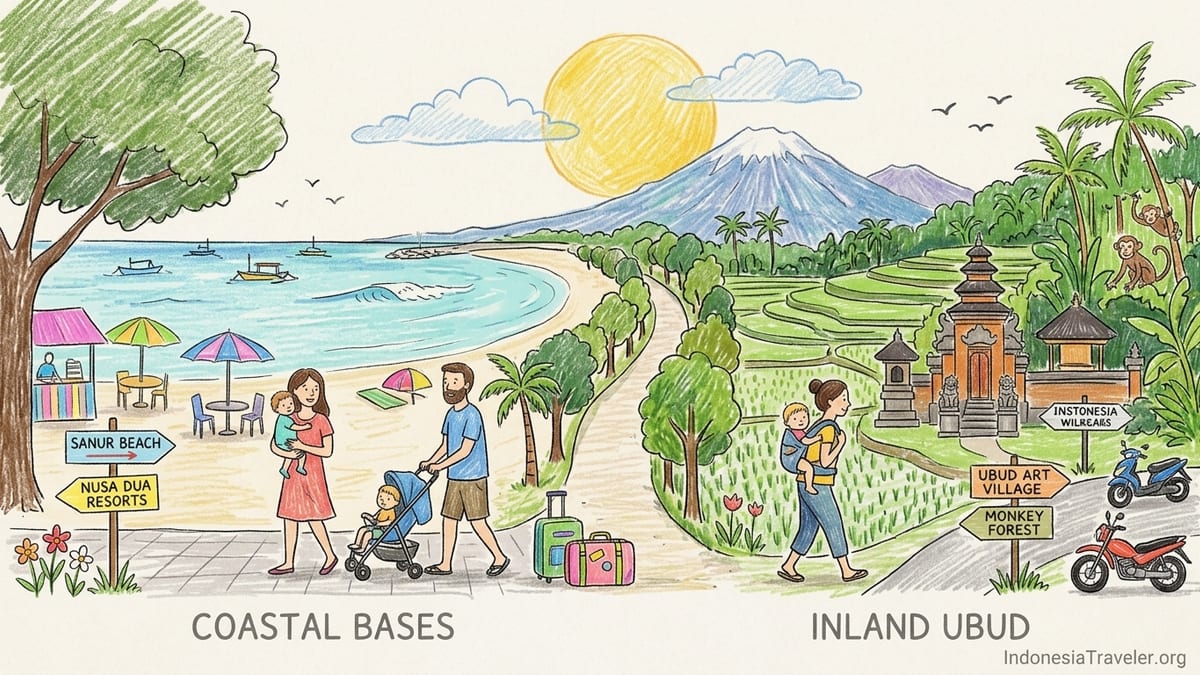
Sanur, Nusa Dua, Jimbaran and Ubud: Choosing a Realistic Base
For families with toddlers, four areas regularly come up as suggested bases: Sanur, Nusa Dua, Jimbaran and Ubud. Each offers genuine benefits, but each also has limitations that glossy hotel marketing quietly skips. Before you book that “family package,” it is worth understanding how they really work with small children who need naps, shade, predictable food and safe water access.
Sanur, on Bali’s south‑east coast, is often described as the calm, family‑friendly option, and for good reason. The long beachfront path is pram‑friendly, and the offshore reef usually keeps the lagoon relatively sheltered. However, there are two competing realities about swimming here. Some official tourism material now claims Sanur is swimmable all day because the lagoon is reef‑protected. At the same time, current local guides and Sanur specialists note that at low tide the sea can retreat a long way, leaving shallow, sea‑grassy water that is not practical for proper swimming and may expose rocks and urchins. In practice, with toddlers you are likely to plan your beach swims around the tide, using high tide windows for deeper water and low tide for sand and shell play on the wide exposed flats.
Nusa Dua, on the other hand, often feels purpose‑built for the package‑holiday family. The beaches fronting major resorts are relatively protected, there are lifeguards on the main section, and several hotels offer supervised kids’ clubs. The trade‑off is cost and isolation. Many large Nusa Dua hotels are set inside gated complexes, which can mean high prices for food, laundry and activities, and limited interaction with local communities unless you actively seek it out by taxi or driver. With toddlers, this can be both a blessing and a curse: it simplifies logistics on site but makes any off‑resort excursion involve a car trip and a mental reset.
Jimbaran occupies an in‑between space. Parts of the bay, especially around the central stretch near the seafood restaurants, can offer gentler surf than places like Canggu, and some family‑oriented resorts here have relatively calm beachfronts. But Jimbaran varies enormously by exact location. The section near the airport can be noisy and less appealing, some stretches are dominated by daybeds and restaurant setups rather than clear sand, and onshore winds can bring in rubbish at certain times of year. If you book purely on the basis of “Jimbaran Beachfront” in the hotel description without checking a map and recent photos, you may arrive with a stroller and beach toys to find that the nearest child‑friendly paddling area is a 15‑minute walk down uneven sand.
Ubud, popular with wellness travelers, is regularly marketed as a family‑friendly culture hub. It can work well if you want rice field walks, craft workshops and access to Bali’s central attractions. But it is important to accept that Ubud has no beach at all and no natural safe water play equivalent. What you will have instead are hotel and villa pools, busy narrow streets with uneven sidewalks, and steep drives to many rural properties. Moving a sleeping toddler from a carrier to a cot after stop‑start traffic on monkey‑lined roads is a different reality from the tranquil jungle images in brochures. For some families, Ubud is best as a three‑ or four‑night second base once children are settled after a calmer start on the coast.
Canggu and Uluwatu: Trendy, But Are They Toddler‑Appropriate?
Canggu and Uluwatu dominate Instagram feeds, yet they are not straightforward choices with toddlers. Canggu’s cafes, playgrounds and co‑working spaces have attracted many expat families, which can create the impression that it must be ideal for visiting children too. The complication is the traffic. Canggu’s narrow roads and rapid development have produced chronic congestion, with many visitors relying on scooters to dodge stand‑stills. For a visiting family without their own car seats and local driving experience, weaving between trucks and villas on a rented motorbike while holding a child in your arms is a very different proposition to a long‑term local parent doing a school run on familiar roads.
Uluwatu has some of Bali’s most striking cliffs and surf breaks. For adults, the drama is part of the appeal. For toddlers, that same drama can translate into steep staircases to reach the beach, exposed drops, and powerful waves that generate strong shore breaks. Even beaches marketed as “family friendly” here often involve multiple flights of stairs with no handrails and narrow paths carved into limestone. Many cliff‑top villas have spectacular infinity pools that blend into the horizon, but the drops beyond the pool edge can be significant, and terraces are often only semi‑fenced. It is not that families cannot visit Uluwatu; it is that the environment demands consistent close supervision and a low tolerance for risk.
There is also the question of how honest you want to be with yourself about the purpose of your trip. If you are primarily motivated by surf, cocktails and long sunset sessions, toddlers become an add‑on to an adult‑centric trip, and you will be more tempted to compromise on things like safe transport and appropriate water conditions. Framing Canggu or Uluwatu as a short, carefully‑managed add‑on from a gentler base like Sanur or Nusa Dua may be more realistic than treating them as your main hub with very young children.
Accommodation Safety: Villas, Pools and the “Family Friendly” Label
Bali’s villa culture is one of its attractions, but for families with toddlers it can quietly be one of the biggest safety challenges. A typical private villa might feature an unfenced pool directly off the living area, open‑sided staircases with wide gaps, ornamental ponds that are exactly toddler height, and high terraces with balustrades a small child could climb. Many listings are tagged as “family friendly” simply because they can fit several people and have spare mattresses, not because they have been fitted out for under‑fives.
By contrast, a larger hotel or resort with a supervised main pool introduces at least some formal safety structure. Lifeguards on duty during core hours, designated shallow zones, and clear depth markings all help. In Sanur, for example, a mid‑range family resort may have a kids’ pool that is under half a meter deep next to the main pool, with staff watching during the day and towels, shade and toilets within a few steps. No resort can remove the need for active parental supervision, but it does reduce the number of simultaneous risks compared with an open, multi‑level villa where a child can slip outside to a pool area in silence.
It is possible to make villas safer, but this usually requires advance planning and explicit negotiation rather than trusting generic labels. Several Bali‑based equipment hire companies offer temporary pool fences, cots, high chairs and stair gates. Parents who researched carefully have reported arranging a full set of baby gear including a compliant car seat and portable cot before arrival, delivered and installed on day one. Others who relied on a “kids welcome” box ticked on a booking site have arrived to find no cot, no high chair and a pool step a toddler can easily fall from. Ask for clear recent photos of the pool edges, staircases and railings. Confirm whether bedrooms can be secured so no child can access the pool overnight.
When comparing properties, move beyond the marketing words to a practical checklist. Ask in writing whether they can provide a wooden or travel cot that meets your comfort standard, a proper high chair with straps, stair gates or at least doors you can lock, a real pool fence rather than decorative rope, and a working fridge freezer for milk, expressed breast milk or medication. Clarify laundry arrangements, because toddlers generate washing; some hotels offer same‑day laundry at a per‑item rate that can add up, while certain apartment‑style hotels in Sanur or Nusa Dua now advertise in‑room washing machines. Also ask who you would call for a basic medical issue at 2 a.m., and which local clinic or hospital they usually use for guests.
Transport Safety: Cars, Child Seats, Taxis and Scooters
Transport risks in Bali rarely feature in glossy brochures, yet for toddlers they matter as much as pool design. The island’s official road rules require helmets on motorbikes but do not mandate child car seats in the way many Western countries do. On the ground, you will see children of all ages riding pillion on scooters, often without helmets, balanced between parents or standing in front. For locals for whom scooters are a daily necessity, this is normalized. That does not mean it is a sensible choice for visiting families trying to manage jet lag, new roads and heavy traffic while carrying a sleepy two‑year‑old.
For medium and longer transfers, such as airport pickups or day trips to the Bali Botanic Garden near Bedugul, the safer arrangement is usually a prebooked car and driver with verified child seats. Several Bali‑based family travel services and equipment hire companies now advertise this specific combination: an English‑speaking driver, fuel and insurance included, and properly installed rear‑facing or forward‑facing seats. Parents sharing recent experiences have reported paying in the rough range of the equivalent of 50 to 70 US dollars for a full‑day charter vehicle with a car seat provided, which compares reasonably to private driver services in other tourist regions, especially if multiple family members share the cost.
By contrast, app‑based taxis and on‑demand rideshare vehicles in Bali usually do not carry child seats as standard. You may be able to bring your own travel seat or booster and install it yourself for short city trips, but you should not assume that any random Grab or Blue Bird car will turn up with age‑appropriate restraints. If you know that your child cannot legally travel without a seat at home, reflect honestly on whether it is acceptable to abandon that standard on holiday. There is no safety magic in Bali’s streets that makes a toddler’s body more resilient to sudden braking or a side impact.
Scooters deserve particular scrutiny. It is common to see holidaymakers posing on rented motorbikes with a child strapped to their chest in a baby carrier or held between adults. This practice is regularly defended online as “how locals do it” or “part of the Bali experience,” but it ignores the reality that any low‑speed fall could leave a toddler trapped under a bike or exposed to direct impact. A carrier that works for walking is not designed as a crash restraint. If your daily life at home would not include riding a motorbike with your baby in your arms, Bali does not change the physics. With young children, a conservative approach is to avoid scooters entirely and rely on cars with belts and seats, accepting that you may spend more time in traffic and less time racing between cafes.
Beach and Water Safety: Sheltered Lagoons, Heavy Surf and Nusa Penida
Bali’s beaches range from gentle lagoons to exposed surf breaks, often within a short drive of each other. For toddlers and non‑confident swimmers, it is important to distinguish between genuinely sheltered spots and photogenic yet hazardous shorelines. Sanur’s main advantage is that its offshore reef takes the energy out of many incoming waves, creating a relatively calm lagoon inside. When the tide is reasonably high, this can be a very forgiving environment for supervised paddling and short swims. There is usually less powerful shore break than along Bali’s west coast, and you can often find sections where local families swim alongside tourists, which is a useful cue.
Uluwatu sits at the opposite end of the spectrum. Here, big‑wave surfers chase swells that crash directly onto reefs and narrow beaches. Even toddlers just paddling at the edge can be knocked off their feet by shore dump. Some beaches involve descending steep staircases cut into the cliff, carrying children and gear, sometimes with wet, slippery treads and no handrail. This combination of heavy surf, limited exit points and vertical access makes Uluwatu more appropriate for short, tightly supervised visits with young children rather than relaxed all‑day beach play.
Nusa Dua’s central public beach and the frontages of major resorts tend to offer moderate conditions when weather is stable, with some sections protected by offshore reefs and lifeguards patrolling the busiest strips. Still, currents and wave size can shift quickly with wind and swell. In all coastal areas, it is sensible with children to swim on patrolled sections when flags are visible, ask lifeguards about conditions that day, and avoid the water entirely if you see red flags or unusually strong currents. Bali’s lifeguard presence is not as dense as in some countries, so parental judgment and willingness to say “no swim today” remain crucial.
Nusa Penida deserves special caution. It is heavily promoted as a must‑visit day trip for beach photos and snorkeling, including to families. However, recent incident reports from travelers, local dive operators and regional news have highlighted ongoing concerns about fast boat safety, including overcrowding and rough crossings, and about snorkeling sites where boat traffic and currents create genuine risk even for adults. Some experienced guides who have made the crossing dozens of times describe most passengers becoming seasick on rough days and emphasize that strong currents, surge and rips near sites like Crystal Bay demand skill and vigilance. When you then add young children who may not understand instructions, the idea of Nusa Penida as an easy, low‑stress beach day becomes questionable.
Manageable Experiences: Birds, Gardens, Promenades and Culture
Once you have a safe base and sensible transport, the next question is what to actually do. Many signature Bali experiences, such as dawn volcano hikes or late‑night temple ceremonies, are not realistic with toddlers. Fortunately, there are several manageable, low‑stress outings that can work well for under‑fives when paced carefully.
Bali Bird Park, located in Batubulan between Sanur and Ubud, is a practical example. Official information indicates that the park typically opens from 9 a.m. to 5.30 p.m., and recent pricing for foreign adults has hovered in the mid‑hundreds of thousands of rupiah per person, with children under 12 at a lower rate. Tickets commonly include access to bird shows and exhibits without separate activity fees. Families usually spend two to three hours here, which is manageable between naps if you arrive at opening time to avoid midday heat. The paths are mostly stroller‑friendly, and there are shaded areas and a restaurant where you can manage snacks and hydration.
For a cooler‑climate day, the Bali Botanic Garden near Bedugul, about 90 minutes’ drive north of Denpasar in the hills, offers wide lawns, paved walkways and fresh air at around 1,200 meters above sea level. This highland garden is Indonesia’s largest botanical garden, covering more than 150 hectares with collections of tropical plants, lakes and a small children’s playground. Reaching it requires a longer car journey, so it fits best as one of your more demanding excursions, ideally paired with an early start and time for kids to nap in the car on the return drive.
Within Sanur itself, the beachfront promenade is one of Bali’s most toddler‑friendly everyday experiences. Local families and visitors use it for stroller walks, balance bikes and gentle evening play. You can walk for several kilometers along mostly flat, paved paths, stopping under trees or at simple playgrounds attached to cafes. Because you are not dodging the constant scooter traffic you would in Canggu or central Ubud, you can let children move a little more freely while still staying close. This kind of low‑key daily outing is often what keeps a Bali trip feeling enjoyable rather than exhausting with small children.
In and around Ubud, many studios and village co‑operatives offer short craft experiences aimed at children: simple batik painting on pre‑drawn cloths, making basic offerings from palm leaves, or child‑appropriate dance and gamelan introductions during the day. These are usually more successful with preschoolers than with babies, but they can provide gentle cultural engagement without late nights. Daytime traditional dance performances in central Ubud or nearby villages are also an option; seek shows that start in the late afternoon and last under an hour so you can return to your accommodation before bedtime meltdowns.
Wildlife and Monkey Forest: Cute Photos versus Real Risks
Ubud’s Sacred Monkey Forest appears in most family itineraries, yet it calls for honest risk assessment. The monkeys here are habituated to humans and have learned that plastic bags and visible food often yield rewards. They can and do jump on people, open zippers, and grab bottles. While park staff work to manage interactions and provide guidance, any close contact between toddlers and opportunistic wildlife carries risk of bites, scratches and disease exposure.
If you decide to visit with young children, treat it as a cautious observational experience rather than a petting zoo. Follow staff instructions exactly, keep all food and drink fully concealed, and avoid bringing snacks in backpacks or prams that monkeys can open. Do not allow children to hold bananas or pose with animals on their shoulders. Carry a small basic first‑aid kit including antiseptic wipes and dressings, and know where the nearest clinic is if a bite occurs so you can seek medical advice promptly about wound care and possible post‑exposure treatment.
In some cases, the better option with toddlers is to skip Monkey Forest entirely and focus on safer wildlife encounters like Bali Bird Park or more distant, behind‑glass experiences at larger parks. Very young children rarely remember specific animal interactions anyway; what they will retain is the general feeling of safety, fun and parental calm.
Health, Mosquitoes, Hydration and Medical Care
Safe water, sun exposure and mosquito‑borne illness are often more realistic threats to toddlers in Bali than dramatic events. Tap water is not considered potable for visitors, so families usually rely on bottled or filtered water provided by hotels and villas. Check that your accommodation supplies ample drinking water each day, and pack reusable bottles you can refill from safe sources. For babies on formula, used water should be from a reliable filtered or bottled source that you are comfortable with, and feeding gear needs careful cleaning; many parents bring a small bottle brush and portable sterilizing system.
Mosquito prevention deserves consistent attention, especially in the wet season and in rural or rice field areas. Use physical barriers where possible: light‑weight long sleeves and trousers in the evenings, stroller covers, and bed nets properly tucked in. For exposed skin, families often choose repellents containing DEET or other active ingredients at concentrations considered appropriate for children in their home country, applied according to pediatric guidance. Check that your room’s windows and doors close properly and that there are no standing water containers that could be breeding grounds. If your child develops fever, lethargy or unusual symptoms, seek local medical advice rather than assuming it is “just heat.”
Sun exposure is another predictable issue near the equator. Rash vests, wide‑brimmed hats, good‑quality sunglasses and shade structures on the beach all matter more than a perfect tan. Many family‑oriented resorts in Sanur and Nusa Dua now set up fixed umbrellas or cabanas that can be reserved, which is worth using with babies who nap outdoors. Remember that toddlers can overheat quickly; schedule outdoor activity in the early morning and late afternoon, and retreat inside during the midday peak.
On vaccinations and medicines, guidance will vary by country of residence, so consult a travel medicine or pediatric specialist at home several weeks before departure. Bring a carefully assembled medical kit with child‑appropriate pain relievers, oral rehydration salts, any regular prescriptions and basic wound care supplies. Larger hospitals and clinics in Bali’s main tourist areas can usually manage routine pediatric issues, but rural facilities may be more limited. Ask your accommodation which clinic they recommend for children, and keep that information saved in your phone along with your travel insurance details.
A Relaxed Seven‑Day Sanur Itinerary
To translate all this into a lived experience, here is a sample seven‑day Sanur‑based plan that assumes at least one toddler, midday naps and a desire to avoid constant rushing. It keeps to the principle of no more than one demanding excursion every two days, with easier days in between.
Day 1 is about arrival and orientation. Arrange a prebooked car and driver with a child seat to meet you at the airport, and aim to arrive at your Sanur hotel or resort by late afternoon. After check‑in, walk part of the beachfront promenade, let the children paddle at the water’s edge if the tide and conditions are appropriate, then have an early dinner at a nearby beach cafe where you can keep them in sight on the sand.
Day 2 can be your first gentle beach and pool day. Check the tide times and choose a morning or late‑afternoon swim window when the water in front of your accommodation is deeper but still calm. Alternate between shaded sand play, short dips in the pool and rest time in your room. Use the afternoon for a stroller walk along the promenade, perhaps stopping at a small playground or for ice cream.
Day 3 is a moderate excursion day. After an early breakfast, take a prebooked car to Bali Bird Park, about 30 to 40 minutes from Sanur depending on traffic. Spend two to three hours exploring shaded aviaries and watching a show, then return to Sanur for naps and a quiet afternoon by the pool. This keeps the longest car ride of the day in the cooler morning hours and ensures you are back before the late‑afternoon traffic builds.
Day 4 is another low‑key Sanur day: more pool time, perhaps a short visit to the local night market in the early evening for simple food if your children cope well with crowds, and another relaxed promenade walk at sunset. Keep bedtime predictable to stabilise everyone’s body clocks.
Day 5 could be your longest outing of the week, for example a private car trip to the Bali Botanic Garden and nearby lake temple area in the highlands. Leave early, bring car‑safe snacks, and plan no more than a few hours of gentle exploration in the gardens before heading back to Sanur so toddlers can nap in the car. Treat this as your main “big day” and keep expectations realistic.
Day 6 should then be deliberately simple: maybe a short visit to a nearby playground or a gentle bike ride with a child seat along the quiet sections of Sanur’s paths, combined with plenty of pool downtime. On Day 7, depending on your departure time, repeat your favourite low‑stress activity from earlier in the week, whether that is another easy beach morning or a final promenade walk.
A Ten‑Day Sanur–Ubud Itinerary
If you want both beach and inland culture without overloading small children, a split between Sanur and Ubud works well. This sample ten‑day itinerary keeps the same rule of no more than one demanding excursion every two days and avoids constant hotel changes.
Days 1 to 5 follow the Sanur structure outlined above, including one moderate day trip to Bali Bird Park and one bigger excursion to the highland gardens or similar. On Day 6, move from Sanur to Ubud in the morning by prebooked car with child seats, aiming to arrive before lunch. Choose accommodation within or close to central Ubud to minimise time spent in traffic for every meal. After check‑in, take a short walk to a nearby cafe with a garden or rice field view, then retreat to the pool and keep the rest of the day calm.
Day 7 in Ubud can focus on culture at toddler pace. Visit a small craft workshop that explicitly welcomes children, such as a batik painting studio where kids can colour pre‑drawn cloths, or a simple offering‑making class. Keep the activity under two hours, return to your hotel for naps, and perhaps attend an early evening dance performance that starts before dark and lasts under an hour.
Day 8 should be left mostly free, with just a gentle rural walk if conditions allow: perhaps a pram‑friendly edge‑of‑rice‑field path close to town, avoiding steep, narrow tracks. Spend plenty of time in the pool and take advantage of your hotel’s grounds rather than ticking off more sights. On Day 9, if you still want to visit Monkey Forest, this is where it might fit, as your one demanding activity for that two‑day block. Go early in the morning when it is cooler and quieter, follow staff guidance closely, and keep the visit short. Alternatively, substitute another low‑risk outing such as a visit to a small museum or a child‑friendly cooking demonstration.
Day 10 is departure day. Depending on your flight time, give children a final swim or a short walk to a favourite cafe, then transfer to the airport with the same prebooked car and seats setup you used earlier. Resist the temptation to cram in one more temple or waterfall. Ending the trip with rested, relatively calm children is a more realistic measure of success than the number of attractions you posted online.
The Takeaway
Traveling to Bali with toddlers and young children can be memorable and enriching, but it is not automatically easy simply because the island is full of resorts and villas. The safest, most enjoyable family trips I have seen are not the most glamorous; they are the ones where parents questioned assumptions, chose calmer bases like Sanur or Nusa Dua, treated trendier areas like Canggu, Uluwatu and Nusa Penida with appropriate caution, and insisted on concrete safety measures around pools, transport and health.
If you approach Bali as a place that requires the same safety standards you expect at home, adjusted for local realities rather than lowered for holiday mood, you are more likely to come home with good memories instead of near misses. That means calmly declining scooters with children, reading past the word “family friendly” on accommodation descriptions, checking tides and flags before every swim, and building itineraries that respect small bodies’ needs for rest, shade and routine.
In the end, toddlers do not need infinity pools hanging over cliffs or viral beach swings. They need cool water that does not knock them over, stretches of promenade to toddle along, patient adults and enough predictability that everyone can sleep. Bali can absolutely provide those things, but only if you design your trip around your children’s safety and capacity rather than around the island’s marketing.
FAQ
Q1. Is Bali safe for toddlers overall?
Bali can be reasonably safe for toddlers if you base yourself in calmer areas like Sanur or Nusa Dua, insist on car travel with child seats, choose accommodation with secure pools and take sun, water and mosquito precautions seriously. It is not automatically safe just because many other families visit.
Q2. Which area of Bali is best to stay with very young children?
For a first visit with toddlers, Sanur is often the most practical base thanks to its relatively calm lagoon, pram‑friendly beachfront path and concentration of mid‑range family hotels. Nusa Dua is another option if you prefer gated resorts and are comfortable with higher costs and more reliance on hotel facilities.
Q3. Should I book a villa or a hotel with toddlers?
Hotels and resorts with supervised pools, fenced kids’ areas and on‑site medical contacts are usually simpler and safer with under‑fives. A villa can work if you install temporary pool fencing, secure stairs and confirm baby equipment in advance, but an unfenced pool directly off the living room is a serious risk for toddlers.
Q4. Do I really need a car seat in Bali?
Local practice often skips car seats, but from a safety perspective toddlers are far better protected in a properly installed child seat, just as at home. Prebook a car and driver who can supply suitable seats, or bring a travel‑friendly seat yourself rather than relying on taxis or scooters without restraints.
Q5. Is it safe to take toddlers on scooters in Bali?
Riding scooters with young children is common but risky. A minor fall can injure an unrestrained child, and baby carriers are not crash restraints. With toddlers, a conservative approach is to avoid scooters entirely and use cars with seatbelts and child seats instead.
Q6. Can I take my toddler to Nusa Penida for a day trip?
Nusa Penida has beautiful scenery but involves fast boat crossings, often rough seas, busy snorkeling sites and steep cliff access. These factors make it a challenging and potentially stressful day trip with toddlers. Many families choose to postpone Penida until children are older and stronger swimmers.
Q7. Is Ubud’s Monkey Forest suitable for young children?
Monkey Forest can be visited with toddlers but requires strict precautions: no visible food, close supervision, following staff instructions and readiness to leave quickly if children are scared. Some families prefer to skip it and choose safer wildlife experiences instead.
Q8. What health preparations should I make before traveling to Bali with kids?
Consult a pediatrician or travel clinic several weeks before departure about routine and travel vaccines, bring child‑appropriate medicines and oral rehydration salts, and plan for sun, heat and mosquito protection. Also check that your travel insurance covers pediatric care and medical evacuation.
Q9. Is the tap water safe for children to drink in Bali?
Tap water is not considered safe for visitors to drink. Use bottled or properly filtered water for drinking and toothbrushing, and prepare formula or rehydration drinks with safe water. Hotels and villas generally supply drinking water; confirm this before you arrive.
Q10. How many excursions can we realistically do with toddlers?
A good rule is no more than one demanding outing every two days, with easier beach or pool days in between. Young children need time for naps, quiet play and recovery from heat and stimulation, and overscheduling is a common cause of meltdowns and parental frustration.