


Here is the uncomfortable truth I wish more Bali itineraries admitted: Nusa Penida, Nusa Lembongan and Nusa Ceningan are all part of Bali Province, but they are not a quick extension of your Seminyak or Ubud stay. They require a separate sea crossing, time-consuming port check-ins, and completely different transport logistics. Treat them as a side trip that must earn their place in your itinerary, not as an automatic box to tick because social media told you every Bali holiday needs a day on a Nusa island.
Understanding the Nusa Islands: Bali, But Not Really Bali
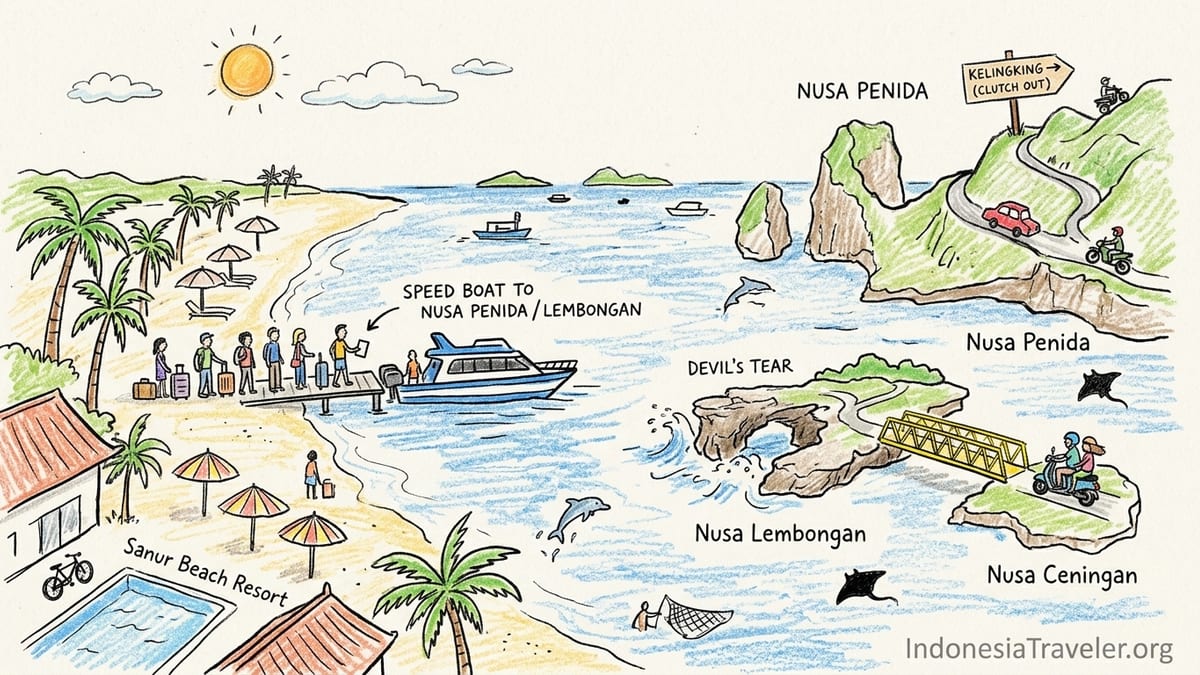
Nusa Penida, Nusa Lembongan and Nusa Ceningan sit in the same Indonesian province as mainland Bali and are administered by Klungkung Regency. On a map they look temptingly close, just across the Badung Strait. In practical travel terms, they function more like separate destinations. You cannot just “pop over” between breakfast in Canggu and sunset in Uluwatu without accepting some friction: a road transfer to a port, ticketing, luggage handling, a sea crossing, disembarkation on a different island, then yet another transfer to your hotel or tour starting point.
Most fast boats to Penida and Lembongan leave from Sanur’s new harbour on Bali’s southeast coast. Even with the upgraded pier, you still need to factor in around 40 to 50 minutes on the boat, plus 30 to 60 minutes of pre-departure check-in, baggage tagging and waiting. Morning departures can be crowded, and boarding is often via narrow gangways or floating pontoons that feel very different from the controlled environment of an airport gate. For travellers with heavy luggage, mobility issues or young children, that matters.
Crucially, your fast boat ticket only gets you across the water. It does not guarantee sensible, safe or comfortable onward transport once you arrive. On Penida in particular, where attractions are spread all over a hilly island, the informal taxi and tour car economy can be chaotic and far more stressful than mainland Bali’s ride-hailing comfort zone. When people say, “We did Penida as a day trip and it was exhausting,” much of that exhaustion is baked into these basic logistics.
Before you book, it helps to shift mindset. You are not simply choosing “Bali plus an extra day.” You are committing to a mini-expedition: Bali mainland, then boat, then island-specific roads, rules and risks. Seen that way, Penida, Lembongan and Ceningan become a serious decision, not an automatic add-on.
Transport Reality Check: Boats, Time and What Your Ticket Really Buys
Fast-boat marketing makes the crossing sound almost casual: “Sanur to Nusa Penida in 40 minutes.” That time is broadly accurate in calm conditions, according to current schedules from several operators checked in October 2026. One-way fares for foreigners commonly sit in the range of about 200,000 to 350,000 rupiah per adult, depending on operator, departure time and whether hotel pickup is bundled. What those tidy numbers do not show is the real door-to-door commitment.
If you are staying in Ubud or Canggu, your hotel pickup window for a morning boat might run from 6:30 to 7:00. You reach Sanur around 7:30 to 8:00, queue for check-in, tag luggage, then wait for boarding. The actual sailing might be 8:30 or 9:00. Add the 40 to 50 minute crossing, slow docking, and careful unloading of bags, and it is easy to arrive on Penida or Lembongan around 9:30 to 10:00 even on a smooth day. Then you still need to find your driver, negotiate if nothing was prearranged, and bounce along to the first viewpoint or your hotel. By the time you repeat all of this in reverse to return to Bali, you have chewed up a full day just on “getting there and back.”
Safety is another layer that deserves sober attention. Indonesia has a long record of small boat accidents, and Bali is not magically exempt. In August 2025, for example, a fast boat travelling from Nusa Penida to Sanur partially sank and ran aground near Bali, killing two Chinese tourists and leaving one Indonesian missing, according to reports from Indonesian search and rescue officials carried by international news agencies. In April 2026, eight people were rescued after a fishing boat capsized in rough seas near Nusa Lembongan, following high waves that flipped the vessel. There was also the well-publicized Sea Dragon snorkeling boat accident earlier in this decade, in which an Australian tourist died after the boat bound for Nusa Penida was overwhelmed by waves.
These incidents do not mean every fast boat is unsafe, and it would be unfair and inaccurate to claim that. Many crossings run uneventfully every day. What they do prove is that “it will be fine” is not an adequate safety plan. When I board these boats I now consciously check a few basics: Are there enough life jackets visible for every passenger, including children? Is there a simple safety briefing, even if brief and accented? Does the crew appear sober, attentive and in control of loading? How crowded is the boat compared with its stated capacity? And critically, what are the sea conditions that day? If forecasts mention 2 to 3 meter swells, I think hard about postponing or choosing a larger, more established operator rather than a no-name bargain ticket.
Nusa Penida: Jaw-Dropping Cliffs, Grueling Roads and Real Risk
Nusa Penida has become a social media star because its topography is outrageous. Kelingking’s T-rex shaped headland, Broken Beach’s collapsed sea cave, Angel’s Billabong’s emerald rock pool, Crystal Bay’s curve of sand backed by palms, and the east coast gems of Atuh and Diamond Beach look like something a landscape designer dreamed up. The cliffs are high, the water surreal shades of blue, and in the right light it can all feel impossibly cinematic. On the surface, Penida is everything the algorithm promises.
On the ground, the island is far more demanding. Distances between major sights are long, with narrow, twisting roads that combine steep gradients, blind corners and patchy surfacing. Even though road quality has improved in some sections compared with pre-2020 reports, you are still looking at roughly 45 minutes to an hour to reach Kelingking from the main Toya Pakeh harbour area in a car, and another 45 minutes or more to continue on to Broken Beach and Angel’s Billabong. The east coast attractions sit in the opposite direction, so any attempt to “do everything” in one day requires a brutal itinerary and a driver with both skill and patience.
Walkways and access paths demand respect too. Broken Beach and Angel’s Billabong, for instance, are cliff and rock-pool viewpoints, not safe swimming beaches. Angel’s Billabong has a tragic record of visitors being swept off the edge by rogue waves when they stepped too close to the seaward lip during high swell conditions. Atuh and Diamond feature long staircases carved into cliffs, with steep, narrow steps and sections that feel more like ladders than stairs. In tropical heat, a ten or fifteen minute descent can turn into a slick, exhausting challenge, especially on the way back up.
Kelingking is where fantasy and reality collide hardest. From the main viewpoint, where most tour groups stop, you stand on a fenced platform looking across at the dinosaur-shaped ridge and turquoise cove below. This is a viewpoint, and for most travellers it should remain exactly that. The path that leads down to the beach is not a casual nature walk. It is an exposed, dusty route dropping hundreds of meters, with uneven steps, sections of dirt and loose rock, and bamboo-and-rope railings that would never pass a rigorous safety inspection. In September 2026, a tourist fell to their death here after slipping near the trail, an accident that was widely reported in local media on 12 September. Earlier that year, rescue teams were called to retrieve stranded visitors from the lower part of the path after waves pounded the beach, cutting off a safe return. These are not freak events so much as the logical outcome of an expert-level route being treated as a casual hike by people in flip-flops and swimwear.
Penida Day Trip vs Staying Three Nights: The Trade-Offs
There are two broad ways most visitors tackle Nusa Penida: a one-day “Greatest Hits” tour from Bali mainland, or a slower stay of several nights on the island itself. I have done both, and they are radically different experiences. The typical day tour looks something like this: early pickup on Bali mainland, morning fast boat from Sanur, arrival at Penida harbour mid-morning, a loop of west coast spots like Kelingking, Broken Beach, Angel’s Billabong and Crystal Bay, then an afternoon boat back to Sanur and a drive “home.” On paper you might spend five to six hours on the island. In reality, as much as half that time disappears into van rides between dispersed sights and queues at popular viewpoints, especially at Kelingking where hundreds of people can cluster on the main ridge during the midday peak.
On a one-day tour, you have almost no slack. If traffic around the harbour is snarled or the boat is late, your driver may rush to keep the schedule. Lunch stops can feel perfunctory. Sunrise and sunset, which radically change how these cliffs feel, are usually off the table. You will likely end the day with a camera full of hits and a body that feels like it has been through a washing machine. For travellers who have only a few days in Bali total, dedicating this much energy to a rushed Penida loop often means sacrificing a relaxed day in Ubud’s rice terraces or a slow afternoon exploring local warungs.
Staying three nights on Penida flips the script. With a base near Toya Pakeh or along the northern coast, you can structure days sensibly: perhaps Kelingking and the west coast one morning, Atuh and Diamond on another, and a quieter day snorkelling around Crystal Bay or Gamat Bay. Early starts let you see Kelingking before the pressure of day-tour vans. Late afternoons at Diamond Beach are far calmer when the crowds have drifted back to their boats. The trade-off is that Penida’s infrastructure still lags behind mainland Bali: electricity cuts, variable water pressure, basic clinics, and fewer dining options after dark. You accept the island’s rough edges in exchange for more space and fewer time pressures.
My conclusion after doing both is blunt. If you only have five or six days in Bali in total, a one-day Penida blitz will probably feel like a punishing detour that you do “for the photos” rather than because it adds depth to your trip. Penida really starts to make sense at three nights or more, when you can respectfully pace the drives, prioritize safety on the steep descents, and accept that not every famous angle needs to be collected in a single day.
Nusa Lembongan: Compact, Beach-Focused and Actually Relaxing
If Penida is the dramatic, high-maintenance sibling, Nusa Lembongan is the compact, easier-going cousin. The island is much smaller, with accommodation and restaurants concentrated in a handful of areas: the long Jungut Batu strip along the northwest coast, the sheltered Mushroon Bay area, and the cliffy southwest cluster around Dream Beach and Devil’s Tear. Many travellers choose Lembongan precisely because they want an island vibe without committing to Penida’s long drives and steeper risks.
From Sanur, fast boats to Lembongan also take roughly 30 to 40 minutes under normal sea conditions, with similar pricing bands to Penida. The difference kicks in once you land. Distances on Lembongan are short enough that you can feasibly explore the main areas by scooter, on foot or by hiring a small open-back truck for a casual island tour. Jungut Batu’s main street is lined with cafes, dive shops, beach bars and midrange guesthouses, all within walking distance of the sand. It feels more like a classic small beach town than a wild frontier.
Beaches here are beaches, not just viewpoints over violent surf. Jungut Batu and Mushroom Bay offer actual swimmable stretches in normal conditions, with sandy entries and gentler waves than Penida’s exposed coves. Dream Beach has stronger swell and rips, so it is not always safe for casual swimmers, but it frames one of the island’s most photogenic sunsets. Devil’s Tear, a rocky headland where waves explode against cliffs and send up spray, is stunning at golden hour but must be observed from a respectful distance. Several tourists have reportedly been caught by large waves here in past years, and it has become another reminder that “up close” is not always better.
Another advantage of Lembongan is how its marine tourism is organized. Many snorkelling and diving trips depart directly from Jungut Batu and Mushroom Bay, visiting nearby spots between Lembongan, Ceningan and Penida such as mangrove areas, drift sites and manta cleaning stations. Because the islands are closer together here, you spend less time commuting and more time in the water. That said, the wider region has seen serious accidents, including cases of snorkellers and spearfishers being struck by boats between Lembongan and Penida. When booking, I now explicitly ask operators about guide-to-guest ratios, whether they use surface marker buoys, and how they brief boat captains about swimmers’ locations.
Nusa Ceningan and the Yellow Bridge: Small Scale, Real Limits
Nusa Ceningan is the smallest of the three islands and connects to Lembongan via the now-iconic Yellow Bridge over the narrow channel between them. The bridge itself has a complicated history. An earlier version collapsed in 2016, killing several people during a local ceremony, and the reconstructed bridge was built with clear vehicle and load limits. Today only motorbikes and pedestrians are allowed to cross; cars and trucks are prohibited. This matters because it shapes exactly how you move between Lembongan and Ceningan: on foot, by scooter, or on small, light vehicles operated by locals.
Ceningan’s appeal is quieter and more contained. There are a handful of cliff-front bars with views back to Lembongan, some compact beach clubs, a small blue lagoon, and several accommodation clusters that feel like a sleepy village rather than a full island hub. For many people, Ceningan is an afternoon side trip: rent a scooter on Lembongan, ride carefully over the bridge, loop the island in a couple of hours, stop for drinks at a clifftop bar, then return for dinner in Jungut Batu or Mushroom Bay.
Here too, cliffs and currents demand common sense. The blue lagoon area has cliffs that have tempted a cottage industry of informal cliff jumping content, but local authorities and many guides now caution strongly against it when swell is present. Underwater rocks sit just beyond the visible drop, and rescue resources on Ceningan are extremely limited. This is a place where I personally draw a firm line between taking a photo from a safe rim and treating the lagoon as an adventure playground.
In practical terms, Ceningan is not an island you dedicate separate nights to unless you want to be very still. Its magic lies in enhancing a Lembongan stay. With one or two full days based on Lembongan, Ceningan easily becomes part of your rhythm: morning coffee on Jungut Batu, a scooter ride over the bridge after breakfast, lagoon and cliffs for a few hours, and a slow return as the light softens.
Which Itinerary Makes Sense: One Day Penida, Two Nights Lembongan, Three Nights Penida
So, given all of this, which combinations genuinely earn a place in your Bali itinerary? A one-day Penida loop is the most heavily promoted option, and it suits a narrow kind of traveller. If your absolute priority is to stand at the classic Kelingking viewpoint, snap the photo and tick off Broken Beach, Angel’s Billabong and Crystal Bay in a single intense push, then a day tour can achieve that. You must simply be honest that it will involve very early wake-ups, a lot of hours in vans, minimal flexibility and superficial contact with the places you see.
A two-night Nusa Lembongan stay, by contrast, fits much more smoothly into a typical Bali holiday. You can leave the mainland on a mid-morning boat, check into a Jungut Batu or Mushroom Bay guesthouse by lunchtime, and spend your first afternoon on the beach or exploring Devil’s Tear and Dream Beach. The next day might be a snorkelling trip or a lazy scooter loop that folds in Ceningan. On your final morning you can still have a swim or coffee with a sea view before an early afternoon boat back to Sanur and dinner in Ubud or Sanur itself. The pace aligns with what most people imagine “Bali” will feel like in their minds.
A three-night Nusa Penida stay is a more committed choice that rewards those who prioritize wild landscapes and do not mind some discomfort. Night one: arrival and a soft introduction along the north coast. Day two: west coast route with Kelingking as a viewpoint only, followed by Broken Beach and Angel’s Billabong if conditions are safe. Day three: Atuh and Diamond on the east, with generous rest breaks for the demanding stair climbs. Mixed into those days, perhaps a carefully vetted snorkelling session at Crystal Bay. With this amount of time you can wait out a day of rough seas or heavy rain, shift plans to avoid midday heat on the trails, and keep safety paramount instead of racing a tour timetable.
Viewed side by side, my recommendation is blunt. If you are curious about the Nusa islands but do not love long, stressful transfer days, make Lembongan with a dash of Ceningan your default. Leave Penida for the trips where you are willing to allocate three or more nights, select operators carefully, and realistically assess your group’s fitness and comfort with steep, exposed terrain.
Who Should Skip the Nusa Islands and Stay on Mainland Bali
After years of watching visitors push themselves too hard just to collect a Kelingking photo, I have become comfortable saying something that tourism marketing rarely will: some travellers should simply skip the Nusa islands entirely and use that time on mainland Bali instead. If you are in Bali for less than a week and already trying to fit in Ubud’s temples, a north Bali waterfall, and at least one proper day of doing nothing by a pool, a Penida or Lembongan detour can easily turn into a rushed blur that subtracts more joy than it adds.
Families with very young children, people with a fear of boats, those with mobility limitations and anyone with a history of motion or sea sickness need to weigh the realities carefully. The fast boat crossings can be bumpy, with passengers occasionally standing to brace themselves as the hull slaps into oncoming swell. Boarding and disembarking sometimes involve negotiating wet steps or uneven floating platforms. On Penida, steep cliff paths and long drives on winding roads are not compatible with strollers or travellers who struggle with heat and stairs.
There is also a psychological factor. Penida especially has become a magnet for a particular brand of hyper-Instagram travel, where groups queue for a single photo while guides shout instructions and engines idle nearby. If what drew you to Bali was the idea of slow walks through rice terraces, quiet courtyard temples, and unhurried food experiences, mainland Bali already offers more than enough. Rice field paths in Ubud, black sand beaches along the east coast, calmer snorkelling in places like Padangbai or Amed, and sunsets from Sanur’s promenade will rarely go viral on social media, yet they feel far more aligned with the idea of “rest” most people secretly crave.
The critical question I now ask myself when planning or advising on itineraries is simple: “Would this island side trip make the holiday feel richer or more frantic?” If the honest answer is “more frantic,” there is no shame in staying on Bali proper. You can always come back with more time, better conditions and a clearer understanding of what these islands really demand.
FAQ
Q1: Is a Nusa Penida day trip from Bali really worth it?
For many travellers with short holidays, a Penida day trip feels rushed and exhausting. You spend hours in vans and on boats for a brief glimpse of famous viewpoints. Penida makes far more sense if you can stay at least three nights and slow the pace.
Q2: Are fast boats to Nusa Penida and Lembongan safe?
Most crossings are uneventful, but Indonesia has recorded serious boat accidents, including a 2025 fast boat incident between Penida and Sanur and fatal cases involving smaller vessels near Lembongan. Rather than assuming danger or safety, choose established operators, check life jackets, watch passenger numbers and avoid sailing in obviously rough conditions.
Q3: How much does the fast boat from Sanur to the Nusa islands cost in 2026?
Recent price checks in late 2026 show one-way adult fares from Sanur to Nusa Penida or Lembongan commonly starting around 200,000 rupiah and rising to roughly 300,000 to 350,000 rupiah with flexible timings or hotel transfers included. Always confirm current prices, as operators adjust fares with demand and fuel costs.
Q4: What makes Nusa Lembongan a better fit for a short trip than Nusa Penida?
Lembongan is compact, with beaches, restaurants and guesthouses clustered around Jungut Batu and Mushroom Bay. Distances are short, beaches are more swimmable, and you can comfortably explore over two nights without marathon drives or steep cliff descents. It feels like a relaxed beach town, not an endurance test.
Q5: Is it safe to go down to Kelingking Beach?
The path to Kelingking Beach is steep, exposed and far more serious than many visitors expect. A tourist died after a fall here on 12 September 2026, and rescue teams have had to assist stranded visitors when waves trapped them below. For most families and inexperienced hikers, I recommend treating Kelingking strictly as a viewpoint and skipping the descent.
Q6: Can I visit both Nusa Lembongan and Nusa Ceningan in one day?
Yes. Since the islands are joined by the Yellow Bridge, you can easily rent a scooter on Lembongan, ride carefully across the bridge, and loop Ceningan’s viewpoints and cafes in a few hours. Just remember the bridge is restricted to motorbikes and pedestrians, and drive cautiously on narrow roads.
Q7: Are snorkelling and diving trips around the Nusa islands suitable for beginners?
The region has world-class sites but also strong currents and heavy boat traffic. Some accidents, including people hit by boats, have occurred between Penida and Lembongan. Beginners should choose reputable dive centres, follow guide instructions closely, and avoid trips in rough conditions or to high-exposure sites like Manta Point on bad days.
Q8: How many nights should I stay on each island?
For a relaxed experience in line with a standard Bali holiday, two nights on Nusa Lembongan with a side visit to Ceningan works very well. Nusa Penida really comes into its own at three or more nights, allowing time for long drives, weather changes and safe pacing of cliff hikes. Anything less on Penida tends to feel compressed.
Q9: What should I pack differently for a Nusa island trip compared with mainland Bali?
Sturdy footwear for cliff paths and long stairs, a light rain jacket for sudden showers at sea, a dry bag for electronics, motion sickness medication if you are prone to nausea, and extra sunscreen are all wise. On Penida, I also recommend carrying more water than you think you need for hot, exposed viewpoints.
Q10: Who should seriously consider skipping the Nusa islands?
Travellers with less than a week in Bali, families with toddlers, people who dislike boats or have mobility challenges, and anyone primarily seeking a slow, restorative holiday are usually better served by staying on mainland Bali. In those cases, reallocating Nusa island days to Ubud, north Bali or the quieter parts of the east coast will often result in a calmer and more satisfying trip.