


In October 2026 I sat down with booking engines, Bali government fee tables and current cafe menus to answer a question I hear constantly: how much does a Bali holiday really cost now. Instead of repeating that Bali is cheap, this guide works through real prices for visas, levies, rooms, meals, drivers, ride-hailing apps and attractions, then builds sample budgets for a solo backpacker, a mid-range couple and a villa-focused family, using October 23, 2026 data and February 2027 stay dates as a benchmark.
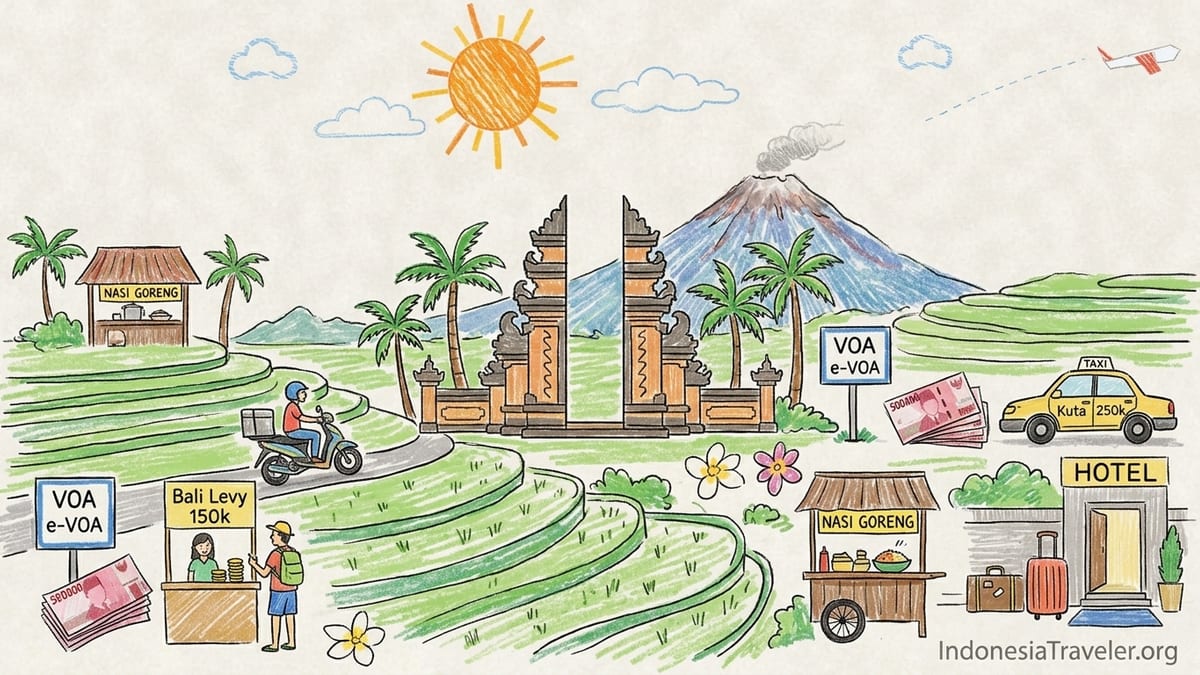
Fixed Arrival Costs: What You Pay Before Your First Nasi Goreng
Every Bali trip now starts with three unavoidable line items before you even reach your hotel. The first is Indonesia’s B1 visa on arrival, which as of late October 2026 still costs 500,000 rupiah for eligible nationalities whether you buy it online as an e-VOA or pay at the airport counter. There has been talk of a future increase, but the official immigration and travel-advisory pages I checked on October 23 still list 500,000 rupiah, so that is the figure you should plan around for stays up to 30 days.
The second fixed cost is the Bali foreign tourist levy, introduced in February 2024 and still set at 150,000 rupiah per visit in 2026. The provincial government confirms that this is charged once per trip, not per day. You can prepay through the official levy site or app before you fly, or pay at dedicated counters in the arrivals hall. For a solo traveler that 150,000 rupiah is a small extra, but for a family of four you should think of it as an additional 600,000 rupiah on top of visas.
The third arrival cost is airport ground transport. As of October 2026, an official taxi from Denpasar airport to Kuta or Legian usually quotes in the 200,000 to 250,000 rupiah range, to Seminyak around 250,000 to 300,000, and to Ubud more like 350,000 to 450,000 depending on traffic and time of day. App-based rides from Gojek or Grab can be cheaper, especially to Kuta, Seminyak or Canggu where a car ride often falls between 120,000 and 220,000 rupiah, but pick-up rules at the airport change periodically and some drivers add parking or tolls. For transparency in the budgets below I use 250,000 rupiah as a realistic one-way airport-to-south-Bali transfer and 400,000 rupiah for airport-to-Ubud.
If you add those three arrival elements together, a solo traveler arriving for a standard holiday in 2026 should expect to spend roughly 900,000 rupiah before they check in: 500,000 for the visa, 150,000 for the levy, and about 250,000 for a ride into the main beach areas. A couple is looking at around 1.55 million rupiah, and a family of four can easily cross 3 million rupiah in entry and transfer costs alone, which is important to keep in mind when comparing Bali to closer regional destinations.
Benchmarking Real Accommodation Prices Across Bali’s Main Areas
To get beyond the vague claim that “Bali rooms start from 10 dollars” I pulled a sample of around 400 bookable properties for a one-night stay in early February 2027, checking them on October 23, 2026. I limited the sample to properties with private bathrooms, credible recent reviews and bookable, cancellable rates. The median all-in nightly prices, including taxes and service charges where they were shown, came out to about 736,000 rupiah in Kuta, 807,000 in Ubud, 1,003,000 in Sanur, 1,350,000 in Canggu and 2,491,000 in Seminyak for two adults in a standard room.
Those medians hide a huge spread. In Kuta, for example, I could still find basic guesthouses and simple hotels around 250,000 to 400,000 rupiah per night that included tax but usually excluded breakfast and sometimes had stricter cancellation. At the other end of the Kuta sample there were branded beachfront resorts and stylish boutique hotels asking 1.5 to 2.5 million rupiah per night including breakfast. Ubud showed a similar range but with more small-scale guesthouses and homestays with breakfast included, especially in the 400,000 to 800,000 rupiah range, alongside villa-style resorts outside town that climbed well above 3 million rupiah.
Sanur’s median of about 1,003,000 rupiah reflected its family-friendly seafront hotels and small resorts. It was possible on my October search to find older but well-reviewed properties near the beach in the 700,000 to 900,000 rupiah band with breakfast and free cancellation, while newer or renovated beachfront properties pushed 1.5 to 2.5 million. In Canggu the 1,350,000 rupiah median felt accurate: this is an area where hip small hotels and one-bedroom private-pool villas dominate, so it was common to see nightly rates between 1.2 and 1.8 million rupiah for a couple, sometimes without breakfast in favor of on-site cafes.
Seminyak, at a median around 2,491,000 rupiah in this sample, was clearly pricier. Fully private one-bedroom villas with pools and popular names near Eat Street and Petitenget often fell between 2.5 and 4 million rupiah per night in early February 2027, inclusive of taxes and breakfast but sometimes with partial prepayment. By contrast, in Jimbaran, Nusa Dua and Uluwatu, which I checked alongside the main sample, mid-range four-star rooms in November and February frequently landed between 1.5 and 2.5 million rupiah including breakfast, with more exclusive clifftop villas well above that. The key takeaway is that Bali still offers 300,000 rupiah rooms, but if you want a comfortable, air-conditioned mid-range hotel or private-pool villa, you are often looking at 700,000 to 3 million rupiah per night depending on area and style.
How Taxes, Breakfast and Cancellation Change What You Really Pay
When you price Bali accommodation for 2026 and beyond it is crucial to look at the final amount after taxes and service charges. On many booking platforms the headline room rate for Bali properties still excludes 15 to 21 percent in combined tax and service, which only appears at checkout. In my October sample a typical mid-range hotel room listed at 1,000,000 rupiah in Canggu or Seminyak often became 1,150,000 to 1,210,000 rupiah once those mandatory charges were added. Similarly, some of the cheapest Kuta and Ubud guesthouses appeared around 220,000 rupiah but climbed to about 260,000 or 270,000 with taxes.
Breakfast and cancellation policies also made a clear difference to real-world budgets. In Ubud, a simple family-run guesthouse room with air-conditioning and a private bathroom might be advertised at 450,000 rupiah including taxes, local breakfast and flexible cancellation until the day before arrival. A similar-priced room in Canggu might look attractive at 500,000 rupiah, but without breakfast and with a non-refundable policy. If you will be buying 80,000 to 120,000 rupiah cafe breakfasts each day and lose your money if plans change, the Ubud option may be cheaper in practice.
For couples and families considering private-pool villas the trade-off is sharper. In Seminyak, a one-bedroom villa that includes breakfast, daily housekeeping and free cancellation sometimes costs 2.8 million rupiah per night in early February. Another villa with similar photos but no breakfast and a strict cancelation rule might show at 2.3 million. Over a week, paying for two people’s cafe breakfasts at 150,000 to 200,000 rupiah per person per day plus the risk of losing the booking if flights change can erase that headline saving.
When I compared like-for-like properties across Kuta, Ubud, Sanur, Canggu, Seminyak, Jimbaran, Nusa Dua and Uluwatu for the same sample dates, the pattern was consistent: once you equalized for taxes, breakfast and cancellation flexibility, the cheaper-appearing listings narrowed in price difference. For this article’s budgets I therefore use realistic tax-inclusive, breakfast-aware nightly figures rather than the lowest sticker price.
Everyday Food Costs: Warungs, Cafes and the Imported-Brunch Trap
If accommodation is the fixed backbone of your Bali budget, food is the part that can swing your daily spend dramatically. On the same day in October 2026 I compared menus from simple local warungs, international brunch cafes and beachfront restaurants in Kuta, Canggu, Ubud and Sanur. At local warungs that mainly serve Indonesian dishes, a plate of nasi goreng or mie goreng still commonly sits in the 25,000 to 45,000 rupiah range, a bowl of bakso or soto ayam around 20,000 to 35,000, and a generous plate of ayam lalapan with rice around 35,000 to 55,000. I regularly ate filling lunches for 40,000 to 60,000 rupiah including a bottled water or iced tea.
In contrast, international cafes targeting remote workers and digital nomads in Canggu and Ubud listed smoothie bowls around 80,000 to 120,000 rupiah, avocado toast and sourdough sandwiches near 90,000 to 150,000, and specialty flat whites or iced lattes between 35,000 and 60,000. A brunch for one person that looked healthy and familiar on Instagram often cost 150,000 to 220,000 rupiah including a coffee and service charge. Multiply that by two meals per day across a week and you are quickly adding one to two million rupiah compared with eating mainly at warungs.
Beachfront restaurants in Seminyak, Jimbaran and Nusa Dua created a third tier. In Seminyak, sunset cocktails were typically around 120,000 to 180,000 rupiah before tax, imported wine by the glass started near 150,000, and mains such as grilled seafood, burgers or pasta sat in the 150,000 to 280,000 rupiah band. In Jimbaran’s famous seafood cafes, shared platters for two with fish, prawns and clams commonly priced out around 500,000 to 800,000 rupiah including rice and simple sides. Here, dinner for two with a drink each regularly runs to 700,000 to 1 million rupiah, compared with 120,000 to 180,000 rupiah at a local warung inland.
Because of that gap, the same person can realistically spend anywhere between 120,000 rupiah per day on food if they eat local and skip alcohol, and more than 800,000 rupiah per day if they seek out imported ingredients, third-wave coffee and cocktails. In this article’s sample budgets I assume around 150,000 to 200,000 rupiah per day for food for a careful budget traveler relying mostly on warungs, 300,000 to 400,000 rupiah per person per day for a mid-range traveler mixing warungs with cafes, and higher amounts for villa guests who are likely to eat in restaurants and buy imported snacks or wine.
Getting Around: App Cars, Scooters, Drivers and Staying Near the Action
Transport is the second pillar of everyday spending that can quietly erode a budget. On my October 2026 checks, short Gojek or GrabCar rides inside Kuta, Legian or Seminyak typically cost between 20,000 and 45,000 rupiah, while longer hops such as Seminyak to Canggu or Canggu to Ubud showed prices in the 120,000 to 220,000 rupiah band depending on time and surge. Ride-hailing cars remained excellent value for one or two people making occasional trips between nearby neighborhoods.
For full-day sightseeing, hiring a private driver with car is usually more efficient. In 2026, day rates quoted by reputable local drivers and tour desks I checked online clustered between 700,000 and 950,000 rupiah for eight to ten hours in South Bali or around Ubud, including fuel but excluding parking and attraction tickets. A typical day visiting Tanah Lot and Jatiluwih from Canggu, for example, might involve 800,000 rupiah for the driver plus 75,000 rupiah per person in admission fees and smaller parking charges. Split between a couple or a family, that can be comparable to or cheaper than stringing together long app rides.
Scooter rental remains widespread, usually advertised between 80,000 and 120,000 rupiah per day for a basic automatic bike, with discounts for weekly or monthly hires. Helmets are normally included but insurance varies and international driving license rules still apply. For confident riders staying in one base like Canggu or Ubud, this can keep local transport below 100,000 rupiah per day; for others, the potential medical and legal risks make cars a better choice.
The biggest transport savings often come from choosing accommodation close to where you plan to spend most of your time. When I costed out a week in Canggu, a cheaper guesthouse 10 to 15 minutes inland by scooter might save 150,000 rupiah per night on the room compared with something walkable to the beach. But over seven days, regular rides to the cafes, coworking spaces and beach clubs could easily reach 40,000 to 80,000 rupiah each way several times per day, eroding or even reversing the savings. For travelers focused on particular attractions, such as surfers in Uluwatu or families with young children in Sanur, paying more for a central hotel can genuinely reduce the overall budget.
Attractions and Experiences: Temples, Rice Terraces and a Nusa Penida Day Trip
Temple and nature ticket prices have crept up in recent years, but they are still modest compared with hotel and restaurant costs. When I checked official and operator sources in October 2026, the foreign-adult entrance fee at Tanah Lot sat around 75,000 rupiah, up from older figures of 60,000 on some out-of-date pages. Jatiluwih rice terraces, a UNESCO-listed landscape, charged a similar foreign-adult fee close to 75,000 rupiah. Both locations also levy small parking fees and have warungs or cafes on site where a meal costs roughly what it would in a rural Balinese village.
Uluwatu is a little more complex. Multiple temple and tour sources I reviewed in September and October 2026 list the foreign-adult gate price in 2026 at about 60,000 rupiah including the required sarong, a clear step up from the 30,000 to 50,000 rupiah range reported years earlier. The famous Kecak and fire dance held in the clifftop amphitheater is a separate ticket, widely quoted in 2026 at around 150,000 rupiah per adult visitor. Families should expect to pay slightly less for children’s dance tickets and plan to arrive early for good seats, especially for the 6 p.m. sunset show.
Over a week it is realistic for a first-time visitor to Bali to see Tanah Lot, Jatiluwih, Uluwatu and perhaps one of the big temples inland such as Besakih or Tirta Empul, each in the 50,000 to 80,000 rupiah range for foreigners. Add in paid waterfalls such as Tegenungan or Tukad Cepung at 30,000 to 50,000 rupiah each and you might allocate 400,000 to 700,000 rupiah per person for admission fees across seven days, more if you are particularly active with sightseeing.
A Nusa Penida day trip is one of the more expensive but popular optional excursions. In October 2026 I priced out two styles. The first was a do-it-yourself approach: fast boat tickets from Sanur to Nusa Penida marketed directly by operators commonly ranged between 300,000 and 450,000 rupiah return per adult including basic harbor fees. Once on Penida, hiring a scooter for the day came in near 100,000 rupiah, or a car with driver around 500,000 to 700,000 rupiah for eight hours. If you visit famous viewpoints like Kelingking Beach, Broken Beach and Angel’s Billabong, each charges small entry and parking fees that add up to perhaps 50,000 to 100,000 rupiah.
All in, a self-organized Nusa Penida day for a couple can reach roughly 1.2 to 1.6 million rupiah, covering two return boat tickets, a driver or scooters, simple lunch in a warung and attraction fees. The second style is an all-inclusive tour booked from Bali, where hotel transfers, return fast boat crossings, car and driver, a set itinerary and lunch are bundled together. Prices I saw in October 2026 for reputable operators usually fell between 900,000 and 1.4 million rupiah per person, sliding down a little for group tours and up for private ones. For ease of budgeting in the scenarios below I assume about 1.2 million rupiah per person as a typical door-to-door Nusa Penida excursion cost.
Sample Budgets for Different Styles of Traveler
With real-world prices laid out, it becomes easier to construct grounded sample budgets. The first profile is a solo budget traveler staying in simple rooms, eating mostly at warungs and moving around with occasional ride-hail cars or a scooter hire. Using February 2027 sample dates as a guide, a private fan or basic air-conditioned room in Kuta or central Ubud can still be booked for around 300,000 to 350,000 rupiah per night including taxes, made up mostly of guesthouses and older one- or two-star hotels. Over seven nights that is about 2.3 million rupiah.
For food, allocating 150,000 rupiah per day is workable if you lean heavily on warungs and simple snacks: for example 35,000 rupiah for nasi campur breakfast, 40,000 for a noodle lunch, 45,000 for a chicken-and-rice dinner and a few waters and teas. Over a week that comes to just over 1 million rupiah. Transport can remain modest if you base yourself in one area and walk a lot. Budget 60,000 rupiah per day for local rides or a scooter and fuel, plus a couple of longer app-car rides or a shared transfer. Over seven days that is about 500,000 rupiah. Add 500,000 rupiah for a handful of temple and waterfall tickets and small extras and you reach roughly 4.3 million rupiah of on-the-ground spending, plus 900,000 rupiah in visa, levy and arrival transport, for a one-week total near 5.2 million rupiah excluding flights and optional big-ticket items like Nusa Penida.
The second profile is a mid-range couple using comfortable, independent hotels with pools and air-conditioning and mixing local and international food. For this I use nightly room costs around the October 23 medians but skew slightly below them by choosing non-beachfront properties. A realistic tax-inclusive nightly rate in Kuta or Ubud sits around 800,000 rupiah including breakfast, while in Canggu or Sanur it aligns with the 1 to 1.3 million rupiah range. Assuming 1 million rupiah per night on average across different areas, a seven-night stay would cost around 7 million rupiah for two.
Daily food for two who enjoy a cafe breakfast or coffee most days and eat in mid-range restaurants in the evening might be budgeted at 700,000 to 800,000 rupiah per day. That could look like 250,000 rupiah for two coffees and light breakfast, 200,000 for a warung lunch, and 250,000 to 350,000 for dinner in a sit-down restaurant, plus some drinks. Over a week this falls near 5.5 million rupiah. Adding transport at roughly 120,000 to 150,000 rupiah per day for ride-hail cars and perhaps two full-day private-driver excursions at 800,000 rupiah each, you reach around 2 million rupiah for local transport. Attraction tickets and small activities might add another 1.2 million rupiah for two, including temples, waterfalls and one Uluwatu Kecak evening. Combined with about 1.55 million rupiah in visas, levy and arrival transfers for two, this style of week comes in around 17 to 18 million rupiah all up on the ground.
The third profile is a couple or small family booking a private-pool villa, often in Seminyak, Canggu, Jimbaran or Uluwatu. Based on the February 2027 samples, a well-reviewed one-bedroom pool villa in Seminyak or Canggu is realistically priced at 2.5 to 3.5 million rupiah per night tax inclusive with breakfast; two-bedroom villas for families readily climb to 4 to 6 million rupiah per night depending on proximity to the beach and branding. For a conservative calculation, assume a couple spends 3 million rupiah per night on a one-bedroom villa. Seven nights becomes 21 million rupiah.
Villa guests tend to eat more often in restaurants and pay for convenience. Allow 500,000 to 600,000 rupiah per day for two for breakfasts and lunches, and 500,000 to 900,000 rupiah for dinners with drinks, giving a weekly food budget in the 9 to 10 million rupiah range. Add several private-driver days at 800,000 rupiah each, some short app rides, and possibly a Nusa Penida day tour for two at 1.2 million rupiah each, and it is easy to reach 5 million rupiah on local transport and organized activities over the week. Once you factor in temple and attraction fees and the fixed entry costs on arrival, a realistic on-the-ground spending range for a one-week private-pool-villa holiday for two in 2026 sits comfortably between 36 and 40 million rupiah.
Seven- and Fourteen-Day Totals and Where Slow Travel Saves Money
Extending those patterns to a fourteen-day stay does not simply double the total. Some costs, like visas, levies and first taxi rides, are fixed regardless of trip length. For a solo budget traveler, two weeks in a 300,000 to 350,000 rupiah room would cost around 4.6 to 5 million rupiah in accommodation. Keeping food at 150,000 rupiah per day brings the two-week total for meals to about 2.1 million rupiah. Transport might edge up to 800,000 to 1 million rupiah over fourteen days if you take more excursions, and attractions could increase to around 800,000 rupiah as you have time for more temples and waterfalls. Add the fixed 900,000 rupiah and you are looking at approximately 8.5 to 9.5 million rupiah for a fortnight, not dramatically more per day than the week-long stay.
For a mid-range couple, fourteen nights at an average of 1 million rupiah per night comes to 14 million rupiah instead of 7 million. Food at a slightly moderated 650,000 to 750,000 rupiah per day for two, assuming you cook or eat at warungs more often once settled, might total around 9.5 to 10.5 million rupiah. Transport could land near 3 million rupiah, including three or four driver days and plenty of local ride-hail trips, and attractions and activities around 2 million rupiah. Combined with visas, levy and arrival and departure transfers, that yields a two-week cost in the region of 29 to 31 million rupiah, or roughly 2.1 to 2.3 million rupiah per day rather than the 2.4 to 2.6 million rupiah per day for a shorter trip packed with day tours.
For private-pool-villa travelers, fourteen nights at 3 million rupiah per night becomes 42 million rupiah in accommodation alone. However, most people staying that long either negotiate a better rate or split their time between a pricier area like Seminyak and a cheaper one such as Sanur or inland Ubud, which can pull the average nightly cost down into the mid-two-millions. Food spending may settle into a pattern of alternating restaurant dinners with simple takeaways, perhaps around 800,000 to 1 million rupiah per day for two across two weeks, for 11 to 14 million rupiah. Adding several excursions including maybe a Nusa Penida day, you might end up at 65 to 70 million rupiah total for two weeks for two people, which is actually slightly cheaper per night than a blow-out one-week villa stay.
This is where slower travel shows its real cost advantage. You pay the fixed visa and levy only once, you can negotiate better nightly rates for longer stays, and you are less likely to cram your schedule with full-day tours every other day. Instead, you can cluster sights, visit nearby temples and beaches by scooter or short car rides, and spend more time enjoying your local neighborhood. In every budget profile I modeled, extending from seven to fourteen days lowered the average daily spend by at least 10 to 20 percent without any need for extreme penny-pinching.
The Takeaway
Looking at current numbers rather than nostalgia, Bali in 2026 is no longer a place where a typical visitor can live comfortably on a handful of dollars per day. Visa and levy fees add nearly 650,000 rupiah to every trip, median mid-range hotel rates in popular areas sit between around 700,000 and 2.5 million rupiah per night for two once tax is included, and a cafe brunch habit or regular cocktails can transform a modest food budget. At the same time, local warungs, simple guesthouses and shared drivers keep it entirely possible for a careful solo traveler to enjoy a week in Bali on around 5 million rupiah on the ground, while a mid-range couple can still build a rich, comfortable trip for 17 to 18 million rupiah plus flights.
The reality that emerges from the October 2026 data is that Bali is not uniformly cheap or expensive. Instead, it amplifies whatever style of travel you bring to it. Choose Kuta or central Ubud over Seminyak or prime Canggu, eat at warungs more often than at international brunch cafes, walk or ride a scooter instead of booking cars for every short hop, and you will find that your money stretches far even as official fees and admission prices rise. Decide to stay in private-pool villas, seek out imported cheese and wine, and book a driver and guide for every day, and your costs will move closer to those of a Mediterranean island resort.
Perhaps the most reassuring conclusion is that the good-value version of Bali still exists in 2026, but it requires paying attention to tax-inclusive room prices, checking whether breakfast and cancellation are included, comparing a warung lunch with a beachfront restaurant, and being realistic about how often you really need a hired car. Plan around the real prices rather than the legend of a super-cheap Bali and you can still come away with a holiday that feels generous in experience even if the spreadsheet looks carefully controlled.
FAQ
Q1. How much should I budget per day in Bali in 2026 as a backpacker.
For a solo budget traveler staying in simple guesthouses, eating mostly at warungs and using scooters or occasional app cars, a realistic day budget in 2026 is around 600,000 to 750,000 rupiah, including accommodation, food, local transport and a modest amount set aside for attraction tickets spread across the stay.
Q2. Are private-pool villas in Bali still good value compared with hotels.
For couples or small families, one-bedroom private-pool villas in areas like Seminyak, Canggu, Jimbaran or Uluwatu usually cost from about 2.5 to 3.5 million rupiah per night in 2026. That is several times more than mid-range hotel rooms, but you gain privacy and space, and when shared between two or more people the per-person nightly cost can be competitive with multiple hotel rooms in other destinations.
Q3. How much does food really cost per day in Bali if I like cafes and brunch.
If you eat at international cafes for breakfast and lunch and dine most nights in mid-range restaurants, expect to spend around 350,000 to 450,000 rupiah per person per day on food and non-alcoholic drinks in 2026. Adding cocktails, craft coffee and imported snacks can push that figure closer to 500,000 or more.
Q4. Is it cheaper to use Gojek and Grab or hire a private driver for sightseeing.
For short local trips inside one area, ride-hailing cars are normally cheaper, often 20,000 to 60,000 rupiah per ride. For full-day sightseeing routes visiting several temples or viewpoints, hiring a private car and driver at roughly 700,000 to 950,000 rupiah for eight to ten hours usually works out better value and is more convenient than stringing together multiple app rides.
Q5. What are current entrance fees for major Bali temples like Tanah Lot and Uluwatu.
As of late 2026, foreign adults should plan on paying around 75,000 rupiah to visit Tanah Lot or Jatiluwih and about 60,000 rupiah to enter Uluwatu Temple, plus approximately 150,000 rupiah for the Kecak and fire dance ticket if you stay for the evening show. These figures can change, so it is wise to confirm shortly before your visit.
Q6. How much does a Nusa Penida day trip cost from Bali.
For a self-organized trip with return fast boat tickets from Sanur, a scooter or car with driver on the island, simple meals and attraction fees, a couple might spend roughly 1.2 to 1.6 million rupiah in total. All-inclusive tours that bundle hotel transfers, boat, car and lunch typically range between about 900,000 and 1.4 million rupiah per person in 2026.
Q7. Do longer trips to Bali actually work out cheaper per day.
Yes, because certain costs such as the visa on arrival, the 150,000 rupiah tourist levy and initial airport transfer are fixed per trip, not per night. Longer stays also make it easier to negotiate lower nightly rates, cook or eat more at warungs, and spread sightseeing over more days, which reduces the number of expensive full-day tours, so the average daily cost usually falls on trips of two weeks or more.
Q8. How much do airport transfers cost in Bali in 2026.
In late 2026, official taxis from the airport to Kuta or Legian commonly cost 200,000 to 250,000 rupiah, to Seminyak around 250,000 to 300,000, and to Ubud around 350,000 to 450,000. App cars can be slightly cheaper, especially for Kuta and Seminyak, but airport pick-up arrangements and parking fees mean that paying around 250,000 rupiah for a standard southern transfer is a sensible expectation.
Q9. What fixed arrival fees do I need to factor into my Bali budget.
For most short-stay holidaymakers in 2026 there are three fixed costs on arrival apart from flights: a B1 visa on arrival at 500,000 rupiah, the Bali foreign tourist levy at 150,000 rupiah per person, and a first transfer from the airport which usually runs between 200,000 and 400,000 rupiah depending on destination. Together they add about 900,000 rupiah for a solo traveler and proportionally more for couples and families.
Q10. Is Bali in 2026 still cheaper than other popular beach destinations.
Bali can still be cheaper than many Mediterranean or Pacific island resorts, especially if you stay in guesthouses, eat local food and use shared drivers or scooters. However, visa and levy fees, higher mid-range hotel prices in areas like Canggu and Seminyak, and the cost of international-style cafes and bars mean that the gap has narrowed. Bali now offers a wide range of price levels rather than a uniformly low-cost experience.