


I still remember my first arrival in Bali, stepping into the humid air and thinking I had finally reached the mythical cheap, peaceful island where every beach was swimmable and every temple untouched. I had seen the same images you probably have: empty rice terraces at sunrise, quiet cliff temples above turquoise coves, scooters cruising on open roads. After multiple extended visits spread over several years, including the record-breaking 2025 season, I have to say what many repeat visitors now whisper in private: for a lot of travelers, Bali is overrated. Not because it is unworthy, but because the reality of crowds, traffic, commercialization and environmental pressure is so far from the paradise they were sold.
The Numbers That Broke the Paradise Myth
It is impossible to understand modern Bali without starting with the numbers. In 2025, Bali’s statistics office recorded 6,948,754 direct foreign arrivals, the highest figure in the island’s history and about 10 percent above the pre-pandemic peak. That number counts only people who passed immigration in Bali itself, mostly through Ngurah Rai International Airport, and it excludes anyone who arrived elsewhere in Indonesia and connected onward to the island.
What the provincial government talks about is bigger again: more than 16 million tourist trips in 2025 once you add domestic travelers from across Indonesia to that 6.9 million foreign figure. Officials in Denpasar have cited totals around 16.3 to 16.6 million combined domestic and international arrivals, with roughly 7 million of those international and more than 9 million domestic. The gap between the BPS statistician’s precise 6,948,754 “direct foreign arrivals” and the province’s broader 16 million visitor trips is where the pressure comes from. Every one of those people needs beds, vans, fast boats, food, water and waste collection on an island with about 4.3 million residents.
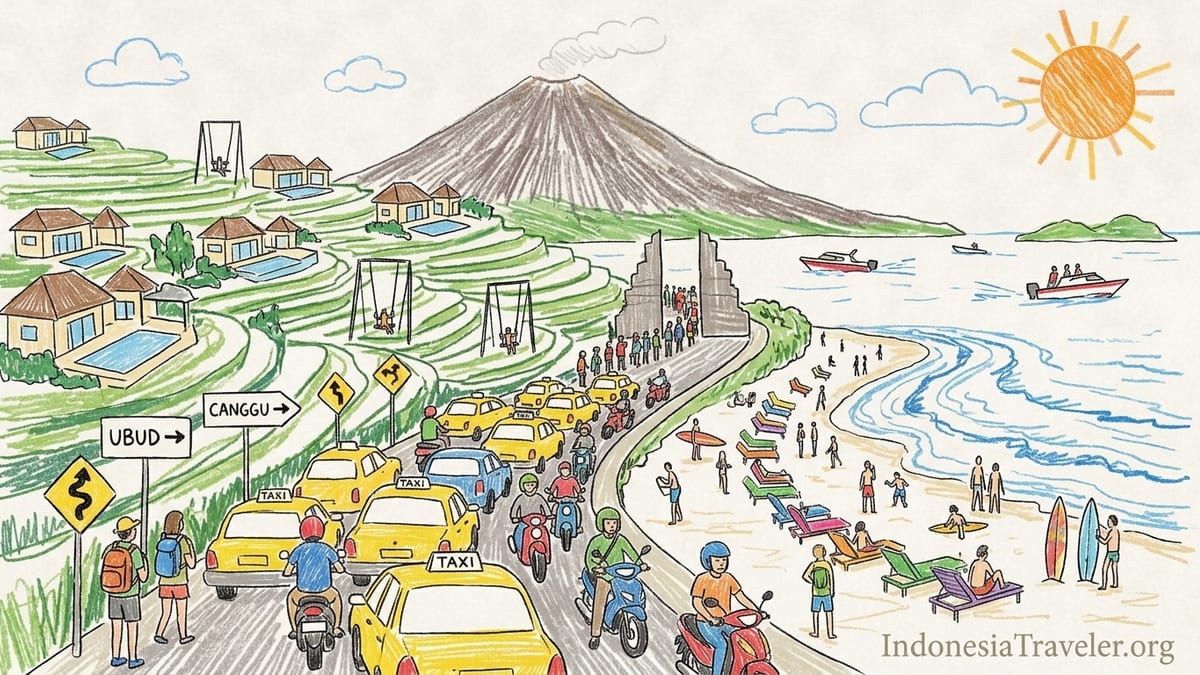
On the ground, those numbers translate to something very simple: almost nowhere on the main tourist circuit is quiet any more at mainstream hours. When you stand in an hour-long line at a photo platform, crawl through the same bottleneck into Canggu every afternoon or wait for a table at what used to be a sleepy warung in Ubud, you are feeling the difference between six or seven million foreigners and sixteen million total tourist trips.
None of this means you cannot still find calm in Bali. It does mean that arriving with the expectation of a cheap, uncrowded tropical backwater is a recipe for disappointment. The island you have seen on social media is a selective slice of reality taken at 6 a.m., in low season, with crowds cropped out.
Traffic: The Time Sink No One Puts on Their Itinerary
The first and most brutal shock for many first-timers is the traffic. Bali’s tourism has grown faster than its roads. Distances that look trivial on a map routinely turn into journeys of ninety minutes or more. Official transport guides and local planning sites now suggest allowing 45 to 75 minutes from the airport to Canggu or Seminyak, and 75 to 105 minutes to Ubud in normal conditions. In peak afternoon or early evening traffic, many drivers quietly double those estimates.
On my last trip, I timed several standard routes with a private driver. Canggu to Uluwatu for a sunset visit to the temple and Kecak performance took two hours each way, leaving at 3:30 p.m. and returning after 9 p.m. Seminyak to Ubud on a mid-morning transfer took just over two hours in slow, stop-start traffic. Ubud down to the airport on a late afternoon run, with rain, took almost two and a half hours. None of these were freak events. Traffic specialists monitoring Bali’s main corridors now warn that Seminyak to Ubud can easily stretch beyond 90 minutes at busy times, and Canggu to Ubud or Uluwatu regularly pushes toward the two-hour mark.
This is where Bali’s “stay in five different areas to see it all” itineraries fall apart. Every hotel change comes with packing, check-out, waiting for a driver, the journey itself, and then check-in and settling on the other side. That is rarely less than three hours door-to-door once you add the road time. Do that three or four times and you have lost a full day of your trip just to logistics. I have met couples who spent a week in Bali and realized they had been in transit vehicles for close to fifteen hours, not counting day trips.
The flip side is that if you choose two bases carefully instead of four, you immediately gain back swathes of your holiday. For example, three or four nights in Canggu or Seminyak to explore the south, followed by four or five nights in Ubud or Sidemen, lets you cover most of the popular circuit without repeating long transfers. When people tell me Bali “was not relaxing at all,” the common thread in their stories is not just the crowds, but the sheer number of hours they spent in traffic because they tried to chase every highlight from multiple distant bases.
Tourist Traps and Manufactured Moments
Bali has always charged admission fees to major temples and attractions. The problem today is not that things cost money, but how aggressively certain spots have been remade into machines for staged social media moments. Tegallalang’s famous rice terraces north of Ubud are a textbook example. The landscape is genuinely beautiful, a UNESCO-listed subak irrigation system still functioning beneath the tourism infrastructure. Yet the main ridge is now lined with ticketed swings, nests, heart-shaped viewing platforms and operators calling out for photos. Each swing or platform has its own price, often paid in cash on the spot, and some visitors report being surprised by add-on fees for camera angles, guides or costumes.
I remember standing on one of Tegallalang’s upper paths watching a line of tourists take turns on a giant swing, drones buzzing above them, while workers tended the paddies below almost invisible in the background. Expectation: tranquil green terraces. Verified reality: a narrow strip of heritage landscape wrapped in a commercial carnival of pay-per-photo experiences. The consequence is not just disappointment; it is the creeping idea that everything beautiful in Bali is now behind a paywall designed for Instagram.
Lempuyang Temple’s “Gates of Heaven” might be the single clearest case of expectations colliding with reality. The famous image that circles the internet shows a perfect mirror reflection of the split gate and Mount Agung rising behind. The reflection is not a magical lake. It is a simple camera trick using a small mirror or glass pane held under the lens. On site, there is no reflective pool, just a flat stone courtyard and staff who manage a virtual queuing system. Wait times of one to three hours in the middle of the day are common, and your turn is reduced to a few rapidly posed shots under time pressure so the line can keep moving.
At Uluwatu, the temple itself and the Kecak fire dance at sunset are marketed as one seamless experience, but they are sold on separate tickets. You pay an entrance fee to access the temple grounds and clifftop walk, then a different ticket for the Kecak performance in the open-air amphitheater. Neither of these prices is unreasonable in isolation, but for budget travelers expecting “cheap Bali,” two tickets, paid transport, plus the time lost in traffic, adds up quickly. The alternative is to visit a smaller sea temple like Tanah Lot or Gunung Payung Temple earlier in the afternoon, or to seek out a Kecak performance in a village stage around Ubud where the experience may feel less like a conveyor belt.
Beaches That Do Not Match the Brochure
If you go to Bali expecting every beach to be a calm, swimmable lagoon, you are set up to be disappointed. Canggu and Kuta, two of the island’s best-known coastal hubs, are primarily surf beaches. Their dark volcanic sand and consistent swell are ideal for surfing lessons and beach bars but often create strong currents, larger shore breaks and red-flag days where weak swimmers should stay out of the water. Standing on Batu Bolong Beach in Canggu at mid-tide, what you see is a field of surfers and whitewater, not the glassy water that adorns resort brochures.
On the Bukit Peninsula around Uluwatu, the coastal scenery is spectacular. High limestone cliffs drop to bright sand coves such as Padang Padang, Bingin and Suluban. However, access often means steep staircases carved into rock, sometimes with uneven steps and crowded bottlenecks. Padang Padang’s narrow entrance is famous not only for its beauty but for its queues; at busy times you shuffle down a cramped rock cleft with boards and bags, then climb back up the same way in the heat. Elderly travelers, people with mobility issues or those visiting with small children are frequently caught off guard.
Sanur, on the southeast coast, is marketed as the gentle, family-friendly alternative, and it does offer calmer waters behind a protective reef. The catch is that at low tide the lagoon can all but drain out, leaving long sand and seagrass flats where the water is only ankle deep. In the middle of the day, you may find you cannot swim properly at all. Hotel pools become the default, which is not necessarily bad, but is rarely what people imagine when they book a beachfront stay.
The practical alternative is to match your base to your real priorities instead of chasing an image. If you want swimmable water at most tides without heavy surf, parts of Nusa Dua, some stretches of Jimbaran and the eastern side of Nusa Lembongan usually fit better than Canggu or Kuta. If you crave the drama of Uluwatu’s cliffs, accept that access is physical and crowds are part of the package, then plan rest days where you do not have to tackle the stairs at all.
Rice Terraces, Subak, and the Strain on Bali’s Land
One of the most painful disconnects in Bali is between the postcard rice terraces and the reality of a farming system under pressure. The island’s iconic terraced landscapes form part of a UNESCO World Heritage property known as the “Cultural Landscape of Bali Province: the Subak System as a Manifestation of the Tri Hita Karana Philosophy.” In recent state of conservation reports, UNESCO experts have expressed explicit concern about over-tourism around key terrace areas and the encroachment of villas and tourism infrastructure onto rice fields, warning that unchecked development could fragment the landscape and weaken the traditional subak irrigation cooperatives.
Walking through Tegallalang or Jatiluwih today, you see both sides at once. On one ridge, farmers are still planting and harvesting rice according to centuries-old water-sharing agreements. On the next, concrete guesthouses, cafes and private pools are marching across former paddies. Locals will tell you, quietly, that leasing land to developers often pays better than growing rice. The consequence is that the very system tourists come to see as “authentic Bali” is being eroded to service tourism itself.
Environmental strain shows up in other ways too. Academic studies and local environmental groups have documented rising solid waste and wastewater challenges in Bali as visitor numbers climb. Rubbish collection and landfill capacity struggle to keep pace with the volume created by millions of tourists buying bottled drinks and disposable pool toys. Rivers and drainage canals in urbanized areas like Denpasar and Badung often carry plastic and household waste to the sea. In some villages, farmers complain that irrigation channels receive untreated greywater from upstream guesthouses.
Water demand is a quieter but equally serious issue. High-end villas with multiple bathrooms, private pools and manicured gardens draw heavily on groundwater, sometimes in areas that once relied on springs and streams to feed subak systems. Researchers looking at Bali’s water balance have highlighted declining groundwater levels in parts of the south, linking them to tourism-related extraction. The practical alternative for travelers is not to boycott Bali, but to choose properties that can explain their water and waste systems, carry refillable bottles rather than buying endless plastic, and consider spending part of their stay in regions where tourism density and infrastructure are more in balance, such as Sidemen or the villages around Munduk.
Safety, Fast Boats and the Kelingking Cliff
One of the most uncomfortable truths about modern Bali travel is that some of the most aggressively promoted “must do” experiences come with real safety concerns that are glossed over in itineraries. Nowhere is this clearer than in the fast-boat shuttles between Bali and Nusa Penida, Nusa Lembongan and the Gili Islands. In August 2025, a fast boat named Dolphin II partially sank and ran aground near the entrance to Sanur harbor on a Nusa Penida to Sanur run. Indonesia’s search and rescue agency reported multiple foreign deaths and missing passengers. This was not an isolated incident; local news periodically covers collisions, mechanical failures or overloaded boats in these busy straits.
Travel agency marketing, however, often treats the crossing as a carefree hop, sometimes bundled into “all-inclusive” day tours with vague wording about the operator and safety equipment. When you read the small print, lifejacket availability, passenger limits and contingency plans for rough seas are often unclear. The consequence is that travelers, including families, step aboard assuming standards equivalent to regulated European or North American ferry routes when in reality enforcement is looser and weather windows matter far more.
The tragedy at Kelingking Beach on Nusa Penida in September 2026 should be a turning point in how we talk about Bali itineraries. On 12 September, a 29-year-old Australian woman fell around 80 meters from the cliff at Kelingking and died after reportedly looking for an independent route to the viewpoint edge. Local authorities told reporters she slipped into a ravine while seeking a better angle. Long before this, Bali’s own police and village leaders had been warning about risky behavior at Kelingking’s unguarded edges, but social media continued to reward the most daring cliffside poses.
I do not blame individual tourists for wanting the photo they have seen a thousand times. I do blame the way Kelingking is packaged as a quick stop on frenetic day trips that allow barely ten or fifteen minutes at the viewpoint before herding visitors back onto vans and boats. Tired travelers rushing on narrow dirt paths with minimal barriers, distracted by guides calling them back and by pressure to “get the shot before the next group,” is a safety problem created by the industry, not by one traveler’s mistake.
The responsible alternative is unglamorous but simple. If you choose to do Bali’s fast-boat routes, ask specifically which operator is used, what safety briefings are provided, and whether trips are canceled or rescheduled when swell picks up. Wear the lifejacket. For Kelingking and other high-risk viewpoints, slow down. Give yourself time, avoid the edge, accept that you are not owed a particular angle just because you have flown a long way, and push back against itineraries that cram Kelingking, Diamond Beach, Broken Beach and Angel’s Billabong into one rushed day.
Money, Licenses and Fine Print
Overtourism does not just crowd your photos; it also creates fertile ground for small-scale scams and misunderstandings. In Bali’s main resort strips, visitors still report encountering money changers advertising unusually favorable exchange rates, only to be hit with hidden commissions or sleight-of-hand tactics at the counter. Official advisories from several foreign consulates now warn visitors to use only reputable, authorized money changers and to avoid those offering significantly better rates than banks. Even without outright fraud, counting large stacks of rupiah in cramped booths when you are jet-lagged is a recipe for mistakes.
Accommodation pricing has grown more opaque too. Villa stays that appear cheap on booking platforms can balloon in cost once you add mandatory service charges, taxes, cleaning fees and sometimes high-season surcharges that are listed only in fine print. I have seen nightly rates jump by more than 30 percent at payment stage. In a saturated market where owners compete fiercely, headline nightly prices are treated as marketing tools rather than realistic totals. The consequence is that travelers arrive convinced Bali is still “cheap” and then find themselves paying mid-range European nightly rates once everything is included.
Scooter rental is another area where expectation often clashes with Indonesian law and reality. To legally ride a scooter in Bali, you need the correct category on your home license plus an international driving permit. Police periodically run enforcement checkpoints, especially in Canggu, Kuta and Ubud. Tourists without documentation can face on-the-spot fines. More importantly, insurance policies routinely exclude coverage for accidents if the rider was unlicensed or not wearing a helmet. Yet rental kiosks continue to hand over scooters to travelers with no experience riding in heavy traffic, sometimes after a two-minute “lesson” in a side street.
Finally, there are the vague transfer and tour inclusions. Shared airport transfers that sound simple can involve long waits while vans fill up and multiple hotel drops, turning a 45-minute ride into a two-hour crawl. “All-inclusive” temple and waterfall tours may cover entrance fees but not parking or sarong rental, leaving guests surprised by extra charges paid in cash on the day. The practical antidote is to insist on itemized inclusions and to factor some cash for on-the-spot fees into your budgeting, rather than assuming Bali’s reputation for affordability means there will be no surprises.
Twelve Common Disappointments and Better Alternatives
Expectation: Canggu or Seminyak as a quick, central base for day trips all over the island. Verified reality: south Bali traffic means getting from Canggu to Ubud, Uluwatu or even the airport can take up to two hours each way at busy times, and days that were meant to be beach-and-temple combos turn into long, hot journeys. Consequence: frustration, missed sunset shows, and the feeling that you have spent your holiday in vans. Practical alternative: choose two bases that reduce backtracking, such as Uluwatu or Jimbaran for the first days, then Ubud or Sidemen for the inland portion, and cluster your activities around each base instead of ping-ponging across the island.
Expectation: Tegallalang as an untouched valley of rice fields. Verified reality: the main ridges are lined with swings, nests and ticketed photo platforms, each charging its own fee, with music and drone noise overlaying the landscape. Consequence: many visitors leave feeling they visited a theme park wrapped around a heritage terrace rather than a living farming landscape. Practical alternative: visit Jatiluwih early in the day, where the terraces spread more widely and visitor numbers, while growing, are still thinner, or hire a local guide to walk lesser-known subak paths around Sidemen or Tabanan where agriculture still dominates.
Expectation: Lempuyang’s Gates of Heaven as a mystical lake-top temple. Verified reality: the iconic reflection photo is created with a handheld mirror or glass, there is no pool under the gate, and you wait in a managed queue system for a strictly timed, staged photo sequence. Consequence: after hours in line, many travelers leave with beautiful but clearly manufactured images and little sense of the temple’s religious significance. Practical alternative: if you go, arrive very early, treat the queue as optional rather than essential, or instead attend a ceremony at a smaller local temple where you are a respectful observer rather than a customer on a production line.
Expectation: Uluwatu as a serene cliff temple and soulful fire dance at sunset. Verified reality: the temple and Kecak performance require separate tickets, crowds are dense, monkeys hassle visitors for food and loose items, and the access road often jams both before and after the show. Consequence: stress and expense overshadow the cultural content. Practical alternative: visit Uluwatu temple in the morning for views without the worst crowds, and see a Kecak performance elsewhere around Bali, such as an evening show in Ubud or at a community stage where seating is simpler and arrival logistics are easier.
Expectation: Kuta and Canggu as perfect family swimming beaches. Verified reality: these are surf coasts with powerful shore breaks and currents, red flags on rough days and boards zipping through the shallows. Consequence: parents end up anxious, weak swimmers stay mostly on the sand, and some families find they barely swim in the sea at all. Practical alternative: for confident surfers or those keen on lessons, Canggu can be great. For swimming, look to Nusa Dua, parts of Sanur at mid to high tide, Jimbaran’s central bay, or consider boat trips to calmer coves around Nusa Lembongan.
Expectation: Sanur as a year-round, all-day swimming lagoon. Verified reality: at low tide the water recedes far from the beach, leaving seagrass flats and ankle-deep shallows where swimming is impractical. Consequence: guests who booked specifically for sea swimming are restricted to hotel pools or short dips at carefully timed tides. Practical alternative: check tide charts when planning your stay, choose hotels further out along the eastern stretch where the lagoon can be deeper, or split your time between Sanur and another beach where tide dependence is less severe.
Expectation: Nusa Penida as a quick, simple day trip with effortless crossings. Verified reality: fast-boat incidents like the 2025 Dolphin II grounding and sinking highlight real safety and weather risks on this route, and harbors can be chaotic at boarding and landing. Consequence: stress on rough crossings, delays, or in worst cases, injuries and fatalities. Practical alternative: if you go, book with reputable operators that explain safety procedures, avoid the most overloaded departure times, or stay at least one night on Nusa Penida to reduce pressure and avoid the rush of day-trippers.
Expectation: Kelingking Beach as a straightforward viewpoint for a dramatic photo. Verified reality: narrow dirt trails, limited barriers and intense crowding at peak times have already contributed to serious falls, including the fatal September 2026 incident involving a traveler seeking a route to the edge. Consequence: life-altering accidents in pursuit of a specific social media shot. Practical alternative: stay behind the barriers, accept wider-angle views, visit during quieter times, or choose safer viewpoints on Nusa Penida and Nusa Lembongan that do not require approaching unguarded cliff edges.
Expectation: Bali as a universally cheap destination. Verified reality: entrance fees, photo charges, guided experiences, private drivers and villa service fees add up quickly, especially in the most touristed districts, and many mid-range villas now charge rates comparable to European resort towns once tax and service charges are added. Consequence: budget shock, corners cut on safety or experiences, and resentment that undermines enjoyment. Practical alternative: plan with realistic mid-range budgets, eat many meals at local warungs rather than only at western-style cafes, and prioritize a smaller number of meaningful paid activities over chasing every activity on offer.
Expectation: “Freedom” on a scooter as the best way to see the island. Verified reality: heavy traffic, police checks, licensing requirements and patchy insurance coverage mean that an unlicensed tourist on a scooter who crashes may face fines and uncovered medical bills. Consequence: serious financial and physical risk, particularly at night or in rain. Practical alternative: if you are not already comfortable riding in dense traffic, hire a private driver for inter-area travel and use ride-hailing apps where allowed for short hops, or restrict scooter use to quieter rural districts after arranging proper licensing.
Expectation: Money changers as a harmless way to squeeze a little extra out of exchange rates. Verified reality: reports of short-counting, hidden commissions and distraction tactics persist among fringe operators offering above-market rates in tourist strips. Consequence: lost cash and distrust that lingers throughout the trip. Practical alternative: withdraw cash from ATMs attached to major banks, use well-known authorized money changers that post clear rates and receipts, and avoid any outlet whose offer seems significantly better than the rest of the market.
Expectation: “All-inclusive” waterfall or temple tours as simple, transparent packages. Verified reality: inclusion lists can be vague, and travelers sometimes discover they must pay extra for parking, sarongs or specific photo platforms, or be hustled through rushed itineraries that prioritize commission-heavy stops. Consequence: fatigue and the sense of being treated as a wallet on legs. Practical alternative: confirm in writing what is covered before booking, favor smaller local operators recommended by recent travelers, and consider hiring a driver by the day and paying entrance fees yourself for full control.
The Takeaway
So, is Bali overrated? If you arrive expecting an inexpensive, quiet island of empty beaches and untouched temples, the honest answer is yes. The 6,948,754 direct foreign arrivals and more than 16 million total tourist trips in 2025 have transformed large parts of the island into one of the busiest resort regions in Asia, with traffic, commercialization and environmental strain to match. Many of the most famous images in Bali’s marketing are now carefully framed exceptions rather than the everyday reality.
But overrated does not mean worthless. Bali remains exceptional in ways that are easy to miss if you only chase social-media checklists. The strength of local community life, the depth of ceremony woven into daily routines, the sophistication of the subak irrigation cooperatives and the creativity of Balinese arts are still there beneath the traffic jams and ticket booths. You just have to align your expectations with the island that actually exists in the 2020s rather than the one captured in a 1980s backpacker memoir.
If you go, go with open eyes. Expect heavy development in parts of Canggu, Kuta, Seminyak, Uluwatu and central Ubud, and plan your bases to minimize time lost in congestion. Budget as you would for any mid-range international beach destination, not as a rock-bottom bargain. Choose operators who treat safety and environmental impact as non-negotiable rather than extras. Most of all, give more of your time to genuine cultural understanding: sitting quietly at a village ceremony you were invited to, walking with a farmer who explains how water is shared, or spending an afternoon at a local compound instead of in line for a staged swing photo.
Seen that way, Bali stops being an overrated postcard and becomes what it actually is: a crowded, complicated, beautiful island that can still move you deeply, if you are willing to let go of the filtered version and meet the real one.
FAQ
Q1. Is Bali still worth visiting despite the crowds and traffic?
Yes, if you adjust your expectations. Bali is no longer a quiet budget hideaway, but it remains rich in culture, landscapes and hospitality. Choosing fewer bases, traveling outside peak hours and focusing on experiences beyond the most famous Instagram spots can still make a trip deeply rewarding.
Q2. How bad is the traffic between places like Canggu, Seminyak, Uluwatu and Ubud?
Traffic in south and central Bali is often heavy. Journeys that look like 20 or 30 kilometers on a map can easily take 90 minutes or more, especially before sunset and after major events. Planning two main bases instead of many hotel changes and grouping activities by area helps reduce hours lost on the road.
Q3. Are Bali’s beaches safe and suitable for swimming everywhere?
No. Canggu and Kuta are primarily surf beaches with strong waves and, at times, powerful currents. Some Uluwatu-area beaches require steep staircases and are better suited to confident swimmers. Sanur is calmer, but can be very shallow at low tide. If swimming is your priority, research specific bays and tides rather than assuming all Bali beaches are alike.
Q4. What is the issue with popular photo spots like Lempuyang’s Gates of Heaven?
The famous reflection at Lempuyang’s gate is created with a mirror or glass under the camera, not a natural pool. Visitors often face long queues for tightly timed, staged photos that can feel disconnected from the temple’s religious meaning. Understanding this in advance can help you decide whether the experience matches what you want from your trip.
Q5. How serious are safety concerns about fast boats and places like Kelingking cliff?
Fast boats between Bali and nearby islands have had documented accidents, including a 2025 sinking near Sanur with foreign casualties. Kelingking’s cliffs on Nusa Penida have seen fatal falls, including a widely reported death on 12 September 2026. Choosing reputable operators, wearing lifejackets, avoiding cliff edges and resisting rushed, checklist-style itineraries are essential precautions.
Q6. Is it legal for tourists to ride scooters in Bali on a standard license?
To ride legally you need the correct motorcycle category on your home license and an international driving permit, plus a helmet. Police do conduct checks and can issue fines to unlicensed riders. Many insurance policies will not cover accidents if you are unlicensed or not properly equipped, so renting a scooter without the right documents carries real risk.
Q7. Are reports of scams and money-changer fraud in Bali exaggerated?
Most visitors do not encounter major scams, but there are still money changers using hidden fees or sleight-of-hand tactics, especially those advertising unusually good rates. Using reputable, authorized changers, counting money carefully and avoiding offers that seem too generous greatly reduces your risk.
Q8. How is mass tourism affecting Bali’s environment and rice terraces?
UNESCO and researchers have raised concerns that over-tourism, villa development and infrastructure are encroaching on rice terraces and straining the traditional subak irrigation system. Waste and water use are also growing challenges. Supporting accommodations with strong environmental practices and visiting less-saturated terrace areas can help ease some pressure.
Q9. Can I still find quiet, less crowded places in Bali?
Yes, but not usually in the busiest parts of Canggu, Kuta, Seminyak, Uluwatu or central Ubud. Quieter experiences are more likely in areas like Sidemen, parts of east and north Bali, or village districts off the main tourist strip. Even in busy areas, early mornings and shoulder seasons tend to be calmer.
Q10. How should I plan my Bali itinerary to avoid common disappointments?
Limit yourself to one or two main bases, cluster activities by area, and be realistic about travel times. Treat heavily marketed photo spots as optional, prioritize safety over tight checklists, and budget for Bali as a mid-range international destination rather than a rock-bottom bargain. Most importantly, leave space for unscripted cultural encounters instead of chasing every trending location.