


Canggu’s reputation has grown faster than almost anywhere in Bali, helped by social media images of poolside parties, smoothie bowls and perfect longboard waves. On the ground, the reality is more mixed. The coastline still offers mellow surf and big sunsets, but it is also busy, noisy in places and increasingly expensive. This guide focuses on experiences that genuinely define Canggu, explains where social-media hype plays a bigger role, and gives you enough practical detail on locations, prices, time and safety to plan a trip that suits how you really like to travel.
Understanding Canggu’s Coastline: Beaches by How You Use Them
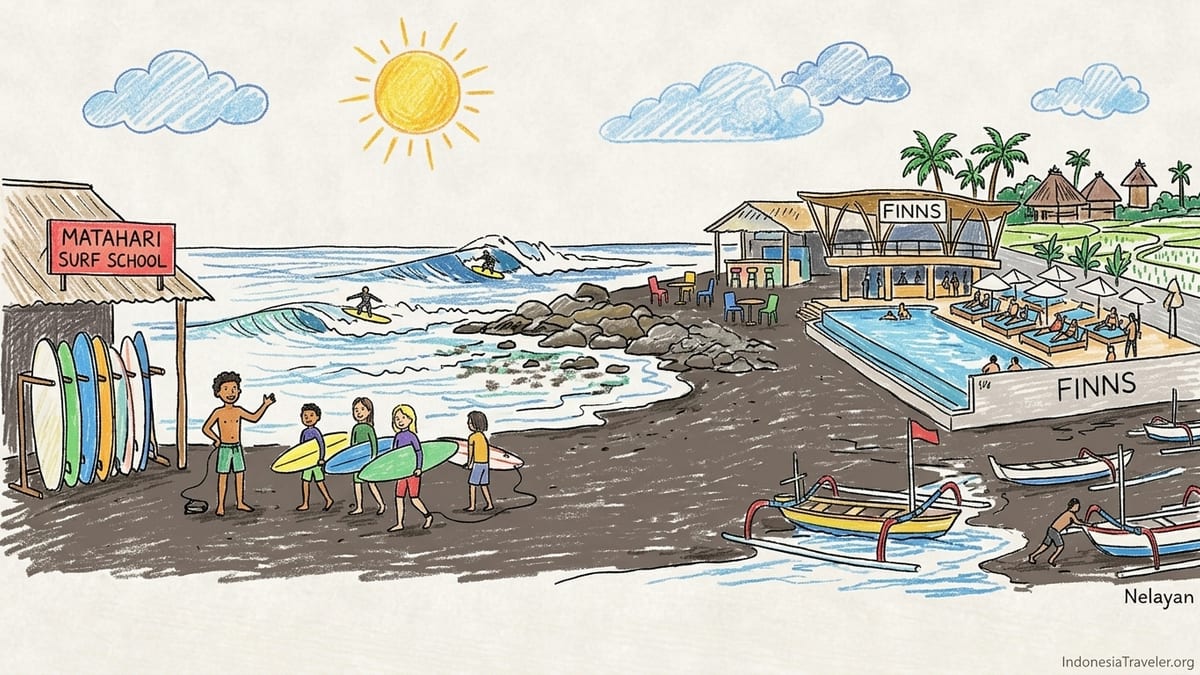
Canggu is essentially a chain of black and dark-sand beaches west of Seminyak, each with its own character. Rather than ranking them by beauty, it is more useful to think about what you do on each stretch. Batu Bolong is the social and beginner-surf hub, Echo Beach suits intermediate surfers who are comfortable around reef, Berawa is dominated by beach clubs, Nelayan has a smaller-village feel with fishing activity, and Pererenan and Seseh remain less developed coastal areas a short ride away. All of them can have powerful shorebreaks, rip currents and changing sandbanks. Conditions that are fine for a supervised beginner surf lesson are not automatically safe for inexperienced swimmers without boards, leashes and instructors watching.
Distances are short but traffic is slow. Batu Bolong and Echo Beach are roughly 15 to 20 minutes’ ride from Berawa in light traffic, yet at sunset that same trip can stretch to 40 minutes or more. Walking between adjacent beaches is possible at low to mid tide, but sections can be soft and uneven underfoot. For planning purposes, treat each beach area as its own mini-neighbourhood with distinct facilities, food options and crowds rather than expecting one continuous seaside promenade.
For first-time visitors, it helps to locate your accommodation based on what you will actually do each day. If you want easy beginner surf, cafés and evening buzz on foot, staying close to Batu Bolong or the top of the beach road is practical. For quieter nights and a base that still reaches Batu Bolong in 10 to 15 minutes on a scooter or in a car, Pererenan and the laneways back from Nelayan remain good options. Berawa works best if you expect to spend time at FINNS Beach Club or similar venues and are comfortable with noise and traffic at peak hours.
Batu Bolong: Beginner Surf, Board Rentals and Sunset Life
Batu Bolong is the heart of Canggu’s surf scene and one of Bali’s most approachable learner waves. The main break has a relatively forgiving, rolling takeoff over a mixed sand-and-reef bottom, and there are several well-established surf schools operating directly from the beach. Local outfits typically run two-hour sessions that include a beach briefing, warm-up, board, rash guard and coaching in the water, with lesson times adjusted around tides and swell.
As of October 2026, a clear benchmark for pricing is Matahari Surf School at Batu Bolong. Its published rates are IDR 390,000 for a two-hour small-group lesson for two to five people and IDR 490,000 for a two-hour private one-to-one lesson, including equipment and instruction, verified against the school’s own booking channels in September 2026. Other schools clustered near the car park and warungs tend to fall in a similar band, commonly between about IDR 350,000 and IDR 650,000 for a two-hour lesson depending on group size and branding. Always confirm what the price covers before paying, especially whether it includes board rental after the lesson or just coaching time.
Conditions at Batu Bolong are usually suitable for carefully supervised beginners, but that does not mean the sea is safe for casual swimming. Long-period swells can still produce heavy sets and strong currents, and a board with a leash plus an instructor’s help changes the risk profile significantly. If you are not surfing, confine swimming to the shore edge when waves are small, stay within your depth, and avoid the main takeoff zone where boards travel at speed. Families with younger children are usually better off with sand play, paddling at the shoreline and watching the surfers, rather than treating Batu Bolong as a calm swimming beach.
A typical first-lesson schedule is around two to three hours door to door. Allow 15 to 20 minutes to ride down from central Canggu, 15 minutes for sign-in and getting a board fitted, 20 to 30 minutes for land instruction and warm-up, then about 60 to 75 minutes in the water before fatigue sets in. Add time after for a shower and snack. Board rentals without instruction, from simple longboards to soft-tops, are easily available on the beach, generally starting around IDR 50,000 to IDR 75,000 for one to two hours, though rates are open to discussion and can rise in high season.
Echo Beach and Berawa: Stronger Waves and Social-Media Beach Clubs
Echo Beach lies just north of Batu Bolong and is synonymous with more powerful, less forgiving surf. Here the seabed is heavily influenced by reef, and many peaks are best suited to confident intermediates and above. Several cafés and warungs line the sea wall with elevated views of the breaks, and it is an excellent place to watch good surfers carving along longer waves at higher tide. If you are taking lessons, most reputable beginner-focused schools will keep you at Batu Bolong or other gentler spots. A few independent instructors will consider Echo Beach for progressing students, but only when conditions are smaller.
Echo Beach is not a safe choice for casual, inexperienced swimmers. Sharp reef, strong currents and crowded takeoff zones mean that even wading out to waist depth can be risky on a big day. The more realistic way for non-surfers to enjoy Echo Beach is to come for an hour or two around late afternoon, order a drink or simple meal at one of the sea-view warungs, and treat the coastline as a natural theatre. For a less commercial way to spend time near the water, walk 10 to 15 minutes in either direction along the sand at lower tide, where you can still enjoy the coastline without being surrounded by as many surf schools.
Berawa Beach, farther south heading back toward Seminyak, is where social media and reality diverge most sharply. The sand itself is similar to the other Canggu beaches and the surf can be fun for experienced riders, yet the focus has shifted toward large, highly produced beach clubs. FINNS Beach Club dominates this stretch with pools, music and multi-level decks facing the ocean. Online images emphasize a luxury atmosphere and crowds in swimwear, but understanding how access and costs work will help you decide if it suits your style.
As of 2026, FINNS Beach Club states that there is no general entrance fee for walk-in guests. You can enter without paying at the door and order food or a single drink at bar tables or in some standing areas, subject to space and house rules. Costs increase once you reserve specific seating like daybeds or cabanas, where you commit to a minimum spend that is then credited toward your food and drinks. Publicly advertised minimum spends fluctuate with demand, bed location and promotions, but advance online booking often reduces the spend compared with walking in, and large beds for groups can run into several million rupiah for a full day, especially on weekends. Separate, ticketed events such as New Year’s Eve parties operate differently again, with an entrance price that is not simply a minimum spend. If you prefer a quieter seaside experience and do not enjoy loud music or crowds, a less commercial alternative is to spend an hour at a simple beach bar farther along Berawa or back toward Nelayan, where plastic chairs on the sand and basic grills replace polished decks and DJ booths.
Nelayan, Pererenan and Seseh: Quieter Sand and Fishing Activity
Pantai Nelayan sits between Batu Bolong and Berawa and feels more like an older fishing area that has gradually absorbed parts of Canggu’s tourism boom. Traditional jukung fishing boats usually line sections of the sand, especially at the southern end, and you will see locals launching or landing catches in the early morning. Accommodation and cafés now reach the streets behind the beach, but the waterfront remains slightly less intense than Batu Bolong. Surf here can be fun for intermediates, though conditions and sandbanks change, and there is less of a fixed surf-school presence.
For visitors, Nelayan works well for an hour-long early-morning walk from nearby accommodation, watching the fishing activity and then heading back inland for breakfast. Families often appreciate the slightly calmer feel compared with Batu Bolong’s main drag, but the same cautions about swimming apply. Dark sand and the open exposure of the coast mean that waves and currents can be energetic even when everything looks manageable from your sunbed. If you want children in the water, keep them in very shallow shorebreak, watch for sets and consider inflatable armbands a backup rather than a safety guarantee.
Continuing north, Pererenan and then Seseh form a longer belt of less intensely developed coastline, with a mix of independent guesthouses, villas and a few boutique hotels. Pererenan Beach itself has a growing row of cafés and a modest beachfront parking and temple area, but it still feels more residential than tourist-zoned. Seseh retains more of a village atmosphere, with rice fields and temples playing a larger role than bars. Travel time by scooter from Batu Bolong to Pererenan is around 10 to 20 minutes, depending on traffic and your exact starting point. The main draw here is space and a slightly slower tempo. As a less commercial alternative to sunset at loud beach clubs, many visitors walk the Pererenan or Seseh shoreline for 60 to 90 minutes in the late afternoon, pausing at simple warungs for coconut water or tea rather than cocktails.
Surf along this stretch becomes more exposed and, in parts, is framed by reef. You will see locals and experienced foreigners riding a variety of peaks. If your surfing is still at the whitewater stage, this is not the place to experiment independently. Use it instead as a way to see how the coast looks beyond Canggu’s densest blocks of cafés and shops, and to balance time in the most Instagrammed spots with an environment that still feels like a working coastal community.
Surf School Comparison: How to Choose and What You Pay
Surf lessons are one of Canggu’s defining activities, and they are also an area where prices, quality and expectations vary. Based on checked 2026 information from Batu Bolong and wider Canggu, two-hour group lessons commonly cluster around IDR 350,000 to IDR 450,000 per person, with some premium operations and surf camps charging more. Private two-hour lessons, where one instructor works only with you, usually fall between about IDR 490,000 and IDR 650,000 at independent schools, with integrated surf camps quoting higher packages that might include transport and multiple sessions.
The clearest current benchmark for a stand-alone surf school on Batu Bolong is Matahari Surf School, whose website lists IDR 390,000 for a two-hour small-group lesson and IDR 490,000 for a two-hour private lesson, checked in September and October 2026. These figures match the pricing still visible at the time of writing and align with third-party guides that verify the school’s details, so they can be treated as a reliable reference point for budgeting. Other schools at Batu Bolong report broadly similar ranges for equivalent two-hour sessions, and at least one local instructor collective at the same beach advertises group lessons around IDR 350,000 for two hours, which sits just below the Matahari benchmark.
Because surf conditions change daily, the better schools will only finalise lesson times after seeing tide forecasts and swell. When you enquire, ask very specific questions. Confirm the exact duration of the session, whether it is a full two hours in the water or includes land briefings, how many people each instructor will supervise, and whether rash guards and soft-top beginner boards are included. Also clarify rescheduling terms if the surf becomes unsuitable; responsible schools are willing to move or cancel sessions when currents or wave size make entry unsafe for the level you booked.
From a safety standpoint, a supervised lesson for a new surfer offers layers of protection that casual swimming in the same conditions lacks. Instructors monitor rip currents and incoming sets, choose entry and exit points, and often hold or push the board to control speed. Conditions that are considered acceptable for a beginner lesson can still be dangerous for someone without a leash, board and supervision. Treat your first lesson as both a way to catch waves and a practical introduction to reading the ocean on this coastline. For a less commercial alternative to heavily branded surf schools, you can ask your guesthouse to recommend a local independent instructor who operates with similar pricing but less marketing presence, while still checking that they are willing to cancel or move a session when conditions are not safe.
Eating in Canggu: Warungs, Brunch Cafés and Restaurants
Food is one of Canggu’s biggest draws, and it falls broadly into two overlapping categories. On one side are traditional warungs, family-run eateries serving Indonesian dishes like nasi campur, mie goreng and grilled fish at modest prices. On the other are international cafés, bakeries and restaurants focusing on brunch plates, specialty coffee, sourdough, plant-based menus and higher-end dinners. Batu Bolong, Nelayan, Berawa and Pererenan each have their own mix, and choosing where to eat shapes how commercial or local your visit feels.
Around Batu Bolong and the top of the beach road you will find clusters of all-day brunch cafés promoting dishes such as avocado toast, smoothie bowls and shakshuka, alongside espresso-based coffee. Prices here are closer to European city levels than traditional Bali; it is common to spend the equivalent of several local meals on a single café breakfast and drink. In contrast, simple warungs a few streets back or in the same area might serve a plate of rice, vegetables and chicken or tofu for a fraction of that amount, with a more everyday local environment. If your budget is limited or you want to balance your impact, alternating between café brunches and warung dinners is a realistic compromise.
Nelayan and Berawa show a similar pattern. Streets inland from Nelayan Beach mix newer cafés and juice spots with older local eateries that predate much of Canggu’s growth. Berawa leans more heavily toward international options and premium restaurants, especially near the shortcut roads and closer to the beach clubs, with menus running from wood-fired pizza to modern Asian fusion. The variety is useful if you are travelling with a mixed group, but it is also where social-media exposure plays a bigger role; many venues are designed to be photographed as much as to be eaten in. For a less commercial alternative to Berawa’s main strip, consider dinner in Pererenan, where the balance still tilts slightly toward small restaurants and warungs integrated into a residential community.
Pererenan’s main road has added several new cafés and bakeries in recent years, but once you turn off into smaller lanes you quickly find quieter local food spots and small family-run warungs. Here, the atmosphere is calmer and the ratio of residents to short-stay visitors remains a little higher. Spending an evening here rather than only in Batu Bolong or around FINNS gives a clearer sense of Canggu as part of a broader Balinese district, not just a series of highly curated social-media sets.
Markets, Shopping Streets and Independent Makers
La Brisa’s Sunday market at Echo Beach has evolved into one of Canggu’s most distinctive weekly events. Held inside the La Brisa beach club complex on Sundays, it focuses on local farmers, small producers, craft makers and sustainable goods. Stalls might offer fresh fruit and vegetables, homemade sauces, baked items, natural skincare, hand-crafted jewellery and locally produced textiles. The market environment encourages chatting with vendors, sampling products and spending one to two hours browsing in the late morning or early afternoon, often followed by a simple lunch or coffee either inside La Brisa’s public areas or at one of the small cafés nearby.
This experience is quite different from Canggu’s evening shopping streets, which cluster along Batu Bolong, towards Nelayan and in parts of Berawa. Those strips mix boutiques, branded resort-wear stores and souvenir outlets with bars and cafés, many of them strongly targeted at short-stay visitors. You can easily spend a couple of hours walking a single stretch in the early evening, dropping into shops that specialise in swimwear, candles, beach accessories or home decor. Prices are often closer to international levels than traditional local markets, and the product selection is curated with social-media visibility in mind.
Small independent businesses survive in the gaps between these larger clusters. Studio-style spaces offer ceramics, slow-fashion garments or limited-run art prints, often tucked into side streets away from the main drag. Visiting these takes more effort, usually involving a scooter or car ride and short walks off the busiest roads, but the experience is more personal and less scripted. For a less commercial alternative to La Brisa’s market, you can look for village markets or smaller weekend pop-ups advertised locally, where the focus is more on daily Balinese life than on curated lifestyle products, though these change frequently and may not align neatly with a short stay.
Plan your time around daylight and heat. A realistic schedule could be a mid-morning visit to La Brisa’s market on a Sunday, two to three hours of rest or beach time in the afternoon, then a separate evening devoted to exploring the Batu Bolong or Berawa shopping streets once the worst of the sun has passed. That way you avoid compressing too much walking into the middle of the day, when pavements are hot and traffic fumes are more tiring.
Beyond the Beach: Yoga, Fitness, Skate and Creative Workshops
One reason many visitors stay in Canggu for weeks rather than days is the range of non-beach activities. Yoga studios across Batu Bolong, Berawa and Pererenan run multiple daily classes in vinyasa, yin, restorative and other styles, often in open-air shalas with fans and garden views. Drop-in prices for a single class in 2026 commonly sit in the mid-hundreds of thousands of rupiah, depending on the studio’s profile, with small discounts for multi-class passes. A typical class runs 60 to 90 minutes. Most advertise English-language instruction and cater to a mix of beginners and regular practitioners, though advanced classes also exist.
Fitness and strength training options now range from small independent gyms to large, branded training centres, some combining open-weight areas with group classes such as high-intensity intervals or functional fitness. Day passes are widely available, and early morning or late afternoon sessions fit best around the heat. If you are new to structured training, consider starting with an introductory or beginner-level class and confirm whether coaching is included in the price; some gyms separate floor access and coached sessions. For a less commercial alternative to polished fitness studios, many accommodations now offer simple on-site yoga or stretching classes in small groups at lower prices, or you can build your own routine on quieter parts of the beach at sunrise.
Canggu has also become a hub for skateboarding and surf-skate. Several venues in and around Berawa and Batu Bolong offer concrete bowls and ramps, with board rental and coaching available. Sessions for beginners, including children, often run for one to two hours with helmets and pads provided. These can be a good option for families when surf conditions are unsuitable for younger kids, but the same safety logic applies: a supervised skate lesson on a proper surface is safer than practising alone on public roads, which are crowded and uneven.
Cooking classes and craft workshops offer another way to connect with Balinese culture beyond the beach clubs. In and near Canggu you can find half-day Balinese cooking courses that include a market visit, explanation of local spices and hands-on preparation of dishes such as lawar, satay and traditional desserts. Prices vary with class size and setting but generally fall into the mid-range for paid activities, reflecting shopping, instruction and the meal you share at the end. Craft workshops might cover batik, silver jewellery, wood carving or traditional offerings. A realistic time commitment is three to four hours, including transfers and slow traffic. For a less commercial experience, look for classes held in family compounds or village settings rather than in highly stylised studio spaces; your accommodation host may know local contacts.
A Nearby Excursion: Tanah Lot Without Pretending It Is Canggu
Tanah Lot Temple is one of Bali’s most famous sea temples and is often mentioned in the same breath as Canggu, but it sits outside the Canggu area in Tabanan Regency. In travel time terms, it is a separate outing rather than a simple extension of a beach walk. From central Canggu or Batu Bolong, expect a car or scooter journey of roughly 35 to 60 minutes each way, depending heavily on traffic. Most visitors time their arrival for late afternoon to see the temple outlined against the sunset, which also means sharing pathways and viewpoints with tour buses and large crowds.
Foreign-adult admission fees to Tanah Lot have changed over time. For several years, many guides quoted figures around IDR 75,000 per foreign adult as a typical reference. Current prices are subject to periodic adjustment by local authorities, and reliable 2026 information indicates that foreigner admission now sits higher than older guidebooks and blog posts suggest. Because these fees can change with little notice and different sources may lag behind official updates, it is safest to treat older quoted prices such as IDR 75,000 as historical examples rather than as up-to-date numbers. Before you travel, check the latest admission details through your accommodation or recent on-the-ground reports.
A realistic half-day schedule from Canggu might be a mid-afternoon departure, one to one and a half hours at the temple complex, and a return that brings you back into Canggu after dark. If you hire a private driver, negotiate whether waiting time and any parking charges are included in the quoted price, and clarify whether fuel surcharges apply. Families should be prepared for uneven paths, some short but steep sections and strong sun, especially before sunset. For a less commercial alternative to peak-time Tanah Lot, consider visiting at an earlier hour when tour bus numbers are lower, or ask locally about smaller sea temples closer to Canggu that welcome quiet visitors without large tour groups.
From a safety and comfort perspective, Tanah Lot is more demanding than a casual Canggu beach stroll. Waves can be powerful near temple bases, rocks are often slippery, and access to some viewpoints is restricted when tides are high or conditions are rough. Wear shoes with grip, carry water, and be prepared for crowds that make it harder to keep groups together. For younger children, agreeing on clear meeting points in case someone gets separated from the group is practical.
The Takeaway
Canggu in 2026 is a place of sharp contrasts. On one side are mellow longboard waves at Batu Bolong, small family warungs, fishing boats at Nelayan and wider sands at Pererenan and Seseh. On the other are high-decibel parties at Berawa, global-style brunch cafés, and carefully curated markets and boutiques that owe at least as much to social media as to local tradition. Navigating these contrasts starts with understanding what each part of the coastline is actually used for and how that matches your own priorities.
If you want to learn to surf, expect to pay around the benchmark of IDR 390,000 for a two-hour group lesson and IDR 490,000 for a private one at Batu Bolong, and recognise that seas suitable for supervised surfing are not automatically safe for unsupervised swimming. If you are drawn to La Brisa’s Sunday market, allow time to also explore less marketed streets and independent makers so your money reaches a broader slice of the community. When considering FINNS and similar clubs, distinguish between free general access, minimum spends for specific seating and separate ticketed events rather than assuming there is a single flat entrance fee for all visitors.
Balance your itinerary: mix beach time and surf with yoga or fitness sessions, a cooking or craft workshop, and at least one cultural excursion like Tanah Lot that you acknowledge as a separate day out rather than a casual stop. For every highly photographed venue, look for a less commercial alternative nearby, whether that is a simple warung up the street, a quieter stretch of sand, or a family-run class. In doing so you will experience a version of Canggu that goes beyond the usual feed of images and gives you a more grounded sense of this changing corner of Bali.
FAQ
Q1. Is Canggu a good place for complete beginner surfers?
Yes, Canggu can be good for beginners if you book with a reputable surf school, especially at Batu Bolong, and stick to supervised lessons rather than paddling out alone.
Q2. How much should I budget for a surf lesson in Canggu in 2026?
Based on current published rates, budgeting around IDR 390,000 for a two-hour group lesson and about IDR 490,000 for a two-hour private lesson at Batu Bolong is realistic.
Q3. Are Batu Bolong and Echo Beach safe for swimming?
They are surf beaches with changing waves and currents. Conditions that are acceptable for supervised surf lessons can still be risky for inexperienced swimmers, so casual swimming should be cautious and close to shore.
Q4. Do I have to pay an entrance fee to visit FINNS Beach Club?
As of 2026, general walk-in access to FINNS Beach Club is free, but reserving specific seating like daybeds or cabanas involves a minimum spend, and special events may have separate ticketed entry.
Q5. What makes La Brisa’s Sunday market different from other shopping in Canggu?
La Brisa’s Sunday market focuses on local farmers, producers and makers inside a beach club setting, whereas the main shopping streets centre on boutiques, curated fashion and souvenir stores aimed at visitors.
Q6. Where can I find more traditional food around Canggu’s beaches?
Look for warungs on side streets off Batu Bolong, Nelayan, Berawa and Pererenan, where you will find Indonesian rice and noodle dishes at lower prices than most international brunch cafés.
Q7. Is Tanah Lot part of Canggu?
No, Tanah Lot is a separate sea temple complex in Tabanan Regency, usually reached from Canggu by a 35 to 60 minute drive each way, and best treated as a half-day excursion.
Q8. Can families enjoy Canggu without going to beach clubs?
Yes. Families can focus on supervised beginner surf at Batu Bolong, morning walks at Nelayan, quieter time in Pererenan, yoga suitable for all levels and daytime markets or craft workshops.
Q9. Do I need a scooter to get around Canggu’s beaches?
A scooter or car is useful because traffic is heavy and pavements are limited. Some areas are walkable, but distances between Batu Bolong, Berawa and Pererenan are longer than maps suggest once heat and traffic are factored in.
Q10. How can I avoid the most commercial side of Canggu?
Stay slightly away from the busiest streets, eat regularly at local warungs, choose independent studios or village-based classes for activities, and spend time on quieter beaches like Pererenan and Seseh instead of only at major beach clubs.