


When I booked my first surf lesson in Canggu, every blog and brochure promised the same thing: Batu Bolong was the safe, soft “baby” wave of Bali, a kind of ocean training wheel where even the most hesitant beginner could stand up on their first try. By the time I actually paddled out at high tide, clipped a submerged rock with my fin, and watched two learners collide in front of me, it was obvious that the beginner label told only half the story.
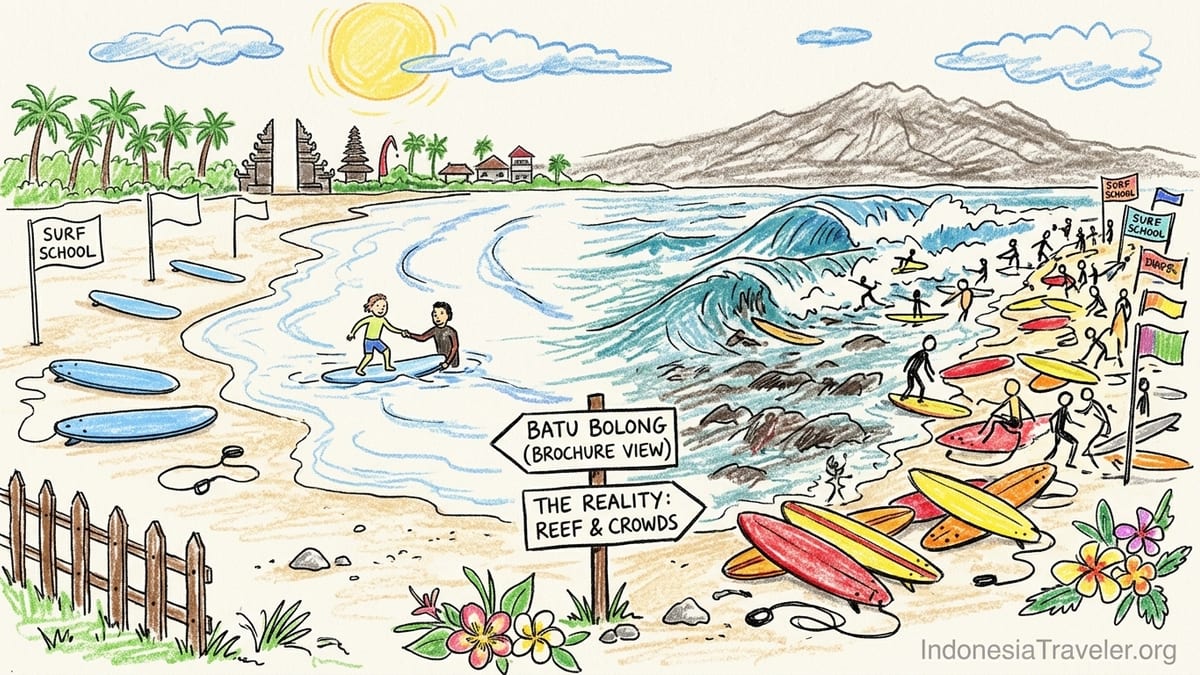
Arriving at the “Beginner” Dream: Expectations vs Reality
Before I reached Canggu, my research had been reassuringly uniform. Surf guides described Old Man’s and Batu Bolong as mellow, long, rolling waves that peeled over “forgiving” bottom, perfect for first-timers and longboard cruises. A surf guide from a local hotel even called it Canggu’s “friendliest wave,” and surfline-style spot descriptions listed it as suitable for beginners and intermediates when swells stayed small. On paper, it looked like the safest place I could possibly learn.
That narrative shaped my expectations. I imagined wading out through soft sand, catching slow waist-high waves in an orderly beginner area patrolled by attentive instructors. I pictured something closer to a water park ride than wild ocean. I did not expect to be threading my way through dozens of foam boards, dodging longboard noses, or feeling coral scrape the skin off my ankle. The marketing had promised a controlled classroom; what I found was a crowded and changeable reef break that only sometimes behaved like a beginner beach.
The gap between the brochure version of Batu Bolong and my lived experience is what this article is about. Not to scare new surfers away from Canggu entirely, but to replace the lazy “it’s easy” label with something more honest: Batu Bolong can be a fantastic first step, but only if you catch it with the right tide, the right swell, and the right people in your corner.
The Lesson I Actually Took: Prices, Provider and Conditions
I booked my first lesson through a locally run school on Batu Bolong that uses the classic flags-in-the-sand setup. For transparency, I will compare it with current, clearly published prices from other schools rather than hide behind generalities. Matahari Surf School, which also operates on Batu Bolong, currently advertises 2-hour group lessons (2 to 5 people) for 390,000 rupiah and 2-hour private lessons at 490,000 rupiah. Nyangko Surf School, which teaches around Canggu, lists group lessons at 350,000 rupiah per person and private coaching at 400,000 rupiah for roughly the same duration. My own lesson sat in the same band: 400,000 rupiah for a 2-hour session, nominally “semi-private,” with a promised ratio of one instructor to two students.
In reality, those ratios flex with demand. On the morning I paddled out, my “semi-private” grew into a three-person group, because a walk-up guest had paid cash and been added to our slot. That moved us closer to the Matahari group model of up to five people per instructor than the 1:2 coaching I expected. The price did not change, but the amount of attention per wave certainly did. The session started with a ten-minute land lesson on paddling technique and pop-ups, followed by a rushed explanation of right of way that most of the class clearly did not absorb.
Conditions also diverged from the mellow brochure image. We entered on an incoming mid-to-high tide with a clean 2- to 3-foot southwest swell, period around 12 seconds, and light offshore wind early that swung onshore by the end of the session. That combination pushed the waves into more size and power than many first-timers realize when they see the gentle inside rollers from the beach. The deeper water over the mixed sand-and-reef bottom made the first paddle-out manageable, but the set waves were head-high for shorter students, and the whitewater walls had enough punch to sweep people sideways across the crowd.
The boards, included in the lesson fee, were typical rental-shop soft-tops: 8-foot and 8’6" foam longboards with plastic fins and plenty of volume. Soft boards do reduce some risk of cuts and fractures compared with hard fiberglass boards, but lined up in dozens they also create a moving obstacle course. Every mis-timed takeoff sent another foam torpedo down the line. Insurance was not mentioned, and when I asked, I was told matter-of-factly that any damage to boards would have to be paid in cash and that personal injury was “your own responsibility.”
One Coast, Many Characters: Berawa, Nelayan, Batu Bolong, Echo and Pererenan
One of the most misleading ideas I arrived with was that each Canggu beach could be neatly stamped with a single difficulty label. In reality, Berawa, Nelayan, Batu Bolong/Old Man’s, Echo Beach and Pererenan all share swell and exposure, and their personalities shift dramatically with tide, size and wind.
Berawa, to the south, feels more like a classic beach break, with peaks that shift along a long stretch of sand. On small days with a mid tide, outer banks form soft shoulders that are relatively kind to beginners who already know how to paddle and stand. Add more swell or a dropping low tide and those same banks can dump with surprising force, closing out fast and punishing late takeoffs. It is not “easy” or “hard” in absolute terms; it oscillates between both.
Just north of Berawa, Nelayan sits in a quieter pocket between the more famous peaks. Here I found fewer surf schools and more independent surfers. On days when Batu Bolong turned into a zoo, Nelayan’s inside reforms could be forgiving for someone who already understood basic etiquette and was comfortable out of the instructor bubble. But the lack of structured school zones means less built-in protection for total first-timers; without guidance, it is easy to paddle into a pack that is surfing far more aggressively.
By contrast, Batu Bolong and Old Man’s form Canggu’s central beginner magnet. The bathymetry here creates a long, rolling right-hander on many swells, especially when waves stay under head-high. Walk to the waterline and you will usually see multiple layers of surfers: absolute beginners being pushed into whitewater closer to shore, then learners trying to catch the unbroken “green” sections further outside, and finally more experienced longboarders sitting on the peak of the reef. It looks mellow, but there is very little spare space when conditions are good.
Further north still, Echo Beach and Pererenan reveal a different character. Both have reef-influenced sections and faster walls. On one morning at Echo, a mid-tide right near the rivermouth raced down the line far quicker than anything at Batu Bolong, with a lip that pitched rather than crumbled. Pererenan’s main peak, on a stronger pulse of swell, had sets that stood up suddenly over shallow rock, leaving little room for beginner hesitation. These are spots where timing, positioning and comfort over reef matter much more than at the gentle inside of Old Man’s. Calling any of these beaches permanently “advanced” or “beginner” misses a critical truth: a soft 2-foot pulse on a high tide can make Echo look tame, while a long-period swell and wrong tide can turn Batu Bolong into an ankle-cutting washing machine.
Batu Bolong Up Close: Rocks, Crowds and the Longboard Highway
From the sand, Batu Bolong presents itself as a wide, friendly bay framed by beach bars and board racks. Step into the lineup and the fault lines appear quickly. The first is the bottom itself. Batu Bolong is not a pure sand beach; it is a reef-influenced wave with fingers of rock and coral that become alarmingly shallow at low tide. On one of my sessions, an instructor stopped our group halfway out and pointed to a darker patch under the surface, explaining that at dead low water you could stand there in waist-deep water over live reef. Earlier that week, another student had caught a fin on the same section and flipped headfirst, emerging with reef rash from shoulder to hip.
Crowding is the second, and arguably the bigger, hazard. At sunrise on a small swell, Batu Bolong can feel almost peaceful. By mid-morning on a good forecast, the takeoff zone turns into an aquatic roundabout. Multiple surf schools set up flags and send their students into overlapping corridors of whitewater. Longboard specialists sit right on the peak, competing for the best lines, while independent learners fan out inside, paddling randomly without much awareness of who has priority. My own lesson was interrupted twice so my instructor could physically shove our group out of the path of another school’s convoy of soft-tops bearing down on us.
The third piece is longboard traffic. Batu Bolong’s sloping shoulders are ideal for 9-foot logs and traditional longboard surfing. That also means many of the best riders here use heavy boards with sharp fins and wide noses, moving with real speed. When these riders share the same narrow takeoff area as total beginners, the risk of collisions multiplies. I watched one advanced local bail off the back of a wave to avoid a student who had drifted directly into the pocket. The resulting wipeout launched his board toward the inside, where it grazed another learner’s thigh. No serious injury, but enough force to leave a purple bruise by the next day.
The wave size itself shifts through the session. What looked like waist-high peelers from the beach occasionally surged into chest or head-high sets on the outer peak, with powerful whitewater rolling through the beginner zone. On one set, a line of three students from another school took off late, pearled, and cartwheeled straight toward us. Foam boards or not, thirty extra kilos of water, board and momentum is not something you want landing near your head.
Reef, Tide and Risk: Echo Beach and Pererenan in Contrast
My harshest lessons about tide and reef came not at Batu Bolong, but upstream at Echo Beach and Pererenan. After gaining some confidence standing up in whitewater, I booked a follow-up session marketed as “step-up” coaching, with the promise of green waves away from the crowds. The price was higher than my Batu Bolong lesson, reflecting what local operators describe as a premium for more advanced spots, and the instructor was clear that we would only paddle out if the tide and swell lined up.
Echo Beach, even on a relatively modest swell, felt more serious. The main peaks here are shaped by rock and reef. On a mid-to-high tide, the takeoffs stood up quickly but with enough depth that a wipeout meant a tumble into water rather than stone. As the tide began to drop, everything changed. The same right that had been fun an hour earlier started to break in shallower water, throwing more lip and leaving less room for error. My instructor repeatedly called off sets, telling me that if I hesitated and went over the falls, I would meet the reef much sooner than I expected.
Pererenan, a short drive further north, drove the point home. We did not surf it that day because the tide was already running out and the swell angle sent lines straight into obvious shallow sections. From the beach, I could see sets pitching over exposed rock. My coach pointed out the kind of injuries that happen when people treat these spots like Batu Bolong: fin cuts to the scalp from being thrown backward, gashes on shins and knees from scraping along the reef, and more subtle but dangerous scenarios where a leash gets caught under a ledge during a wipeout.
The common denominator in all of this was tide. Enter at the wrong stage and you compress all the hazards. At very low tide, the water thins over the reef and any fall becomes a direct collision with rock. At very high tide, especially with longer-period swell, the waves can jack up suddenly as they hit the reef, leading to powerful, pitching sections that are far from beginner-friendly. Neither Batu Bolong nor Echo nor Pererenan can be called safe without qualification. They are sometimes forgiving, sometimes unforgiving, and the line between the two can be a matter of an hour on the tide chart.
Forecasts, Wind and the Illusion of Safety
Surf forecasting apps contributed to my original overconfidence. Staring at clean interfaces showing neat wave icons for Canggu, I saw readings like “2-3 ft, 12s period, light offshore” and translated them into “ideal beginner conditions.” What those numbers actually describe is energy and shape, not safety.
Swell height describes the size of the waves offshore in deep water. Period, measured in seconds, tells you how much energy is packed into those waves; longer period swells travel faster and feel more powerful when they reach the shallows. Swell direction indicates which way those waves are coming from, and depending on the shape of the coast and reef, that angle can focus or diffuse their power. At Canggu, a moderate southwest swell with a period of 12 to 14 seconds can deliver playful peelers at Batu Bolong while simultaneously turning parts of Echo or Pererenan into dense, heaving walls.
Wind adds another layer. Offshore wind, blowing from land to sea, holds up the face of the wave and creates that classic “clean” look that fills surf photography. Onshore wind, from sea to land, ruffles and chops the surface, making takeoffs less predictable and turning smooth shoulders into crumbling messes. During my lesson, our early glassy hour shifted abruptly when a light onshore breeze arrived. Suddenly, what had been smooth reforming waves broke in lumpy, sectioned whitewater that threw boards in unexpected directions. None of that showed up in the static optimism of the booking flyer.
The deeper point is that a favorable forecast is not a safety guarantee. It is a starting hypothesis that must be checked against the real ocean in front of you. On one of my Canggu days, an app showed almost identical numbers to my lesson morning, but a short-lived squall line offshore sent rogue sets marching into Batu Bolong every twenty minutes. Those larger sets caught entire clusters of beginners inside, washing boards through the crowded channel. I watched more people get hit by loose boards in that half hour than in my entire first lesson.
What I learned is simple: beginners should absolutely learn how to read forecast basics, but they should also be taught humility. A 2- to 3-foot, offshore day can still produce currents, hold-downs and board collisions that exceed a new surfer’s bandwidth. The only real safeguard is combining the forecast with honest local knowledge, a conservative mindset and a willingness to sit on the beach if the ocean looks angrier than your app.
Etiquette and Impact: Right of Way in a Crowded Lineup
The other hard truth about learning at Batu Bolong is that you are not just learning to stand up on a surfboard. You are entering a living, contested neighborhood. Local longboarders, visiting intermediates, surf school fleets, and fishermen who have used this coastline long before it was fashionable all have to share the same moving space. When etiquette breaks down, injury risk and local resentment spike together.
In my class, etiquette was a three-minute footnote. The instructor outlined right of way in the most basic terms. The surfer closest to the breaking part of the wave has priority. Do not take off in front of someone already riding. Do not paddle straight through the path of an oncoming surfer. Once we reached the water, those rules dissolved under the pressure of waves and nerves. I saw my own classmates dropping in on locals, sometimes because they were pushed into waves without looking, sometimes because they had never practiced scanning the peak before paddling.
Dropping in is not just rude; it is dangerous. When two boards share the same narrow ribbon of water, one of them usually has to straighten out or bail, sending a loose projectile into the crowd. In one incident I witnessed, a visiting intermediate on a hard longboard aimed for a peeling right, only to have a school student on a foam board launched directly in front of them. The intermediate straightened out to avoid a collision, washed into the inside, and their board shot backward into a group wading out. Again, no catastrophic injuries, but plenty of shaken faces and angry words in the whitewater.
There are other unglamorous etiquette basics that matter in Canggu’s crush. Always use a leash, and check it is securely attached before entering the water. Hold onto your board when you can, instead of throwing it away behind you as a wave approaches. If you must bail, look behind first. Paddle wide around the breaking zone when you are returning to the lineup, instead of straight through the pocket where surfers are riding. Treat fishermen and local users of the beach with visible respect; do not block their access paths with boards and scooters, and avoid tangling your leash in their lines. None of this is complicated, but it is rarely explained in the depth it deserves in cheap beginner packages.
Value for Money: Prices, Ratios and Hidden Costs
On the face of it, surf lessons in Canggu appear affordable relative to many Western beach towns. A 2-hour group lesson at Matahari Surf School on Batu Bolong is listed at 390,000 rupiah, while a private is 490,000. Nyangko Surf School and similar operators advertise group rates around 350,000 rupiah per person and private coaching at 400,000. There are also boutique outfits and villa-based coaches charging significantly more, especially for one-on-one advanced sessions at Echo or Pererenan.
The question is not just price, but value. In my experience, the key variables were instructor-to-student ratio, quality of explanations on land, and how assertively safety was managed in the water. A cheaper lesson with a four- or five-student group can feel like good value if the ocean is uncrowded and small. At Batu Bolong on a busy day, those same ratios start to look irresponsible. My own semi-private lesson that quietly became a trio could have absorbed that extra student in a quiet, spread-out lineup. In the reality of Canggu’s peak-hour crush, each extra body meant more time spent herding and less time spent coaching.
Included equipment also matters. Most schools bundle board hire and a rashguard into the lesson price. Few include reef booties, which can be very useful at low tide, or formal insurance beyond whatever coverage the business itself carries. Several schools I spoke to indicated that any board damage from student negligence would be charged at fixed rates, and that medical costs from cuts or collisions were the student’s responsibility. That is not unique to Bali, but the marketing rarely spells it out as clearly as it should.
Did cheaper lessons deliver better value? Not automatically. The most expensive session I took, a private coaching hour with a reputable instructor at Batu Bolong, felt far safer and more productive than my budget group or semi-private experiences. The coach chose a calmer tide window, kept us on the less crowded shoulder of the peak, gave repeated reminders on etiquette, and pulled the plug entirely when the wind switched and the crowd thickened. We caught fewer waves than in the conveyor-belt group classes, but every one came with feedback. In a place as busy and variable as Canggu, paying more for specificity and honesty is often the real bargain.
The Real Difficulties: What Makes Canggu Hard for Beginners
Looking back, at least five distinct difficulties stood out in my Canggu learning curve. The first was crowding. Batu Bolong in particular is one of the most congested beginner lineups I have ever seen. Dozens of boards, most of them ridden by people still figuring out basic control, create constant near misses and occasional collisions. This alone makes the spot more complex than its “gentle wave” marketing implies.
The second is the presence of reef and rock. Batu Bolong’s reputation as a soft option glosses over the fact that you are surfing over living coral in places. At mid to low tide, especially on bigger swells, falls that would be harmless over sand can turn into reef cuts and bruises. Echo Beach and Pererenan amplify this hazard with more exposed rock and shallower sections during the wrong tide window.
The third difficulty is timing the tide. Most marketing materials simply tell beginners that Bali’s west coast is best in the morning. They rarely explain that a dead low tide at a reef break can be significantly more dangerous, or that very high tide with more powerful swell can create thick, shifting waves with strong currents. Without at least a basic tide briefing, beginners have no way to judge whether their 7 a.m. booking is actually a smart call.
The fourth issue is collisions, or at least the constant risk of them. Between runaway soft-tops, longboard traffic, students who throw their boards away at every approaching wave, and coaches trying to manage too many people at once, the chance of being hit is non-trivial. On one Batu Bolong morning, I counted three separate incidents of boards smacking people in the head or torso within a single hour. None were catastrophic, but any of them could have been, especially if fiberglass instead of foam was involved.
Finally, there is overconfident beginner marketing. When a wave is sold as “perfectly safe” or “easy for everyone,” students and even some instructors let their guard down. People who should be practicing in waist-deep whitewater are pushed toward the peak for those Instagram-ready “first green wave” shots. Learners show up expecting a controlled amusement park instead of an ocean that can and does change character within a session. That mismatch of expectation and reality is, in my view, one of the most dangerous things about Canggu.
The Takeaway
So does Canggu work for learning to surf, or not? The uncomfortable but honest answer is that it depends far more on timing, conditions and attitude than on the printed label under a beach name. Batu Bolong can be an excellent classroom on small swells, with a mid tide and light offshore wind, especially in the very early morning or late afternoon when crowds thin. A slow, rolling longboard wave that starts over deeper water gives beginners more time to stand up and more room to make mistakes.
On the wrong day, the same spot can feel like a contact sport above a shallow reef. If the tide is too low, if the swell period is longer than usual, if local holidays or weekend crowds fill the lineup, or if instructors overload their groups to chase revenue, Canggu stops being the right place to take your first steps. In those situations, you are often better off postponing your lesson, heading for a more spacious beach break such as parts of Kuta or Legian, or seeking out a school that will drive you to a more suitable spot on the east coast when the west is maxed out.
What my time in Canggu taught me most was not how to pop up cleanly on a foam board, although that came with practice. It was how quickly a “beginner” spot can flip into something more serious when tides, swell and human behavior collide. If you come to Batu Bolong with eyes open, choose instructors who are transparent about conditions and ratios, and treat both the ocean and the lineup with respect, it can still be a beautiful place to learn. Just do not let the word “beginner” lull you into thinking that Bali’s waves owe you safety. They do not.
FAQ
Q1. Is Batu Bolong really suitable for complete beginners?
It can be, but only in the right conditions. On small swells with a friendly tide and lighter crowds, the long, rolling waves are ideal. On big or very low-tide days, the combination of reef, current and congestion makes it challenging and sometimes unsafe for absolute first-timers.
Q2. How much should I expect to pay for a surf lesson in Canggu now?
As of late 2026, many Batu Bolong schools charge around 350,000 to 400,000 rupiah for a 2-hour group lesson and roughly 400,000 to 490,000 rupiah for private coaching. Higher-end or highly experienced coaches, especially at Echo or Pererenan, may charge more for one-on-one sessions.
Q3. What is a safe instructor-to-student ratio for beginners?
For a first lesson, a ratio of one instructor to two or three students is a good upper limit in crowded spots like Batu Bolong. Larger groups can work on very small, quiet days, but in practice they often mean less individual feedback and slower reactions to safety issues.
Q4. Do I need reef booties at Batu Bolong?
You do not strictly need them, but they can help. At mid to low tide, parts of the bottom are rocky or coral, and cuts are common if you stand or fall in the wrong place. If you are nervous about reef, booties add a layer of protection while you build confidence.
Q5. How important is checking the tide before a lesson?
Very important. At reef-influenced breaks like Batu Bolong, Echo and Pererenan, low tide can expose shallow sections, while strong swells on very high tides can produce powerful, jacking waves. Ask your school which tide window they are targeting and why, and do not be afraid to reschedule if it sounds risky.
Q6. What is the difference between Batu Bolong and Echo Beach for learners?
Batu Bolong offers longer, softer waves with more space on smaller days, though it is crowded. Echo Beach tends to break faster over more defined reef sections and is less forgiving of late takeoffs and poor positioning. Many beginners are better off starting at Batu Bolong or another softer spot before trying Echo.
Q7. Is it worth paying extra for a private lesson?
In Canggu’s busy lineups, a good private coach can be worth the premium. You get tailored feedback, more flexible timing around tides and crowds, and often a clearer focus on etiquette and safety. For nervous beginners or those with limited time, that extra investment can make the experience far more productive and less stressful.
Q8. How can I reduce the risk of collisions in a crowded lineup?
Choose quieter times, such as sunrise or late afternoon on weekdays. Listen closely to your instructor, keep your board under control, avoid throwing it away when a wave comes, and paddle around the breaking zone rather than through it. Never take off in front of someone already riding and always look both ways before committing.
Q9. Are there safer alternatives to Canggu for first-time surfers in Bali?
Yes. Depending on the season, parts of Kuta and Legian on the west coast or certain east-coast spots with softer waves and more sand bottom can be better suited to total beginners. Some schools based in Canggu will drive students to those beaches when local conditions are too intense.
Q10. Does a good forecast mean the conditions will be safe for me?
No. Forecasts show likely wave size, period, direction and wind, but they do not guarantee a gentle session. Changing tides, local currents, unexpected sets and crowd behavior can all increase risk. Treat a good forecast as a green light to look closely at the ocean, not as a promise that nothing can go wrong.