


I arrived in Canggu feeling prepared. I had my passport, visa, Bali tourist levy and even screenshots of every confirmation on my phone. Within 48 hours, I realised how much I had underestimated the sea, the roads and the unwritten rules that actually shape a safe trip here. This is what I wish I had understood in detail before I booked my first surf lesson or rented a scooter in Canggu.
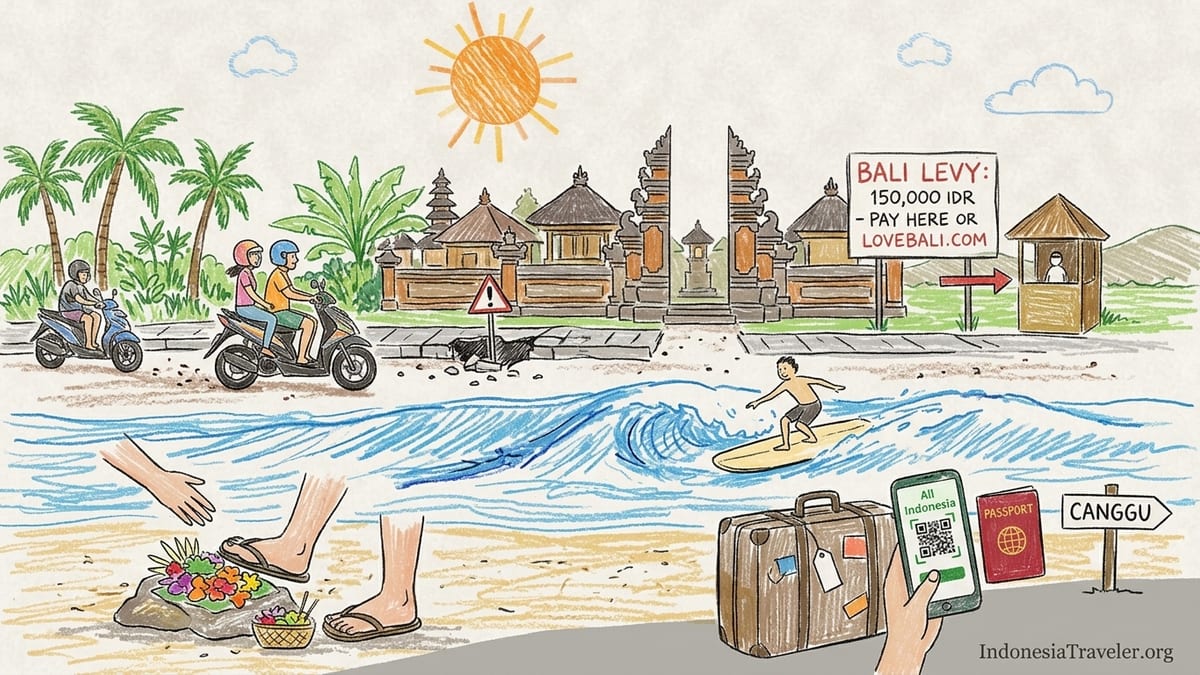
Getting In: Passport, Visa, All Indonesia and the Bali Levy
Before I even saw Canggu’s black sand, there were four national-level requirements I actually had to complete. First was my passport. Immigration at Bali’s Ngurah Rai International Airport really did check that it had more than six months’ validity from the day I landed, and I saw one traveller pulled aside because theirs fell short of that window. Second was the visa. As a tourist, I used Indonesia’s visa on arrival option, which I paid for in the arrivals hall before queuing for passport control. It covered me for tourism, not work, and the immigration officer was clear when I asked that it did not give me any right to earn money in Indonesia.
The third requirement was the All Indonesia arrival declaration. This is the integrated national form that now replaces the old separate customs and health declarations. I filled it in online within three days before my flight, declaring my luggage, contact details and health information. At Ngurah Rai, an officer asked to see the QR code on my phone before I reached customs. It felt bureaucratic after a long flight, but it did save time compared with the old paper cards that fellow travellers complained about in the queue.
The fourth piece was specific to Bali but still handled at provincial level. Bali currently charges a foreign tourist levy of 150,000 rupiah per person, per visit, to fund cultural and environmental programs. I paid it online through the official Love Bali system before I flew, and the receipt generated another QR code. At the airport there was a clearly signed checkpoint where staff scanned it. A few people who had not paid were directed to a payment counter. It was obvious from the signage and from every official communication I saw that this levy is not a visa and does not replace the need for proper immigration documents.
What does not exist is any separate tourist permit just for Canggu. I asked my guesthouse and a local tour organiser, and both confirmed that once you are legally in Indonesia, and have paid Bali’s levy, you are free to stay in Canggu without any extra local tourism licence. The rules that really shaped my stay there were not about paperwork, but about the ocean, the roads and community expectations.
Learning the Hard Way: Surf and Swim Safety in Canggu
My first morning in Canggu I walked down to Batu Bolong, often nicknamed “Old Man’s,” expecting a mellow beach day. From the sand it looked manageable. Waist to chest-high waves, lots of longboards and some beginners wobbling near the shore. Once I paddled out on a rental foam longboard, I understood why so many guides warn that Bali’s west coast is about currents, not sharks. Even on a relatively small day, there were clear channels where the water ran back out to sea faster than I could casually swim against.
The tide made a big difference to how confident I felt. At mid to high tide at Batu Bolong, the waves rolled more gently and broke further in, over a sandy and rubble bottom. When the tide dropped, the same sets stood up steeper, broke in shallower water and exposed more scattered rocks that I had barely noticed earlier. On one low-tide afternoon, I misjudged a small closeout, got flipped and scraped my shin on what felt like a rock or chunk of dead coral. It was a minor cut, but it drove home that this was not a forgiving sandbar like some beginner beaches elsewhere.
Echo Beach, a short walk north, felt like another level again. When I checked it one mid-morning, the surf forecast apps showed around head-high waves and local surfers confirmed it was “pretty typical.” From the cliff, the sets were beautiful. In the water, the takeoff zone was much steeper and the waves broke with more power over a mix of sand and reef. I watched two surfers get caught inside by a bigger set and pushed toward a rip that dragged diagonally out. Lifeguards on the beach had red flags posted and whistles ready. I decided not to paddle out that day, and I am glad I listened to the uneasy feeling in my stomach instead of my ego.
At Berawa and Pererenan, I noticed how quickly conditions changed with the tide and wind. One late afternoon at Berawa, the onshore breeze picked up, creating messy peaks and a lot of whitewater near shore. It looked inviting for body surfing, but the push and pull of the water were still strong. At Pererenan, the rip currents were even more pronounced. Standing at the waterline, I could literally see darker, smoother channels where the water rushed seaward. Local signs and online guides both warn that these rips can appear at any tide along Bali’s west coast. After watching one inexperienced swimmer drift sideways faster than he realised and then struggle to get back to the sand, I made a personal rule: I would only swim between the lifeguard flags and I would not go deeper than chest height when the waves were over shoulder high.
Taking Surf Lessons: What Actually Happened
Because the sea humbled me so fast, I booked a proper surf lesson at Batu Bolong instead of muddling through alone. The school I chose was operating openly on the beach with branded rash vests and a small hut near the entrance. For the beginner group that morning, we had three instructors for eight students. Each of us got a long, wide soft-top board, and the staff provided rash vests and simple reef booties for those who wanted extra protection.
Before we went anywhere near the water, the lead instructor spent about 15 minutes on the sand going over basics. He showed us how to attach the leash, where to place our feet, and most importantly how to fall. He drilled into us that if we felt out of control, we should fall flat, not dive headfirst, to avoid hitting the bottom if a wave drove us down. He also pointed out the day’s rip channels using landmarks on the beach and told us where we would be paddling out to avoid them.
The conditions that day were friendly by Canggu standards. The waves were around waist to chest high, with a long interval that gave us time to catch our breath between sets. Because of this, the school kept the lesson at the standard duration of about 90 minutes in the water. Two days later, when I tried to book a second session, they actually advised postponing. The forecast showed bigger swell and a lower tide during our time slot, which they explained would make the inside section dumpier and less suitable for beginners. I appreciated that the decision to change or cancel was coming from the instructors watching conditions, not from a desire to squeeze in as many paying students as possible.
The most useful habit I picked up from them was checking the beach before I committed. They encouraged us to stand back and watch where surfers drifted in relation to the landmarks, how fast people paddled back from wipeouts, and whether any boards or swimmers were getting pulled sideways more than seemed normal. That simple five-minute observation, repeated at Batu Bolong, Echo and Berawa over the next week, probably did more for my safety than any single piece of equipment.
Road Reality: Licensing, Helmets and Insurance
I assumed that if a scooter rental shop in Canggu was willing to hand me keys, I must be allowed to ride. That belief did not survive my first proper conversation with a local guide and a look at official advice. Indonesian law requires a valid driving licence for the class of vehicle you ride and, for most non-ASEAN tourists, an accompanying International Driving Permit if you want to be fully legal on a motorcycle. Rental shops rarely ask to see either, beyond a quick glance at a passport, but that does not mean you are actually licensed in the eyes of the police or your travel insurer.
In my case, I held a full motorcycle licence from my home country and had an International Driving Permit booklet that specifically listed the motorcycle category. When I was stopped at a police checkpoint near Berawa one afternoon, the officer asked for all three documents: passport, home licence and IDP. Some riders ahead of me were turned around or fined because they had only a car licence or no permit at all. It was a quiet, almost routine interaction, but it confirmed something I had read before arriving. You can rent a scooter in Canggu without anyone checking your qualifications, yet if anything goes wrong, you are the one considered at fault for riding without the correct licence.
The helmet rule is not just a suggestion either. Indonesian regulations require both riders and passengers to wear proper helmets that meet safety standards. In Canggu, I saw everything from solid full-face helmets to flimsy plastic shells that looked barely more protective than a bicycle helmet. My rental came with a basic but decent helmet with a working chin strap, and I chose to keep it on even for the three-minute ride to a café. Several travellers told me they had never been stopped when riding bareheaded, but I saw one tourist pulled over near a busy junction and handed what looked like an on-the-spot fine for not wearing one.
Insurance was the final piece that changed how I moved around. My travel insurance policy had a specific clause about motorcycles. It only covered accidents if I was riding a bike up to a certain engine size, held the correct licence and wore a helmet. A fellow guest at my homestay in Canggu discovered the hard way that his sprained ankle from a scooter fall would likely not be covered because he had no motorcycle licence at home. After hearing his story, I realised that for many visitors, the safest option is not to ride at all but to rely on ride-hailing apps like Gojek or Grab, or on taxis arranged by hotels, especially at night or after drinking.
Walking Canggu: What It Is Really Like on Foot
Before visiting, I pictured Canggu as a laid-back village where I could stroll everywhere. The reality on the ground was that walking often felt like the riskiest part of my day. Many of the smaller roads around Batu Bolong and Berawa have little or no sidewalk. Where there are pavements, they are often broken, patched with different materials or suddenly disappear, forcing pedestrians into the edge of the road with scooters passing close by.
One evening I walked from a café near Batu Bolong back to my guesthouse about 15 minutes away. The sun had set, and although some shops lit the roadside, there were long stretches with poor street lighting. In those darker gaps, it was hard to see uneven patches and, more worryingly, open drainage channels. In a couple of places, slabs over the drains were cracked or missing entirely, leaving gaps that were easily big enough to trap a foot or leg. I watched a local woman gently steer her child around one of these holes with a torch from her phone and started using my own flashlight whenever I walked at night.
Pererenan felt a little calmer, with some wider verges and fewer crowds, but the basic pattern was the same. Roads that carried heavy scooter traffic were not designed with pedestrians in mind. After a couple of near-misses where a bike swerved around a pothole toward where I was walking, I changed my habits. For longer distances after dark, I ordered a motorbike taxi or car, even if it felt indulgent for a 1.5 kilometre trip. The cost, usually the equivalent of a few US dollars or less, felt like a fair trade for not playing a nightly game of chance in the road.
Daytime walking was more comfortable, especially on shorter stretches between accommodation, co-working spaces and nearby cafés. Still, I learned to watch the ground almost as much as oncoming traffic. Smooth tiles outside one property might be followed by loose gravel or a sudden step down to exposed concrete. Canggu is perfectly manageable without a scooter, but it is not a flat, even, universally walkable resort town, and that is something I wish I had fully appreciated before I packed only sandals and optimistic assumptions.
Temples, Ceremonies and Why Your Beach Outfit Is Not Enough
It took only a few days in Canggu to realise how close daily beach life sits to deeply rooted Hindu practice. On my second morning, walking toward Echo Beach, I had to wait while a procession crossed the road. Women in lace kebaya blouses carried tall offerings stacked with fruit and flowers. Men walked beside them in white shirts and traditional udeng headcloths. The procession was heading toward a sea temple, and traffic stopped respectfully. Standing there in a damp T-shirt and boardshorts, I felt suddenly underdressed.
Later that week, I wandered down a smaller lane in Pererenan and found a temple courtyard where preparations were underway for another ceremony. A local elder at the entrance gently indicated that my shoulders should be covered and that it was not appropriate to enter wearing only a tank top and shorts. He was not angry, just firm. When I returned the next day wearing a T-shirt and a simple sarong I had bought in town, the welcome was completely different. He smiled, nodded toward the offerings and invited me to stand quietly at the edge and watch.
The same kind of respect carries over to the shrines and offerings that appear along Canggu’s beaches. It is common to see small woven trays of flowers and rice placed on the sand or rocks at dawn. I watched one surfer casually step over an offering on his way to the water, and the vendor next to me winced. She later explained, in simple English, that those offerings are part of daily prayers and should not be trampled or treated as decoration. Since then, I have taken a small detour around any offering I see, whether on a beach, a scooter seat or a shop doorway.
Beach clothing that feels normal between cafés and sunbeds can become inappropriate in a second if you step into a temple compound or cross paths with a ceremony. In practical terms, I learned to carry a light scarf or sarong in my day bag. It weighs almost nothing and meant I could quickly cover shoulders or legs if I wanted to enter a temple or if a procession appeared and I found myself standing close to a sacred space. I did not see any formal fines handed out for clothing, but I did see security staff at one coastal temple turn away visitors in bikinis and shirtless men who assumed they could wander anywhere because they were still near the water.
Nightlife, Money, Accommodation and Working Remotely
Canggu’s evenings revolve around beach bars, rooftop venues and late cafés. The combination of alcohol, scooters and patchy lighting is where many small risks combine. On my first big night out, I made the mistake of assuming I could “just walk back” from Batu Bolong after a couple of drinks. The route that had felt manageable by daylight became a narrow, uneven obstacle course in flip-flops. After that, I set a simple boundary: if I was going to drink, I booked a motorbike taxi or car both ways, rather than leaving myself the option of riding or walking home impaired.
Handling money also came with its own learning curve. Around Canggu there are both official bank branches and independent money changers. Locals and long-term expats repeatedly told me to use either ATMs attached to recognised banks or money changers with clear signage showing they were authorised, often located inside or next to bank branches or major supermarkets. I did step into a small standalone changer once, attracted by a slightly better rate on the board. When I counted the rupiah the clerk handed over, the stack came up short by the equivalent of a few dollars. He corrected it politely when I pointed it out, but I took that as my cue to stick to more established counters from then on.
Accommodation safety in Canggu varies widely. My guesthouse was a small family-run place a few minutes inland from Batu Bolong. It had solid room doors with functioning locks and simple safes bolted to the wardrobe. Friends staying in a cheaper homestay nearby found that their room doors closed only with a loose padlock and that the windows did not latch properly. Before booking anywhere now, I look closely at recent guest reviews that mention security, check that rooms have individual keys rather than shared access, and on arrival I physically test the locks and see whether there is secure storage for passports and electronics.
I came to Canggu partly to work remotely, and this raised another layer of rules. From an immigration perspective, the tourist visa I used allowed me to be in Indonesia as a visitor, but it did not authorise me to take up employment locally or be paid by an Indonesian entity. I worked online for a foreign employer, from my laptop, in cafés and co-working spaces. When I asked at a co-working reception, they confirmed that plenty of people did the same, but they also reminded me that the legal distinction matters. If you plan to be hired by an Indonesian company, draw a local salary or run a business on the island, you need an appropriate work or business visa and, in some cases, a local company structure. Sitting in a café sending emails on a tourist visa may be tolerated, but it is not the same as having permission to work in Indonesia’s economy.
For connectivity, I bought a local SIM card from a major Indonesian provider at a small phone shop near Berawa. The staff registered it using my passport, as required, and helped me choose a data package with enough gigabytes for video calls. Mobile data coverage around Canggu was strong, but power cuts did happen. My guesthouse had a backup generator, though some smaller cafés simply shut their Wi-Fi off until the electricity returned. A small power bank and the habit of downloading key documents offline made a noticeable difference on those occasions.
Wet Season, Medical Back-Up and Small Surprises
My visit overlapped with the start of the rainy season, which showed me a different side of Canggu’s streets and beaches. One afternoon, a heavy downpour turned the road near Berawa into a shallow river within minutes. Scooters slowed to a crawl through ankle-deep water, and in some places the drains overflowed, sending murky water across the pavement. I watched one rider stall his bike in a deeper patch and have to push it to the side while cars edged around him. After that, I avoided riding or even walking long distances during the heaviest bursts of rain.
The same storms affected the beach. Runoff from the streets washed debris onto the shoreline, and the usually clear water near the break took on a brownish tinge close to the river mouths. Experienced surfers I chatted with chose to sit out sessions immediately after bigger downpours, citing both water quality and hidden obstacles stirred up by the floods. On those days, I treated the ocean as off-limits, however tempting the empty lineups looked from a distance.
On the medical side, I was fortunate not to need emergency care, but I made a point of locating the nearest clinics that other travellers recommended in Canggu and nearby Seminyak. Several pharmacies stocked basic first aid supplies, including antiseptic for reef cuts, elastic bandages and over-the-counter painkillers. One small but important detail I am glad I handled before departure was buying travel insurance that explicitly covered surfing and motorcycle use within defined limits. When I emailed them with a hypothetical question about a scooter accident, their reply confirmed what local stories had already hinted at. If I rode without the correct licence or a helmet, or on a bike more powerful than my policy allowed, any claim could be refused.
Little everyday surprises filled in the rest of the safety picture. Dogs roam freely in some lanes and on the beach, usually unconcerned with people, but occasionally territorial if you try to squeeze past on a narrow path. Roosters provide an early morning alarm well before sunrise in quieter parts of Pererenan. None of these are serious hazards in themselves, but they add context. Canggu is not an isolated resort bubble. It is a living collection of villages where tourism, local life and nature all interlock, and being a considerate guest means adjusting your expectations accordingly.
The Takeaway: My Personal Checklist for Next Time
Looking back on my time in Canggu, the biggest risk was assuming that “everyone does it” equated to “it must be fine.” In reality, the people who seemed most relaxed were usually the ones who had done their homework about the sea, the roads and local customs. If I were planning a return trip, this is the practical checklist I would follow for my first few days, built from the lessons above.
On arrival at the airport, I would double-check that my passport has at least six months’ validity, confirm my visa type suits a tourist stay only, and complete the All Indonesia arrival declaration in advance so I just need to show the QR code. I would pay the 150,000 rupiah Bali tourist levy before flying, screenshot the receipt and keep a printed copy in my daypack. At the baggage carousel, I would already have a local SIM plan in mind and enough local currency or a card ready to book a reputable taxi or ride-hailing car straight to my accommodation.
Before my first surf lesson, I would spend at least one tide cycle simply watching Batu Bolong or Berawa from the sand. I would look for rip channels, note where people drift over 10 or 15 minutes and see how comfortable swimmers look when they fall off their boards. I would choose a surf school that keeps groups small, uses soft-top boards and is willing to postpone lessons when the swell or tide are not beginner friendly. I would commit to wearing a leash and rash vest, and to staying within my limits, even if that means skipping more advanced spots like Echo Beach and Pererenan on bigger days.
For evening transport, I would decide in advance that I am either a pedestrian using motorbike taxis and cars, or a sober rider who treats the scooter like a serious vehicle, not a toy. If I choose to ride, I would bring my home motorcycle licence and an International Driving Permit listing the correct category, wear a real helmet with a fastened strap and make sure my insurance covers exactly what I am doing. If not, I would delete the idea of “just a quick ride back” from my options once I have had a drink.
On the cultural side, I would pack a light sarong and modest tops as intentionally as I pack swimsuits, assume that any temple, shrine or ceremony deserves more respectful clothing than a beach bar, and walk around offerings instead of over them. Those small gestures cost almost nothing yet change the way locals respond when you share their streets and sand. Canggu can be an easygoing place to visit, but the ease is built on invisible rules. The more of those I choose to understand and honour, the safer and richer my time there becomes.
FAQ
Q1. Do I need a special permit to stay in Canggu as a tourist?
No. Once you have the correct Indonesian visa, have completed the All Indonesia arrival declaration and paid Bali’s provincial tourist levy, there is no extra permit required specifically for Canggu.
Q2. How dangerous is the surf in Canggu for beginners?
The main risk is from strong rip currents and powerful waves, especially at Echo Beach and Pererenan. Batu Bolong and Berawa can be more forgiving, but conditions change quickly with tide and swell, so beginners are safest taking lessons and following lifeguard flags.
Q3. Can I rent a scooter in Canggu without a motorcycle licence?
Most rental shops will rent you a scooter with just a passport and cash, but that does not mean you are legal. Indonesian rules still expect you to have a valid motorcycle licence and, for most foreign visitors, an International Driving Permit that covers motorcycles.
Q4. Are helmets really enforced for scooter riders and passengers?
Yes. Helmets are required by law for both rider and passenger. Enforcement varies, but police checkpoints around Canggu do stop riders without helmets, and riding bareheaded can also give your insurer a reason to deny cover after an accident.
Q5. Is Canggu walkable if I do not want to ride a scooter?
You can get around Canggu on foot for short distances, but expect narrow or broken pavements, poor lighting at night and open drains in places. For longer trips or late evenings, many visitors rely on motorbike taxis, ride-hailing cars or hotel transfers.
Q6. What should I wear if I want to visit a temple near Canggu?
You should cover shoulders and knees, wear a sarong or long skirt and avoid beachwear like bikinis, shirtless torsos and see-through fabrics. Some temples lend sarongs at the entrance, but carrying your own light wrap makes it easier to be respectful on short notice.
Q7. Is it safe to swim anywhere along the beaches in Canggu?
Not always. The safest option is to swim only where lifeguards are present and flags are posted, stay within your depth and avoid entering the water near obvious rip channels or river mouths, especially after heavy rain.
Q8. How can I avoid scams when changing money in Canggu?
Use ATMs attached to well-known banks or authorised money changers located inside banks, shopping centres or big supermarkets. Count your cash carefully before leaving the counter and avoid small standalone booths that advertise unusually good exchange rates.
Q9. Can I work remotely from Canggu on a tourist visa?
Many visitors do online work for foreign employers while on a tourist visa, but that is different from being legally employed in Indonesia. If you plan to earn money from an Indonesian company or run a local business, you need the correct work or business visa instead of relying on a tourist stay.
Q10. What is the Bali tourist levy and how do I pay it?
The Bali tourist levy is a provincial charge of 150,000 rupiah per foreign visitor, collected to support culture and the environment. You can pay it online before arrival and present the QR code, or pay at the airport on landing, but it is separate from both your visa and the All Indonesia arrival declaration.