


Indonesia is far more than Bali’s sunset bars and social media viewpoints. Strung across more than 17,000 islands, the world’s largest archipelagic nation offers ancient Buddhist monuments, active volcanoes, dragon-guarded savannas, rainforest orangutan sanctuaries and coral reefs at the heart of the Coral Triangle. This guide focuses on the experiences worth crossing seas for, organized by history, wildlife, volcanoes, marine ecosystems and living cultural traditions, to help you plan an itinerary that goes well beyond the usual Bali bucket list.
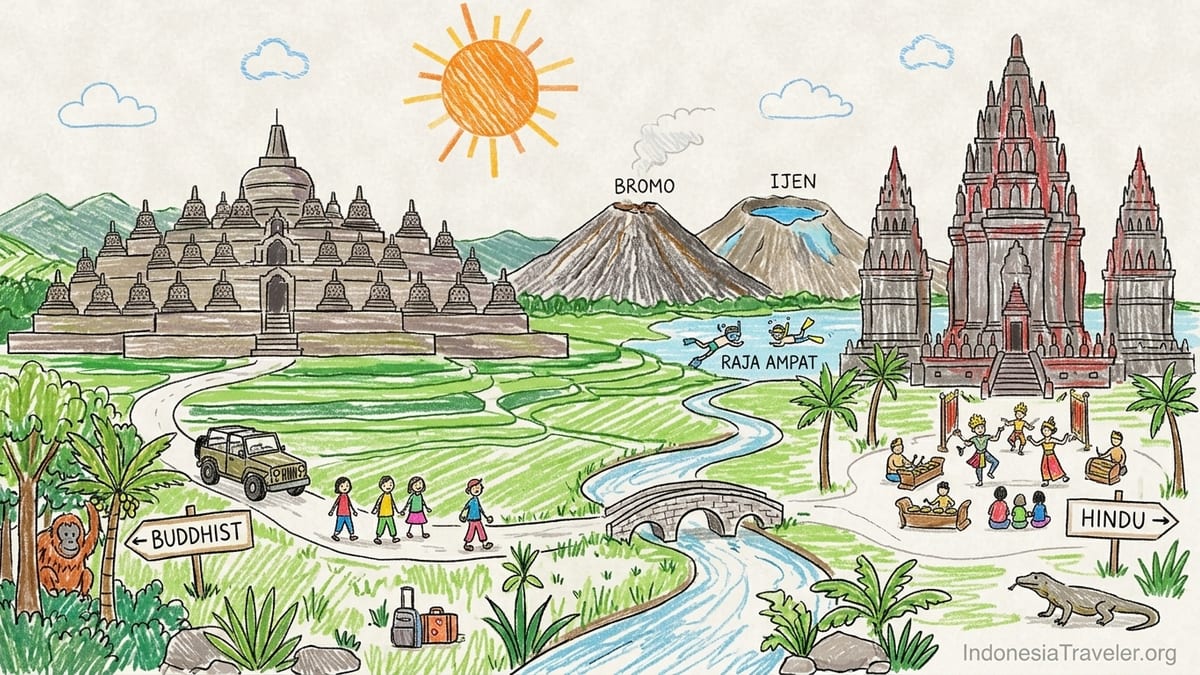
Borobudur and Prambanan: Two Temples, Two Faiths, Very Different Visits
Borobudur, a 9th century Mahayana Buddhist monument in Central Java, is often the first place travelers discover that Indonesia’s spiritual heritage long predates the modern Republic. Rising above rice fields near Magelang, about 1.5 hours by road from Yogyakarta, its nine stacked platforms and bell-shaped stupas are designed as a three-dimensional mandala. Visiting today, however, is not as simple as buying a single ticket and wandering up the terraces. Management has introduced strict limits to protect the stonework from erosion, and you need to understand the ticket structure before you arrive.
Foreign visitors now see two main options listed for Borobudur: “Temple Ground” and “Temple Structure.” The Temple Ground ticket grants access to the wider park and the base courtyard around the monument, where you can photograph the temple from below, visit the small museum and walk the landscaped grounds. It does not allow you to climb the stone staircases or walk among the upper stupas. The more coveted Temple Structure ticket includes both park access and a timed, guided ascent onto the monument itself. Numbers are capped per day and per time slot, and visitors must wear special upanat sandals provided on site to reduce damage to the stones. In high season, early morning structure tickets can sell out days ahead, so it is worth securing a slot as soon as sales open rather than expecting to buy on arrival.
A typical Borobudur visit that includes climbing the structure takes three to four hours from the time you arrive at the ticket gate. Factor in at least half a day from Yogyakarta including transport. Sunrise access on the monument itself has been heavily restricted in recent years, and currently most visitors experience sunrise from designated viewpoints around the hill rather than from the upper terraces. Security staff strictly enforce route markings, and drones are prohibited. While a guide is not mandatory on the grounds, joining one of the small, official guided groups for the structure climb adds context to the reliefs and stories etched into the stone, especially if you are new to Buddhist cosmology.
About 45 minutes by road southeast of Yogyakarta, Prambanan offers a very different temple experience. This 10th century Hindu complex is dominated by slender, 47 meter tall stone spires dedicated primarily to the Trimurti: Shiva, Vishnu and Brahma. Where Borobudur unfolds horizontally, Prambanan stretches vertically, with steep staircases leading into compact inner chambers. Many visitors combine both sites in a single long day from Yogyakarta, visiting Borobudur in the morning and Prambanan for sunset, but it is worth slowing down if time allows. Prambanan’s bas-reliefs retell episodes from the Ramayana, and unlike Borobudur, the monument is closely tied to living performance traditions.
On selected evenings, the Prambanan Ramayana Ballet stages a large-scale dance-drama that combines Javanese court dance, gamelan orchestra and the Ramayana story, performed either at an indoor Trimurti Theatre or an open-air stage with the illuminated temples as backdrop. As of 2026, indoor shows run several nights a week year-round, while the full open-air performance is typically scheduled in the dry season months with a mix of one-hour and ninety-minute programs. Ticket classes range from basic seating to VIP sections, and some packages include a pre-show buffet dinner at nearby restaurants. Performances usually start around 7:30 pm, so if you are visiting Prambanan the same day, it makes sense to enter the temple complex by mid-afternoon, watch the light shift over the reliefs, then walk or shuttle to the theatre. For those interested in architecture, religion and performing arts, local guides and bilingual program booklets add substantial value by unpacking the symbolism in both stone and dance.
Volcano Journeys: Bromo’s Sea of Sand and Ijen’s Acidic Lake
Indonesia sits on the Pacific Ring of Fire, and few experiences capture its raw geology like standing above an active crater at dawn. Two of the most accessible and dramatic volcano journeys for visitors are Mount Bromo in East Java and Kawah Ijen, whose luminous crater lake straddles the Banyuwangi and Bondowoso regencies.
Mount Bromo is usually approached from Probolinggo, Cemoro Lawang or the Malang area, all reachable in roughly three to four hours by road from Surabaya. The classic “Bromo sunrise” actually takes place at a viewpoint on Mount Penanjakan or nearby hills on the caldera rim, looking down onto Bromo, Mount Batok and the more distant Mount Semeru. Local regulations require visitors to purchase an online or on-site quota-based entry ticket for Bromo Tengger Semeru National Park and, in most cases, to use registered jeeps inside the caldera. You will often see tour descriptions broken down into three elements: Penanjakan viewpoints, the Sea of Sand and crater access.
A standard itinerary sees jeeps leaving village guesthouses around 2:30 or 3:00 am to reach Penanjakan before first light. The main viewpoint can be crowded on weekends and holidays, but there are secondary hills such as King Kong Hill that offer slightly different angles with fewer people. After sunrise and photographs of the caldera, jeeps descend into the Sea of Sand, a vast volcanic plain where visitors can walk or ride horse transport toward the foot of Mount Bromo. From there, a staircase of several hundred steps climbs the outer cone to the crater rim. This last section is physically demanding for anyone with knee or respiratory issues due to altitude, ash and sulfur fumes, and it is sometimes closed temporarily during heightened volcanic activity. Even when open, visibility at the rim can be reduced by gas clouds, and park rules prohibit descending into the active crater.
Kawah Ijen offers a different personality altogether. Here, a milky turquoise lake fills the crater of an active stratovolcano, its waters among the most acidic of any volcanic lake on earth. Access for visitors begins from trailheads near Licin on the Banyuwangi side or from Bondowoso, with most organized tours departing Banyuwangi town around midnight or 1:00 am to reach the park gate as it opens in the early hours. The hike to the crater rim is around three kilometers uphill on a wide former mining track, generally taking between ninety minutes and three hours depending on fitness. Headlamps, warm layers and sturdy shoes are essential.
Since a series of safety incidents and air quality alerts, Indonesian conservation authorities have tightened controls on Kawah Ijen. As of 2026, official notices specify regular monthly closure days for area cleaning and environmental recovery, and they explicitly warn that the crater can be closed at short notice due to volcanic gas levels, strong winds, heavy rain, wildfires or other hazards. In practice, this means that even travelers who hoped to see the famous “blue fire” down by the lake often find that descending from the rim to the shoreline is off-limits or allowed only with strict ranger supervision. When conditions are unsafe, rangers may permit visitors to reach the upper viewpoint but block the steep inner path, or close the site entirely. Booking through a reputable local operator can help, as guides usually receive updates from rangers and carry gas masks, but no one can guarantee crater access on a particular night. For planning, allocate one night in Banyuwangi, understand that the experience may stay at rim level, and be prepared to accept last-minute changes in the name of safety.
Wild Encounters: Orangutans in Sumatra and Dragons in Komodo
Indonesia’s islands support some of the world’s most distinctive wildlife, yet these ecosystems are fragile and increasingly regulated. Two experiences stand out for visitors seeking meaningful, ethical encounters: trekking for orangutans around Bukit Lawang on the edge of Gunung Leuser National Park in Sumatra, and ranger-led visits to see Komodo dragons in Komodo National Park in East Nusa Tenggara.
Bukit Lawang, reached by road in roughly four to five hours from Medan, has long been a base for jungle treks in search of semi-wild Sumatran orangutans. Treks are only permitted with licensed local guides, and options range from short half-day walks along the forest fringe to two or three day routes that include camping in simple riverside shelters. The terrain is humid and steep in places, with muddy roots and leeches during the rainy months, so a reasonable baseline of fitness is important. While sightings are common, especially near former rehabilitation sites, orangutans remain wild animals and should never be called, bribed with food or positioned for photos. Responsible guides maintain a clear distance, allow only limited time when apes are visible, and discourage clients from touching branches near them to prevent disease transmission. Before you book, ask operators how many trekkers are in each group and confirm that they follow park ethics and carry out trash, rather than advertising “guaranteed selfies.”
Further east, Komodo National Park protects the largest remaining population of Komodo dragons along with rich marine habitats. Access points are typically Labuan Bajo on Flores, served by flights from Bali and Jakarta, and multi-day liveaboard boats that combine diving or snorkeling with dragon walks. Travel times from Labuan Bajo to commonly visited islands like Rinca or Padar are between one and two hours by speedboat. All visits to Komodo or Rinca’s dragon-viewing areas occur under ranger supervision, usually in small groups that follow short walking trails across scrubby hills and savanna.
Several factors have changed the practicalities of visiting Komodo in 2026. Following environmental impact studies, the Komodo National Park authority has introduced a formal visitor management system with a reported cap of around 1,000 visitors per day across key terrestrial sites, effective from April 1, 2026. Entry now requires a dated reservation in addition to the standard park fees and local retribution charges. Some dive centers and reputable tour operators handle these permits on behalf of guests, bundling them into package prices, while others expect visitors to secure their own spots through the official reservation platform or local ticket offices in Labuan Bajo. Reports from recent seasons indicate that quotas can be fully allocated days in advance during holidays and peak dry months from June to September, which means it is no longer realistic to arrive in Labuan Bajo and expect next-day space on any departure without planning.
On the ground, ranger walks on Komodo and Rinca are not strenuous for most visitors, usually lasting one to two hours over rolling trails. However, daytime temperatures are high, and there is limited shade. Travelers with reduced mobility can request shorter routes that stay close to the ranger stations, though participation still involves some walking on uneven ground. As with orangutans, ethical behavior matters. Rangers often carry sticks as safety tools, but reputable guides and park rules prohibit baiting dragons or disturbing them for photographs. If you see a guide encouraging guests to pose within a few meters of a dragon’s head, step back and lodge a polite complaint with the park office in Labuan Bajo. This type of visitor feedback, combined with the quota and permit system, is part of how authorities are trying to keep the focus on conservation rather than spectacle.
Underwater Indonesia: Raja Ampat, Komodo and Wakatobi
Indonesia’s marine diversity is among the highest on the planet, and three archipelagos in particular have become bywords for world-class diving and snorkeling: Raja Ampat in West Papua, Komodo in East Nusa Tenggara and Wakatobi in Southeast Sulawesi. Although all three sit within the Coral Triangle, each offers different conditions, required skill levels and logistical challenges.
Raja Ampat, whose main gateway is Sorong, spreads across hundreds of limestone islets, mangroves and reef systems. Most international visitors fly via Jakarta, Makassar or Manado to Sorong, then transfer by scheduled fast boat or resort-operated launches to homestays and dive lodges in the Dampier Strait and beyond. Travel time from Sorong to popular sites like Kri Island or Mansuar is typically two to three hours. Here, current-swept channels support dense schooling fish, manta cleaning stations and hard coral gardens, which makes the area famous for advanced diving. Many sites involve moderate to strong currents and require good buoyancy control and experience with negative entries. That said, protected lagoons and shallower reefs near homestays can be excellent for beginner-friendly snorkeling, with house reefs hosting anemonefish, giant clams and occasional reef sharks in only a few meters of water.
Komodo’s underwater landscape is equally renowned, but carries its own safety considerations. Day boats and liveaboards out of Labuan Bajo visit sites where cold upwellings mix with warm waters, creating dramatic thermoclines and powerful horizontal currents. Dive spots like Batu Bolong or Castle Rock are legendary among experienced divers precisely because of these conditions. For beginners or rusty divers, it is sensible to start in calmer areas such as the northern reefs or sheltered bays, and to choose operators that explicitly match site selection to certification level and recent logged dives. Snorkelers, too, must respect current patterns especially in channels like the one at Manta Point. Reputable operators conduct drift snorkels with surface support and clear pre-briefings rather than simply dropping guests at random.
Wakatobi, reached by regional flights to Wangi-Wangi or private charter arrangements with certain resorts, offers a different rhythm. The reefs here are often accessed from shore or short boat rides, with many slopes and walls well suited to both intermediate divers and snorkelers comfortable in open water. Currents can still be present, but the variety of sheltered sites makes it easier to tailor conditions to less experienced guests. Infrastructure is more limited than in Komodo or Raja Ampat, so planning ahead is crucial, especially if you rely on specific dietary requirements or rental equipment sizes.
Across all three regions, seasons shape visibility and sea conditions. In general terms, the April to October period offers favorable weather in Komodo and Wakatobi, while Raja Ampat is often dived year-round with local variations between its northern and southern sections. Because remote marine tourism depends heavily on small-boat transfers, travelers with limited mobility should discuss realistic access with operators before booking. Boarding speedboats from simple village jetties can involve stepping down into moving vessels without handrails, and some liveaboards use narrow ladders between decks. Companies that regularly host older guests or families may be better equipped with wide ladders, helpful crew and flexible site choices, but there is no standard, so detailed pre-trip communication matters more here than glossy brochure images.
Living Cultures Across the Islands: From Lake Toba to Toraja and Beyond
Indonesia’s cultural experiences extend far beyond temples. Traveling between Sumatra, Java, Bali, Sulawesi and the lesser-known spice islands, you encounter very different ways of living and storytelling. Some of these can be visited in a long loop, while others demand dedicated side trips, but each offers insight into how communities continue to adapt ancient traditions to modern realities.
In North Sumatra, Lake Toba fills a vast volcanic caldera, accessible from Medan in roughly five to six hours by road and short ferry. On Samosir Island in the center of the lake, Batak Toba villages like Tomok and Ambarita showcase distinctive saddle-roof houses and stone meeting circles where elders once presided over customary law. Visitors often base themselves in the guesthouse strip around Tuk Tuk, using it as a relaxed hub for cycling between villages, visiting small museums and attending music performances that blend traditional gondang ensembles with contemporary guitar. While the landscape invites slow travel, it is useful to know that road conditions on Samosir can be bumpy and hilly. Travelers with limited mobility may prefer to hire a car and driver from Parapat or Tuk Tuk rather than relying on scooters.
Further east in South Sulawesi, the highland region of Tana Toraja is known for elaborate funerary rituals, cliff burial sites and boat-shaped tongkonan houses. Reaching the main town of Rantepao requires a day-long journey from Makassar by road or a shorter domestic flight followed by vehicle transfer, so most visitors allow at least three full days in the region. Cultural visits here are best undertaken with reputable local guides, who can explain which ceremonies are appropriate for visitors, how to dress modestly and what level of contribution is customary when attending a funeral feast. Terrain around traditional villages and burial cliffs often involves stairs carved into rock and uneven earthen paths. It is possible to arrange gentler itineraries focused on architecture and daily life rather than trekking, but anyone with mobility challenges should discuss this clearly in advance.
On Bali, which many travelers use as their entry point to Indonesia, it is still possible to experience living traditions beyond the most publicized Instagram temples. The island’s subak irrigation cooperatives and water temples like Taman Ayun or the network feeding Pura Ulun Danu Batur express a philosophy of collective resource management that has been recognized by UNESCO. Visiting rural rice terraces near places like Jatiluwih with a local farmer or community guide reveals how water allocations, planting cycles and temple rituals are coordinated. These walks can be adjusted to different fitness levels, from gentle one-hour loops along concrete paths to longer hikes through terraced slopes. Unlike heavily commercialized photo spots where visitors queue on swings, subak visits are more about understanding how communities retain control over shared water in the face of resort development pressures.
On Flores, weaving villages around Ende or Maumere keep alive ikat textile traditions, where cotton threads are dyed with plant-based pigments before weaving into complex patterns that encode clan stories. Day visits from regional hubs can include demonstrations of spinning, tying and dyeing along with opportunities to purchase textiles directly from cooperatives. These visits typically take a few hours and involve short walks between houses, making them accessible to most travelers. To avoid turning culture into a spectacle, look for arrangements where village representatives set prices and schedules, and clarify in advance if demonstrations are part of everyday work or staged specifically for groups.
In the Banda Islands of Maluku, reachable by occasional small planes or overnight Pelni ships combined with local boats, history is written in nutmeg trees and fort walls. Once a focal point of the global spice trade, Banda Neira still shows Dutch colonial buildings, forts and nutmeg plantations that can be explored in walking tours of two to three hours. Visiting here requires more logistical effort than mainstream destinations, often with schedules that can shift due to weather and shipping. However, for travelers with time and an interest in maritime history, the combination of underwater reefs, hilltop fort views and plantation visits delivers a sense of Indonesia’s place in global trade that beach-focused itineraries rarely touch.
Cities, Food and Everyday Life: Yogyakarta, Jakarta and Semarang
Indonesia’s cities provide the connective tissue for journeys between islands. Beyond airports and train stations, they offer food, art and colonial-era districts that help frame the historical context of temple and village visits.
Yogyakarta, often shortened to Jogja, is the cultural hub most travelers use as a base for Borobudur and Prambanan. Within the city, the Kraton palace compound, batik workshops and contemporary art spaces give a taste of how Javanese culture continues to evolve. Culinary experiences range from street food stalls along Malioboro and Sosrowijayan streets to modern cafes in Prawirotaman and Kotabaru. Joining a guided night food walk can be particularly helpful for first-time visitors, offering structured introductions to dishes like gudeg, bakmi Jawa and sate klathak, along with practical tips on hygiene. These walks are generally flat and last two to three hours, with plenty of sitting breaks, making them suitable for most abilities.
Jakarta, Indonesia’s capital, is often seen purely as a transit point but merits at least a day if your schedule allows. The Kota Tua old town district preserves Dutch-era buildings around Fatahillah Square, now housing museums and cafes. Walking tours here typically last two hours and cover short distances on mostly flat pavements, though heat and humidity can be taxing. Nearby Sunda Kelapa harbor shows a working port where wooden Bugis schooners still load cargo. For travelers interested in Indonesia’s modern story, time in Jakarta’s museums and neighborhoods provides perspective on the political and economic forces that shape life on the islands you will visit later.
Semarang on Java’s north coast offers a different angle on colonial history, with the restored Old Town and landmarks like the Lawang Sewu building. It also forms a practical stopover if you are moving overland between Jakarta or Bandung and Yogyakarta, or connecting to ferries toward Karimunjawa. Culinary highlights here include lumpia Semarang and local coffee houses set in restored warehouses. City walking conditions are similar to Jakarta, with some uneven pavements but mostly gentle gradients, and organized heritage walks can be tailored to shorter or longer routes depending on interest and stamina.
Choosing Your Indonesia: A Simple Selection Matrix
With so much spread across so many islands, first-time visitors often wrestle with where to begin. Instead of trying to tick every box in two weeks, it can help to match destinations to your primary interests, acknowledging travel times, fitness and the increasing role of permits or quotas.
For first-timers who want a balanced overview, one practical route combines Yogyakarta with Borobudur and Prambanan, Mount Bromo, Kawah Ijen and a short stay in Bali or the Gili Islands for rest. This loop fits into roughly twelve to fourteen days, using domestic flights between Yogyakarta, Surabaya and Bali and including at least one overnight transfer near each volcano. It delivers ancient temples, active craters and a taste of Indonesian urban life without requiring advanced hiking or diving skills. Adding a Komodo day trip from Labuan Bajo is technically possible within this timeframe, but with the 2026 visitor quotas, it is wiser to commit to Komodo only if you can secure permits and are comfortable dedicating several nights to Flores and nearby islands.
Cultural travelers with more time might focus on a Java, Sumatra and Sulawesi arc: Yogyakarta for court culture and temples, Lake Toba for Batak heritage, Tana Toraja for ritual architecture and funerary customs, and possibly Banda Neira if schedules align. This type of trip tends to require three to four weeks once you account for long road transfers and slower inter-island connections. Physical demands are moderate rather than extreme, centered on village walks, staircases at heritage sites and occasionally hot, humid city explorations.
Nature enthusiasts and divers may prioritize Raja Ampat, Komodo and Wakatobi, with short cultural stopovers in Yogyakarta or Bali. Here, the key planning levers are dive certification level, comfort with currents and budget, as remote marine travel can become expensive due to boat fuel, park fees and limited accommodation. Building in extra days as a buffer for weather-related delays or temporary site closures at locations like Kawah Ijen or certain dive spots helps avoid disappointment.
Visitors with limited mobility or those preferring gentler travel can still enjoy many of Indonesia’s highlights by choosing access-friendly experiences. Temple grounds tickets at Borobudur allow you to appreciate the monument from below without climbing steep stairs, while short ranger walks on Rinca, colonial walking tours in Jakarta or Semarang and village visits around Lake Toba or Jatiluwih can be adjusted to individual comfort levels. Communicating needs clearly to guides and accommodations before arrival remains essential, especially in rural areas where ramps, lifts and paved paths are not standard. With realistic expectations and thoughtful planning, Indonesia beyond Bali’s beaches opens up to a much wider range of travelers than social media snapshots might suggest.
FAQ
Q1. Do I automatically get to climb Borobudur with a regular entrance ticket?
No. A Temple Ground ticket only allows access to the park and the base courtyard. You need a separate, quota-limited Temple Structure ticket to climb the monument.
Q2. How far in advance should I secure permits for Komodo National Park in 2026?
Because of the daily visitor quota introduced in April 2026, aim to confirm your park reservation and boat trip several weeks ahead for peak months, and at least a few days ahead during quieter periods.
Q3. Is Mount Bromo suitable for travelers who are not strong hikers?
Yes, to a point. Sunrise viewpoints are reached by jeep with short walks, and the Sea of Sand is mostly flat, but climbing the crater stairs can be demanding for knees, lungs or anyone sensitive to altitude and ash.
Q4. Can I still see Kawah Ijen’s blue fire up close?
Access to the crater lake edge is heavily regulated and often closed due to gas levels or safety concerns. Many visitors now experience Kawah Ijen from the crater rim only, without descending to the blue fire source.
Q5. Are orangutan treks in Bukit Lawang ethical?
They can be if you choose licensed guides who keep distance, avoid feeding, limit group sizes and follow park rules. Ask specific questions about their practices before booking.
Q6. Do I need to be an advanced diver to visit Raja Ampat or Komodo?
Advanced skills greatly expand your options, especially at current-heavy sites. However, both regions also offer calmer reefs and snorkeling areas that operators can select for beginners or less experienced divers.
Q7. What is the best season to combine temples and volcanoes in Java?
The generally drier months from around May to September offer clearer views and more reliable sunrises at Borobudur, Bromo and Ijen, though each site remains open, weather and safety permitting, outside this window.
Q8. Is Indonesia beyond Bali realistic for a two week trip?
Yes, if you focus. Combining Yogyakarta, one or two volcanoes and either Komodo or a shorter beach stay is achievable. Trying to add Raja Ampat or Toraja in the same period often leads to rushed connections.
Q9. How can I support local communities during cultural visits?
Hire local guides, stay in community-run guesthouses where possible, buy handicrafts directly from cooperatives and follow local etiquette at ceremonies or village events.
Q10. Are there options for travelers with limited mobility to enjoy Indonesia’s heritage sites?
Many. Temple grounds at Borobudur and Prambanan, city walking tours that can be shortened, lakeside villages at Toba and accessible viewpoints in Bali’s rice terraces can all be adapted with advance planning and private transport.