


Indonesia in 2026 is not one tropical island but a vast, multi‑time‑zone nation of more than 17,000 islands, from hyper‑urban Jakarta to the jungle valleys of Papua and the coral gardens of Raja Ampat. For travelers who only know Bali from social media, understanding the scale, geography and logistics of the archipelago is the key to designing a rewarding, realistic itinerary.
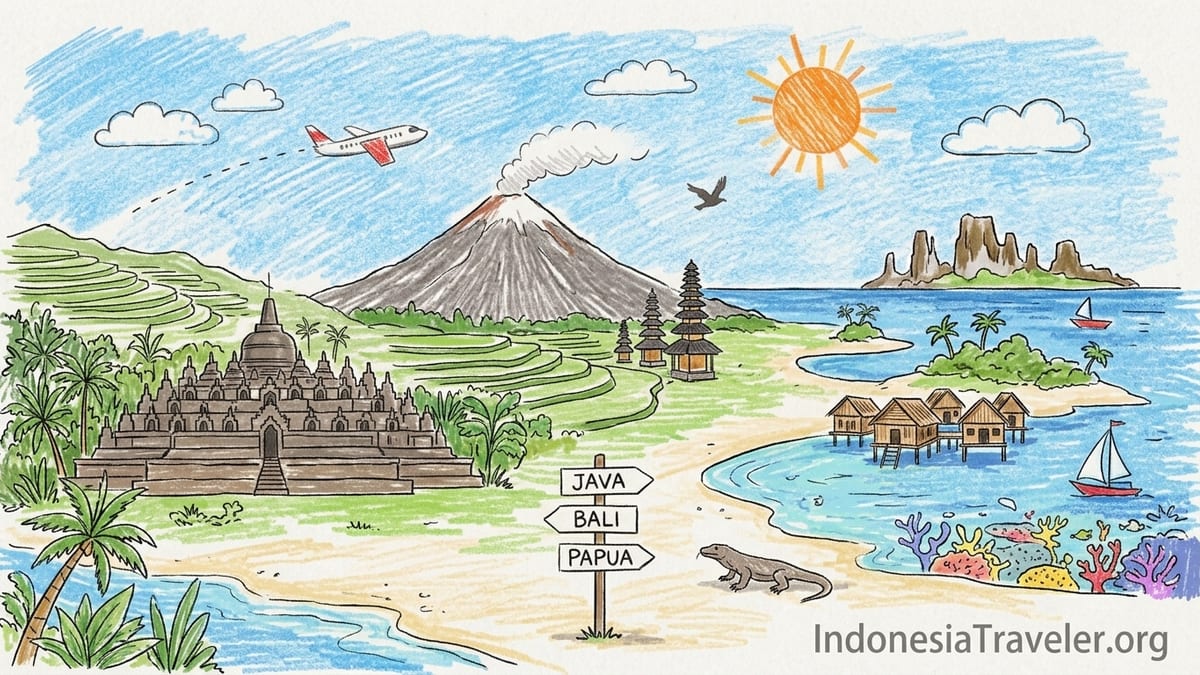
Understanding Indonesia’s Three Time Zones and Island Identities
Indonesia stretches across three official time zones: Western Indonesia Time (WIB, UTC+7) for Sumatra, Java and western Kalimantan; Central Indonesia Time (WITA, UTC+8) for Bali, Lombok, Nusa Tenggara, much of Kalimantan and southern Sulawesi; and Eastern Indonesia Time (WIT, UTC+9) for Maluku and Papua. When it is 9 a.m. in Jakarta on Java, it is already 10 a.m. in Bali and Lombok, and 11 a.m. in Raja Ampat in West Papua. Flight times and meeting times on tickets are shown in local time, so a morning departure in one zone can appear to land only “one hour later” but actually be a longer flight across a time boundary.
Each major region has a very different character. Java is the country’s political and economic heart, crowded and energetic, with Jakarta as the main gateway and Yogyakarta as the cultural capital of classical Javanese arts. Bali is majority Hindu and feels distinct from the rest of the Muslim‑majority nation, with temples, ritual calendars and its famous subak irrigation culture embedded into daily life. Lombok, just across the narrow Lombok Strait, is more relaxed and predominantly Sasak Muslim, with quieter villages and less developed tourism once you leave the main beach hubs.
Further east, the Nusa Tenggara chain, including islands such as Flores and Sumba, offers volcanoes, rugged coastlines, and access to the Komodo National Park, where live‑aboard boats and small day tours visit Komodo and Padar. To the west, Sumatra is defined by rainforest, orangutan habitat in Gunung Leuser and the volcanic caldera of Lake Toba. North of Java, Kalimantan (Indonesian Borneo) is about rivers and lowland forest, while Sulawesi is shaped like a four‑armed starfish and known for Toraja highland culture and world‑class diving in Bunaken and Wakatobi.
Farther east again, the Maluku islands were once known as the Spice Islands, with quiet bays, small guesthouses and relatively low visitor numbers. Papua and West Papua, on the New Guinea landmass, are the country’s wild frontier, where steep jungle mountains meet remote communities and offshore archipelagos such as Raja Ampat hold some of the richest marine biodiversity on the planet. Seeing Indonesia as a set of very different regions spread over three time zones, rather than a single “Bali‑style” destination, is essential when choosing where to spend your limited days.
Gateways, Heritage Cities and Volcanic Adventures in Java
For most international visitors, Jakarta’s Soekarno‑Hatta International Airport is the main metropolitan gateway to Indonesia, with direct flights from hubs such as Singapore, Kuala Lumpur, Doha and Dubai. The city itself is a dense sprawl of toll roads, high‑rises and malls, interesting mostly for travelers curious about Indonesia’s contemporary urban life. If you stay a night, you might explore the Kota Tua old town, visit the National Monument and Museum, and dine at a modern Indonesian restaurant in Menteng or SCBD, but many travelers connect directly onward to Yogyakarta or Bali.
Yogyakarta, usually shortened to Jogja, is the best base for understanding classical Javanese heritage. The city is a center of batik, gamelan music and wayang kulit shadow puppetry, and also gives access to two major temple complexes. Borobudur, about an hour and a half’s drive northwest of the city, is a vast ninth‑century Buddhist monument and is on the UNESCO World Heritage list. Prambanan, to the east of Yogyakarta, is a large compound of Hindu temples that is also UNESCO‑listed. In contrast, famous volcanoes such as Bromo and Ijen, or popular mountains like Merapi, are not on the UNESCO list, which helps correct the common impression that every famous Indonesian landmark has that status.
Visiting Mount Bromo and the Ijen crater requires more planning than urban sightseeing. Reaching Bromo commonly involves an overnight journey by train or flight to Malang or Probolinggo, followed by a jeep transfer into the Tengger caldera and a pre‑dawn wake‑up for sunrise viewpoints. Ijen, in East Java, involves a long road transfer from Banyuwangi or Bondowoso and a night hike to the crater rim, where sulfur gases can be intense and local authorities sometimes suspend access if conditions are unsafe. Travelers need to factor in early starts, cold temperatures at altitude, possible volcanic alerts and the cost of hiring local guides, 4WD vehicles and proper masks rather than treating these peaks as simple day trips.
In practical terms, a Java segment in your trip might look like two nights in Yogyakarta for Borobudur and Prambanan, a night on the train or in transit, one or two nights near Bromo, and an overnight in Banyuwangi for Ijen before crossing by ferry or short flight to Bali. This sequence shows how even within one “island,” moving between highlights can absorb a surprising number of days due to distances, terrain and early‑morning scheduling.
Bali as More Than One Destination: Ubud, South Coast and the Subak System
Bali remains Indonesia’s best‑known island, but it helps to think of it as several different destinations. The southern beaches around Kuta, Legian, Seminyak, Canggu and Jimbaran are the most developed, with international chain hotels, beach clubs and dense traffic. These areas suit travelers looking for restaurant choice, nightlife and surf, but first‑time visitors are sometimes surprised by how urban and crowded parts of South Bali feel, particularly in peak season and around major holidays.
Ubud, in central Bali, has a different atmosphere. It is surrounded by rice fields and ravines, and has become a base for yoga retreats, wellness resorts and contemporary Balinese art galleries. A traveler might stay at a guesthouse in Penestanan, take a dawn walk along the Campuhan Ridge, visit smaller temples and craft villages like Mas and Celuk, then return for a traditional dance performance in the town palace courtyard. For many visitors, Ubud is where they first encounter Bali’s ritual calendar, with offerings placed on sidewalks, temple ceremonies closing streets and gamelan rehearsals drifting from community banjar halls.
To the east, areas such as Amed, Candidasa and Padang Bai offer quieter coastal stays, with small family‑run hotels and easy access to snorkeling and diving at sites like the USAT Liberty wreck off Tulamben. The pace is slower than the south and the villages feel more residential. Travelers planning a combination trip with Lombok or the Gili Islands often route through Padang Bai, where fast boats depart across the Lombok Strait, or continue around the coast by car to reach less crowded viewpoints of Mount Agung.
Bali’s terraced rice landscapes are part of a UNESCO‑listed cultural system known as subak. This is not just about photogenic green steps at places such as Jatiluwih and Tegallalang. Subak is a cooperative irrigation system that links water temples, farmers’ associations and religious obligations. Water allocation is coordinated through temple hierarchies and planting schedules are aligned with ritual calendars, which in turn support pest control and soil health. When you see farmers cleaning canals, attending temple meetings and making offerings at small shrines in the fields, you are observing subak as a living relationship between agriculture, religion and local governance, not simply a backdrop for social‑media photos.
Lombok, Nusa Tenggara and Komodo: Beaches, Gilis and Volcanic Coasts
East of Bali, Lombok feels more spacious and less built‑up. The main beach area of Kuta (often called Kuta Lombok to distinguish it from Kuta in Bali) has seen rapid growth, with cafes, surf shops and small hotels catering to visitors who want beaches and waves without the same intensity as Canggu or Seminyak. North of the island, the Gili Islands of Gili Trawangan, Gili Air and Gili Meno are reached by speedboat from Bali or by local boat from Lombok itself. Gili Trawangan is the liveliest, with beach bars and backpacker hostels, whereas Gili Air and Meno are quieter, with more focus on snorkeling and relaxed stays.
Inland Lombok is dominated by Mount Rinjani, one of Indonesia’s most impressive volcanoes. Multi‑day treks to the summit or crater rim, often two or three days with camping, have become popular but can be tough, with steep ascents, basic campsites and rapidly changing mountain weather. Local authorities sometimes close the upper trails after seismic activity or during the rainy season, so trekkers should verify current access with registered trekking operators in Senaru or Sembalun rather than assuming year‑round availability.
Further along the Nusa Tenggara chain lies Flores, a long, mountainous island that offers both cultural villages and access to Komodo National Park. Travelers commonly fly into Labuan Bajo at the western end of Flores, now a busy gateway with a cluster of waterfront hotels and tour agencies. From here, day trips and live‑aboard boats visit Komodo and Rinca to see Komodo dragons, Padar Island for the famous multi‑bay viewpoint, and snorkeling or diving sites across the park. The park is internationally recognized, but not every well‑known site here is UNESCO‑listed, which again underlines that fame and social‑media visibility are not the same as formal heritage status.
Costs in Komodo are higher than on Bali or Java due to boat charters, park entrance fees and fuel. As one concrete example, a basic shared day trip from Labuan Bajo that includes Padar, Komodo and snorkeling can easily cost the equivalent of several dozen US dollars per person by 2026, while multi‑day live‑aboards with cabins, meals and multiple dives can run into hundreds or more per person. These prices reflect the fuel, staffing and park‑management costs of operating in a relatively remote marine area.
Sumatra, Sulawesi and Kalimantan: Wildlife, Culture and Coral Reefs
To the west of Java, Sumatra is one of the best regions for travelers interested in wildlife and big landscapes. In North Sumatra, Bukit Lawang provides access to Gunung Leuser National Park, where guided treks can offer a chance, never guaranteed, to see orangutans, gibbons and hornbills in the forest. Guides usually organize half‑day to multi‑day walks, with simple jungle camps for those staying overnight. South of here, Lake Toba, formed in a giant volcanic caldera, offers a cooler climate and homestays on Samosir Island, where Batak culture, traditional architecture and church spires mix in villages scattered around the shore.
Further south in Sumatra, other national parks such as Kerinci Seblat protect highland forests and rare species, but access is significantly more demanding in terms of transport and guiding. Many independent travelers limit themselves to the north for a first visit, combining Bukit Lawang, Berastagi’s volcanoes and Lake Toba using domestic flights through Medan’s Kualanamu International Airport.
Sulawesi offers a different combination of highland ritual culture and marine life. In the south, Tana Toraja is known for cliff graves, elaborately carved tongkonan houses and multi‑day funeral ceremonies, which are major social events for Torajan communities. Visitors typically travel by bus or flight from Makassar to Rantepao and then hire local guides for village visits. In the north, near Manado, Bunaken Marine Park is famous among divers for steep wall dives and abundant turtles, while the Wakatobi islands in Southeast Sulawesi, accessed via connections through Kendari or charter arrangements, draw dedicated divers to remote reefs with high visibility.
Kalimantan, the Indonesian part of Borneo, is less visited than Sumatra or Sulawesi but offers river journeys through lowland rainforest. In Central Kalimantan, boats on the Rungan and Kahayan rivers can reach areas where orangutans are sometimes seen, while in West Kalimantan, longhouse communities highlight Dayak culture along the upper Kapuas. Compared with Java and Bali, infrastructure in Kalimantan can feel sparse, with limited public transport and simple accommodation once you leave the main cities, which suits travelers who prioritize wilderness over convenience.
Maluku, Papua and Raja Ampat: Remote Frontiers and Specialist Marine Travel
East of Sulawesi, the Maluku islands are scattered across the Banda Sea and were once the global center of the spice trade. Today, islands such as Ambon, Banda Neira and Kei attract a smaller number of visitors: divers drawn to clear water and historical wrecks, and travelers looking for quiet villages and long, white‑sand beaches. Guesthouses and small inns often arrange island‑hopping by local boat and include meals, but you should not expect the range of services found in Bali or Jakarta.
Even farther east, West Papua and Papua sit on the western half of New Guinea, a region of steep mountains, dense forest and significant cultural diversity. Overland travel is challenging and expensive, and most visitors fly between key towns such as Sorong, Waisai and Wamena. Weather can disrupt small‑plane schedules, and some interior areas have restricted access or require special permits, which is another reason to build time buffers into any Papua itinerary.
Raja Ampat, off the coast of West Papua, is one of Indonesia’s most celebrated marine regions. The archipelago’s karst islets, soft coral gardens and fish populations draw divers from around the world, and many visitors stay at dedicated dive resorts or simple overwater homestays on islands such as Kri or Gam. Marine park entry fees apply to foreign visitors and are significantly higher than national park fees in more accessible parts of Indonesia. As of late 2024 and 2025, published information from dive resorts and local authorities indicates that foreign visitors pay on the order of hundreds of thousands to around one million rupiah for marine park permits, with exact tariffs subject to periodic review.
The high cost of reaching Raja Ampat reflects multiple factors. Travelers often need a domestic flight from Jakarta or Bali to Sorong, a transfer to the harbor, a public fast boat or private speedboat to Waisai or directly to an island, and then a stay at a resort or homestay where room rates typically include meals and boat transfers to dive sites. Food supplies and fuel must all be shipped in. A week at a mid‑range dive resort including multiple dives can easily cost the equivalent of several thousand US dollars per person, which is substantially more than a week in a comfortable guesthouse in Ubud or Yogyakarta. Travelers who do not dive can still enjoy snorkeling and island scenery here, but the region makes the most sense for those whose main priority is marine life and who are ready for specialist‑level costs and logistics.
Visas, Arrival Formalities, Domestic Flights and Safety
For many nationalities in 2026, the simplest way to enter Indonesia for tourism is the B1 Visa on Arrival, known locally as Visa Kunjungan Saat Kedatangan. Official immigration information confirms that this visa costs 500,000 Indonesian rupiah and is valid for an initial stay of up to 30 days, with the possibility of one extension for another 30 days at the same fee, processed at designated immigration offices. Travelers can usually obtain this as a physical visa on arrival at major airports or apply for an electronic version in advance, but eligibility by nationality should always be checked against the latest official lists before travel.
Since 2025, Indonesia has been rolling out a national digital system called All Indonesia that integrates several arrival processes into one platform. Government releases describe All Indonesia as a mandatory integrated declaration covering immigration data, customs declarations, health information and quarantine details at airports and seaports where it has been implemented. At key gateways such as Soekarno‑Hatta in Jakarta and Ngurah Rai in Bali, international passengers are now required to submit their arrival declaration through the All Indonesia app or web platform, which replaces separate electronic customs forms. Travelers can normally complete this declaration in the days just before arrival, so it is worth installing the app and filling in the details while you still have reliable internet.
Bali has, in addition to national requirements, its own provincial tourism levy. The Bali government introduced a foreign tourist levy of 150,000 rupiah per person in February 2024, payable once per visit by non‑Indonesian passport holders. By late 2026, the levy can be paid online through official provincial channels before arrival or at designated payment points in Bali’s airport and through some hotels and travel agencies. It is important to understand that this levy is separate from any visa fee: a traveler using the B1 Visa on Arrival will pay 500,000 rupiah for the visa itself plus 150,000 rupiah for the Bali levy when they visit the island.
Given the distances between islands, domestic flights are a core part of almost every multi‑region itinerary. Major routes such as Jakarta to Bali, Jakarta to Medan, Surabaya to Makassar or Bali to Labuan Bajo have multiple daily services on national carriers and low‑cost airlines. Smaller airports in places like Waisai, Ternate or smaller Sumatran towns may see only a few flights a week, and weather or operational issues can cause delays. Ferries are an important part of Indonesia’s transport network, but recent news of capsized or burned ferries in the Java Sea and other waters underlines ongoing safety concerns. Travelers should favor reputable operators, accept that schedules may change, and avoid overloading or visibly poorly maintained vessels when there is an alternative.
Realistic 7, 14 and 21 Day Itineraries Across the Archipelago
Because of the country’s size, realistic itineraries for Indonesia require hard choices. A seven‑day trip works best when you focus on one main island and its immediate surroundings. One practical example is a Java and Bali snapshot: arrive in Jakarta and connect straight to Yogyakarta for three nights, with day trips to Borobudur and Prambanan, then fly to Bali for four nights split between Ubud and a South Bali beach area or Amed. This gives a mix of heritage, landscapes and relaxation with only two domestic flights.
A fourteen‑day trip allows you to add another region without turning the holiday into a domestic‑airport tour. A classic two‑week route might be “Java, Bali and Komodo”: three nights in Yogyakarta, two nights near Bromo or Ijen, five nights in Bali split between Ubud and the coast, then three or four nights in Labuan Bajo with a full‑day Komodo and Padar boat trip and one or two days exploring Flores’ inland villages or coastal viewpoints. Another two‑week option is “Sumatra and Bali”: start in Medan, spend several days between Bukit Lawang and Lake Toba, then fly to Bali for a cultural and beach finish.
With twenty‑one days, you can combine three quite different regions or add a remote marine destination. One example is “Java, Bali, Sulawesi and Raja Ampat”: begin with Yogyakarta and either Bromo or Ijen, then a week in Bali, followed by a week split between Tana Toraja and Bunaken in Sulawesi, and finally five or six days in Raja Ampat focused on diving or snorkeling. This requires careful sequencing of domestic flights, overnights near connecting airports and generous time buffers for weather‑related disruptions, especially toward the end of the trip before your international departure.
Budget and energy levels matter as much as geography. A traveler comfortable with frequent domestic flights and a higher daily budget for marine travel might prioritize Flores, Wakatobi and Raja Ampat, while someone more interested in local performance, food and handicrafts could invest their time in Java, Bali and the cultural highlands of Sulawesi or Sumatra. The key is to accept that even three weeks in Indonesia only scratches the surface, and that slowing down often results in richer experiences.
Experience Matrix: Beaches, Culture, Wildlife, Trekking, Diving and Independence
Different regions of Indonesia lend themselves to different travel priorities. For beaches, Bali’s south coast, the Bukit Peninsula, Lombok’s south shore and the Gili Islands are the easiest options, thanks to good accommodation ranges and relatively straightforward access from major airports. Those seeking more remote sand and sea might look to Sumba, the Keis in Maluku or small islands in the Togian group off Sulawesi, understanding that reaching them requires more time, patience and sometimes chartered boats.
Cultural immersion is strongest in places where living ritual remains part of community life. Yogyakarta and Solo provide deep exposure to Javanese court traditions, performance and batik. In Bali, temple ceremonies and the subak system link everyday routines to Hindu ritual. In Tana Toraja, funeral ceremonies and house architecture express distinct highland identity, and on Samosir in Lake Toba, Batak Christian and older traditions intertwine. Travelers interested in crafts can focus on specific centers, such as textile weaving in Flores or ikat production in Sumba, and arrange homestays or village visits through local cooperatives.
For wildlife, Gunung Leuser in Sumatra and orangutan centers in Kalimantan are primary draws, along with birdlife across Papua’s highlands and the lesser visited interior of Sulawesi. Responsible wildlife experiences in Indonesia usually involve hiring licensed local guides, accepting that sightings are never guaranteed, and budgeting for park fees. Trekkers, meanwhile, are drawn to volcanoes such as Rinjani, Bromo, Ijen, Semeru and Kerinci, as well as longer routes in Papua’s highlands or Sulawesi’s interior. Many of these treks are strenuous and subject to closures because of volcanic or weather conditions, which is why early communication with local operators is important.
Divers and snorkelers can think in tiers. Entry‑level and budget‑friendly options include Amed and Tulamben in Bali, or the Gili Islands. Intermediate choices with richer reefs but higher costs and more travel include Bunaken, the Banda Sea and Komodo. At the top end, Wakatobi and Raja Ampat cater to divers who are willing to plan months ahead, pay higher marine park fees and accept complex logistics in exchange for exceptional biodiversity. Independent travelers will find it easiest to improvise in Java, Bali, South Sulawesi and parts of Sumatra, where bus networks, ride‑hailing apps and a range of guesthouses exist. In contrast, Maluku, Papua, Wakatobi and more remote islands often reward those who arrange at least the skeleton of their itinerary, including domestic flights and boat transfers, before arriving.
The Takeaway
Indonesia in 2026 rewards travelers who think beyond the idea of “a trip to Bali” and instead approach the country as a chain of distinct regions stretched across three time zones. From Jakarta’s metropolitan sprawl and Yogyakarta’s temples to the rice terraces of Bali, the beaches of Lombok, the dragons of Komodo, the jungles of Sumatra and the coral pinnacles of Raja Ampat, the variety is enormous, but distances and logistics are real constraints.
Understanding the B1 Visa on Arrival, the All Indonesia arrival declaration and Bali’s provincial levy will smooth your entry. Accepting domestic flights as the backbone of longer itineraries, treating ferries and volcano treks with respect, and budgeting realistically for remote marine destinations will keep your plans grounded. Whether you have one week or three, choosing a handful of islands that match your interests in beaches, culture, wildlife, trekking or diving will almost always be more satisfying than racing across maps. Indonesia is vast enough that even repeat visitors only ever see a fraction, and that is part of its enduring appeal.
FAQ
Q1. Is the B1 Visa on Arrival really 500,000 rupiah in 2026?
The official fee for Indonesia’s B1 Visa on Arrival remains 500,000 rupiah for an initial stay of up to 30 days, with the option to extend once for another 30 days for the same fee, although any future regulation changes should be checked close to your travel date.
Q2. Do I have to use the All Indonesia app before arriving?
At major airports and ports where it has been implemented, international passengers are required to complete their arrival declaration through the All Indonesia platform or app, which replaces separate customs and health forms, so it is wise to install and fill it out in the days before your flight.
Q3. Is the Bali tourist levy the same thing as my visa fee?
No. The Bali tourist levy of 150,000 rupiah per foreign visitor is a provincial tax collected by the Bali government and is entirely separate from national visa fees such as the 500,000 rupiah B1 Visa on Arrival.
Q4. Are all famous Indonesian sites such as Bromo and Komodo UNESCO‑listed?
No. Some major sights like Borobudur and Prambanan are UNESCO World Heritage Sites, but others, including Mount Bromo, Ijen and several popular islands, are not on the UNESCO list despite being very famous with travelers.
Q5. How dependent will I be on domestic flights for a two‑week trip?
For a typical two‑week itinerary that combines at least two islands beyond your arrival point, such as Java, Bali and Flores, you should expect to take several domestic flights, since overland and ferry options would add many extra days.
Q6. Are Indonesian ferries safe for travelers?
Ferries are widely used across Indonesia, but periodic accidents reported in national and international media show that safety standards vary, so travelers often choose larger, reputable operators, avoid visibly overloaded boats and factor in weather conditions when deciding which services to use.
Q7. Why is Raja Ampat so much more expensive than Bali?
Raja Ampat involves long domestic flights, boat transfers, higher marine park fees and the cost of shipping in fuel, food and equipment to remote islands, so accommodation and diving packages are significantly more expensive than comparable stays in places like Ubud or South Bali.
Q8. Can I trek volcanoes like Bromo or Rinjani without a guide?
While certain viewpoints at Bromo can be reached independently, many volcano treks, especially multi‑day routes on peaks like Rinjani or Semeru, are best done with licensed local guides or organized operators due to steep terrain, rapidly changing weather and potential volcanic activity.
Q9. Is it realistic to visit Java, Bali, Sumatra and Raja Ampat in 10 days?
No. Trying to cover all those regions in ten days would result in a trip dominated by airports and transfers; focusing on one or two regions, such as Java and Bali or Bali and Flores, is far more practical for a short visit.
Q10. Which areas are best for independent, low‑budget travel?
Java, Bali, parts of Sumatra and South Sulawesi are best suited to independent, lower‑budget travel thanks to frequent public transport, widespread guesthouses and inexpensive local food, while remote marine regions like Wakatobi or Raja Ampat are harder to visit cheaply or spontaneously.