


I have lost count of how many times someone has asked me which Indonesian island is “best.” The question sounds simple. The reality on the ground is not. For a start, Bali, Lombok, Java and Flores are individual islands, while Raja Ampat is a scattered archipelago of hundreds of islands in West Papua. Even within Java and Flores, regional differences are so stark that trying to squeeze them into a single travel style is misleading at best. Rather than pretending there is one winner, it is more honest to ask what kind of trip you want, in what season, and how much time, money and patience for logistics you really have.
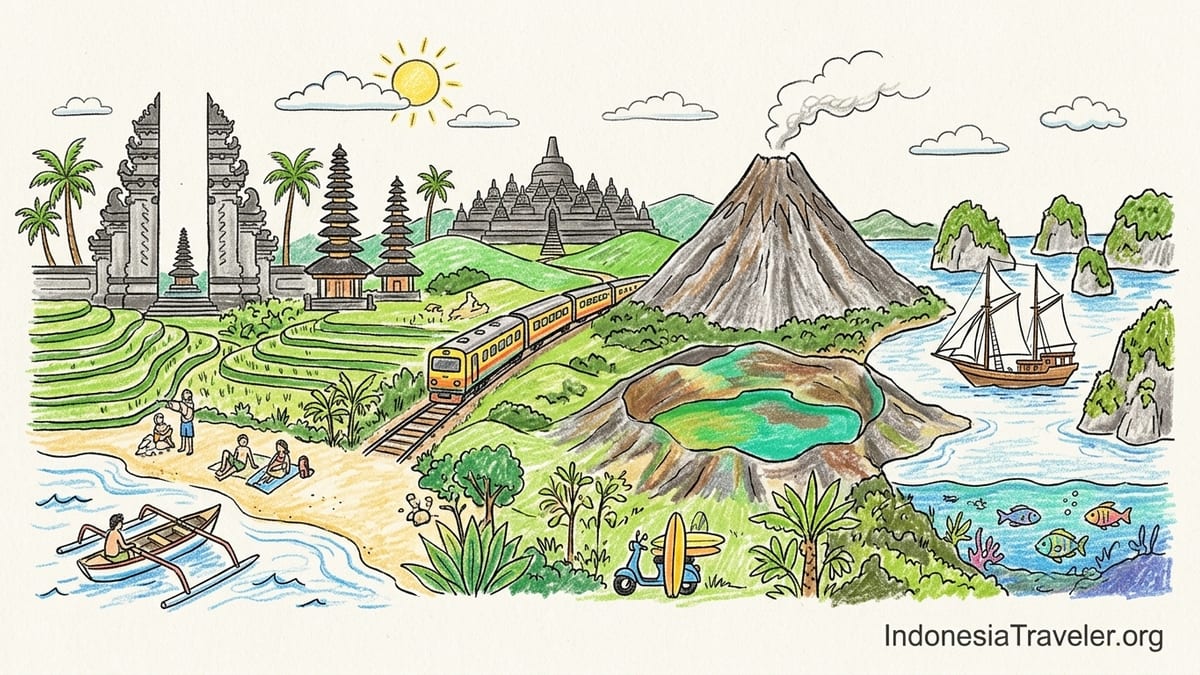
Islands, Archipelagos and the Myth of the “Best”
Indonesia stretches over 5,000 kilometers, and treating Bali, Lombok, Java, Flores and Raja Ampat as interchangeable beach backdrops ignores how different they are. Bali and Lombok sit next to each other in the central part of the country, both with volcanic spines and tourist belts along their southern coasts. Java, home to more than half of Indonesia’s population, runs west to east from Jakarta through Yogyakarta and Surabaya to Banyuwangi. Flores lies further east again, a long, mountainous island whose western tip at Labuan Bajo serves as the main springboard to Komodo National Park. Raja Ampat is not one island at all but an archipelago reached through the port city of Sorong in West Papua, followed by ferries and boats scattered over a broad marine park.
Even talking about “Java” or “Flores” as if they were single destinations is slippery. A week spent between Yogyakarta and Borobudur, riding the train and climbing Mount Bromo, feels entirely different to a work trip stuck in Jakarta traffic. Likewise, a quick Komodo day tour from Labuan Bajo has little in common with a ten-day overland journey across Flores, bouncing along winding roads from Ruteng to Bajawa, Ende and Maumere. When you ask which one is right for you, you are really asking whether you want nightlife or quiet reefs, rail journeys or island hops, cheap street food or remote eco-resorts, and how you feel about paying separate marine park fees or sitting on a bus for ten hours.
Money, Seasons and Logistics: The Real Deciders
In practice, budget, timing and transport routes shape Indonesian itineraries more than any romantic idea of the “perfect” island. Bali is usually the easiest and cheapest starting point for international flights, with a huge spread of bed prices, from simple guesthouses in Canggu under the cost of a sit-down dinner at home to clifftop villas in Uluwatu that rival global luxury resorts. Lombok and Flores are typically reached via short domestic flights from Bali or Jakarta, while Java is threaded with trains that let you move between cities without navigating airports. Raja Ampat is another world again: you must fly to Sorong, transfer to Waisai by ferry or fast boat, then continue by smaller boats to reach your homestay or resort, and every step along that chain adds to the bill.
Seasonality cuts across this. Broadly, April to October brings the driest conditions for Bali, Lombok, Java and Flores, with clearer skies for volcano sunrises and more reliable sea crossings. In contrast, Raja Ampat’s most popular dive season runs roughly October to April, when seas tend to be calmer in much of the archipelago and visibility is often better. Pick August only thinking of Bali’s cool evenings and you may find Raja Ampat trips limited by swells in some areas. Pick January for peak manta sightings around Raja Ampat and you will be in the middle of the wetter months across much of Java and Bali, making volcano hikes and long road trips more complicated. The question is not which weather is “best” but which trade-offs fit your plans.
Bali: Infrastructure, Convenience and Crowds
Bali remains the highest-concentration tourism hub in Indonesia, and that fact alone makes it both very easy and very frustrating. If you want accommodation choice, Bali wins hands down. In the same week you can stay in a family-run homestay in Ubud for the price of a mid-range restaurant meal, move to a midscale hotel with a pool in Seminyak, and finish with a splurge in a private pool villa among the rice fields. Ride-hailing apps operate widely, the island has countless cafes, co-working spaces and spas, and almost every driver seems to offer custom day tours. For a first trip to Indonesia, that infrastructure cushions the culture shock.
Yet Bali’s popularity has costs. Traffic between Canggu, Seminyak and Ubud can turn a fifteen-kilometer drive into a grinding, stop-start hour at the wrong time of day. Beaches vary dramatically in quality. The wide, golden sands of Balangan or Mengiat in Nusa Dua feel worlds away from the narrow, erosion-affected strip at parts of Canggu, where high tides can leave little room to sit. Some formerly quiet areas have filled up with beach clubs blaring music over what used to be fishing villages. It is still possible to find quieter corners, such as the north coast around Lovina or the less-developed east near Amed and Sidemen, but they do not offer the same concentration of services as the southern resort strip, so you trade nightlife and dining choice for space and calm.
Money-wise, Bali can be as cheap or expensive as you allow it to be. Local warungs serving nasi campur or grilled fish remain very affordable, and hiring a scooter is still one of the fastest ways to move, but imported wine, cocktails and Western-style brunches can quickly bring your daily spending closer to what you might pay in Sydney or Los Angeles. Compared with Java’s train-based city hopping or Flores bus journeys, Bali’s costs are less about base transport fares and more about how deeply you lean into its cafe, bar and wellness scenes.
Lombok: Quieter Coasts, Surf and Sasak Culture
Lombok is often marketed as what Bali “used to be.” That is an oversimplification, but it captures two truths: its tourist infrastructure is more limited, and much of the island still feels decidedly local in rhythm. Southern Lombok around Kuta Lombok and Gerupuk has become the main surf hub, with beaches like Tanjung Aan and Selong Belanak offering turquoise bays framed by headlands. Guesthouses and small boutique hotels line the new bypass road, and a string of surf schools runs daily trips by outrigger boat. The three Gili Islands off Lombok’s northwest, especially Gili Trawangan and Gili Air, remain popular for simple beach stays, snorkeling and party nights, although they are very different in mood from the relatively conservative villages on Lombok’s mainland.
Culturally, Lombok is the homeland of the Sasak people, with their own language, music and traditions. Day trips from Kuta might include visiting weaving villages near Sukarara or traditional compounds around Sade. Climbing Mount Rinjani, when open, is one of Indonesia’s great treks, with two to three day routes that reach the crater rim or summit. This is where Lombok’s relative lack of infrastructure shows: outside the tourism corridors between the airport, Kuta, Senggigi and the Gilis, public transport options thin out sharply. Many travelers either hire a driver for point-to-point transfers or rent a scooter, which can be intimidating on dark, unlit roads for those without motorbike experience.
Costs in Lombok are usually slightly below Bali for similar standard rooms, particularly once you get away from the most fashionable beach pockets, but some imported goods are more expensive due to less competition. Overland buses across Lombok and public boats to the Gilis remain relatively inexpensive, but there is less price transparency than you find when buying a rail ticket in Java or a budget homestay in central Bali online. If your priority is quieter beaches, surf breaks and a sense of being somewhere with its own distinct culture rather than a Bali satellite, Lombok makes a strong case, provided you accept rougher edges in transport and healthcare access.
Java: Culture, Volcanoes and Rail, With Crowds
Java is where many of Indonesia’s most important historical and cultural sites sit, from the Buddhist temple complex of Borobudur near Yogyakarta to the Hindu Prambanan temples and the colonial-era neighborhoods of cities like Bandung and Semarang. Yogyakarta in particular has become a cultural capital for visitors, with batik workshops, contemporary art spaces and the kraton palace. One of Java’s great advantages over the other islands in this comparison is its rail network. Multiple trains each day link Jakarta to Yogyakarta in about six to eight hours, with economy fares often under the cost of a restaurant meal and executive-class seats costing roughly the price of a midrange dinner out in a Western city, based on recent ticket searches.
From Yogyakarta you can continue by rail toward Surabaya, then join organized trips to volcanic landscapes such as Mount Bromo and the Ijen crater. These overland routes let you see rice paddies, villages and city edges from your window rather than jumping from airport to airport. For budget-conscious travelers, the ability to buy a clear-priced train ticket on apps and know exactly what you will pay is a major strength compared with bargaining over minivan seats on Flores or last-minute boat rates in Labuan Bajo.
The trade-off is that Java is intensely populated and, in many urban areas, heavily trafficked. Jakarta’s congestion can be overwhelming, and even Yogyakarta chokes up around holiday periods. Pollution around some industrial corridors and city fringes can be noticeable, and spontaneous “scenic” detours may dump you into endless suburbs rather than empty coastline. For travelers who imagine Indonesia as solely palm-fringed bays, Java’s reality of malls, mosques, factories and flyovers can be jarring. Yet those same characteristics also make it the best-value place in this comparison for intercity travel and street food. A plate of gudeg in Yogyakarta or bakso on a street corner often costs far less than equivalent tourist-area meals in Bali or Lombok.
Flores and Komodo: Do Not Confuse the Island with the Boat Trip
Flores occupies an awkward position in many itineraries because its name is often shorthand for “Komodo trip,” when in fact Komodo National Park is a separate group of islands reached from Labuan Bajo at Flores’ western tip. Most visitors now fly to Labuan Bajo, walk out of the small airport and see rows of tour desks selling one-day speedboat trips to Padar Island, Komodo or Rinca and Pink Beach, or multi-day liveaboard cruises sleeping on traditional-style phinisi boats. Recent discussions among travelers and operators suggest that three-day, two-night shared-boat itineraries from Labuan Bajo typically cost in the low hundreds of US dollars per person, with private or luxury boats running far higher. On top of that sit Komodo National Park entrance tickets, ranger fees and, on some routes, camera or drone charges.
The mistake is to treat that boat loop as the whole of Flores. Once you leave Labuan Bajo, the character of the island changes. The road east climbs into cool highlands around Ruteng, passes through coffee-growing regions and descends to towns like Bajawa, known for traditional Ngada villages and soaking in hot springs with a view of conical volcanoes. Further along, near Ende and Moni, travelers get up in the dark to watch the sunrise over the multi-hued crater lakes of Kelimutu. Public buses, shared cars and private drivers connect these dots, but travel times are long. A stretch that looks short on a map may take six hours of hairpin bends. This overland part of Flores is where you encounter more homestays than resorts, patchy mobile signal and limited ATM access.
Financially, doing Flores “properly” often means accepting higher per-day costs in the Komodo section and much lower daily spending while inland. Once you are away from Labuan Bajo, simple guesthouses and market food are inexpensive, but boat trips and park tickets around Komodo compress a lot of spend into a few days. Compared with Raja Ampat, however, Komodo trips remain a more affordable way to see dramatic islands, reefs and big marine life, especially for those who are happy to join a shared boat rather than insisting on a private charter.
Raja Ampat: World-Class Reefs, World-Class Complexity
Raja Ampat has become something of a holy grail for divers and underwater photographers, and for good reason. Its location at the heart of the Coral Triangle gives it an extraordinary density of coral and fish species, and recent conservation efforts have improved reef condition and shark and manta sightings. Yet those same conservation measures, plus its remoteness, also make it the most complex and expensive destination in this comparison. To get there you must first reach Sorong, usually by domestic flight from hubs like Jakarta or Makassar, then transfer to Waisai by ferry, and then often take a smaller boat again to your chosen homestay or resort scattered among the islands.
On top of flights and boats, Raja Ampat layers mandatory fees. Current regulations require foreign visitors to pay a Raja Ampat environmental service charge, often described as a marine park permit, which in 2026 is set at roughly one million rupiah per person. In addition, there is a separate Raja Ampat tourism entry fee collected by the regency government, also currently listed at around one million rupiah for international visitors. Local information sources explain that these two fees fund different things: one supports marine protected area management and patrols, while the other funds jetties, viewpoints and tourism infrastructure. You may also encounter smaller village-level fees at certain islands, and you still need to pay for the ferry between Sorong and Waisai and for resort or homestay transfers on top.
Accommodation patterns reflect this. Budget travelers can still find homestays on smaller islands that offer full-board stays, with basic rooms, shared bathrooms and simple electricity schedules. Above that tier, midrange eco-resorts and upmarket dive resorts include guided dives, meals and boat transfers in their packages. Once you tally round-trip flights from Bali or Jakarta to Sorong, multiple boats, environmental and entry fees and dive packages, Raja Ampat usually ends up costing far more than a Bali or Lombok beach week, a Java rail loop or a Komodo liveaboard. That does not make it overpriced in context of the conservation work it funds, but it means it is a poor choice for anyone who simply wants “nice beaches” without being deeply interested in the marine environment and willing to budget accordingly.
Head‑to‑Head Comparisons: Beaches, Culture, Adventure and Reefs
Bali versus Lombok for beaches is less straightforward than brochure photos suggest. South Bali offers an easy string of surfable, mostly west-facing beaches: Kuta and Legian for busy, beginner-friendly waves and nightlife; Canggu for a cafe scene and black sand breaks; Balangan and Padang Padang for more dramatic cliffs and reef waves; Nusa Dua and Sanur for calmer, family-friendly shallows. Many of these areas also suffer from crowding, scooter congestion and coastal development that narrows the sand strip at high tide. Lombok’s southern coast, by contrast, feels more spacious. Tanjung Aan has a wide, curved bay with pale sand and a modest number of warungs. Selong Belanak spreads along a broad, gently shelving bay popular with surf schools. Yet outside of Kuta Lombok, evening dining choices are limited, street lighting can be sparse and emergency services are thin on the ground. If you want busy, walkable beachfront neighborhoods with lots of restaurants, Bali still wins. If you prioritize space and are comfortable on a scooter or hiring drivers, Lombok’s beaches have the edge.
For culture, Bali versus Java plays out differently. Bali’s Hindu temples, dance performances and offerings in family compounds make its rituals very visible to visitors. Attending a kecak performance at Uluwatu or watching daily offerings placed on scooter seats in Ubud quickly creates a sense of “Bali-ness” that is easy to grasp in a short stay. Java’s culture is less concentrated into a single, island-wide image. Yogyakarta offers batik workshops, gamelan music, the sultan’s palace and access to Borobudur and Prambanan, while cities like Solo and Bandung have their own performing arts and crafts traditions. Much of Java, however, feels like everyday Indonesia: mosques announcing prayer times, food carts selling fried snacks, office workers on commuter trains. Bali is the better choice if you want highly accessible, visually distinctive rituals in a few days; Java rewards those willing to ride trains, learn some phrases and sit longer with its layered, Javanese, Sundanese and Betawi cultures.
Lombok versus Flores for adventure is really a question of time and endurance. Lombok’s signature adventures are concentrated: two to three days to climb Rinjani when trails are open, a day to ride to waterfalls like Tiu Kelep from Senaru, or a few days of surfing or kitesurfing around Kuta. Distances are manageable and you can base yourself in one town. Flores demands more movement. A serious overland route might run from Labuan Bajo through Ruteng, Bajawa and Ende to Maumere, with stops to trek to traditional villages, soak in hot springs, see spider-web rice fields and catch dawn at Kelimutu. Roads are paved but winding, and shared transport schedules can be elastic. If your idea of adventure is pushing your legs and lungs hard in a concentrated burst, Lombok suits. If it is journeying across an island where phone signal fades and you count days in bus hours, Flores is more compelling.
Komodo versus Raja Ampat in marine terms is mostly about style and cost, not quality in any simple sense. Komodo National Park is relatively compact and reachable by day trip from Labuan Bajo for snorkeling with manta rays at sites like Manta Point, hiking Padar for a sunrise ridge view and visiting dragon-inhabited islands with a ranger. Liveaboard trips over three or four days offer repeated dives or snorkels among reefs teeming with fish and turtles, but the focus is split between marine and topside scenery. Raja Ampat itineraries, particularly for divers, tend to revolve almost entirely around the marine environment, with repeated dives each day, focus on hard and soft coral gardens, schooling fish and more limited land excursions. Permits and overall trip costs in Raja Ampat are higher, and getting there is more involved. For many divers, Raja Ampat is worth the premium. For travelers whose budget would strain under multiple domestic flights, layered entry fees and resort-based dive packages, Komodo delivers exceptional experiences at a lower financial and logistical bar.
Alternatives: Sumatra and Sulawesi in the Mix
It would be a mistake to talk as if Indonesia only consists of the five places above. Sumatra and Sulawesi, while beyond the original list, often emerge as alternatives once travelers start comparing costs and crowds. In northern Sumatra, the pairing of Bukit Lawang for orangutan-focused jungle trekking and Lake Toba for volcanic-lake scenery offers a combination of wildlife and relaxation that none of Bali, Lombok, Java, Flores or Raja Ampat quite match. Flights into Medan can be combined with overland transfers to guesthouses that organize guided walks into the forest. Prices for simple accommodation and local food here can be lower than Bali’s coastal hotspots, though travel conditions are rougher and infrastructure less predictable.
Sulawesi, particularly its northern and central parts, is another underused option for those focused on diving and culture. The Bunaken Marine Park near Manado has long been known for wall dives and turtles, and the small island of Siladen hosts beachside dive resorts that are often more affordable than equivalent properties in Raja Ampat. Inland, the highlands of Tana Toraja in South Sulawesi draw visitors interested in elaborate funeral rituals, cliff burial sites and carved houses. What keeps Sulawesi from being mentioned in the same breath as Bali or Java for many first-time visitors is simply awareness and routing convenience, not a lack of interest or value. Once again, there is no absolute “better,” simply a matrix of price, access, season, and what kind of experiences you care most about.
The Takeaway: Matching Islands to Traveler Types
When I strip away the marketing slogans and think about actual routes, budgets and seasons, the idea of a single best Indonesian island feels unhelpful. Instead, I think in terms of who you are and what trade-offs you want to make. First-time visitors who want a mix of beaches, temples, rice terraces and reliable infrastructure usually do best starting in Bali, perhaps adding a side trip to Yogyakarta in Java by plane or train if they have the time. Couples looking for a blend of comfort and relative quiet often split time between a calmer part of Bali, such as Sidemen or north coast resorts, and southern Lombok or the Gilis, accepting extra transfers in exchange for less nightlife and more stars.
Backpackers with more time than money tend to get the most from Java and Flores. Java’s rail network keeps intercity travel costs predictable and low, while Flores rewards patience with homestays, hot springs and crater lakes that feel a world away from Bali’s cafe lines. Divers and underwater photographers should be frank with themselves about budget. Komodo liveaboards accessed from Labuan Bajo can already feel like a major splurge once you add flights and park fees, but they still undercut Raja Ampat in most cases. Those who have saved specifically for a once-in-a-decade trip, are comfortable navigating layered permits and transfers through Sorong and Waisai, and are happy for most of their time to be boat based will get more from Raja Ampat than from trying to stretch a thin budget there.
Families often underestimate how tiring complicated logistics can be. For those traveling with young children, Bali’s combination of short internal drives, family-oriented resorts with pools, kids’ clubs and easy access to pharmacies and clinics is hard to beat. Adding Nusa Dua, Sanur or north Bali can give calm water options, while a short hop to Lombok’s gentler beaches might make sense for older kids used to boats and longer transfers. Travelers who do not want to drive or ride scooters at all generally find Bali and Java easier, thanks to taxis, ride-hailing services around Denpasar and Ubud and clear rail routes in Java. Lombok, Flores and parts of Sulawesi involve more reliance on private drivers or tour pickups, which adds to the budget.
In the end, the only wrong choice is pretending there is a universal right one. Bali is not automatically better than Lombok, any more than Raja Ampat is inherently superior to Komodo or Java is “just a transit island.” Each destination exists within a web of money, seasonality and logistics. If you choose based on what you actually value and what you are genuinely willing to spend in time and cash, rather than on someone else’s top ten list, you are far more likely to find the version of Indonesia that feels right for you.
FAQ
Q1. Is Bali really that much easier for first-time visitors than the other islands?
Bali has the densest concentration of tourist infrastructure, from accommodation at every budget level to cafes, pharmacies and transport options, which usually makes it less stressful for a first trip than Lombok, Flores or Raja Ampat.
Q2. How expensive is Raja Ampat compared with a Komodo liveaboard or a week in Bali?
Raja Ampat usually ends up significantly more expensive once you factor in flights to Sorong, ferries, boat transfers, environmental and entry fees and dive packages, while Komodo trips from Labuan Bajo and even a comfortable week in Bali generally require a lower overall budget.
Q3. Do I need to plan my trip around different seasons for Bali, Java and Raja Ampat?
Yes, Bali, Lombok, Java and Flores are often best from around April to October for dry conditions, while many divers target Raja Ampat between roughly October and April for calmer seas and good underwater visibility.
Q4. Can I visit Flores without doing a Komodo boat tour?
Absolutely, you can travel overland across Flores to places like Ruteng, Bajawa, Ende and Kelimutu, staying in homestays and guesthouses without ever joining a Komodo boat trip from Labuan Bajo.
Q5. Is Java only big cities and traffic, or is it worth visiting for scenery?
Java does have major urban areas and congestion, especially around Jakarta, but it also offers rice-field landscapes, volcanic areas like Bromo and Ijen, and cultural centers such as Yogyakarta and Solo.
Q6. Which is better for beaches, Bali or Lombok?
Bali wins for easy access to a wide range of beach neighborhoods with many restaurants and bars, while Lombok offers quieter, often less-developed bays and surf beaches that require more transfers and comfort with limited services.
Q7. Is it safe to travel in Indonesia if I do not want to ride a scooter?
Yes, but your island choice matters; Bali and Java are easier with taxis, ride-hailing services and trains, while Lombok, Flores and some parts of Sulawesi and Sumatra rely more on private drivers and arranged transfers.
Q8. How do train costs in Java compare with flights or ferries elsewhere?
Intercity trains in Java are usually very good value, with economy and executive fares that are often lower than equivalent domestic flights and more predictable than many bus or boat prices in eastern Indonesia.
Q9. Is Raja Ampat only for advanced divers?
No, there are options for beginners and snorkelers, but currents can be strong and logistics complex, so it suits travelers who are deeply motivated by the marine environment and prepared for higher costs and planning effort.
Q10. If I have two weeks, can I combine more than one of these destinations?
Yes, many travelers pair Bali with either Lombok or Yogyakarta and Java; adding Flores, Komodo or Raja Ampat in the same two-week window is possible but increases flight time, costs and travel fatigue.