


I arrived in Yogyakarta with a notebook full of prices and a simple question: in 2026, is Indonesia still a budget destination once you start hopping between islands? On paper, it looked affordable. I had benchmark daily ranges of roughly IDR 450,000 to 750,000 for budget travel, IDR 900,000 to 2,000,000 for moderate independent trips, and IDR 2,000,000 to 3,500,000 or more for comfortable holidays. The reality on the ground turned out to be more nuanced. Indonesia can still feel wonderfully inexpensive if you slow down and stay put, but the moment you start stringing together Bali resorts, domestic flights, boat transfers and remote marine parks, costs climb fast.
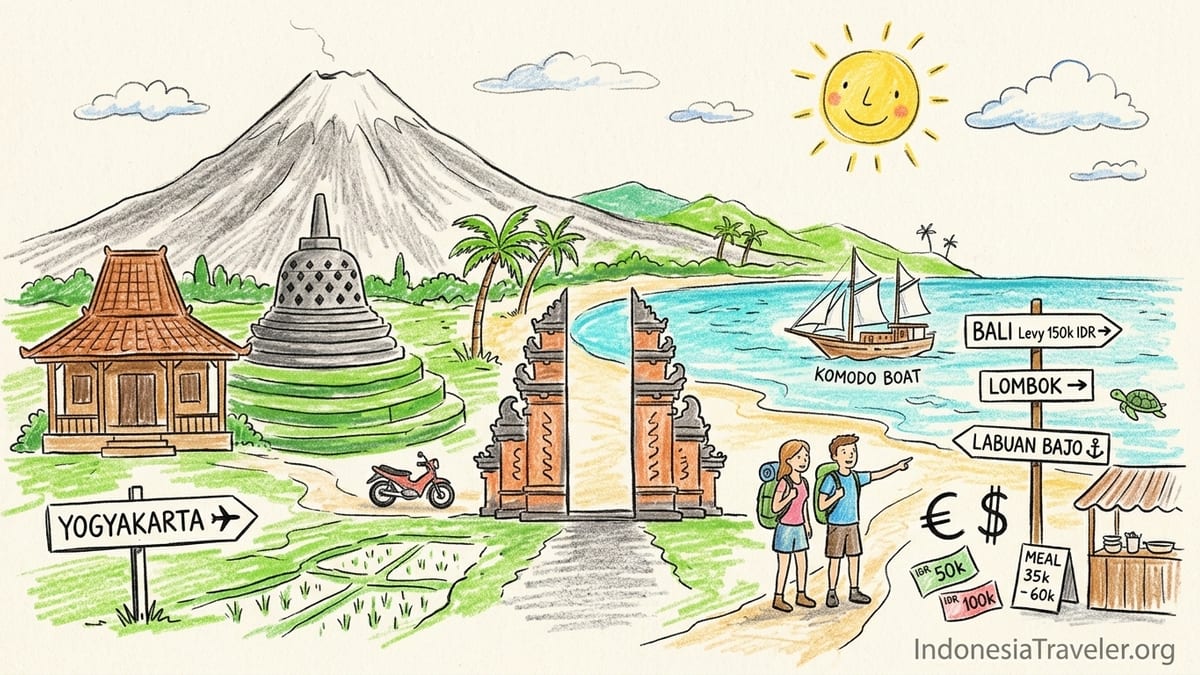
How I Researched: Route, Assumptions and Exchange Rates
For this investigation I combined my own 2026 trip with current pricing checks on Indonesian and international booking sites, plus recent official announcements. I focused on a route many first-time visitors consider: a week based in Yogyakarta on Java, then Bali’s south and central beach towns, plus side trips to Lombok, Labuan Bajo for Komodo National Park, and Raja Ampat in West Papua. I cross-checked hostel, guesthouse and hotel prices in Yogyakarta, Ubud, Canggu, Sanur, Kuta Lombok, Labuan Bajo and Raja Ampat, always looking at similar dates in the same month to avoid wild seasonal swings.
Accommodation data came from platforms that track prices in rupiah and in euros or dollars, which gave a useful sense of how Indonesia’s inflation and currency shifts play out for visitors. For example, a recent hostel and budget hotel snapshot for Yogyakarta showed dorm beds around the equivalent of 7 to 14 euros per night, and simple hotels a little higher, which translates to roughly IDR 130,000 to 275,000 at late 2026 exchange rates. Bali’s Ubud and Canggu, by contrast, often started closer to 13 to 15 euros per night for the cheapest rooms and averaged in the low 30s, so roughly IDR 250,000 to 600,000 and beyond for midrange options on comparable dates.
For food, I ate at warungs and street stalls, then compared receipts against recent food cost guides that track actual bills across Indonesian cities. In 2026 these guides typically show complete warung meals in the IDR 35,000 to 60,000 bracket for a main, rice and drink, with touristy cafes and beach restaurants rising to several times that once imported ingredients, coffee culture expectations and service charges are layered on. That tracked closely with my own spending from Yogyakarta to Bali.
Throughout, I treated the daily ranges of IDR 450,000 to 750,000 for budget, IDR 900,000 to 2,000,000 for moderate and IDR 2,000,000 to 3,500,000 plus for comfortable travel as planning benchmarks, not national averages. The goal here is not to claim one magic number for “how much Indonesia costs” but to show how real choices about pace, comfort and destinations move you along or even beyond those bands.
Fixed Arrival Costs: Visas, Bali Levy and First-Day Spending
Before you ever eat a plate of nasi goreng, there are unavoidable entry and setup costs. In 2026, most short-stay tourists who are not visa-exempt still use Indonesia’s B1 Visa on Arrival, available at major airports and seaports or as an electronic e-VOA before departure. The official fee remains IDR 500,000 for a 30-day stay, whether purchased online or on arrival, with the same fee again if you extend for a further 30 days later in-country.
If your first stop is Bali, you now also pay the provincial tourist levy. Since February 2024 the Bali government has charged foreign visitors IDR 150,000 per person per visit, collected online before arrival or at designated counters. It is framed as funding cultural and environmental protection, but from a traveler’s perspective it is a one-time additional fixed cost that sits alongside the visa, effectively adding about one third again to the upfront entry fee for a typical short trip.
Then there are the less visible but very real first-day expenses. Airport transfers rarely feel like a bargain after a long flight. From Yogyakarta’s airport into central accommodation areas you can expect to pay somewhere around IDR 120,000 to 200,000 for an official taxi or ride-hail trip, depending on traffic and exact location. In Denpasar, a private transfer to Canggu, Sanur or Ubud commonly falls in the IDR 250,000 to 400,000 range for a normal car if you book ahead or use airport-authorized services. These one-off rides quickly add up if you change hotels frequently.
Data and money access also cost something. A basic eSIM or local physical SIM with several gigabytes of data for two to four weeks might fall roughly in the IDR 150,000 to 300,000 range, while ATM operators often charge a fee per withdrawal on top of any foreign bank charges. If your bank stacks a couple of dollars in fees on every cash withdrawal, taking out small amounts can silently add another IDR 100,000 or more over two weeks. Travel insurance, which many visitors sensibly arrange at home, also sits in this fixed pre-trip bucket and can equal several days of budget travel spending, although it will not appear in local receipts.
Where You Sleep: Yogyakarta vs Bali, Lombok, Labuan Bajo and Raja Ampat
Staying put in an affordable city like Yogyakarta is where Indonesia still feels famously kind to your wallet. Nightly prices for simple but clean hostels and guesthouses remain some of the best value in Southeast Asia. Recently sampled properties show dorm beds clustered roughly around IDR 130,000 to 225,000 and private rooms in modest guesthouses in the IDR 200,000 to 400,000 band, often with breakfast and Wi-Fi included. Comfortable midrange hotels with pools and air conditioning may run from about IDR 400,000 to 800,000 per night, and sales occasionally bring those down further outside peak domestic travel dates.
On Bali, the same standard tends to cost more, especially in high-demand pockets. Ubud, with its inland setting but heavy tourist focus, and Canggu, with its beach, surf and cafe culture, often see entry-level rooms around IDR 250,000 to 350,000 for the cheapest basic guesthouses on typical dates, with widely advertised midrange hotels and boutique stays more often falling between IDR 600,000 and 1,200,000 per night. Sanur can still have slightly softer prices for simple guesthouses, sometimes starting near IDR 225,000 to 300,000, but beachfront hotels and resorts rise quickly into the seven-figure rupiah bracket, particularly if breakfast, sea views and flexible cancellation are included.
Cross to Lombok and the pattern shifts again. Kuta Lombok, the main southern beach town, currently shows a wider spread, but many decent guesthouses and homestays stay in the IDR 200,000 to 450,000 bracket, with comfortable hotels often around IDR 500,000 to 900,000. Compared with Bali, it is still possible to find clean private rooms and pool access for prices that in Ubud or Canggu might only cover a basic fan room far from the main streets. Lombok’s value becomes even clearer if you are willing to base yourself in less famous towns rather than chasing every trending beach or cafe.
Once you jump again, to Labuan Bajo on Flores for Komodo trips or into Raja Ampat’s scattered islands, the accommodation curve steepens. Labuan Bajo’s budget hotels and hostels show entry prices similar to cheap Bali areas, sometimes from around IDR 200,000 to 300,000 for basic rooms, but the better reviewed options and seaview properties quickly rise to IDR 600,000, 900,000 or more per night. In Raja Ampat, mainstream booking sites often start around the midrange and go up. Dive resorts price overwhelmingly in foreign currency and, when converted, often sit several times above even Bali’s resort rates. There are still homestays and simpler lodges at lower prices, but even those frequently cost more than a comparative room in Yogyakarta or Lombok once you factor in mandatory meal packages and boat transfers.
Real Food Costs: Warungs, Cafés and Beachfront Indulgence
Food is where Indonesia most obviously rewards slow and local travel choices. In Yogyakarta, eating predominantly at warungs and simple rumah makan, I typically paid between IDR 20,000 and 40,000 for a plate of rice with vegetables and tempeh, or chicken dishes with sambal, plus another IDR 5,000 to 15,000 for a drink like iced tea. This aligns with wider 2026 observations that a complete warung meal, including rice and a drink, commonly sits in the IDR 35,000 to 60,000 window. Three such meals in a day, plus the odd snack, can easily keep a solo traveler’s food spending under IDR 150,000 without feeling deprived.
In Bali’s tourist centers, the same style of eating is still possible if you walk a few streets inland from the main strips. A plate at a local warung in central Ubud or an unremarkable side street of Canggu may cost around IDR 30,000 to 60,000, with a basic drink nudging the total toward IDR 50,000 or 70,000. Shift up to imported-food cafes, smoothie bowls and flat white coffee culture and you are more likely to see main dishes in the IDR 70,000 to 130,000 range, specialty coffees around IDR 35,000 to 60,000 and craft cocktails from IDR 100,000 upwards. Dinner for one at a stylish but not extravagant restaurant can easily pass IDR 200,000 to 300,000 before alcohol.
Beachfront dining magnifies the difference. Along Sanur’s promenade or in Canggu’s beach clubs, menus naturally incorporate higher rents, imported ingredients and entertainment costs. Grilled fish dinners and sunset cocktails for two that would strain a budget traveler’s entire daily allowance are commonplace. On Lombok’s Kuta strip, prices are often a shade lower than the most fashionable corners of Bali, but still significantly higher than a family-run warung one block inland. In Labuan Bajo and Raja Ampat, where supply chains are long and tourism is more concentrated around diving, restaurant prices tend to lean toward the upper end. Buffets at dive lodges and resort meals are commonly rolled into package prices precisely because itemizing each imported snack or drink would look alarming to travelers used to warung economics.
Alcohol consistently behaves like a luxury. Local beers remain relatively modest in price by international standards, but they stand out against the cost of a warung meal. Cocktails, wine and imported spirits can quickly double a dinner bill. For travelers trying to stay within the lower or middle of the benchmark daily ranges, shifting even a few nights from beach cocktails to fresh juices and tea makes a noticeable difference to the two-week bottom line.
Domestic Transport, Luggage Fees and the Price of Island Hopping
The real inflection point in an Indonesia budget is not usually a single resort or meal, but how often and how far you move. Domestic flights, ferries, private transfers and incidental transport charges all multiply when you try to taste Java, Bali, Lombok, Komodo and Raja Ampat within the classic two-week vacation. That is where an ostensibly “cheap” country begins to rival midrange trips elsewhere.
On the reasonable end, flights such as Yogyakarta to Denpasar, Denpasar to Lombok or Denpasar to Labuan Bajo can sometimes be found for the equivalent of 40 to 120 US dollars one way, depending on airline, timing and how far in advance you book. In rupiah terms that often means somewhere between roughly IDR 700,000 and 1,800,000 once taxes, seat selection and luggage are layered on. Many low-cost carriers advertise very low base fares that do not include checked bags, so a traveler with a 20 kilogram suitcase might pay an additional IDR 150,000 to 300,000 or more per flight for baggage alone. On a dense itinerary with three or four domestic flights, luggage fees can eat the equivalent of several days of a budget traveler’s food and lodging.
Boats introduce another tier of costs. Fast boats between Bali and the Gilis or mainland Lombok are often marketed in foreign currencies per sector through agents and hotels. Converted to rupiah, typical one-way adult fares cluster somewhere around IDR 300,000 to 600,000 for standard operators, with discounts sometimes offered for open return tickets. Private boat charters, whether for surfing, island-hopping or accessing remote dive sites, can be significantly more, often quoted as a flat fee running into the low or mid millions of rupiah for a day, then divided between passengers. In Komodo and Raja Ampat, almost every meaningful sightseeing day (beyond simply sitting on one island beach) requires some combination of speedboats or liveaboard ships that are priced well beyond normal public transport levels.
Even on land, moving too fast costs money. Airport transfers, taxi rides between towns, motorbike rentals with fuel, paid scooter parking at attractions and private vehicles to trailheads all stack up. A scooter in Bali or Lombok may only cost IDR 80,000 to 120,000 per day to rent, but helmets, fuel, parking and the occasional damage deposit quibble add complexity. Travelers not comfortable riding themselves often need to rely on hired drivers at day rates around IDR 600,000 to 900,000 for an air-conditioned car on Bali or Lombok, more if off-road access or very long hours are involved. Spread over four passengers, that can be excellent value. For a solo visitor trying to keep a lid on costs, several such days inside a fortnight can push them straight into the “comfortable” benchmark bracket.
Protected Areas, Park Fees and Why Old Prices Mislead
Indonesia’s great natural drawcards are not city skylines but jungles, volcanoes and coral reefs. Many of these sit inside national parks or marine protected areas that charge separate, sometimes complex fees. The details of these fees matter because changes have been frequent, controversial and not always updated promptly on older blogs or tour operator sites. Relying on a pre-2024 discussion thread is an excellent way to be surprised at a park gate in 2026.
Komodo National Park is a case in point. It has cycled through several proposed and partial tariff overhauls in recent years, including briefly mooted steep annual passes that were later walked back. As of late 2026, recent reports from visitors and operators suggest that foreign adult entry and conservation fees sit in the low hundreds of thousands of rupiah per person, often quoted up to around IDR 250,000, but layered with additional charges for specific sites, guide services and boat anchoring. There is also a cap on daily visitors that tour companies must navigate. The total cost of a Komodo day, once boat, crew, guide, park entry and island landing fees are all added, typically lands far higher than the official base park tariff would suggest.
Raja Ampat in West Papua operates on a different model: a marine park entry card or environmental service fee that supports conservation and community patrols. Recent guidance pegs this entry fee for foreign visitors at IDR 700,000 for access to the marine protected areas, with separate information from dive resorts indicating a broader marine park entry cost of up to IDR 1,000,000 in some packages. The discrepancy partly reflects different authorities, time frames and whether fees are charged per year, per visit or per stay. What matters for budgeting is that anyone planning even a short Raja Ampat trip in 2026 should expect to pay close to or above one million rupiah in mandatory conservation fees before setting foot in the water.
Elsewhere, fees are often more modest but still worth including. Volcano hikes in Java may attract small local government charges or community levies at trailheads, from a few tens of thousands of rupiah per person upwards. Snorkeling tours in lesser-known marine parks sometimes bundle conservation fees into the advertised price, but in other cases visitors pay the ranger post separately in cash. Guides, porters and private vehicles to remote trailheads like those in East Java’s mountains or Lombok’s interior carry their own tariffs, and cutting corners here can be a false economy if it leads to unsafe hikes or unlicensed operators in sensitive wildlife areas.
Three Worked Budgets: Java–Bali, Bali–Lombok and a Komodo Detour
To make these numbers concrete, it helps to walk through sample 14-day budgets that reflect real-world choices. These are not the cheapest possible trips in 2026, nor extravagant blowouts, but plausible itineraries for independent travelers. All figures are in Indonesian rupiah and rounded to keep them readable.
First, consider a Java–Bali trip at a moderate level of comfort. Imagine 6 nights in Yogyakarta and 8 nights split between Ubud and Sanur. In Yogyakarta, a solo traveler books a midrange hotel with air conditioning and a pool at around IDR 500,000 per night, totaling about IDR 3,000,000. In Bali, they alternate between a similar standard in Ubud and a simpler but central guesthouse in Sanur, averaging around IDR 700,000 per night for 8 nights, or IDR 5,600,000. Lodging for the full 14 nights comes to roughly IDR 8,600,000.
Food on this itinerary mixes warungs with occasional cafe or restaurant splurges: say an average of IDR 200,000 per day in Yogyakarta and IDR 300,000 in Bali, reflecting higher cafe prices and a few cocktails. Over 6 days in Java that is about IDR 1,200,000, and over 8 days in Bali another IDR 2,400,000, for a total of IDR 3,600,000. Local transport, data and small extras might average IDR 100,000 per day in Yogyakarta and IDR 150,000 in Bali, adding roughly IDR 1,800,000 across the two weeks.
Flights and big transfers include the arrival visa at IDR 500,000, the Bali levy at IDR 150,000 if flying into Denpasar, a domestic flight from Yogyakarta to Bali at perhaps IDR 1,200,000 including luggage, and airport transfers in both cities totaling around IDR 600,000. That cluster alone reaches approximately IDR 2,450,000. Add a couple of day trips with drivers, temple entries and a volcano sunrise excursion in Java at, say, IDR 1,500,000 to 2,000,000 all-in, and a few paid cultural experiences or yoga classes in Bali for another IDR 1,000,000. All up, this moderately paced 14-day Java–Bali trip for one traveler lands in the region of IDR 17,000,000 to 19,000,000, or about IDR 1,200,000 to 1,350,000 per day. That sits comfortably within the “moderate independent travel” benchmark band.
A second 14-day example, Bali–Lombok, shows how shifting choices change the math. Picture a couple traveling together, sharing rooms and some transfers. They spend 7 nights in Canggu and Ubud combined, then 7 nights in Kuta Lombok. In Bali, they pick midrange hotels at around IDR 900,000 per night, while in Lombok they find a stylish but cheaper guesthouse averaging IDR 700,000 per night. Fourteen nights of accommodation cost around IDR 11,200,000, but split between two that is IDR 5,600,000 each. Food might average IDR 350,000 per person per day in Canggu and Ubud, where they favor cafes, and IDR 250,000 in Kuta Lombok, where prices are a little gentler, totaling roughly IDR 4,200,000 per person.
Boat transfers and transport shape this itinerary. The pair flies into Bali, paying the same IDR 500,000 visa and IDR 150,000 levy each. After a week, they book a fast boat to Lombok, at perhaps IDR 500,000 each one way. Local taxis, scooter rentals and two or three days with a private driver around Lombok’s beaches might together average IDR 200,000 per person per day over the fortnight, another IDR 2,800,000 each. With a few paid activities such as snorkeling trips and a waterfall hike in Lombok, maybe another IDR 1,500,000 per person, this two-week Bali–Lombok loop could reasonably end near IDR 15,000,000 per person, or roughly IDR 1,050,000 per day, comfortably in the middle of the moderate range.
The Komodo example illustrates how a short detour suddenly shifts you toward the upper benchmarks. Imagine adding just three days and two nights in Labuan Bajo to the Java–Bali itinerary above, including one full day in Komodo National Park. A return flight from Bali to Labuan Bajo with checked luggage may cost around IDR 2,400,000 to 3,000,000 per person. Two nights in a midrange Labuan Bajo guesthouse with air conditioning at roughly IDR 700,000 per night adds another IDR 1,400,000. A one-day shared speedboat tour visiting a couple of islands, including Komodo or Rinca, Padar’s famous viewpoint and a snorkel site, often sits somewhere around IDR 1,500,000 to 2,500,000 per person once fuel, captain and guide are included, with park fees either wrapped in or collected separately.
In this worked example, let us assume IDR 2,000,000 for the tour and IDR 300,000 for individual park and ranger fees on top, plus IDR 400,000 for airport transfers in Labuan Bajo and Bali. Those three Komodo-focused days could easily add around IDR 6,000,000 to 7,000,000 to the Java–Bali baseline for one traveler, even before special gear rentals or underwater camera hire. Spread over a now 17-day trip, their average daily spending jumps significantly. On paper, Indonesia may still look like a budget destination, but in practice the craving to “see dragons” shifts the experience solidly into the comfortable band for those specific days.
Slow Travel Savings and Hidden False Economies
When you lay these budgets side by side, a clear pattern emerges. Slow, regionally focused itineraries that minimize domestic flights and high-speed boat transfers genuinely keep Indonesia inexpensive, especially if you gravitate toward cities like Yogyakarta or secondary islands like Lombok that have not yet reached Bali’s most inflated corridors. A traveler who spends two full weeks based mostly in Yogyakarta, taking a couple of day trips to nearby temples and landscapes, can realistically stay close to the lower half of the moderate range or even nudge into the budget band while sleeping comfortably and eating well at warungs.
Even within Bali, anchoring yourself in one town for a week or more can drive nightly accommodation costs down as you qualify for weekly rates, avoid constant transfer fees and learn quickly where locals eat. Canggu, for instance, often becomes better value for digital nomads who rent monthly rather than short-term vacationers paying nightly for villas. Sanur’s quieter scene similarly rewards those willing to walk past the first beachfront cafe row and eat where shopkeepers and teachers have lunch. Cutting one domestic flight from a two-week plan and reallocating that money to better rooms or fewer but higher-quality tours often improves both comfort and financial sanity.
By contrast, many apparent savings turn out to be false economies. Skipping travel insurance on the assumption that Indonesia is “cheap” can prove very costly if a scooter accident, dive mishap or sudden illness leads to hospital stays or evacuation. Trying to avoid paying for licensed guides in national parks or on volcanoes by following unverified online tracks risks both safety and fines, and can undercut local communities that depend on tourism stewardship. Choosing the absolute cheapest boat operator to reach Komodo or Raja Ampat, regardless of safety equipment or environmental practices, may save a few hundred thousand rupiah in the moment and cost far more in stress or danger.
Other false economies show up in luggage and booking policies. Booking nonrefundable domestic flights to save a small amount, then paying rebooking fees or forfeiting fares when ferries are delayed by weather, is a common frustration in an archipelago of over 17,000 islands. Travelers who try to dodge airline baggage fees by stuffing heavy backpacks into overhead bins can run into last-minute gate checks with higher charges. A more honest approach is to acknowledge the real cost of moving around Indonesia and either budget for it properly or design itineraries that stay closer to one island at a time.
In the end, Indonesia in 2026 is still very much a place where a bowl of mie ayam can cost less than a bottle of water in Western Europe, and where a guesthouse room with a pool can be cheaper than a hostel bed in many world cities. It is also a country where tapping “add flight,” “add island” or “add marine park” on your planning app carries multiplied financial consequences. Treating warungs, public ferries and long stays in affordable hubs as features, not mere stepping stones, is the surest way to keep the magic of the archipelago accessible without unpleasant surprises at the ATM.
FAQ
Q1. How much should I budget per day for Indonesia in 2026 as a backpacker?
For a careful backpacker who mostly stays in cheaper cities, favors dorms or basic guesthouses and eats at warungs, aiming around IDR 450,000 to 750,000 per day is realistic. That usually covers a simple room or dorm bed, three local meals, local transport and a modest activity every few days, but not frequent domestic flights or expensive parks.
Q2. Is Bali really more expensive than Java and Lombok?
Yes, in most of the main tourist areas. Comparable accommodation and cafe meals in Ubud or Canggu often cost significantly more than Yogyakarta or many parts of Lombok. You can still find good value on Bali by staying away from the busiest strips and eating at local warungs, but island-hopping specifically to Bali tends to lift your average daily spend.
Q3. How much do domestic flights add to an Indonesia trip budget?
Each one-way domestic flight with luggage commonly runs from the high hundreds of thousands into more than one million rupiah per person. Add two or three such flights plus bag fees and you can easily add several million rupiah to a two-week budget, which is why tightly packed multi-island itineraries feel much more expensive than slow travel on a single island.
Q4. What do typical meals cost from warungs to tourist restaurants?
At a simple warung or street stall, a complete meal with rice and a drink can often fall in the IDR 35,000 to 60,000 range. In tourist-focused cafes or beach restaurants in Bali and other hotspots, mains more commonly sit between IDR 70,000 and 130,000, with drinks on top, so a single meal can equal a full day of warung food.
Q5. How do park fees for Komodo and Raja Ampat affect costs?
Both destinations levy conservation and access fees that sit well above ordinary attraction prices elsewhere in Indonesia. Between marine park entry charges, local ranger or guide fees and boat costs, a single day in Komodo or a short stay in Raja Ampat can add one to several million rupiah per person to your overall budget, so they deserve separate line items when planning.
Q6. Are the Bali tourist levy and visa on arrival the same thing?
No. The visa on arrival is a national immigration product and in 2026 still costs IDR 500,000 for many visitors. The Bali tourist levy is a separate provincial charge of IDR 150,000 for foreign tourists entering Bali. Travelers who start their trip on Bali usually pay both.
Q7. Can I keep Indonesia cheap if I want comfort, not bare-bones travel?
You can enjoy a comfortable trip without overspending if you move slowly and pick your splurges. Staying longer in a few hubs like Yogyakarta, Ubud or Kuta Lombok, choosing midrange guesthouses rather than international chains and limiting expensive excursions to one or two highlights can keep you within roughly IDR 2,000,000 per day or less.
Q8. How much extra should I allow for contingency and unexpected costs?
It is sensible to add at least 10 to 20 percent on top of your calculated budget for delays, medical visits, last-minute itinerary changes or opportunities such as a special tour. In practice, ringfencing several million rupiah as a buffer for a two-week trip is a good starting point.
Q9. Are scooters really the cheapest way to get around Bali and Lombok?
Daily scooter rental rates are low, but they are only a good deal if you are an experienced rider who wears a helmet and understands local traffic. For many visitors, especially those without motorbike experience or comprehensive insurance, hiring licensed drivers or using taxis for key journeys is a safer choice, even if it costs more day to day.
Q10. Where does slow travel in Indonesia save the most money?
Slow travel saves most where fixed and per-move costs are high: visas, levies, airport transfers, domestic flights, boat tickets and frequent room changes. By spending more nights in each base, making use of weekly or monthly room rates, and favoring nearby day trips over constant hops between islands, you spend more on what you actually enjoy and less on the mechanics of moving.