


Ask five travelers about the best time to visit Indonesia and you will often hear the same answer: avoid the November to March wet season and come in the April to October dry season. That advice may hold reasonably true for Bali and much of Java, but it does not describe a country that stretches more than 5,000 kilometers across the equator, crosses multiple rainfall regimes, and includes mountains, monsoon coasts, and ocean corridors such as Komodo and Raja Ampat. Planning a smart trip in 2026 and beyond means looking region by region and month by month instead of assuming one national dry season fits all.
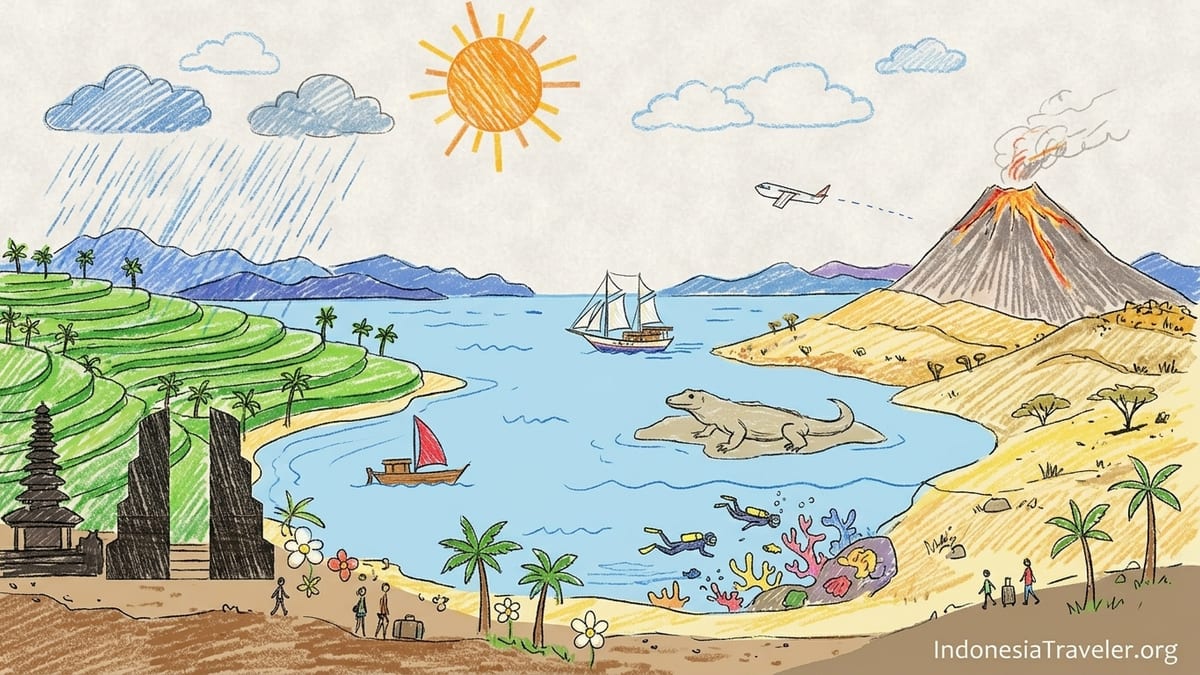
How Indonesia’s Geography Shapes Its Many “Seasons”
Indonesia sits astride the equator between the Indian and Pacific Oceans, spread across thousands of islands from Sumatra in the west to Papua in the east. Much of the country lies in the tropics with warm sea temperatures all year, but the way rain and wind arrive is not uniform. Java and Bali feel classic monsoon swings, Lombok and Flores lean more savanna-like with longer dry spells, and places such as Sulawesi and Maluku follow local rainfall patterns that do not match Bali’s calendar at all.
Broadly, the northwest monsoon brings moist air and heavier rain from about November to March, especially to western Indonesia. From roughly June to September, the southeast trade winds draw drier air across Java, Bali, Lombok and eastern islands. At the same time, Indonesia’s many mountain chains and volcanoes bend clouds and create local rain shadows. For a traveler this can mean that a “wet” month in Bali might be pleasantly dry on the leeward side of Lombok, while the same month is stormy over parts of Sumatra or flat-calm in sheltered pockets of Raja Ampat.
Most of Java and Bali do still experience a recognizable drier season from around April to October and a wetter phase from November to March. However, climate assessments from Indonesian and international agencies now point to shifting rainfall and increasing year-to-year variability, with some areas recording declining average rainfall and more intense downpours instead of predictable showers. That makes it risky to promise that any given month will behave exactly as it did a decade ago.
The surrounding seas matter just as much as the winds. Indonesia’s key marine corridors, such as the Lombok and Ombai Straits or the Dampier Strait in Raja Ampat, funnel currents that affect wave height and visibility. A visitor heading to Bali for surf, Komodo for a liveaboard cruise, or Raja Ampat for a once-in-a-lifetime dive trip needs to think about sea state and current as much as simple rain totals.
Bali and Java: Still the Benchmark, But Less Predictable
For many visitors, Bali and Java provide the baseline picture of Indonesian seasons. In most years, April to October brings lower rainfall, more blue-sky days and lower humidity. This is the stretch when Ubud’s rice terraces are easy to explore on foot, the beaches of Seminyak and Nusa Dua see more consistent sunshine, and city sightseeing in Yogyakarta or Jakarta feels less steamy. June through August often align with peak foreign demand, so room rates in popular Balinese areas like Canggu and Uluwatu rise accordingly, and major cultural sites such as Borobudur and Prambanan see heavier crowds.
From roughly November to March, moist northwest winds turn Bali and much of Java wetter. In practical terms, that can mean afternoon downpours in Ubud, choppy conditions on fast boats to the Nusa Islands, and reduced underwater visibility at nearshore dive sites. Some days will still be bright and clear, and in recent years travelers in January have reported strings of sunny mornings broken by short intense showers. It is safer to think of this phase as hotter, more humid and more variable rather than a solid block of rain.
Because Bali is so linked into international tourism, weather intersects strongly with operations. Luxury resorts in Nusa Dua often run aggressive shoulder-season promotions in April, May, September and October, when conditions are usually pleasant but demand has not yet peaked or has begun to ease. Budget travelers find better deals then, while still enjoying relatively stable weather. Conversely, the year-end weeks around Christmas and New Year combine wetter conditions with some of Bali’s highest hotel and villa prices.
Nyepi, Bali’s Day of Silence, has direct operational impact regardless of the weather. In 2027 the main day of Nyepi falls on March 8. On that date Bali’s airport is scheduled to close to regular flights, ports pause, most roads fall silent, and hotels confine guests to their properties. For many visitors it is an unforgettable cultural experience; for those who have not planned, it can mean an unplanned halt to travel. When Nyepi falls close to other holidays it can compound congestion before and after as domestic tourists and overseas visitors all try to arrive and depart around the closure.
Lombok, Flores and Komodo: Stronger Dry Seasons and Sea-Focused Planning
East of Bali, the islands of Lombok, Sumbawa and Flores show a stronger dry-season pattern than Bali itself, edging toward a tropical savanna climate in parts of East Nusa Tenggara. In practice, Lombok and much of Flores tend to have a long dry stretch from around May to October, with very limited rain and brown hillsides by the middle of the season. Wet conditions concentrate more in the late November to March window. For visitors that often translates into clearer trekking trails around Mount Rinjani in the drier months and more predictable ferry crossings between Lombok, the Gili Islands and eastern ports.
The Komodo region, centered around Labuan Bajo in western Flores, adds another layer as a major marine destination. Local dive centers and liveaboard operators often highlight April to June and September to November as especially attractive periods. During many of those weeks seas can be relatively calmer, visibility can be good, and there is still a chance of seeing signature wildlife such as manta rays at cleaning stations. However, currents remain strong year round in channels like Batu Bolong or Castle Rock, and surface conditions can change quickly. No serious operator will guarantee glassy seas or specific wildlife on set dates, and travelers should approach any such promises cautiously.
April and May often feel like a sweet spot for many travelers to Komodo. The landscape is still green from the wet season, the main international summer rush has not started, and day boats and budget liveaboards can be booked without the heaviest markups. September and October can bring another comfortable window, with warm water and generally manageable winds, though some northern sites may feel more exposed. By contrast, January and February can be both wetter on land and less predictable at sea, which is why some smaller boats scale back operations then.
In 2026, restrictions around Mount Rinjani in Lombok highlighted how natural hazards sit outside standard calendars. Authorities limited or closed access to some trails and summit routes around periods of increased volcanic activity and wildfire risk, with closures sometimes arriving on relatively short notice. These decisions were based on safety assessments rather than the arrival of the dry or wet season. For anyone planning a trek, it is important to check recent advisories from park authorities or reputable trekking outfits instead of assuming that “July is always fine.”
Raja Ampat: When the Winds Swing in Favor of Divers
Raja Ampat, off the coast of West Papua, plays by different seasonal rules from Bali and Komodo. Divers who ask a few operators a simple question about timing will hear a similar answer: conditions for diving and liveaboard trips are most favorable for many visitors between about October and April. During this phase, northwest monsoon winds tend to keep the Dampier Strait and much of northern Raja Ampat relatively calmer, which allows liveaboard vessels and day boats to move more easily between islands and reef systems.
Several dive-focused organizations describe October to April as the prime or recommended season for Raja Ampat liveaboards. Water temperatures often sit in the high twenties Celsius, and visibility at popular sites near Cape Kri, Blue Magic or Arborek can be excellent on many days. Many international liveaboards schedule their Raja Ampat itineraries heavily between roughly November and March, then reposition to Komodo, Banda Sea or other parts of Indonesia during the June to August period when seas can become rougher, especially in exposed passages.
Raja Ampat is not closed in the southeast monsoon months, but conditions can be less forgiving for first-time visitors. July and August are often windier, and some crossings that feel straightforward in February may be uncomfortable or simply not advisable. Homestays on sheltered islands and land-based resorts with boats that can hug the coast still run year round, and experienced divers who are willing to accept choppier rides may enjoy quieter sites in those months. For most travelers, especially those investing in a long-haul journey and expensive liveaboard cabin, looking at the October to April window offers the best combination of calmer seas and access to a full range of sites.
Shoulder months such as late September and late April can behave in a very rewarding way. Some operators quietly recommend them as weeks when the region is less busy but still enjoys many of the benefits of the main calm season. The tradeoff is that transitional months sometimes bring more variable rain and wind, which is why a flexible attitude and robust travel insurance remain useful even in otherwise favorable windows.
Sumatra, Sulawesi and Maluku: Patterns That Do Not Copy Bali
Once you look beyond Bali, Java and Nusa Tenggara, climate patterns diverge further. Sumatra, stretching from Aceh in the far northwest to Lampung in the south, faces the Indian Ocean and is influenced by both equatorial and monsoon rainfall regimes. Western coasts such as those near Padang can receive very heavy rain at different times of year, while inland highlands around Bukittinggi and Lake Toba bring their own microclimates. It is possible to encounter clear skies in North Sumatra in what Bali would call the wet season, and heavy afternoon storms in what Bali would call the dry season.
Sulawesi, shaped like a many-armed starfish, lies in a zone of complex local rainfall systems. The diving hubs of North Sulawesi, such as Bunaken and the Lembeh Strait, see different rainfall timing from central or southern Sulawesi. Likewise, Toraja highlands experience frequent showers and cool nights even when coastal Makassar is hot and comparatively dry. For travelers this means that generic advice like “July is the dry season in Indonesia” helps little when deciding whether to trek in Lore Lindu, dive with reef sharks in Wakatobi, or visit Tana Toraja funerary ceremonies.
The Maluku Islands, sitting between Sulawesi and Papua, further underline the lack of a single national wet season. In parts of central Maluku, including islands such as Seram and Ambon, local wind patterns reverse the story known from Bali. Some areas experience their main rains in the middle of the year, with relatively drier months around northern winter when Java and Bali are at their wettest. This inversion can surprise visitors who assume that Indonesia’s east behaves exactly like its tourist-heavy west.
For all these regions, up-to-date local information from guesthouses, dive shops or trekking operators is essential. A coffee farm homestay near Lake Toba will often know which months in the last couple of years brought the heaviest storms, and a dive center in Manado can explain when their boats most often cancel trips due to local squalls. These on-the-ground patterns matter at least as much as any national average, especially as climate variability increases.
Festivals, Peak Demand and Holiday Congestion
Seasonality in Indonesia is not only a matter of rainfall and waves. Public holidays and religious observances can dramatically affect prices, crowding and transport availability. Two of the most impactful on travel logistics are Bali’s Nyepi and the nationwide Idul Fitri holidays that follow the end of Ramadan. Both are based on calendars that shift relative to the Gregorian year, so travelers planning far ahead should check confirmed dates for their specific year.
Looking at a concrete example helps. In 2027, Nyepi in Bali is scheduled for March 8. Around this date, Bali’s international airport plans to suspend regular operations for 24 hours, with airlines adjusting schedules so that no routine commercial flights take off or land on the day itself. Many ports and roads also quieten, and non-essential movement around the island is heavily restricted. Hotels continue to operate internally, but guests are asked to remain on the property. Arriving on March 8 expecting normal transit between islands or a busy beach club atmosphere would lead to a shock.
The same March 2027 calendar brings Idul Fitri, the celebration marking the end of the Ramadan fasting month. Indonesian government announcements list national holidays for Idul Fitri on March 10 and 11, 2027, and it is common for several additional days of collective leave to cluster around these dates. The result across much of Indonesia is a wave of domestic travel, with millions of people returning to their home regions. Train tickets on Java, short-haul flights between Jakarta and provincial cities, and vehicle ferries across straits such as Merak–Bakauheni often sell out or spike in price well before the holidays.
When Nyepi and Idul Fitri fall close together, as they do in March 2027, the impact on travel can compound. For example, a family trying to connect from Europe into Bali on March 7 and then out again shortly after Idul Fitri may find limited seat options and need to budget more for flights. Domestic tourists from Java may also combine Bali leisure trips with family visits around Idul Fitri, increasing hotel occupancy. Anyone planning inter-island movements or time-sensitive treks in March 2027 should allow more slack than usual in their itinerary.
January to December: A Month-by-Month Planning Lens
January sits firmly within the wetter phase for Bali and Java. Expect heavy showers, steamy afternoons and occasional flooded sections on smaller roads. Fast boats linking Bali with the Gilis, Lombok and Nusa Penida can see disruptions when seas become rough, and nearshore visibility for divers is often at its lowest. In Komodo, some liveaboards pause operations or keep itineraries conservative, while Raja Ampat enjoys its calm-season stride, with many liveaboards fully booked. Domestic demand is high in the first week of January due to New Year holidays, then eases, which opens room deals for those happy to risk more rain.
February behaves similarly for much of Bali and Java, though some travelers report slightly less crowding after the school holiday peak. Beach days are still possible, but the chance of afternoon thunderstorms remains significant. Komodo continues as a shoulder or low point for some operators, while Raja Ampat cruises sail at high occupancy. Sumatra’s west coast can record intense rainstorms, which may affect road journeys, so allowing buffer time around overland transfers is sensible.
March is a month when contrasts sharpen. In Bali and Java, the rains can begin to ease toward the end of the month, though humidity remains high. Surf conditions on Bali’s west coast often start to improve as swell directions shift. In 2027, Nyepi on March 8 will bring a one-day pause in regular movement on Bali, and Idul Fitri holidays on March 10 and 11 will drive a wave of internal travel nationwide. Raja Ampat is still squarely in its recommended season, while Komodo enters a transitional phase as operators ramp up for the coming months.
April often feels like a turning point in Bali, Java and Lombok. Rains reduce, skies brighten, and evenings become more comfortable. Rice paddies around Ubud stay lush and green, making this a photogenic time that sits outside the June to August peak. In Komodo, April stands out as a favored month for many dive and cruise operators because seas are often calmer and visibility improves, though strong currents still require respect. Raja Ampat remains favorable into April, with some operators viewing late April as the tail end of their main season before shifting boats west.
May typically continues the drier, more stable pattern in Bali and Java, while Lombok, Flores and Sumbawa settle further into their long dry season. Komodo sees busy liveaboard schedules, and conditions can be excellent for both divers and surface wildlife viewing around islands like Padar and Rinca. Raja Ampat begins to see fewer liveaboards, although land-based resorts keep welcoming guests. For budget travelers, May can be attractive because it often falls between the high-priced holiday peaks of Easter and the European summer.
June, July and August form the classic high season for Bali and much of Indonesia’s southern belt. Daytime sun, cooler evenings in higher elevations, and more reliable ferry and flight schedules help explain the crowds. Room rates in popular Balinese areas climb, and restaurants around Canggu, Ubud and Uluwatu hum with international visitors. Lombok and Flores are close to their driest, which brings dustier landscapes but good trekking conditions and very low malaria risk in many tourist zones. Komodo’s seas can show stronger south-easterly winds in exposed areas, sometimes creating choppy surface conditions even as underwater visibility remains good. Raja Ampat is now in its windier phase; some liveaboards have left, and those still operating may adjust itineraries based on sea state.
September often delivers a welcome easing of crowds while holding onto many of the dry-season benefits in Bali, Java and Lombok. Travel planners looking for lower prices without sacrificing reliability often circle this month. In Komodo, September and October are frequently cited by local operators as attractive periods offering warm water and rewarding dives, without the full-on high-season crowds of June to August. Raja Ampat experiences a transitional month, with some early-season trips starting later in September or in October as winds begin to moderate.
October bridges seasons in different ways across Indonesia. Bali and Java can stay comparatively dry, though isolated heavy showers become more common later in the month. In Komodo, October still works well for many travelers, but some operators begin planning their repositioning cruises. Raja Ampat, on the other hand, enters its widely recommended calm-season window. Many liveaboards arrive, water temperatures sit in the high twenties Celsius, and dive resorts gear up for the months ahead. For divers trying to combine Komodo and Raja Ampat in one long trip, late September into October can be an interesting moment of overlap.
November nudges Bali and Java back toward their wetter mode, with more frequent storms building, especially in late afternoon and evening. Shoulder-season hotel promotions appear, though some outdoor activities carry a higher chance of disruption. Komodo shifts toward the end of its main operating season for several boats, while Raja Ampat adjusts into what many repeat visitors consider sweet-spot months: sufficiently calm seas, slightly fewer boats than peak holiday weeks, and rich marine life. In regions like central Maluku, this can be a relatively dry period compared with their mid-year wet peaks.
December combines rising rainfall in southern Indonesia with one of the busiest global travel periods. Bali and Lombok welcome large numbers of visitors from Australia, Europe and across Asia despite the clouds, so popular areas see high prices and heavy traffic. Komodo’s activity drops, though some operators still run limited festive-season cruises if conditions allow. Raja Ampat, by contrast, experiences part of its core dive and liveaboard period. Many long-haul divers happily accept the risk of some showers for the chance of calm crossings and busy reefs, provided they book early for Christmas and New Year sailings.
Matching Months to Traveler Types: No Single “Best” Time
Because Indonesia’s regions do not march in lockstep, there is no one perfect month that suits Bali beachgoers, Komodo divers, Raja Ampat liveaboard guests, volcano hikers and budget-focused families all at once. Instead, it helps to think in terms of which months tend to align best with particular priorities, while remembering that year-to-year variability is growing and natural hazards can override any rule of thumb.
For primarily beach-focused travelers who want Bali, Lombok or the Gili Islands, the May to September stretch usually offers the best balance of sunshine, manageable humidity and reliable boat connections. Within that window, May, June and September often mean slightly lower prices and thinner crowds than July and August. If pairing Bali with Komodo, April to June and September to early November are often attractive because both regions can offer workable conditions, although crossing days should always allow extra time for possible delays.
Volcano hikers targeting peaks like Mount Batur in Bali, Mount Rinjani in Lombok or active cones in East Java tend to favor the core dry months from around May to October. Trails are less slippery, summit views are more likely to be clear at sunrise, and guiding companies operate at full capacity. Yet, as the 2026 Rinjani restrictions showed, volcanic activity and wildfire risk can lead to sudden trail closures. Checking recent updates a few weeks before arrival and having a backup plan, such as shifting to Ijen crater or focusing on cultural stays, will reduce disappointment.
Divers must split their attention regionally. Komodo often works best from around April to November, with many divers especially enthusiastic about May, June, September and October. Raja Ampat’s more favorable calm season runs approximately from October to April, with peak liveaboard availability typically from November into March. Serious underwater photographers sometimes plan a multi-week trip that spends one half in Raja Ampat in February and the other in Komodo in October of the same year, accepting that there is no single month when both offer textbook conditions at once.
Families tied to school holidays may have less flexibility, but can still benefit from these patterns. July and August remain logical for Bali and Lombok, so long as parents budget for higher prices and heavier traffic. Southern Hemisphere school holidays in December and January can still work for Bali if families are comfortable with more showers and perhaps one or two days of indoor activities. Budget-conscious travelers who can avoid fixed holiday windows will often find excellent value in shoulder periods like late April, May and September across much of Indonesia, while still accessing good weather in at least one of the major regions.
FAQ
Q1: Is there really no single dry season for all of Indonesia?
Indonesia’s climate varies by region. Java and Bali have a clearer April to October dry phase, but islands such as Sumatra, Sulawesi and parts of Maluku follow different rainfall patterns that do not align neatly with Bali’s calendar.
Q2: When is the best time to visit Bali for mostly sunny weather?
For drier conditions and more reliable sunshine, many travelers target May to September in Bali, with May, June and September often combining good weather with slightly lighter crowds and better value than July and August.
Q3: Which months are usually best for diving in Komodo?
Komodo’s main season generally runs from around April to November. Many dive operators consider April to June and September to November particularly appealing, although currents are strong year round and calm seas are never guaranteed.
Q4: Why do most liveaboards recommend October to April for Raja Ampat?
Between roughly October and April, northwest monsoon winds tend to make large parts of Raja Ampat, including the Dampier Strait, calmer on the surface. This allows boats to access a wider spread of sites with fewer weather interruptions, which is why many liveaboards focus their schedules in that window.
Q5: How will Nyepi in 2027 affect my trip to Bali?
In 2027, Nyepi falls on March 8. On that day Bali’s airport plans to close for regular flights, ports largely stop operating and people are asked to remain indoors. You should avoid scheduling flights on that date and expect quieter conditions immediately before and after.
Q6: What impact does Idul Fitri in March 2027 have on travel?
Idul Fitri national holidays in 2027 fall on March 10 and 11, with extra collective leave days likely around them. This period brings heavy domestic travel, higher demand for transport and accommodation, and busier roads and ferries across the country.
Q7: Are volcano treks like Mount Rinjani always possible in the dry season?
No. Although May to October usually bring better hiking conditions, authorities can close trails at any time due to volcanic activity, wildfire risk or safety concerns, as seen with access restrictions around Rinjani in 2026.
Q8: If I want both Komodo and Raja Ampat in one trip, which months make sense?
There is no single ideal month for both. Many travelers visit Komodo between about April and November, then plan Raja Ampat separately in its October to April calm season, sometimes in different parts of the same year.
Q9: Is it worth visiting Indonesia during the November to March wet months?
Yes, provided you accept more humidity and rain. Prices can drop outside peak holiday periods, some regions such as Raja Ampat are at their best, and many days still offer good conditions between showers.
Q10: How should I factor climate variability into my planning?
Use seasonal patterns as a guide, but allow extra flexibility. Build buffer days before critical connections, buy travel insurance that covers weather disruptions, and check recent local reports from operators in each region before finalizing plans.