


Planning my 2026 trip to Indonesia, I quickly realised that half the panic in online forums comes from people mixing up three completely different things: Indonesia’s national Visa on Arrival, the new All Indonesia arrival declaration, and Bali’s separate provincial tourist levy. After cross-checking official guidance and walking friends through the process for Bali, Java and Raja Ampat, I have pulled everything into one practical, experience-led checklist you can follow before you fly.
Start with your passport: who actually gets Visa on Arrival?
Before worrying about forms and apps, I always start with the most boring detail: the passport in my hand. Indonesia’s B1 Visa on Arrival and its electronic twin, the e-VOA, are only available to nationals on the official eligibility list published by the Directorate General of Immigration. At the time of writing, this list includes the United Kingdom, Italy, Germany, the United States, Canada and Australia, which covers a huge proportion of holidaymakers heading for Bali or Java. If you hold one of these passports and you are coming for tourism, family visits, transit, government meetings or limited business, you are usually fine with B1 Visa on Arrival rather than a pre-arranged visa.
Where things get tricky is with mixed-nationality couples or friends. On a recent Bali planning call, a British traveller assumed her Egyptian partner would just “queue with her for VOA.” In reality, the British citizen was eligible for B1 Visa on Arrival while the partner needed to apply in advance for a different visa category through the e-visa system. If your passport is anything other than widely-travelled Western or East Asian nationalities, you should check your status directly with Indonesian immigration or the nearest Indonesian embassy before you book non-refundable flights.
Whatever your nationality, your passport must be valid for at least six months from your date of arrival and have at least one blank page. This six-month rule is enforced both by airlines at check-in and by immigration at the border. I have seen travellers with five-and-a-half months remaining turned back at departure airports in Europe, not by Indonesian officials but by airline staff who risk fines if they board someone who might be denied entry. If your passport is close to its expiry date, renew first and avoid an expensive last-minute rescue plan.
It also matters that you have a conventional national passport. Indonesia’s e-VOA system in particular does not accept refugee travel documents, temporary travel documents or emergency passports. If you travel on anything other than a standard machine-readable passport, you need specific confirmation from Indonesian authorities on what is and is not possible.
B1 Visa on Arrival and e-VOA: costs, stay length and single entry
The B1 Visa on Arrival is Indonesia’s workhorse entry permission for short trips. Whether you buy it electronically before you travel or at a visa counter on arrival in places like Jakarta, Bali, Surabaya or Medan, the core facts are the same. At present the fee is 500,000 Indonesian rupiah per person, which is roughly the cost of a mid-range dinner for two in Bali or a budget flight between islands. You pay this to the national immigration authorities, not to your airline and not to the province of Bali.
B1 Visa on Arrival grants an initial stay of up to 30 days from the date you enter Indonesia. That means if you land in Denpasar on 10 March, immigration will usually stamp you in up to 8 April. This visa can normally be extended once, for another 30 days, giving a maximum of 60 consecutive days in the country. The extension is handled at an immigration office inside Indonesia, not online, and incurs an additional fee. Travellers I have spoken to in Bali and Yogyakarta typically allow at least a week of slack before the first 30 days expire, because you may need multiple visits for biometrics or queue numbers, especially in high season.
It is important to understand that B1 Visa on Arrival is designed as a single-entry visit. If you spend 25 days in Bali and then pop over to Singapore or Kuala Lumpur for a weekend before coming back, your first visa ends when you leave Indonesia. You start a fresh entry when you return, which usually means paying the 500,000 rupiah again and receiving a new 30-day allowance. A classic mistake is building a 60-day itinerary around a visa-on-arrival extension, then casually inserting a side trip to Penang for cheap flights; that exit cancels your extension plan entirely.
For some travellers, especially digital nomads and long-stay visitors, that 60-day cap is not enough. Indonesia offers other visa classes, such as certain C-category visit visas or longer-stay options like the “Second Home” scheme, but those must be arranged in advance and come with stricter financial and documentary requirements. If you know you will need more than 60 days or multiple entries, plan that visa strategy before you ever click “book” on your accommodation.
Using the official e-VOA system: what I actually had to upload
Applying for the electronic version of Visa on Arrival, the e-VOA, saved me a chunk of time in the arrivals hall but only because I took the document requirements seriously. The official immigration portal asks you to create an account, select the B1 visit category and upload three types of information. First is your passport biodata page, which must be clear, in colour and free of glare or cropped edges. Second is a recent passport-style photograph; friends who reused an old photo from five years ago were asked to re-upload because of obvious age or hairstyle differences.
Third, you must show evidence of your return or onward travel out of Indonesia. In practice this usually means a paid airline booking confirmation or e-ticket to your next country. For example, on my last trip I uploaded a PDF of my Denpasar to Sydney flight several weeks after arrival. If you booked through a major carrier like Singapore Airlines, Qantas, Lufthansa or Emirates, the official itinerary you can download from your airline account is normally accepted. Screenshots of unconfirmed reservations or “on hold” tickets are not a good idea.
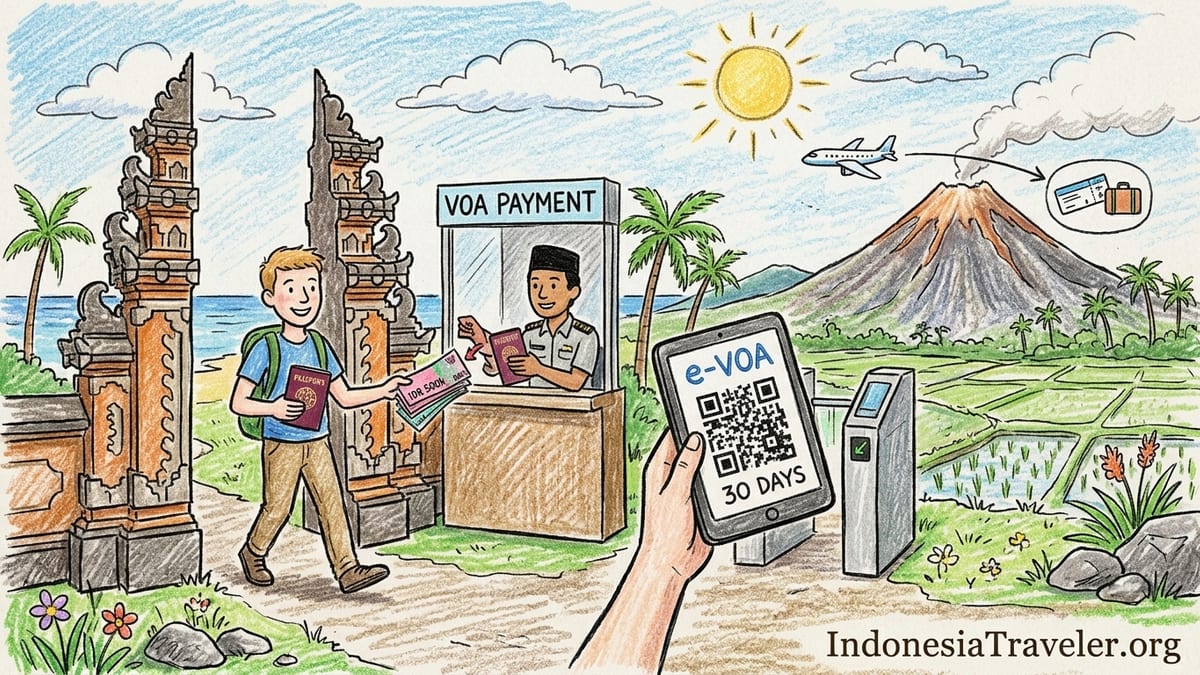
Because the system enforces the six-month passport validity rule, it can refuse applications automatically if your document is too close to expiry. That is one reason I prefer to apply at least two weeks before travel: if something goes wrong, I still have time to contact support or adjust plans. When the application is approved and the payment goes through, you receive an electronic visa document with a QR code. You still join the standard foreign-passport queue at immigration, but officers can scan this code instead of sending you to the visa payment counter.
When I talk travellers through the process, I remind them that there is currently no requirement for British, Italian, German, American, Canadian or Australian tourists on the B1 visa to carry proof of hotel bookings for every night. However, immigration officers are within their rights to ask where you will be staying on your first nights, and I have seen them request to see at least an initial hotel reservation in Bali or Jakarta. Having a printable confirmation from a recognizable brand, whether a modest guesthouse or a chain like Hilton, Accor or Marriott, helps if any questions arise.
The All Indonesia arrival card: not a visa, and not just Bali
Beginning in 2025, Indonesia started to roll out a unified digital arrival declaration called All Indonesia. Unlike the visa, which controls whether you are allowed to enter, All Indonesia is about the information you provide to immigration, customs, health and quarantine authorities. In older trip reports you will see people mention separate QR codes for health forms, standalone customs declarations and paper arrival cards. All Indonesia replaces those with a single online process that you complete close to your departure.
By late 2025, the system had become mandatory at major international airports such as Jakarta Soekarno-Hatta and Bali Ngurah Rai, and the government signalled its intention to require it at all air and sea entry points. The way I treat it is simple: three days before my flight to Indonesia, I sit down with my passport and flight details and complete one All Indonesia arrival card per traveller. You enter typical data such as your identity and contact details, your flight number, where you intend to stay on first arrival, items you are bringing that need to be declared to customs, and a handful of health questions.
The key point is that All Indonesia is not another paid visa and not a Bali-only system. There is no fee to submit the arrival card and you should be suspicious of any third-party site trying to charge you for it. When the form is submitted successfully, you receive a confirmation that can be shown to airline staff at check-in and scanned by Indonesian officials when you land. Some airlines have already made completion of All Indonesia part of their online check-in checklist, similar to how they now remind passengers to obtain United States ESTA or Canadian ETA approvals before departure.
In practical terms, I recommend filling All Indonesia on a laptop or tablet rather than a small phone screen and keeping a screenshot or PDF of the final QR or confirmation page stored offline. On my last trip, the airport Wi-Fi at a Southeast Asian transit hub was patchy, and I watched two passengers frantically trying to reload the site at the gate. Because I had my confirmation already saved, check-in and boarding were uneventful even when the live site loaded slowly.
Understanding Bali’s IDR 150,000 tourist levy via Love Bali
If you fly into Bali’s Denpasar airport, you deal with one more layer that has confused many people since early 2024: the provincial Bali tourist levy. This is a regional tax set by the Bali provincial government, not by Indonesia as a whole. As of 2026 it is fixed at 150,000 Indonesian rupiah per foreign visitor. That is payable once per trip, not per day or per week, and applies whether you are staying two nights in Seminyak or a month in Ubud.
The official payment channel is a system known as Love Bali. Before arrival, you can enter your details, pay the levy by card or other non-cash methods and receive a QR-style receipt. In theory, officials from the provincial government may scan this on arrival at Bali’s airport or seaport. In practice, enforcement has varied. Travellers arriving in 2026 report that the Love Bali website and app sometimes behave erratically and that there are also non-cash payment counters at Denpasar airport where you can pay on the spot if the online route fails.
What matters for your budget and planning is that this Bali levy is completely separate from any national visa fee. A Canadian couple I met in Canggu had budgeted only for the 500,000 rupiah e-VOA each and felt blindsided on arrival when they were asked for the extra 150,000 rupiah per person at a provincial counter. Pay the B1 visa fee to Indonesian immigration and the Bali levy to the Bali provincial government and treat them as distinct. If you land first in Jakarta or Surabaya and only later fly domestically into Bali, you will usually be asked to show or pay the Bali levy when you first enter the island, not at your original international entry point.
Certain categories of traveller are exempt from the Bali levy, for example holders of diplomatic and official visas or longer-term residence permits. Most ordinary holidaymakers are not exempt, including children. I plan for the levy the same way I plan for the cost of my airport transfer: a modest but real extra cost that I want covered long before I am jet-lagged in a crowded arrival hall.
Driving, safety and cultural rules that catch visitors out
Many entry requirements do not sit in immigration law but in practical rules that shape how safe and respectful your trip will be. Renting a scooter in Bali or Lombok is a classic example. Indonesian police expect foreign drivers to hold both a valid licence from their home country and an International Driving Permit that covers motorcycles if you are riding anything larger than a tiny moped. Australian and British travellers are particularly prone to assuming that their home licence alone is enough, only to discover during a roadside check after a minor accident that they are considered unlicensed and that their travel insurance will not cover medical costs.
Helmet rules are another area where casual attitudes collide with local law. Indonesian traffic regulations require motorcycle riders and passengers to wear helmets that meet local standards. In tourist areas you will see people riding bareheaded for “short” distances between beach bars, but police and hospital staff deal with the consequences every day. For my own trips, I either bring a lightweight travel helmet or inspect rental helmets carefully for intact straps and no major cracks, then refuse bikes without decent protection.
Temple etiquette is essential across Bali and parts of Java. When visiting Hindu temples like Besakih or Tanah Lot, or Javanese sites such as Borobudur and Prambanan, shoulders and knees should be covered and sarongs with sashes are often required. At smaller village temples, you may be asked not to enter during ceremonies if you are menstruating or if there has been a death in your immediate family, in keeping with local purity rules. I have had moving experiences being quietly invited to sit at the edge of a ceremony in Ubud, but only after agreeing not to walk between worshippers and the shrines and to switch my phone completely to silent, not just vibrate.
Indonesia’s drug laws are among the strictest in the region. Possession of even tiny amounts of illegal drugs can lead to long prison sentences, and trafficking offences may carry the death penalty. In recent years there has been an increase in undercover operations in nightlife areas of Bali and Jakarta, and Western travellers are sometimes shocked at how quickly a holiday can turn into a legal nightmare. I avoid any contact with recreational drugs in Indonesia and decline drinks from strangers in clubs or beach bars, both to stay on the right side of the law and to avoid drink-spiking incidents, which do occasionally happen in busy tourist districts.
Monitoring weather, volcanoes and protected nature
Indonesia stretches across a vast chain of islands, and its natural beauty comes with very real natural hazards. Before and during my trips, I pay close attention to updates from the national meteorology and geophysics agency, which tracks heavy rain, tropical storms and extreme heat. In the rainy season this helps me understand when to expect flight delays around places like Kupang or Jayapura and when hiking trails on volcanoes such as Rinjani or Merapi may be muddy or closed.
The country also sits on major tectonic fault lines with many active volcanoes. The national geological and volcanology agency issues status levels and alert bulletins for volcanoes, which are used by local authorities to decide when to close climbing routes or evacuate villages. If I am planning to hike a volcano or visit crater lakes, I always check the latest status through reliable channels and I do not argue with park rangers when they say a route is closed. In previous years, visitors ignoring closure signs around active volcanoes have not only put themselves at risk but have complicated emergency responses when sudden eruptions or toxic gas emissions occurred.
In national parks and marine protected areas, there are strict rules on wildlife interaction. In Komodo National Park, for example, visitors must stay with licensed guides and maintain distance from the dragons, while in Raja Ampat marine reserves divers and snorkellers are prohibited from touching coral or feeding fish. Drone use is restricted in many temples and conservation areas, and operating a drone without permission can lead to confiscation of equipment or fines. I build any special filming or photography ambitions into my planning by checking with park authorities or reputable dive operators before departure, rather than turning up with a DJI drone and hoping for the best.
Travel insurance is non-negotiable for me in Indonesia. Policies that cover medical evacuation, diving, trekking and motorbike accidents cost far less than a single private hospital night in Bali or a charter evacuation flight from a smaller island. When comparing policies from providers in my home country, I check the fine print for exclusions related to riding motorcycles without the proper licence or helmet, or engaging in adventure activities above certain altitudes. It is depressing to hear stories of travellers whose policies covered lost luggage but not the surgery they needed after a scooter crash.
Special note on Papua and Raja Ampat travel advisories
Indonesia’s easternmost provinces, often referred to collectively as Papua, include some of the most spectacular and least visited landscapes in the country. Raja Ampat, accessed via Sorong, has become a dream destination for divers worldwide. At the same time, some inland and highland areas of Papua experience sporadic security incidents related to long-running political tensions. Foreign ministries in countries like Australia, the United Kingdom, Germany, Canada and the United States have at times issued more cautious or region-specific advisories for parts of Papua compared with Bali or Java.
From a traveller’s perspective, it is important to separate the popular marine tourism corridors from more sensitive inland regions. International visitors regularly fly into Sorong to board liveaboard dive boats or stay at eco-resorts on islands like Kri or Waigeo, and as of 2026 most government travel advisories recognise this as distinct from remote interior areas. When I planned a dive trip there, I focused on reputable operators with strong safety records and asked them directly about any recent disruptions, both security-related and weather-related.
If your plans involve trekking, missionary work, journalism or independent travel far inland in Papua, your preparation needs to be much more thorough. You should expect to monitor advisories from both your own government and Indonesian authorities, register with your embassy where that is recommended, and accept that permits or access to certain areas can change at short notice. This level of risk management is quite different from the average Bali beach holiday or Java culture loop and deserves its own research beyond a general pre-departure checklist.
Regardless of where you are headed, including Papua, keep copies of your passport, visa approval emails, onward tickets and accommodation confirmations backed up in cloud storage and offline on your phone. This is helpful in standard travel mishaps such as theft or loss of documents and becomes critical if conditions change rapidly during a stay in a more remote province.
Putting it all together: my chronological 2026 entry checklist
To keep myself organised, I now run through the same timeline for every Indonesia trip. Six months before departure, I check my passport expiry date. If I will have less than six months of validity left on my planned arrival date, I renew the passport before doing anything else. This is also when I look up the latest Indonesian visa policy and confirm that my nationality is still eligible for B1 Visa on Arrival or e-VOA under current rules.
Roughly two to three months out, once flights are booked, I reserve at least my first few nights of accommodation in my arrival city, whether that is a guesthouse in Kuta, a hotel in central Jakarta or a homestay in Yogyakarta. This gives me an address to enter in my e-VOA application and on the All Indonesia arrival card. I arrange travel insurance that explicitly covers Indonesia, including any activities I am planning such as diving in Komodo or scooter riding in Lombok.
Between four weeks and ten days before my flight, I apply for the e-VOA through the official immigration system if using it, uploading my passport page, recent photograph and proof of onward travel. Once approved and paid, I download and print the e-VOA document and also store it in a dedicated “Indonesia Trip” folder on my phone. Around the same time I double-check whether I will enter Bali during the trip; if so, I plan to pay the 150,000 rupiah Bali tourist levy through Love Bali a few days before arrival, and I set aside that amount as a backup in case I need to pay at an airport counter instead.
Within the final three days before flying, I complete the All Indonesia arrival card online for each traveller, entering flight numbers, accommodation details and customs and health answers. I screenshot the confirmation page or QR code and keep it alongside my e-VOA and airline boarding passes. I also check the latest weather and volcano updates for my first destinations using reliable national sources, paying particular attention during the rainy season or if I plan to visit any active volcano areas.
On arrival day, I follow signs either to the visa-on-arrival payment counters, if I chose to pay on the spot, or straight to immigration with my printed e-VOA if I applied in advance. I have my passport open to the biodata page, my onward ticket saved on my phone and my All Indonesia confirmation ready to show. After immigration and baggage claim, I look out for any Bali levy checkpoints if Denpasar is my first point of entry to the island. Only after clearing all of this do I concern myself with airport taxis or ride-hailing apps.
For longer trips approaching 60 days, I mark a reminder in my calendar roughly 20 days after arrival to visit a local immigration office and start the visa extension process, taking my passport, address details and enough time for queueing. I treat that extension as a privilege, not an entitlement, and I avoid making non-refundable bookings that depend on an extension being granted until my passport is back in my hands with the updated stay permission.
The Takeaway
By breaking Indonesia’s 2026 entry rules into three separate pieces, the process becomes far less intimidating. Your B1 Visa on Arrival or e-VOA is your legal ticket to enter and stay; the All Indonesia arrival card is your combined digital declaration for immigration, customs, health and quarantine; and Bali’s 150,000 rupiah tourist levy is a provincial tax that lives on top of any national visa fees. Add in sensible preparation for driving, cultural etiquette, strict drug laws and natural hazards, and you move from anxious guesswork to a calm, methodical checklist.
From the perspective of a traveller and writer watching these systems evolve, the biggest differences between an easy arrival and a stressful one are simple: checking your passport early, using only official channels for visas and declarations, completing All Indonesia within the three-day window, and treating Bali’s levy as a normal extra cost rather than an unpleasant surprise. If you build these steps into your planning timeline and stay flexible about rules that may tighten or loosen as 2026 progresses, Indonesia’s islands, temples and reefs remain as rewarding and accessible as ever.
FAQ
Q1. Do British, Italian, German, American, Canadian and Australian tourists all qualify for Indonesia’s Visa on Arrival?
Yes. As of 2026, holders of these passports are on Indonesia’s official B1 Visa on Arrival list for short visits, provided they meet standard conditions like six months of passport validity and proof of onward travel.
Q2. How much does the B1 Visa on Arrival cost and how long can I stay?
The B1 Visa on Arrival, including its electronic e-VOA version, costs 500,000 Indonesian rupiah per person. It grants an initial stay of up to 30 days, which can usually be extended once inside Indonesia for another 30 days, for a maximum of 60 days on a single entry.
Q3. Is Indonesia’s Visa on Arrival multiple entry if I leave for Singapore or Malaysia?
No. The B1 Visa on Arrival is generally single entry. If you leave Indonesia, for example for a side trip to Singapore or Malaysia, that entry ends. You would need to obtain and pay for a new visa on arrival when you return.
Q4. What documents do I need to apply for the e-VOA before I travel?
You need a passport valid for at least six months from your arrival date with at least one blank page, a recent passport-style photograph and proof of onward or return travel such as a confirmed flight booking. Having at least your first accommodation booking is also sensible in case immigration asks where you will stay.
Q5. What exactly is the All Indonesia arrival card and do I have to pay for it?
All Indonesia is a unified digital arrival declaration that combines immigration, customs, health and quarantine information. You complete it online in the three days before arrival. There is no government fee for submitting All Indonesia and it does not replace your visa.
Q6. How is Bali’s 150,000 rupiah tourist levy different from the visa fee?
The Bali tourist levy is a provincial tax collected by the Bali regional government, usually via the Love Bali system or non-cash counters at entry points. It is currently 150,000 rupiah per foreign visitor per trip and is separate from the national 500,000 rupiah B1 visa fee, which is paid to Indonesian immigration.
Q7. Can I drive a scooter in Bali with just my home licence?
Indonesian authorities expect foreign riders to hold both a valid home licence and an International Driving Permit that covers motorcycles. If you ride without appropriate licensing or a helmet, you may face police fines and your travel insurance may refuse to cover injuries from an accident.
Q8. How should I prepare for Indonesia’s natural hazards like volcanoes and storms?
Before and during travel, follow updates from Indonesia’s meteorology and geophysics agency for weather and from the national volcanology service for volcano alerts. Respect any park or trail closures, particularly around active volcanoes, and ensure your travel insurance covers evacuation and medical costs in case conditions change quickly.
Q9. Is it safe to visit Raja Ampat and other parts of Papua?
Marine tourism hubs like Raja Ampat, accessed via Sorong, operate separately from some higher-risk inland areas in Papua. Many divers visit these islands without incident, but you should still check your own government’s travel advisories and consult reputable local operators about current conditions before you go.
Q10. When should I start my visa extension process if I want the full 60 days?
If you plan to extend your 30-day B1 Visa on Arrival to the full 60 days, start the extension process at a local immigration office about one to two weeks before your initial 30 days expire. This allows time for appointments, biometrics and processing delays without overstaying.