


I have lost more hours of Indonesian travel to bad base choices than to delayed flights. Booking a “quiet Ubud villa” that turned out to be 45 minutes from town, realizing my “Bromo hotel” was actually in Probolinggo nowhere near the crater, or learning the hard way that a room in Labuan Bajo does not guarantee a spot on a Komodo boat. Over several trips, I have come to see accommodation in Indonesia less as a bed for the night and more as a strategic decision that can save or burn precious days of your first visit.
Why Your Base Matters So Much In Indonesia
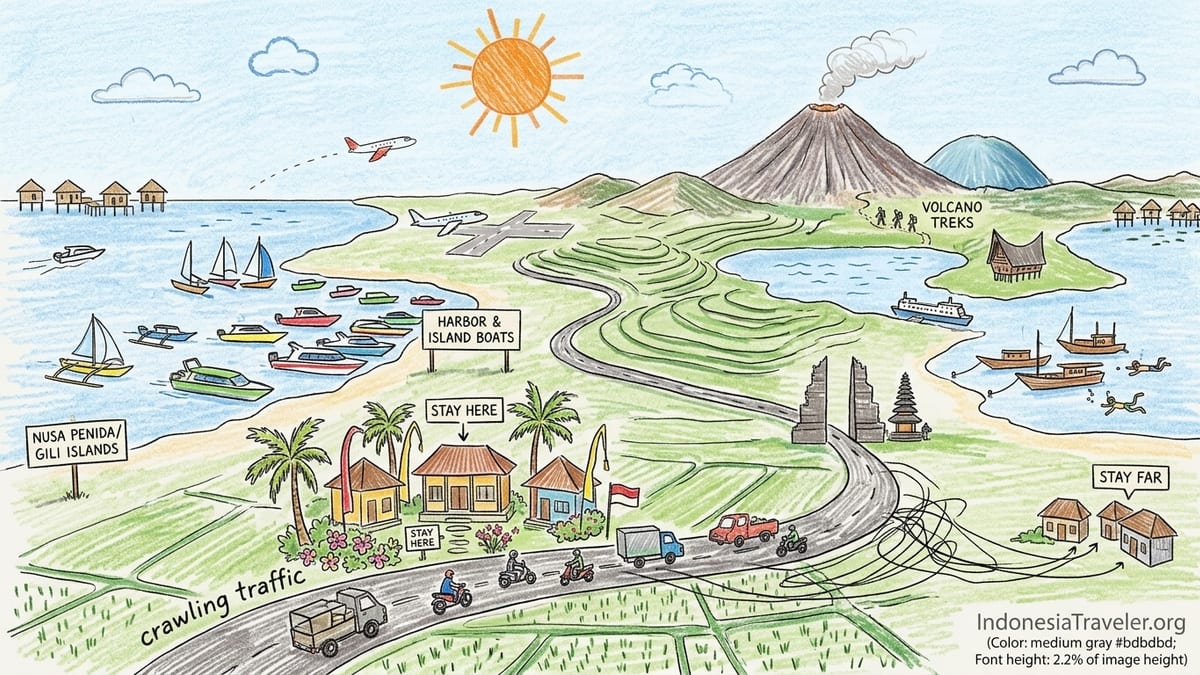
Indonesia rewards travelers who plan in clusters. Distances on the map look modest, but a 30 kilometer transfer can mean crawling behind trucks on a single-lane road, waiting for a boat tide window, or negotiating traffic near a popular temple. Choosing the wrong base can easily turn a three-night stay into one full day of airport or port logistics, another day of driving to and from day trips, and only a single relaxed day on the ground.
The money side is not obvious at first. A cheaper room in the wrong place often explodes the budget once you add repeated transfers. A family of four staying far outside Ubud, for instance, might pay the equivalent of 20 to 30 US dollars per return trip to get into town and back in a private car, several times over a three or four day stay. Over a week, that can quietly cost more than simply booking a central guesthouse that appeared more expensive on paper.
There is also the cost in energy. Sunrise excursions to Borobudur or Mount Bromo mean predawn wake-ups. Add an extra 90-minute transfer to reach the starting point and you begin the day already exhausted. On remote islands, the cost of the wrong base can be even more severe: missing the only public boat of the day, being a long boat ride from basic medical help, or losing power and internet just as you need to change a flight or contact home.
This guide focuses on where to stay rather than what to see, using concrete neighborhood and island examples from Bali, Java, Lombok, Flores, Sumatra and Raja Ampat. The aim is to help you avoid those invisible costs on a first visit, so your money and time are spent on temples, reefs and volcanoes rather than taxis and missed boats.
Bali: Picking the Right Base Instead of Just “Going to Bali”
Most first-time visitors fly into Bali and book a place with a familiar name on the listing: Ubud, Seminyak, Canggu. The catch is that those names are often used very loosely. Ubud, for instance, is both a compact town and a much larger district in Gianyar Regency. Many hotels marketed as “Ubud villa with rice field views” are in outlying villages which can be 30 to 60 minutes from the actual town center by car. That can be idyllic if you want silence, but very inconvenient if you planned to walk to cafes, yoga studios and restaurants.
In the center of Ubud, staying within a ten to fifteen minute walk of landmarks like the Monkey Forest, Ubud Palace or the central market gives you easy access to food, spa treatments and tour pickups. Day trips to Tegallalang rice terraces, Tirta Empul temple or the waterfalls north of town are straightforward from here, with many operators including hotel pickup in their price. Expect to pay more per night than in the outskirts, but factor in that you will likely walk to dinner instead of hiring a private car each time.
On the coast, Sanur is one of the most practical bases on the island for first-timers who want both a calm beach and boat access. The dedicated harbour at Matahari Terbit Beach now handles dozens of daily fast boats to Nusa Penida and Nusa Lembongan, and some onward services to the Gili Islands and Lombok, all from a modern pier that keeps your feet dry when boarding. Multiple operators run crossings from early morning to late afternoon, with recent rack rates around a few hundred thousand rupiah per person one way depending on the company and season. Staying in northern Sanur places you within a short taxi ride or even walking distance of the harbour, while being at the southern end of the beachfront strip can add 20 to 30 minutes in morning traffic.
Seminyak and neighboring Petitenget work best if your priority is restaurants, beach clubs and nightlife. Accommodation here clusters around streets like Jalan Kayu Aya and Jalan Petitenget, with high-end venues and boutique shops mixed in. For a first visit, being close enough to walk to the beach and main dining strip is worth paying for. If you push too far inland to save on room rates, you may spend your evenings in taxis navigating gridlock, especially around sunset when people head to the beach.
Canggu, further up the coast, has become famous for cafes, co-working spaces and beginner-friendly surf beaches. It has also become one of the most congested areas on Bali, with narrow roads and lots of motorbikes. Staying near the actual beaches at Batu Bolong or Berawa makes it easier to walk or ride a scooter to cafes and surf schools, but high demand has pushed prices up. Keeping costs low by staying deeper inland across the rice fields often means depending on scooters or taxis just to reach the beach for a swim or meal, adding money and stress for anyone uncomfortable riding.
Down on the Bukit Peninsula, Uluwatu and Pecatu draw visitors for towering cliffs and famous surf breaks. The scenery is extraordinary, but walkability is poor. Distances between beaches like Padang Padang, Bingin and Suluban are deceptive, involving steep lanes and hot roadside walks with minimal shade. If you are not renting a scooter, base yourself close to one or two specific beaches or near the Uluwatu Temple access road and accept that you will mostly explore those nearby spots. Otherwise, you risk spending half your stay arranging rides over short distances that are awkward on foot.
Jimbaran occupies a convenient niche between local feel and practical access. Its long, gently sloping beach is popular with families, and the line of seafood restaurants on the sand makes for easy dinners. Crucially for short trips, Jimbaran is a ten to twenty minute drive from the airport in light traffic, so a late arrival or early departure is far smoother than from Ubud or Canggu. For a three-night Bali stopover focused on rest, choosing a midrange hotel or villa near the main bay can save both taxi money and time compared to a fancier but remote property inland.
For more nature-focused stays, inland villages like Sidemen and Munduk, and the coastal stretch around Amed, reward travelers who deliberately choose slowness. Sidemen offers rice terraces and valley views east of Ubud, but you are generally at least ninety minutes from Ubud town and several hours from the south coast. Munduk in the north central highlands is surrounded by waterfalls and coffee plantations, yet is far from beaches. Amed, on the northeast coast, is a string of fishing villages known for snorkeling and diving on house reefs and the Liberty shipwreck area nearby. These areas are wonderful if you intend to stay three or more nights and focus on hiking, diving or reading with a view. They are frustrating if you treat them as bolt-ons to a packed day-trip schedule that also expects frequent excursions across the island.
Java: Yogyakarta Bases, Borobudur Nights and Bromo Gateways
On Java, Yogyakarta is the cultural heart for many first-time visitors, and your choice of neighborhood alters the feel of the city. Prawirotaman, a district south of the Kraton, grew up as a backpacker and boutique hotel strip. It has a concentration of guesthouses, small hotels, cafes and bars within walking distance of one another. For independent travelers who value being able to stroll between dinner options and book tours at street-side agencies, it offers a relaxed and social base.
Malioboro, closer to the main train station, is more intense. The area around Jalan Malioboro is lined with larger hotels, malls and late-opening shops. It suits visitors who want easy access to the railway, air-conditioned shopping and straightforward taxi access to the airport. The downside is noise and crowds at night, especially on weekends and holiday periods, which can surprise anyone expecting a quaint historic center.
The Kraton area, near the Sultan’s palace, feels more traditional, with small alleys, local markets and homestays tucked into residential streets. Staying here puts you close to major cultural sights and batik workshops, but you will walk more to reach restaurants and may rely on ride-hailing apps to reach the busier nightlife of Prawirotaman or Malioboro. For families or early sleepers, the relative quiet can be an asset.
For Borobudur, many first-timers base in Yogyakarta and join a sunrise tour that leaves around 3 or 4 in the morning, spending two to three hours each way on the road. This works, but there is a clear cost in sleep and comfort. Staying a night in Borobudur village or nearby Magelang, perhaps in a simple guesthouse or a resort overlooking the temple area, cuts the transfer to a short drive. It also makes it easier to visit at quieter times, like late afternoon, when day-trippers have left. The trade-off is that there is less to do in the village itself once the temple visit is over, so it is more of a one or two night stop than a long base.
Mount Bromo and Ijen show even more starkly why base choice matters. Malang, Probolinggo, Cemoro Lawang and Banyuwangi are often grouped together in travel discussions as “Bromo/Ijen gateways,” but they are not interchangeable. Malang is a sizable city with more accommodation, cafes and flight connections. Tours from here to Bromo involve several hours of driving each way, which can mean eight or more hours in a vehicle for a single sunrise. Probolinggo on the lowlands is closer, but most travelers still face a long pre-dawn transfer to reach viewpoints.
Cemoro Lawang, by contrast, sits on the rim of the Bromo caldera itself. Staying in a simple homestay or lodge here means you can walk or take a short jeep ride to sunrise viewpoints, return to your room for breakfast and a nap, and then explore later in the day if you wish. The downside is limited services and cooler temperatures, with accommodation ranging from very basic guesthouses to a few midrange hotels. Still, the time saved is immense compared with shuttling back and forth from lowland towns.
For Ijen, Banyuwangi on the eastern tip of Java is the practical base, with a range of homestays and hotels and a relatively short drive to the trailhead. Some travelers attempt to combine Bromo and Ijen in a single rushed overland journey between cities, spending much of their time in transit vans. On a first visit, it often makes more sense to accept that these are separate regions and give each one a proper night close to the crater rather than treating cities hours away as simple “gateway” labels.
Lombok: South Coast Surf, West Coast Sunsets and Gili Choices
Lombok offers a different rhythm to Bali, and where you stay shapes that mood. Kuta Mandalika, on the south coast, is the core tourist town in the government-backed Mandalika resort area. It sits near several surf beaches and coves, and has a growing strip of cafes, simple warungs and surf shops. The international-standard circuit that hosts motorcycle racing events and the broader development plans mean more hotels are opening, but away from race weekends it can still feel low-key compared with Bali’s busiest spots.
From Kuta Mandalika, you are well placed for day trips to beaches like Tanjung Aan or Gerupuk, but you are a good distance from the traditional ferry ports and from the Gili Islands. If your itinerary includes flights into Lombok’s airport, plus days of surfing and beach-hopping, basing here works well. If you are mainly chasing the classic Gili island scene, starting your trip on the northwest coast makes more sense.
Senggigi, once the main tourist focus on Lombok, still has a strip of hotels along a curving bay with sunset views across to Bali’s mountains. It is calmer now than in its heyday, but that can be a plus for families or couples wanting facilities without crowds. From here, day trips to waterfalls in the north or boat transfers to the Gilis are feasible, though you will usually transfer by car to a separate pier, such as Bangsal or Teluk Nare, for actual island boats.
For those targeting Mount Rinjani treks, mountain villages like Sembalun and Senaru serve as trail gateways on different sides of the volcano. Sembalun sits in a high valley with sweeping meadow views, while Senaru is set among hills and waterfalls. Staying in either village cuts hours from your trekking day compared with attempting to start from the coast. Facilities are simple and some guesthouses have only intermittent hot water or limited menu options, but you gain cooler nights and the practical benefit of a very early start from near the trail.
The three Gili Islands off Lombok’s northwest coast are often described in shorthand: Gili Trawangan for nightlife, Gili Air for balance and Gili Meno for quiet. That summary holds, but the details matter. Gili Trawangan has the most bars, beach parties and late-night venues, especially on the eastern side of the island. It also has a range of dive centers, cafes and hotels from simple bungalows to chic resorts. If you stay too far inland to save money, you may find yourself walking long distances on sandy paths at night to reach the main strip. For anyone prioritizing nightlife or social diving, basing near the harbor side of Gili T keeps logistics simple.
Gili Air sits closer to Lombok and combines quiet residential lanes with a growing restaurant and cafe scene. The eastern coast has good sunrise views and swimming spots, while the sunset side tends to be sleepier. Accommodation options range from family-run bungalows set back among coconut trees to boutique hotels facing the beach. It suits travelers who want some life in the evenings without full-on party energy.
Gili Meno is the smallest and quietest of the three, with limited services. Power cuts can be more noticeable, medical access relies on small local clinics and boat transfers to the other islands or Lombok are less frequent outside peak times. For honeymooners happy to read, snorkel, and eat at the one or two warungs within walking distance, it can be perfect. For anyone who wants a choice of restaurants, reliable Wi‑Fi and easy options if they feel unwell, it may feel too remote. Here more than in the other Gilis, the cost of the wrong base is being stuck with long, hot walks on sandy tracks to reach basic services.
Flores and Komodo: Labuan Bajo and the Myth of Guaranteed Boats
On Flores, almost everyone headed to Komodo National Park passes through Labuan Bajo. The town has grown from a simple port into a busy tourism hub lined with hotels, liveaboard offices and dive shops. It is tempting to assume that any hotel with a sea view will automatically come with a convenient Komodo boat departure. In reality, tour and dive operators keep their own schedules, and not every hotel or guesthouse lies on every operator’s pickup route.
Most shared speedboat day trips and multi-day liveaboards offer hotel pickups within a defined zone that covers the town center and the main beachfront hotel strip to the south and north of the harbor. If you stay in a hillside villa far above town or in a remote eco-resort on a nearby island, you may need to pay extra for private transfers or even arrange a separate boat to meet your tour. Some island resorts run their own transfer boats from Labuan Bajo once or twice a day, often in mid-afternoon, and state clearly that arrivals after a certain hour cannot reach the resort the same day.
Another common misunderstanding is about availability. In busy months, popular Komodo speedboat day trips and liveaboard cruises can sell out, or operators may not run every route every day. Travelers who assume they can land in Labuan Bajo, book a premium small-group cruise that afternoon, and depart the next morning sometimes discover there are only budget large-group boats left or no seats at all for their preferred day. Staying in Labuan Bajo itself gives you flexibility to shop around agencies in person, but it does not guarantee a particular trip unless you have a confirmed booking.
Boat-based days also depend on weather and sea conditions. On some days, authorities restrict access to certain sites for safety reasons. If your entire Komodo plan is tied to a single prebooked day and you have scheduled your flights tightly, a canceled departure can mean missing the park altogether. For first-time visitors, leaving at least one buffer day in Labuan Bajo and basing somewhere within easy reach of the harbor reduces the risk of missing long-awaited dragon encounters or snorkel sites.
Labuan Bajo itself has more limited urban infrastructure than major Indonesian cities. The airport sits close to town, and ride-hailing motorbike services operate, but there is no mass transit. Power and mobile data are generally stable on land but can be weak or absent once you leave on a boat. If being able to contact airlines, banks or family is critical, do your admin from your hotel on land before boarding, and avoid counting on being able to upload documents from the deck of a wooden boat in strong sun.
Remote Nature Bases: Sumatra Jungles and Raja Ampat Reefs
North Sumatra and Raja Ampat in West Papua provide some of Indonesia’s richest wildlife and marine experiences, but their remoteness makes base choice even more critical. In North Sumatra, Bukit Lawang is the classic base for seeing orangutans in and around Gunung Leuser National Park. The village sits along a fast-flowing river, with guesthouses perched on the banks and simple bridges connecting both sides. Staying within the main cluster means you can walk to trek departures, restaurants and the park office in a few minutes. Moving further up or downstream for a quieter lodge can add steep, uneven paths that are awkward with luggage, especially in heavy rain.
When you trek here, your base is also your fallback in case of minor injuries or illness. The nearest substantial town with hospitals lies some distance away by winding road. Choosing accommodation that can arrange reliable guides, help with transport to Medan, and communicate in a language you share becomes as important as the view from your balcony. Power cuts are not unusual and hot water is not universal, so if these matter to you, check in advance rather than assuming.
On Lake Toba, most visitors stay on the island of Samosir, usually in or near the village of Tuktuk. Here, ferries shuttle passengers and cars between the mainland and various points on the island. Basing in Tuktuk rather than in one of the smaller, scattered lakeside communities gives you a choice of guesthouses, restaurants and small shops within walking distance. If you book a cottage outside Tuktuk without realizing the distances involved, your daily routine may involve long walks or repeated scooter rides simply to get a meal.
Raja Ampat is even more logistically demanding, and getting your base wrong can be expensive. Almost all visitors transit through the mainland town of Sorong, which has the main airport and ferry port. From there, public fast boats and private transfers reach Waisai on Waigeo Island, the administrative capital of Raja Ampat. Waisai has simple hotels and homestays and serves as a staging point, but the most sought-after coral reefs and lagoons lie further afield among islands like Kri, Gam and the remote Misool area.
Homestays on Kri and Gam islands typically offer full-board stays with simple rooms, shared bathrooms and fixed electricity hours, often from evening into the night when generators run. Mobile data coverage can be slow or absent. If you choose one of these homestays, expect to be largely offline and dependent on your hosts’ small boats for reaching snorkeling sites. The upside is that some of the world’s best reefs can be just a few minutes away by boat. The downside is that if you need to see a doctor, change a flight or withdraw cash, you must first arrange a boat back to Waisai or even Sorong, which may only be feasible once a day or on certain tides.
Misool, further south, raises the stakes further. Guests typically stay in dedicated dive resorts or remote homestays accessible by scheduled speedboats that run a few times a week from Sorong. Once there, you are committed to their schedule; missing a transfer can mean several extra nights in Sorong or rearranging a significant portion of your trip at short notice. Medical facilities are minimal on the islands themselves and serious cases require evacuation to larger towns. For first-time visitors, this can be an unforgettable experience, but only if you are comfortable with the risk profile and have insured yourself appropriately.
Electricity and connectivity are not small details in these places. Limited generator hours mean you may be charging camera batteries and phones only in the evening. Water supplies may be rain-dependent, and some homestays ask guests to conserve water during dry spells. Any work that absolutely depends on stable internet or calls is better done from a hotel in Sorong or a major city before heading out. Taking the time to check these factors when choosing your base saves frustration later, especially if your expectations are set by more developed islands like Bali.
Making Sense of It All: A Practical Base-Choice Matrix
With so many islands and neighborhoods, it helps to reduce things to a mental matrix rather than a long wish list. For sightseeing and culture, central Ubud, Yogyakarta’s Kraton area and Prawirotaman, and Bukit Lawang stand out. Staying in the walkable heart of Ubud or near Yogyakarta’s palace area means you can visit temples, markets and workshops without long transfers. Bukit Lawang, though less urban, places you steps from jungle trails rather than starting from a distant city.
For beaches, Jimbaran and Sanur in Bali, Kuta Mandalika and Senggigi on Lombok, the Gili Islands, Amed and sections of south Bali’s Bukit Peninsula are all strong contenders. The real question is how much infrastructure you want with your sand. Jimbaran and Sanur combine swimmable beaches with easy airport or harbor access and a wide range of food options. Kuta Mandalika and Senggigi offer quieter scenes but still have enough cafes and transport services. Gili Meno and remote sections of Raja Ampat lean heavily toward solitude and nature, with correspondingly limited shops, clinics and electricity.
For food and nightlife, Seminyak, Canggu, Gili Trawangan and Yogyakarta’s Malioboro and Prawirotaman areas cluster venues. Seminyak and Canggu offer the broadest range of international dining and cocktail bars in Indonesia outside Jakarta, while Gili Trawangan has informal beach bars and late-night parties. If you value quiet nights, basing one or two streets back from the noisiest strips helps balance access with sleep.
Family suitability often points to Sanur, Jimbaran, Senggigi, Gili Air, central Ubud and Tuktuk on Samosir. These places mix calmer waters or manageable streets with a reasonable choice of restaurants and healthcare access. Very remote homestays in Raja Ampat or far-flung parts of Flores are less forgiving for young children or older travelers, especially if someone falls ill.
Transport and logistics lean heavily toward bases near hubs: Jimbaran and Sanur for Bali’s airport and boat terminals, Senggigi and Kuta Mandalika for Lombok’s airport and ports, central Labuan Bajo for Komodo boats, and Sorong for Raja Ampat ferries. Price often follows the pattern of proximity and popularity. Remote eco-resorts can be expensive despite simple facilities because of supply costs, while homestays in inland Java or Sumatra can be very affordable but require more patience with travel times and basic amenities.
Thinking in terms of this matrix can help you stitch together a first-time itinerary that flows. For example, you might start with three nights in Sanur for boat trips to Nusa Penida, move to central Ubud for inland culture and rice fields, fly to Yogyakarta for temples and city life, then finish with four nights split between Gili Air and Kuta Mandalika on Lombok before flying out. At every step, you would be staying somewhere that matches your main goal for that segment, rather than fighting your base to make your plans work.
The Takeaway
Indonesia is too big and varied to “do it all” on a first trip, but you can avoid many common frustrations by treating your base choices as seriously as your bucket-list sights. Ask where exactly a hotel sits in relation to the town center or harbor, how long transfers really take at the times you plan to travel, whether your preferred tours pick up there, and what happens if you need a doctor or a cash machine. Look at maps with an eye for hills, ports and airports instead of just pretty photos.
The cost of the wrong base is rarely a single dramatic disaster. It is the taxi fares that silently add up when you stay too far from everything, the sleep lost on predawn transfers that could have been shorter, the missed boat because your remote bungalow lies outside the pickup zone, or the stressful scramble to get mobile data in a place where the power goes off after midnight. On the other hand, the right base can make Indonesia feel surprisingly smooth to navigate, even on a first visit.
If you remember one principle, let it be this: match your base to your main purpose for that stop, and do not be afraid to split your stay between two or three well-chosen hubs instead of trying to compromise with a single “central” location. Indonesia rewards those who slow down and choose carefully. Your future self, waking up a short walk from the boat pier or the trailhead instead of in the back of a predawn van, will be grateful.
FAQ
Q1. Is it worth paying more to stay in central Ubud instead of a cheaper villa outside town?
Yes if you plan to eat out, visit yoga studios or join day tours. Central Ubud lets you walk to most places and reduces taxi costs. Out-of-town villas suit travelers who prioritize quiet and do not mind arranging cars for almost every outing.
Q2. Where should first-time visitors to Bali stay for easy island-hopping to Nusa Penida and the Gilis?
Sanur is a strong choice because fast boats to Nusa Penida and Nusa Lembongan leave from its modern harbour, and some services continue to the Gili Islands and Lombok. Staying near the harbour area minimizes early-morning transfers.
Q3. For Borobudur, is it better to stay in Yogyakarta or near the temple?
Staying in Yogyakarta offers more restaurants and nightlife, but means a very early and long drive for sunrise visits. Spending one night in Borobudur or Magelang cuts travel time significantly and makes early or late visits more comfortable.
Q4. What is the most time-efficient base for Mount Bromo?
Cemoro Lawang, on the crater rim, is the most time-efficient base because sunrise viewpoints are nearby. Malang and Probolinggo work if you prefer city comforts but require much longer predawn drives for the same views.
Q5. Which Gili Island is best for a mix of calm atmosphere and some dining options?
Gili Air usually offers the best balance. It has quiet lanes and a relaxed feel but still provides a decent choice of restaurants, cafes and dive shops, without the louder party scene of Gili Trawangan.
Q6. Does staying in Labuan Bajo guarantee I can join a Komodo boat trip on any day?
No. Staying in Labuan Bajo makes access easier, but boat trips have limited capacity and may not run every route every day. It is wise to secure at least your main Komodo excursion in advance, especially in busy seasons.
Q7. How reliable are electricity and internet in remote areas like Raja Ampat and Bukit Lawang?
Electricity in remote homestays often runs on generators for limited hours, and mobile data can be slow or absent. You should not rely on strong internet in these areas and should complete essential online tasks before leaving major towns.
Q8. Is Canggu a good base for families on a first Bali trip?
Canggu has many cafes and beginner-friendly surf, but traffic and narrow roads can be stressful with young children. For a first family visit, areas like Sanur or Jimbaran are often more convenient for walking, swimming and getting around.
Q9. How many bases should I plan for a two-week Indonesia itinerary?
For two weeks, three to four bases usually work well, for example Sanur, Ubud, Yogyakarta and one beach area like Gili Air or Kuta Mandalika. This keeps travel days manageable while letting you experience different sides of the country.
Q10. Are very remote island stays like Misool or outer Raja Ampat suitable for first-time visitors?
They can be, but only for travelers comfortable with limited medical access, fixed boat schedules, generator electricity and being mostly offline. Many first-timers prefer to start with more connected bases such as Kri, Gam or Waisai before considering more remote options on a future trip.