

I have lost count of the number of family questions that begin with a screenshot of a twenty‑something backpacker itinerary and the line, “We’ll just do this with our kids.” The plan usually involves three islands in ten days, 2 a.m. volcano hikes, scooters as primary transport, and a fast boat schedule that would exhaust a professional sailor. Travelling Indonesia with children can be extraordinary, but copying adult-oriented routes rarely serves young bodies or developing nervous systems. This guide looks at Indonesia through a family lens, not an Instagram one, and argues for realistic, safety-first planning across Bali, Java and the Gili Islands.
One-Base Bali vs Multi-Island Ambition
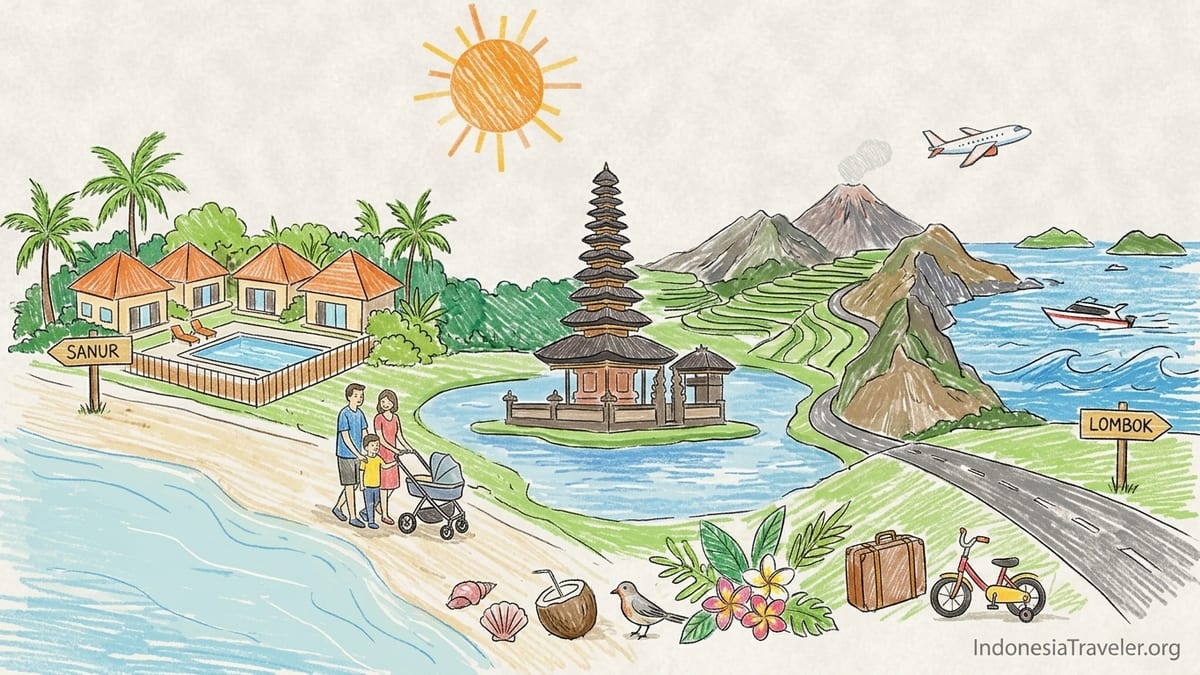
For many families, the core decision is whether to base mostly in one part of Bali or attempt a sweep across multiple islands. A single-base trip, for example seven days in Sanur with one or two day trips, usually means fewer airport transfers, no pre-dawn checkouts, and children who actually sleep. In practical terms, that might look like one airport pickup to a Sanur family villa, five relaxed beach and pool days, one cultural day trip to Ubud, and perhaps an evening at a dance performance. Parents are not packing up Lego and loveys every 48 hours, and toddlers are not shaken awake to catch a 6 a.m. fast boat.
By contrast, many adult itineraries suggest “Bali – Gili Trawangan – Nusa Penida – Lombok in 10 days,” with multiple fast boats and long drives. Fast boats between Bali and the Gilis cross the Lombok Strait, a body of water known for strong swells and, at times, safety incidents involving fires and capsizes. Public data on Indonesian water transport highlights recurring accidents and inconsistent enforcement of lifejacket rules. Families must weigh whether two or three sea crossings, long queueing in hot sun, and the emotional load of rough seas are worth a slightly prettier beach when many Bali and Lombok shores already offer swimmable water.
None of this means “never leave Bali.” It means being strategic. For short trips, a well-chosen Bali base can replicate many of the experiences people chase across islands: calm swimming lagoons in Sanur, rice terraces near Ubud, cultural performances, ethical animal encounters, waterfall visits and even short boat rides in protected waters. Multi-island routes are still possible, but they need to be re-engineered for nap schedules, sun exposure limits and realistic attention spans, not for maximum passport stamps.
This article builds three grounded family models: a seven‑day Bali-only stay, a fourteen‑day Bali–Lombok route with a single carefully chosen transfer, and a fourteen‑day Java–Bali journey aimed at older children. Along the way, it challenges some of the romanticised habits of backpacker travel: toddlers on scooters without helmets, late‑night lava treks, and “everyone does the fast boat, it’s fine” logic.
Who Should Not Travel Like a Backpacker
Adults can decide for themselves to board a 2 a.m. minibus to watch sunrise from a crater rim after hiking in thin volcanic air. Young children cannot. A typical Bromo or Ijen volcano package from Yogyakarta or Bali involves night driving on mountain roads, cold temperatures, darkness, and at times sulphur fumes. Even tour operators that welcome children often recommend a minimum age of eight to ten for the more strenuous hikes, and that is in good weather. For under‑fives, even stable, well-maintained crater viewpoints can be overwhelming and, in poor conditions, unsafe.
Similarly, scooters are widely used by locals and tourists across Indonesia, which leads some visitors to assume that transporting children on scooters is acceptable simply because it is common. Families should resist that normalization. Indonesian roads mix trucks, buses, erratic cars, dogs, and patchy surfaces, often without consistent helmet use or child restraints. Even many locals will tell you privately that they would prefer their own children to ride in a car with a seatbelt, but do not always have that option. Visitors, who have the means to arrange safer transport, should not treat a three‑year‑old clinging to an adult on a scooter as an inevitable cultural experience.
Night buses present another overlooked risk. Some budget itineraries suggest saving money by taking overnight buses between cities or islands, sometimes in combination with ferries. Families considering an overnight bus between Bali and Java or around Java should look closely at driving standards, seatbelts, and the simple reality that children may not sleep in bright, noisy vehicles. Arriving at 5 a.m. in a new city, exhausted and dehydrated, does not set anyone up for a safe day of temple visits.
Fast boats between Bali, Nusa Penida, the Gilis and Lombok are a final flashpoint. Reports of overloaded boats, crowded decks and inconsistent lifejacket provision, especially for small children, are common. International water safety assessments note that Indonesia does not yet have robust, nationally enforced standards for passenger boat safety or lifejacket specifications. Parents who choose a boat transfer should do so once, on a reputable route, having consciously weighed conditions, rather than using boats like buses just because a backpacker blog made the island‑hopping look easy.
Family Itinerary 1: Seven Days, Mostly in Bali
A seven‑day Bali trip with children works best when concentrated in one or two nearby bases. Sanur and Ubud make a sensible pairing, roughly an hour apart by car in regular traffic, with airport access under 40 minutes from Sanur. For babies and toddlers, an entirely Sanur‑based stay is often enough: a calm lagoon protected by an offshore reef, a long beachfront path for prams and scooters, and flat streets that are kinder to little legs and tired grandparents than the traffic of Seminyak or Canggu.
Sanur’s coastline is gently shelving, with typically small waves inside the reef, so children can paddle and swim close to shore during calmer periods. Families still need to watch tides and currents, but in general, Sanur sees fewer of the heavy dumping surf conditions common on Bali’s west coast beaches such as Kuta and Canggu. Parents report being able to let school‑age children splash in waist‑deep water, with soft sand underfoot and fewer rogue waves knocking them over. For very small children, many Sanur beachfront hotels and villas offer shallow pools as an even safer option.
In terms of accommodation, Bali now has a healthy supply of genuinely family‑oriented villas and small resorts. In Seminyak and Sanur, for example, several villa companies advertise pool fences that can be installed before arrival, wooden cots with mosquito nets, high chairs, baby baths, and even car seats for airport transfers. These services are not standard across Bali, though, so parents should never assume. During booking, ask in writing whether the pool can be fenced, whether the fence fully encloses the water with a self‑closing gate, and whether cots and high chairs are included or need to be rented.
For a seven‑day trip with mixed ages, a realistic pattern might be three full pool and beach days, one half‑day in Ubud for a rice terrace walk and a visit to a children’s art workshop, one temple visit such as Tirta Empul or Pura Taman Saraswati, and one “spare” day that can be used for rest or a gentle outing if everyone feels well. That spare day is what is usually missing from backpacker itineraries. With children, someone will get mild diarrhea, sun fatigue or mosquito bites. Having a quiet day available prevents resentment when the plan flexes.
Family Itinerary 2: Fourteen Days Bali–Lombok with One Sea or Air Transfer
Families committed to including the Gili Islands or Lombok should do so once, well, rather than bouncing between several islands. For example, a fourteen‑day route might use seven nights in Sanur or Ubud, then seven nights on Lombok or Gili Air, with a single transfer by plane or carefully chosen boat. Gili Air, the closest of the Gilis to Lombok, combines some sand‑between‑toes charm with a more laidback feel than Gili Trawangan’s party strip, and can be reached by local boat from Bangsal or Teluk Nare harbours on Lombok.
Sea safety is the defining issue here. Families can choose between the larger public ferries that operate between Padang Bai (Bali) and Lembar (Lombok) and the many private fast boats serving Bali–Gili–Lombok routes. Larger ferries take longer, often four to five hours, but their size can feel more stable, and there is usually more space for children to move around. However, national records do list several ferry fires and sinkings in Indonesian waters in recent years, some involving casualties. Smaller fast boats are quicker but ride more roughly and rely heavily on weather and operator judgment about when to sail. In rough conditions, even adults can struggle with seasickness and fear.
If you decide on a sea transfer, treat it as a serious logistics project. Before booking, contact the operator and ask specific questions: Do you carry lifejackets in multiple child sizes, and may we see a photo of them? Are infants under a certain weight accepted, and if not, what is the minimum? What is your weather cut‑off, and who makes that decision on the day? How do you handle cancellations and rebookings if conditions are unsafe? Operators that reply vaguely or sidestep these questions should be avoided. Consider bringing your own Coast Guard‑approved child lifejacket from home, especially for babies and younger children, as very small sizes can be impossible to find on the spot.
For some families, flying is the more controlled option. Short domestic flights link Bali’s main airport with Lombok’s airport in about half an hour of air time, plus check‑in and transfers, and aircraft safety standards are generally higher and more consistently enforced than on small boats. The trade‑off is that you will still need a road transfer at each end, and airport time can be tiring. For motion‑sensitive children, however, one short flight may be vastly preferable to an unpredictable sea journey.
Once on Lombok or Gili Air, slow the pace. Build in whole days of nothing more ambitious than swimming in hotel pools, building sandcastles on beaches with relatively gentle surf, and perhaps renting bicycles or cidomo (horse carts) on Gilis if your values and local conditions align. Check that your chosen island accommodation either has on‑site medical support or a clear plan for getting to a clinic on Lombok in a genuine emergency. Inquire how long it actually takes to reach a hospital in Mataram or another larger town and what that journey involves at night.
Family Itinerary 3: Fourteen Days Java–Bali for Older Children
Java is often presented in adult travel writing as a place for dramatic volcano treks and long train journeys. For families with older children or teenagers who are genuinely interested in history and culture, Java can be deeply rewarding without chasing every crater sunrise. A two‑week Java–Bali route might start with four or five nights in Yogyakarta, then fly to Bali for the remaining days rather than stringing together multiple road and ferry legs.
Yogyakarta is Indonesia’s cultural heartland, with major attractions like Borobudur and Prambanan close enough for day trips. These temple complexes offer wide open spaces, stone reliefs that older kids can interpret like comic strips, and opportunities to learn about Buddhism and Hinduism on site. Kid‑oriented guides in Yogyakarta often weave stories about the Ramayana or Javanese legends into their tours, which helps teenagers see temples as more than just “old stones.” Within the city, places like the Keraton (palace), Taman Sari water castle, and local batik studios can hold attention without exhausting young legs.
Some families also consider volcano experiences from Yogyakarta, such as jeep tours on the slopes of Mount Merapi. These can be more child‑suitable than full crater hikes, as they involve sitting in a vehicle, stopping at viewpoints, and visiting simple museums about past eruptions rather than trekking for hours in the dark. Still, altitude, cold wind, and bumpy tracks may not suit every child. Use age and temperament as your guide, and be wary of any operator willing to take very young children on long night hikes. If you want to include a sunrise experience, consider a more accessible viewpoint that can be reached at a reasonable hour by car, without significant climbing, and bring proper layers.
Transport across Java is another place where family and backpacker styles diverge. Many budget travellers string together economy trains, city buses and shared taxis. With children, a more sustainable pattern can be to use daytime trains in higher‑comfort classes for the main legs, then private drivers for complex local transfers. Daytime trains between cities such as Yogyakarta and Surabaya give children space to read, look out of windows and visit reasonably clean toilets. A late‑night arrival in a new city, after a confusing series of local buses, offers none of those advantages and raises safety questions, especially with tired teenagers carrying gear.
At the end of a Java segment, flying into Bali and finishing the trip with less intense days around Ubud or Sanur can be a psychological breather. Older children often appreciate some unguided time to swim, shop on a main street like Ubud’s central strip, or simply scroll on Wi‑Fi while parents enjoy a coffee. A realistic Java–Bali itinerary does not try to see “all of Java.” It focuses on digestible slices of culture, moderated adventure and age‑appropriate trekking rather than replicating influencer content.
Accommodation for Real Families, Not Fantasy Retreats
The villa marketing language in Indonesia can be seductive: infinity pools, open‑air bathrooms, jungle views. For families, the details that matter most are often buried halfway down the listing. Before booking, scrutinise photos and descriptions for five things: sleeping layout, pool safety, access and mobility, baby and toddler equipment, and proximity to medical care.
Sleeping layout matters because many Balinese villas sprawl. Parents of toddlers usually want at least one bedroom on the same level and within earshot, not a detached pavilion across a garden. If your child is prone to sleepwalking, a ground floor room with simple locks may be safer than an upstairs balcony room. Look closely at staircases in photos; open risers and minimal railings can be nerve‑wracking with preschoolers. Some Sanur villas, for example, explicitly advertise that two of three bedrooms are on the ground floor with direct access to living areas, making them easier for families with strollers or grandparents.
Pool safety is non‑negotiable with non‑swimmers. Several Bali villas and agencies now offer temporary child‑proof pool fences that fully surround private pools, installed before guests arrive. These fences usually come at an extra cost per stay or per day, and you may need to confirm gate locks and fence height. Other properties, including some marketed as family group villas, have deep, unfenced pools with no option to add a barrier. In those cases, constant adult supervision becomes the only line of defence. For some families, especially with multiple under‑fives, an unfenced pool is a reasonable deal‑breaker.
Baby and toddler equipment is worth clarifying in writing. Many family‑oriented villas in areas like Seminyak and Sanur now supply at least one cot or crib, a high chair and sometimes extras such as baby baths or potty seats if requested. However, the quality of mattresses and mosquito nets can vary enormously. If your baby has specific needs, bringing a familiar sleep sack or even a compact travel cot from home may be wise. Also ask villas whether they can arrange car seats for transfers through reputable providers. In Bali, third‑party services can deliver pool fences, prams, cots and car seats to villas, but these must be pre‑booked.
Finally, consider access and healthcare. Multi‑storey cliff villas around south Bali can require dozens of steps to reach reception or the road, which is romantic in photos and exhausting with a baby in arms and a sick four‑year‑old. Central Sanur and some parts of Seminyak, by contrast, are relatively flat and offer easier access to clinics and pharmacies. When you book, pinpoint where the nearest hospital with a pediatrician is, and ask your accommodation which clinic they use in emergencies. Their answer will tell you whether they have ever thought seriously about family health.
Transport Safety, Ferries and the Lifejacket Problem
Transport in Indonesia is where many backpacker norms most sharply clash with child safety. The cheerful “just grab scooters for everyone” advice you see online ignores the vulnerability of small bodies in any collision. Taxis and private cars with seatbelts remain the safer choice within cities for families. In busy areas of Bali, international‑style taxi apps and hotel car services are widely available, although proper child car seats are less common. If you want your child in an appropriate restraint, bring a travel car seat or booster and be prepared to fit it yourself.
For inter‑island travel, ferries, fast boats and small tourist boats present overlapping challenges: overloading, inconsistent maintenance, varied crew training, and an absence of child‑specific safety gear. Global accident data shows that Indonesian passenger vessels have suffered multiple fires, capsizes and groundings in the past decade, some with significant loss of life. One detail that emerges again and again in investigation reports is the lack of lifejackets worn, even when they were technically available. For children, the problem is more acute: suitable lifejackets for under‑20‑kilogram passengers can be rare, and operators may not stock sizes for infants at all.
When evaluating a boat operator, treat their safety posture as seriously as you would an airline’s. Ask them which type of personal flotation devices they carry, how many in total, and whether they include sizes suitable for your children’s approximate weights. Request recent photos of the jackets and the boat itself, not stock images. On boarding, locate lifejackets immediately and fit them on your children before departure, regardless of what other passengers do. If you are handed an adult jacket that clearly does not adjust to your child’s chest and does not have a crotch strap, reconsider whether you are willing to sail.
Weather and cancellation policies also matter. Responsible operators will cancel or delay sailings in storms or heavy swell, even at their own financial loss. Families should build flexibility into itineraries so that they can accept a weather cancellation without missing onward flights. This might mean planning one or two buffer nights near departure ports, or avoiding tight same‑day connections between boat arrivals and international flights. The cheapest ticket is irrelevant if the schedule encourages you to sail in marginal conditions with children.
For many families, all of this will lead to a simple conclusion: limit sea crossings, or choose destinations reachable by road and short flights instead. A slower, safer holiday is not a lesser one. Children rarely remember how many islands they visited, but they do remember feeling scared on a heaving boat or carsick on a mountain road at 3 a.m.
Beaches, Mosquitoes, Hydration and Health
Beach choice in Indonesia is not just about scenery; it is about how often you want to say, “Wait for this set to pass” while clutching a small hand. Sanur’s east‑facing shore, protected by a reef, usually offers calmer, shallower water than the exposed western beaches of Kuta, Legian, Seminyak and Canggu. You still need to watch for currents, jellyfish and occasional debris, but for teaching a cautious eight‑year‑old to float, Sanur is generally less intimidating than a surf beach where powerful shore breaks can knock adults off their feet.
On Lombok and the Gilis, conditions vary by bay. Some beaches offer gentle turquoise shallows over sand; others have quicker drop‑offs or more coral underfoot. Before committing to long swims, walk the shoreline at low tide, look for areas where local children are playing, and test the bottom yourself. Hotel pools and protected lagoon‑style beach clubs can provide safer swim options on days when the ocean feels too rough, and they are often a better match for grandparents whose balance may be challenged by waves.
Mosquito protection is an unavoidable topic in tropical Indonesia, where dengue fever and other mosquito‑borne diseases are present. Families should plan a layered defence: insect repellent suitable for children, long‑sleeved clothing in the evenings, and accommodation with intact window screens or air conditioning. Many villas provide mosquito nets over beds, but these only help if tucked in properly and if children are briefed not to play with them. Stagnant water around villas or in garden pots can attract mosquitoes; do not hesitate to ask staff to empty or treat obvious breeding sites.
Hydration and food hygiene underpin everything else. The heat and humidity in Bali, Java and Lombok can catch out even experienced travellers. Encourage children to drink bottled or filtered water regularly, and carry reusable bottles that you can refill from large dispensers in hotels or cafes. Ice in tourist areas is often made from filtered water, but if in doubt, skip it for smaller children. Street food is part of the joy of Indonesia, yet families may want to choose busy stalls with high turnover and cooked‑to‑order dishes, or rely on restaurants attached to reputable guesthouses. Pack oral rehydration salts and a small medical kit including any regular medications, as brands may differ locally.
Access to pediatric care varies by location. South Bali has multiple international‑standard clinics and hospitals familiar with foreign patients, whereas some smaller islands and rural parts of Java rely on basic clinics. Travel insurance that clearly covers children, with emergency evacuation if needed, is essential rather than optional. Before departure, parents should discuss travel plans with their pediatrician, check recommended vaccinations for Indonesia, and obtain a letter listing any prescription medications their children take.
Cultural Experiences, Wildlife and the Komodo Question
Indonesia’s cultural richness is one of the strongest reasons to bring children. In Bali, family‑friendly options include gamelan music workshops where kids can try simple percussion patterns, short dance performances that start early in the evening, and visits to local markets where they can practice a few words of Bahasa Indonesia. In Ubud and Yogyakarta, batik studios often welcome children for basic fabric painting, letting them bring home a tangible memory instead of only a souvenir T‑shirt.
When it comes to animals, not all experiences marketed to tourists are ethical or safe. Some Bali attractions still promote elephant rides or close interaction with wild animals for photos. Families who care about welfare should look for organisations that emphasise observation at a respectful distance, no riding, and the ability for animals to choose whether to interact. Turtle conservation centres that focus on education and beach clean‑ups, rather than constant handling of hatchlings for selfies, can be more meaningful and less stressful for wildlife.
Komodo National Park is a particularly sensitive topic. Photographs of children standing a few metres from giant lizards circulate widely online, but they can give a misleading impression of what is appropriate. Official park regulations require visitors to be accompanied by rangers on designated trails, and some operators impose minimum age requirements for boat trips and landings, especially to more remote islands. The dragons are wild, heavily muscled predators capable of dangerous bites, and rangers carry long sticks for a reason. Families considering Komodo should think in terms of quiet boat trips with limited landings, strictly following ranger instructions, and accepting that small children may find the experience frightening rather than thrilling.
Even for older children, expectations matter. You are not guaranteed close encounters with dragons lounging perfectly for photos, and ethical guides will keep a safe distance. Boats in the park may also have the same lifejacket and safety concerns already discussed for other Indonesian waters, so all the due diligence about operators and equipment applies here too. For many families, especially with under‑tens, it may be more responsible to postpone Komodo to a later trip when everyone can appreciate both the wonder and the risk.
Budgets and Age-Specific Recommendations
Family budgets in Indonesia span a wide range, but transparency helps with planning. In southern Bali, a genuinely family‑suitable private villa with two or three bedrooms, a fenced pool and basic baby equipment might cost, at the time of writing, anywhere from the mid‑range of local pricing per night in shoulder seasons, rising in peak holidays. Mid‑range hotels in Sanur or Ubud with family rooms and breakfast often come in lower per night than private villas but may lack kitchen facilities. In Java, comfortable hotels in Yogyakarta city are often more affordable than equivalent Bali resorts, which can help balance the cost of domestic flights between islands.
Transport will be a significant line item. Private car and driver hire in Bali, booked through reputable agencies or hotels, usually runs at a day rate that is reasonable compared with many Western countries, especially when split across a family. Domestic flights between Java, Lombok and Bali are generally moderately priced per person, but four or five tickets add up quickly. When comparing with fast boat tickets, factor in not just the headline price but the potential cost of cancellations, extra nights near ports, and the emotional cost of rough crossings.
For babies, the best recommendation is usually to minimise moves. Choose one base with a calm beach or a shaded pool, reliable air conditioning and easy access to a clinic. Avoid fast boats, night travel, and very early starts. Bring familiar formula, baby food pouches and any specialised products, as specific brands may be hard to find. For preschoolers, one or two moves within a fortnight can work, such as Sanur plus Ubud or Sanur plus Lombok, with plenty of downtime. Focus on short cultural visits, hands‑on activities like simple cooking classes or batik painting, and beaches where they can safely paddle.
Older children in primary school can usually handle a bit more movement and structured learning. A Java–Bali combination with Yogyakarta temples, a gentle Merapi jeep tour and several days of pool time in Bali can be very satisfying. Teenagers may be ready for selected adventure elements, such as supervised surf lessons at beaches with trained instructors, longer day trips, and perhaps a carefully chosen volcano viewpoint experience if they are keen and conditions are good. Across all ages, the consistent theme should be respect for their limits, not pressure to tick off online “must‑dos.”
Above all, remember that family travel success in Indonesia is not measured by the number of WhatsApp‑worthy locations covered. It is measured by children who feel safe, curious and rested enough to notice where they are. That almost always requires a slower rhythm than backpacker playbooks suggest, more time in one place, and a willingness to say no to experiences that might put them at unnecessary risk.
FAQ
Q1. Is it safe to take young children on fast boats between Bali and the Gili Islands?
Fast boats can be rough and safety standards vary. Families should research operators carefully, confirm child-sized lifejackets in advance, and consider limiting sea crossings or choosing short flights instead. Many parents of toddlers decide that the risk and discomfort are not worth a brief island stay.
Q2. Which part of Bali is best for a first visit with small children?
Sanur is often the most practical base for younger kids, with relatively calm, reef-protected water, a long beachfront path for prams, and easier access to clinics. Ubud pairs well for a few cultural days, but its traffic and lack of beach make it better as a second base, not the only one.
Q3. Can we use scooters to get around Bali as a family if everyone wears helmets?
Even with helmets, scooters expose children to higher risk in mixed traffic with buses, trucks and uneven roads. Cars with seatbelts and, ideally, child restraints are safer for families. Scooters are common locally but that does not make them an appropriate or necessary transport mode for visitors with young kids.
Q4. Are volcano hikes in Java or Bali suitable for children?
Challenging night hikes like Mount Bromo or Mount Ijen are generally not appropriate for young children due to cold, darkness, fumes and long hours. Older, fit teenagers may join selected viewpoints or gentler experiences, such as daytime jeep tours, if conditions are good and operators take safety seriously.
Q5. How can I check if a villa in Bali is genuinely family-friendly?
Ask specific questions about pool fencing, bedroom layout, stair safety, cots, high chairs, air conditioning and proximity to medical care. Request recent photos of any pool fence and confirm in writing that it will be installed before arrival. Do not rely solely on “family-friendly” labels in listings.
Q6. What should we do about mosquito-borne diseases like dengue?
Use child-appropriate repellent, dress children in long sleeves and trousers at dusk and night, choose accommodation with screens or air conditioning, and eliminate standing water around where you stay. Consult your pediatrician about vaccinations and medicines before travel, and seek medical advice locally if a child develops fever after mosquito exposure.
Q7. Is Komodo National Park a good idea with kids?
Komodo involves wild, potentially dangerous animals and boat-based access with varying safety standards. Rangers set rules on distance and behaviour, and some operators have minimum age limits. Many families choose to postpone Komodo until children are older and can fully understand and follow safety instructions.
Q8. How many accommodation moves are realistic in a two-week Indonesia trip with children?
For most families, two or at most three bases in two weeks are sufficient. More moves mean more packing, transfers and disrupted sleep. A common pattern is Sanur plus Ubud, or Sanur plus Lombok, or Yogyakarta plus a single Bali base, rather than hopping to a new island every few days.
Q9. What health preparations should we make before travelling to Indonesia with kids?
Visit your pediatrician several weeks before departure to review routine vaccines, discuss any region-specific recommendations, and obtain a list of your child’s medications. Pack a small medical kit, including oral rehydration salts, pain and fever medicine, and any prescriptions, and ensure your travel insurance clearly covers children and emergency evacuation.
Q10. Are Bali’s surf beaches completely off-limits for children?
Exposed surf beaches like Kuta or Canggu often have strong shore breaks and currents that are unsafe for small children to play in independently. Families can still enjoy these areas by staying on the sand, using beachfront pools, or arranging supervised surf lessons for older kids with qualified instructors, while doing most casual swimming at calmer spots such as Sanur.