


I did what every breathless Southeast Asia blog and dreamy TikTok montage told me to do: I tried to “do” Indonesia in two weeks. Five islands, volcano sunrises, Komodo dragons, Nusa Penida cliffs, Ubud rice terraces, Canggu cafes, a “quick” hop to Lombok and Sumatra for orangutans. It looked effortless and cheap on screen. On the ground, it was something else entirely: days lost to transfers, hours parked in traffic, boat incidents on the news, closed volcanoes, and a slow realization that Indonesia is not the easy, automatically safe bargain destination its tropical marketing implies. It can be extraordinary, but it punishes rushed, under‑researched itineraries far more harshly than glossy travel content ever admits.
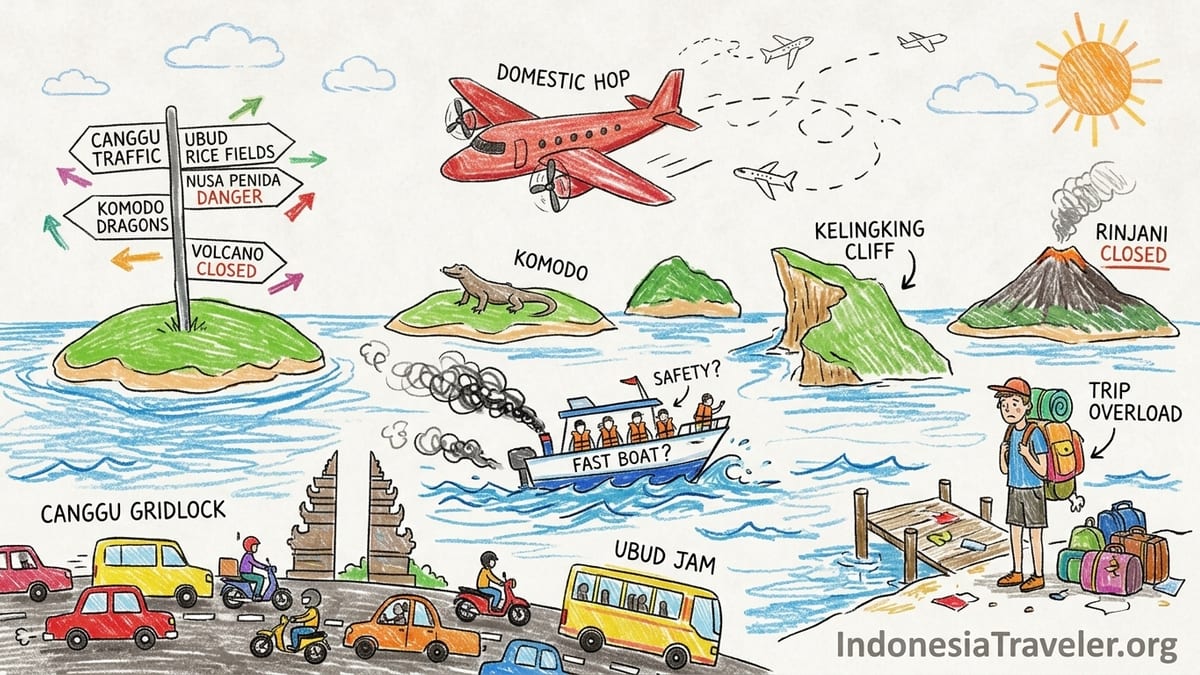
Itinerary Overload: When Five Islands in Two Weeks Becomes a Transport Marathon
The classic Indonesia fantasy itinerary often reads like a trophy list: Bali, Nusa Penida, Lombok, Komodo, Java, maybe even Sumatra. On paper, it seems possible in fourteen days because maps make the distances look small and low‑cost airlines make hops feel trivial. In practice, the combination of airport transfers, domestic check‑ins, traffic, boat schedules and hotel changes can swallow entire days at a time. I learned this the hard way, watching my holiday dissolve into queues and transfer vans.
Take a seemingly simple sequence that many travelers attempt: Canggu to Ubud, Ubud to Nusa Penida, back to Bali’s airport, then on to Lombok and Flores for Komodo. Even if each flight is only around an hour in the air, you pay a heavy tax in logistics. From Canggu to Bali’s Ngurah Rai Airport, it can easily take 90 minutes or more in daytime traffic. From there you arrive in Labuan Bajo for Komodo, then face another round of transfers from airport to harbor, boat briefing, and back again. Each “hop” becomes most of a day when you factor in hotel checkout, driving on crowded roads, the recommended early airport arrival for domestic flights, waiting on delayed departures, and then fighting for luggage on arrival.
Indonesia’s geography adds friction that Instagram never shows. A ferry crossing between Bali and Lombok that is marketed as taking a couple of hours can be delayed by sea conditions, port congestion, or safety checks after high‑profile incidents. Domestic flights between hubs like Denpasar, Jakarta, Surabaya, Medan, Lombok and Labuan Bajo are frequent, but last‑minute schedule changes are not uncommon, especially in rainy season. Arriving late at night in a new place and trying to find your pre‑booked driver in a sea of signs is not the intoxicating “island‑hopping” mood the videos promised.
What nobody told me is that every island swap also means starting from zero again: new ATMs, new e‑hailing apps or patchy coverage, figuring out what “reasonable” taxi prices are in that region, adapting to new local regulations and cash‑only situations, and checking whether your next trek or boat trip is actually running. Instead of deepening my experience, squeezing in that fifth island left me skimming everything and wasting money on nonrefundable reservations that collided with closures or transit delays.
Bali’s Southern Choke Points: Canggu, Seminyak, Ubud and Uluwatu Under Strain
The hardest pill to swallow on my first trip was that the Bali of global imagination no longer matches the reality of its most hyped southern corridor. Canggu, Seminyak, Ubud and the road down to Uluwatu are now infamous for gridlock. In Canggu, even major references describe the main road as notoriously jammed, with cars and motorbikes crawling between beach clubs and cafes while riders divert onto a narrow “shortcut” road that regularly snarls into a standstill.
Seminyak’s beach bars and boutique hotels promise sophisticated relaxation, yet at peak sunset time the coastal strip feels more like a congested entertainment district than a tranquil escape. Uluwatu’s clifftop temples and surf breaks are stunning, but getting there from Canggu or Ubud can mean hours in stop‑start traffic, especially on weekends or around major events. What is sold as a spontaneous sunset dash often becomes a tense, exhaust‑filled crawl, followed by the stress of getting a ride back when every driver is booked.
Ubud, for all its green marketing, is experiencing its own congestion crisis. The central streets around the palace and market can feel like a slow‑moving procession of tour buses, vans and scooters. On busy days it can take 30 minutes just to clear a few hundred meters near the main junctions. Restaurant hosts stand in the fumes trying to lure in tourists who came expecting peace and spiritual quiet. I have had taxi rides from Ubud to south Bali take three hours or more in the late afternoon, leaving me too drained to enjoy the destination I had fought traffic to reach.
To say that “Bali is ruined” is lazy and untrue. Northern and eastern parts of the island still feel dramatically different, and staying out near Amed, Sidemen or Pemuteran can restore the sense of space and local rhythm that drew travelers here in the first place. The frustration is that tourism marketing continues to funnel new visitors into the same oversaturated southern strip without meaningful warning. If your image of Bali is rice terraces without traffic noise and beach sunsets without a wall of tripods, you need to be far more selective about where you stay and how you move.
The Myth of Automatic Cheapness: Hidden Costs That Add Up Fast
Indonesia can still be good value, but the era when it was reliably “cheap” across the board is fading, especially for travelers who want comfort, flexibility and popular experiences. The contrast between the price of a local warung meal and everything wrapped around it is striking. You may pay only a modest amount for nasi goreng at a plastic‑chaired eatery or find a basic guesthouse room for an apparently low nightly rate, but then the add‑ons begin.
First come the official charges: visas where applicable, airport fees folded into tickets, and Bali’s recently introduced tourism levy collected from international visitors on arrival to fund infrastructure and environment programs. Then come the movement costs. In many areas there is no reliable public transport for visitors, so you rely on private drivers or ride‑hailing apps. A seemingly short transfer between tourist zones in Bali can cost as much as several local meals. Multiply that by repeated hotel changes and airport runs and the savings from eating cheap are quickly eroded.
Domestic flights, which online planners treat like bus routes, are another budget trap. Fares on popular holiday corridors such as Bali to Labuan Bajo for Komodo or Bali to Medan for Sumatra can spike at short notice, particularly around weekends, school holidays or Indonesian peak seasons like Lebaran. Add baggage fees for camera gear or trekking equipment and your “cheap hop” starts to resemble a short‑haul flight in Europe. Beach clubs and sunset bars in Canggu or Seminyak routinely charge entry fees or minimum spends that equal, or exceed, a budget traveler’s daily target spend if they are not paying attention.
The most painful hidden costs appear around excursions. A shared Komodo day trip or a Nusa Penida island tour advertised on a hostel whiteboard may look enticingly affordable, but the basic rate often excludes the actual national park fees, snorkeling equipment, port taxes, drone fees, and sometimes even drinking water. More remote adventures, like private boat charters in Raja Ampat or the Spice Islands, can jump into four figures once fuel, permits and crew are properly costed. If you book rigid packages months ahead without building flexibility for closures or quota restrictions, nonrefundable deposits can evaporate when nature or bureaucracy intervenes.
Kelingking Beach: The Difference Between a Viewpoint and a Rescue Call
Kelingking Beach on Nusa Penida is one of Indonesia’s most photographed landscapes: a T‑rex shaped cliff wrapping a luminous turquoise bay. From the main viewpoint above the beach, it is breathtaking and reasonably safe as long as you stay behind barriers and do not lean over the drop for that perfect angle. The trouble starts when social media treats the perilous descent and shorebreak as just another “must do” checklist item, glossing over the steady stream of accidents.
In September 2026, local police and search and rescue teams evacuated an Australian tourist who fell from part of the cliff area around the Kelingking viewpoint, an incident that made Indonesian regional news. A month later, a Bali newspaper reported that a foreign visitor was swept off their feet by powerful waves on Kelingking’s shore and had to be rescued by a jet ski guide, who noted that it was the second rescue in as many days. International media have covered fatalities in the same area, including a widely reported fall of an Australian woman from the cliffs in 2026. None of these incidents were freak one‑offs; they are symptoms of a site where rugged terrain meets crowds and risk‑taking behavior.
On my own visit, I watched people descend the exposed, uneven path in flimsy sandals, clutching damaged wooden railings, pushed along by the fear of missing out. The sand at the bottom looked inviting, but the waves were detonating on a steep shore, generating dangerous backwash and rip currents. There were no lifeguards I could see, just a handful of locals waving frantically at anyone who waded too far. It felt less like a beach and more like a trap for visitors primed by serene photos that downplay the violence of the ocean.
The realistic way to enjoy Kelingking is to treat the upper viewpoint as the destination, not the starting point. If you choose to descend, wear proper footwear, accept that the path is closer to a scramble than a hike, and turn back if conditions or crowds feel wrong. Never enter the water when the surf is heavy, no matter how many people you see posing at the edge. A safer and more rewarding alternative for a swim is to visit one of Nusa Penida’s calmer beaches, or stay on neighboring Nusa Lembongan or Nusa Ceningan, where you can find coves and lagoons with more manageable conditions.
Fast Boats and Ferries: Safety, Fires and the Price of Saying No
Indonesia’s fast boats and ferries are the arteries of island‑hopping. They also represent some of the most under‑discussed risks. Travelers focus heavily on price and schedule, but less on vessel age, safety standards, life jacket availability and weather policies. In August 2026, a ferry in the Lombok Strait caught fire on its route, with Indonesian media reporting casualties and emergency evacuations. Around the same time, national reports documented other ferry fires in Indonesian waters, including a vessel off Madura earlier that month. Each incident triggered investigations and put a spotlight on maritime safety across the archipelago.
Many Bali to Lombok or Nusa Penida fast boats are small, privately operated craft marketed by beach stalls and guesthouses. Some operators provide safety briefings, visible life jackets for every passenger and a clear system for manifest and headcount. Others crowd travelers into enclosed cabins, stash life jackets out of immediate reach, or depart in marginal sea conditions to avoid refunding tickets. I have been on boats where luggage blocked rear exits and where no one seemed inclined to delay departure even when the captain admitted that the swell was higher than usual.
The lesson from recent fires and capsizings is not to panic, but to treat vessel selection as seriously as choosing a trekking guide. Ask direct questions about life jackets, past incidents, and what happens if the company cancels for bad weather. A reputable operator should be willing to shift your ticket to a later departure or refund you rather than sailing in unsafe conditions. Government ferries on major routes may be slower and more basic, but they often have more formal safety oversight than the cheapest unregulated speedboat.
The practical adjustment is to avoid locking in nonrefundable fast‑boat tickets far in advance, especially in rainy or windy seasons, and to schedule buffer days around critical connections like flights home. Paying slightly more for a company that has a local office, clear emergency procedures and evidence of compliance is not glamorous spending, but it is the kind that quietly keeps your dream trip from turning into a nightmare headline.
Wildlife Tourism at Bukit Lawang: When “Close Encounters” Go Too Far
Bukit Lawang in North Sumatra sits at the edge of Gunung Leuser National Park and is one of the best‑known gateways for seeing Sumatran orangutans in the wild. The promise of trekking through humid jungle and watching great apes swing through the canopy is powerful. Unfortunately, the intense competition for tourists, combined with a long history of rehabilitation and feeding programs, has created a gray zone of wildlife encounters that are far less ethical than many visitors realize.
Conservation guidelines for great ape tourism, developed by international bodies and researchers, stress the importance of keeping a respectful distance, avoiding provisioning food, limiting group sizes and exposure time, and not surrounding animals for photographs. Yet reports and photographs from Bukit Lawang over the years have shown guides feeding orangutans to lure them closer, allowing tourists to stand only a few meters away, and in some cases posing guests for near‑touching “close encounter” shots. Orangutan health protocols for the area highlight that these apes share most of their DNA with humans and can catch many of our diseases, including respiratory infections.
When I visited, I met travelers who proudly showed me images of orangutans grabbing bananas from guides’ hands or sitting right above trekking groups. They saw this as proof they had received a premium experience, not recognizing that such behavior teaches wild animals to associate humans with food, changes their natural movement, and can lead to aggressive encounters when snacks stop flowing. Some visitors left camp delighted, unaware that their money had incentivized practices that park authorities and conservationists have tried for years to discourage.
The practical solution is not to skip orangutans entirely, but to research guides and operators with a documented commitment to no feeding, small groups and adherence to official rules. Ask in writing what distance they maintain, whether they ever give food to wildlife, and how they handle crowded sightings. If a seller promises guaranteed close‑up photos, that is a red flag, not a bonus. A glimpse of an orangutan high in the trees, behaving naturally, is ultimately a more honest and sustainable encounter than a staged banana exchange that slowly erodes the very wildness you came to see.
Komodo Quotas, SIORA Glitches and the Illusion of Guaranteed Access
Komodo National Park is another destination where the gap between marketing and reality is widening. To manage environmental pressures and crowding, authorities have introduced a daily visitor quota, commonly cited around one thousand people per day across the park, with advance permits managed through systems such as the SIORA reservation platform. In theory, this creates an orderly channel where registered boats and visitors secure their slots fairly. In practice, the implementation has been bumpy.
Travel forums in 2026 are filled with reports from travelers who booked multi‑day boat trips through hotels or tour agencies in Labuan Bajo, only to discover that the park quota for their dates was already exhausted on the official app. Some operators told guests not to worry, suggesting that enforcement was flexible or that permits would somehow be arranged on arrival. Others attempted to reshuffle itineraries at the last moment, swapping headline Komodo stops for nearby islands when access was denied.
What this reveals is a structural problem: a boat ticket or package sold by a hotel is not the same thing as a confirmed park permit. They should be two separate steps, but intermediaries sometimes blur them to close a sale. As a traveler, you are the one who bears the risk when the central reservation system shows no more capacity while your boat operator insists that everything is fine.
The only realistic solution is verification. Before you transfer any significant deposit, ask for evidence that your name will be registered correctly for specific dates and that your operator has recent experience navigating the current quota system. Consider travelling in shoulder or off‑peak months when demand is lower and availability more flexible. If an agent refuses to address permit questions directly, or pressures you to book “before the app updates,” walk away. A slower plan that combines Komodo with a few nearby islands, rather than a frantic list of every viewpoint, will age better against shifting regulations.
Rinjani, Ijen and the Fragility of Volcano Plans
Hiking active volcanoes is one of Indonesia’s big draws, but the realities of closures and safety rules rarely make it into the bite‑sized social content that inspires people to book. Mount Rinjani on Lombok, a favorite multi‑day trek, closes all of its trails every year from early January through late March for wet‑season safety and environmental recovery, as confirmed by the national park authorities. In 2026, the park office also announced temporary closures and partial reopenings in response to wildfires that affected more than a thousand hectares near popular routes. Updates in September and October showed some trails reopening, while others such as the Torean route stayed off‑limits until further notice.
Ijen Crater in East Java, famous for its electric blue fires and sulfur workers, faces its own disruptions. In 2026, Indonesia’s conservation authorities published closure notices for the Kawah Ijen Nature Tourism Park, citing safety concerns after volcanic activity and later after regional wildfires. News segments in September showed visitors arriving at the trailhead only to be turned away at the gate, with tickets and transport already paid for. Even when the crater area is open, local regulations sometimes restrict night access, which undermines the signature blue fire experience many travelers expect.
The hard lesson is that a nonrefundable volcano tour booked months ahead is essentially a bet against weather, tectonics and bureaucracy. Tour companies may tell you that closures are rare or that they will “find a way,” but final authority rests with park and disaster management officials. If they declare a shutdown for rain, ash, gas or fire, your pre‑booked sunrise package can instantly become worthless paper.
A better strategy is to prioritize operators who explicitly outline their refund or rescheduling policy for official closures and who encourage you to plan Rinjani, Ijen or Bromo toward the middle of your Indonesia stay, not the final day before an international flight. Build backup activities into your itinerary: if Rinjani is closed, can you divert to waterfalls or cultural villages on Lombok instead? If Ijen is off‑limits, can you extend time in Banyuwangi’s coastal areas or head to nearby national parks? Flexibility beats stubbornly chasing one viral volcano photo across a volatile landscape.
Environmental Strain, Water Stress and Uneven Security
Beyond individual disappointments, Indonesia’s most popular regions show signs of strain that conscientious travelers cannot ignore. Bali’s subak irrigation system, the traditional network that channels water through rice terraces and temples, has been under pressure from rapid tourism development. Large hotels, luxury villas and swimming pools consume enormous volumes of water, particularly in dry seasons, competing with traditional agriculture and local communities. As more rice fields around Canggu and Ubud are sold off for construction, the postcard‑ready terraces that define the island’s identity recede further into the hills.
Waste management lags behind visitor numbers. Beaches in Bali, Lombok and the Gili Islands often experience seasonal waves of plastic and organic trash, a mix of local waste and debris carried by currents from elsewhere. Snorkelers around heavily visited reefs near Nusa Penida or Komodo sometimes report broken coral, anchor damage and nervous fish accustomed to daily human invasions. When dozens of boats drop anchor on the same reef slope and hundreds of fins kick through the same shallow coral garden, the ecological footprint far exceeds what glossy brochures acknowledge.
Remote marine destinations like Raja Ampat still protect some of the planet’s richest reef systems, but even there, pressure from liveaboard diving, homestays and speedboats is rising. Every additional charter that cuts corners on fuel management, sewage disposal or anchoring practices chips away at the wildness people travel so far to experience. Choosing operators who use mooring buoys instead of anchors, limit group sizes and engage with local conservation initiatives is not eco‑bragging, it is basic damage control.
Security perceptions are also uneven. Tourists tend to generalize Indonesia as uniformly safe, extrapolating from well‑policed areas like southern Bali or central Yogyakarta. Yet parts of inland Papua, for instance, have seen sporadic conflict, armed groups and government security operations that make independent travel risky or impossible. Foreign ministries in multiple countries maintain travel advisories that differentiate between relatively stable urban areas like Jayapura and more volatile highland regions, where kidnappings or attacks have been reported over the years. Assuming you can backpack everywhere in Indonesia with the same carefree attitude you bring to Canggu is not just naive, it can be dangerous.
Ten Common Indonesia Disappointments, and How to Avoid Them
Across my trips and from talking with other travelers, a pattern of recurring mistakes emerges. The problem is not that Indonesia fails to deliver, but that expectations are inflated and poorly aligned with on‑the‑ground realities. Here are ten of the most frequent disappointments, along with practical adjustments that can turn them into successes instead.
First, the “five islands in two weeks” plan that dissolves into airport lounges and harbors. Expectation: a smooth highlight reel of Bali, Java, Lombok, Flores and Sumatra. Reality: missed sunsets, constant packing, little depth anywhere. Solution: pick two or three regions at most for a two‑week trip, and accept that Indonesia is an archipelago you come back to, not conquer in one run.
Second, treating southern Bali as a serene tropical retreat. Expectation: quiet villas and empty beaches in Canggu and Seminyak. Reality: chronic traffic, construction noise, packed clubs and pricey cocktails. Solution: if tranquility is your goal, stay in Sidemen, Amed, Munduk or the north coast and visit the south only for specific experiences, not as your base.
Third, underestimating transport costs. Expectation: that low warung prices mean everything will be equally cheap. Reality: private car transfers, fast boats and domestic flights inflate the daily budget far beyond food and simple accommodation. Solution: build a detailed transport budget in advance, including realistic quotes for drivers and boats, and consider longer stays in fewer places to reduce transfers.
Fourth, assuming every famous photo spot is safe. Expectation: that Kelingking Beach, Broken Beach or Tumpak Sewu waterfall are as approachable as they look online. Reality: exposed cliffs, slippery ladders, powerful surf and minimal safety infrastructure. Solution: research recent incidents, talk to locals and guides, and be willing to enjoy risky locations from conservative vantage points instead of chasing every angle.
Fifth, trusting any fast‑boat vendor. Expectation: that all Bali to Gili or Lombok boat companies meet similar standards. Reality: significant variation in hull condition, crew training, life jacket access and weather policies, highlighted by recent fires and accidents. Solution: pay more for vetted operators, inspect the boat before boarding, and refuse to sail if safety equipment is inadequate.
Sixth, confusing close wildlife encounters with ethical ones. Expectation: hand‑feeding orangutans in Bukit Lawang or touching sea turtles will be “special.” Reality: feeding changes animal behavior, spreads disease and undermines conservation. Solution: choose guides aligned with international great ape tourism guidelines, avoid any operation that feeds or allows touching, and accept that respectful distance is part of real wildlife watching.
Seventh, assuming a Komodo boat ticket equals park entry. Expectation: that booking through a hotel automatically includes all necessary permits. Reality: national visitor quotas and SIORA reservations may be full, even while agencies keep selling tours. Solution: verify that your operator has actually secured park permits for your dates and keep screenshots or documentation, or adjust travel dates if necessary.
Eighth, locking in nonrefundable volcano treks. Expectation: guaranteed sunrise at Rinjani or Ijen. Reality: annual wet‑season closures, wildfire‑related shutdowns, gas alerts and sudden restrictions. Solution: travel in drier months, book with operators who offer clear refunds or rescheduling for official closures, and schedule big hikes away from immovable flights.
Ninth, ignoring seasonal and environmental realities. Expectation: perfect blue skies and clear water year‑round. Reality: monsoon rains, river floods, smoke from regional fires, and seasonal trash on beaches. Solution: research the specific season for your target islands, check recent news on fires or haze, and have indoor or cultural alternatives in mind.
Tenth, assuming the whole country is as frictionless as Bali’s most touristed corners. Expectation: that you can wing it in Papua, Maluku or Kalimantan the same way you improvise in Canggu. Reality: limited infrastructure, security issues in some provinces, and bureaucratic permit requirements. Solution: read up on current advisories, use local fixers or reputable agencies for remote regions, and consider whether you have the time and resilience those areas demand.
The Takeaway
Indonesia is not overrated because it lacks beauty or depth. It is overrated when sold as an automatically cheap, effortless and safe playground where logistics always work, boats always run, volcanoes always open, animals always perform and every dream shot is a short scooter ride away. That fantasy does both travelers and host communities a disservice. It leads visitors to pack unrealistic itineraries, underinsure their plans, reward operators who cut corners, and treat the archipelago like a backdrop instead of a living, stressed system.
My most rewarding days in Indonesia have had almost nothing in common with the way the country is packaged on social media. They have been slow mornings in a single village, long conversations with guides who care more about their environment than my drone footage, and quiet afternoons when I chose not to push on to another island, but to walk the same rice path again and notice what I missed. They have come from spending a week in one region instead of two days in four, and from checking park announcements and shipping news as carefully as I check restaurant reviews.
If there is a “right” way to approach Indonesia, it begins with humility. This is a vast, geologically restless, politically complex nation of more than seventeen thousand islands, each with its own rhythms and constraints. It rewards travelers who respect its limits: who plan fewer moves, verify permits and quotas, question too‑good‑to‑be‑true excursions, and spend their money with operators who prove their responsibility rather than just claim it. When you stop chasing every famous photo spot and start giving individual places the time and caution they deserve, Indonesia stops feeling overrated and starts revealing the richness that hurried itineraries always miss.
FAQ
Q1. Is Indonesia still a good value destination in 2026?
Indonesia can still offer good value, especially for food and simple accommodation, but transport, excursions and popular island hubs are no longer uniformly cheap. Private drivers, domestic flights, fast boats and national park fees can quickly surpass daily budgets if you try to cover too many regions in one trip.
Q2. How many islands should I realistically visit in a two‑week trip?
For a two‑week trip, focusing on two or at most three regions is far more realistic than trying to hop across five islands. For example, you might combine Bali and Lombok, or Java and Bali, or Bali and Flores, rather than attempting Bali, Java, Lombok, Komodo and Sumatra in one go.
Q3. How bad is the traffic in Bali’s southern areas?
Traffic in Canggu, Seminyak, Ubud and the Uluwatu corridor can be very heavy, especially around rush hours, weekends and holidays. Short distances on the map can take an hour or more by car. If you want a quieter experience, consider basing yourself in less congested parts of the island and limiting trips into the busiest zones.
Q4. Is it safe to go down to Kelingking Beach on Nusa Penida?
The viewpoint at the top is relatively safe if you respect barriers, but the path down is steep and exposed, and the waves at the bottom can be extremely dangerous. In 2026 there have been rescue operations and reported fatalities around the cliffs and shore. Many travelers choose to enjoy the view from above and avoid the descent.
Q5. What should I look for when booking a fast boat between islands?
Check that the operator provides accessible life jackets for every passenger, does a safety briefing, keeps aisles and exits clear, and has a clear cancellation or rescheduling policy for bad weather. Avoid companies that overload vessels, hide safety gear, or pressure you to sail in rough conditions just to avoid refunds.
Q6. Are orangutan tours in Bukit Lawang ethical?
Some tours follow conservation guidelines, but others rely on feeding orangutans and encouraging unnaturally close encounters. This can harm the animals and change their behavior. Choose guides who explicitly commit to no feeding, small groups and maintaining a respectful distance, and be skeptical of anyone promising guaranteed close‑up photos.
Q7. Does a Komodo boat booking guarantee entry to Komodo National Park?
No. A boat booking is not the same as a confirmed national park permit. Komodo has daily visitor quotas managed through reservation systems, and there have been reports of travelers whose boats could not access key sites because the official quota was already full. Always verify that your operator has secured valid permits for your dates.
Q8. How often do Rinjani and Ijen close to hikers?
Mount Rinjani closes all its trails each year during the wet season and may impose extra closures after events like wildfires. Kawah Ijen has seen temporary shutdowns due to volcanic activity, gas hazards and regional fires. Closures can be announced at relatively short notice, so you should monitor official information and book with operators who allow changes or refunds.
Q9. Is Indonesia safe to travel beyond Bali?
Many areas of Indonesia are safe for careful travelers, but conditions vary by region. Some provinces, such as parts of inland Papua, have experienced security issues and may be subject to travel advisories or special permit requirements. Before visiting remote or politically sensitive areas, check current guidance and consider using local experts or reputable agencies.
Q10. What is the best way to avoid disappointment when planning an Indonesia trip?
Slow down your itinerary, focus on fewer regions, and leave room for closures, weather and logistics. Verify permits for places like Komodo and Rinjani, choose responsible operators, and be realistic about transport times and costs. Approaching Indonesia with flexibility and respect for its limits leads to a far richer experience than chasing every trending location.