


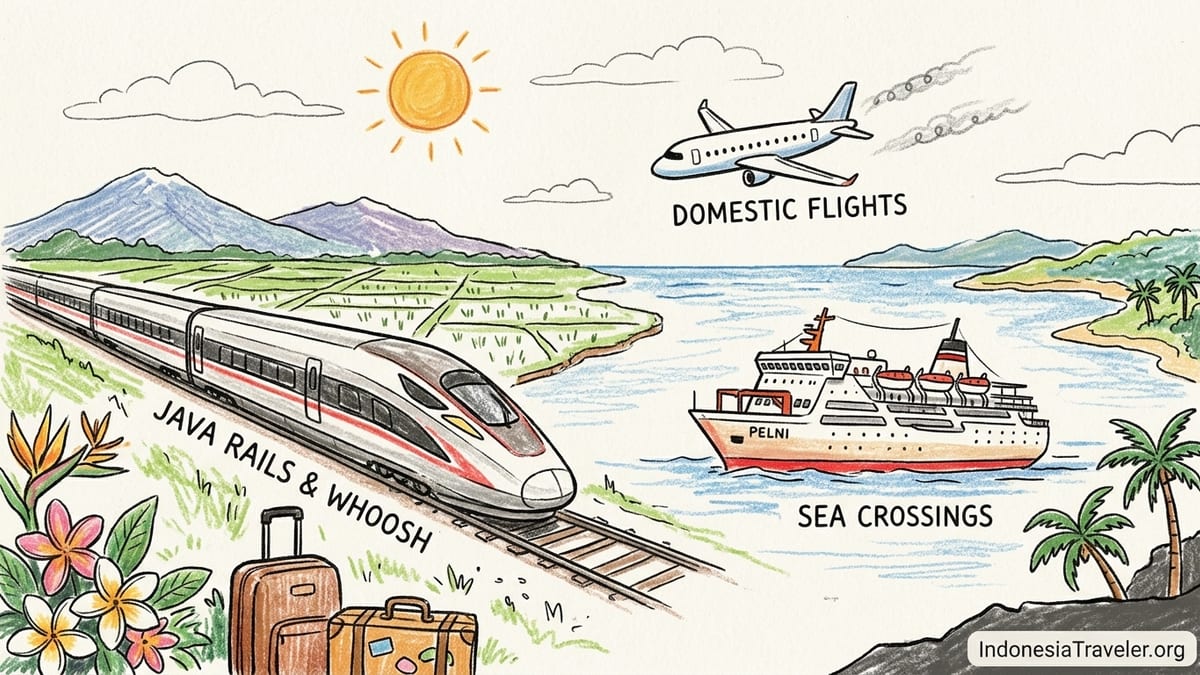
Getting around Indonesia is less about finding one perfect form of transport and more about matching the right vehicle to the right island. Java rewards you with dense rail and bus networks. Bali and Lombok are stitched together by fast boats and short hops. Eastern Indonesia often demands an extra domestic flight or a long sea crossing. Understanding how these systems fit together is the key to building an itinerary that feels smooth rather than exhausting.
Gateways: Where Your Indonesian Journey Really Starts
Most international visitors first meet Indonesia through a handful of big gateways: Jakarta, Bali (Denpasar), Surabaya, Yogyakarta, Medan and Makassar. From each one, onward connections look very different. Jakarta’s Soekarno Hatta airport is the largest hub, with dense domestic flight networks to almost every major island, plus airport rail and buses into the city. Bali’s Ngurah Rai airport is smaller but extremely international, and serves as the main jumping off point for eastern islands like Lombok, Flores and Sumbawa. Surabaya and Makassar sit on important crossroads between Java, Bali, Kalimantan and eastern Indonesia, with long distance Pelni passenger ships calling at both ports.
To reach popular secondary destinations such as Labuan Bajo in Flores, Sorong in West Papua, Lombok or Wangi Wangi in Wakatobi, you almost always add another flight or boat. For example, Jakarta to Labuan Bajo usually means a domestic flight via Bali or Surabaya, while travellers bound for Raja Ampat typically fly to Sorong, then take a fast ferry across to Waisai. Routes like Bali to Lombok combine an air or sea leg with private transfer on either side, and reaching small islands like the Gilis or Nusa Penida involves separate tickets on tourist fast boats from Bali’s southeastern ports.
This layering effect matters when you compare options. A 90 minute domestic flight might save hours compared with a multi segment ferry journey, but only if you include airport transfers and check in time. Likewise, Indonesia’s new Whoosh high speed rail between Jakarta and the Bandung area advertises a 36 to 44 minute ride, yet that figure covers only the time on the train itself, not the taxi, LRT or feeder train legs needed to reach central districts at each end. Building a realistic plan means looking at the whole journey door to door, not just the headline time.
The rest of this guide walks through the main transport systems that tie Indonesia together and shows how to combine them. Think of it not as a list of vehicles, but as a set of strategies that change from island to island. Java invites you to ride the rails. Bali and Lombok call for careful fast boat choices. Sulawesi, Maluku and West Papua reward those who understand domestic flights, ferries and weather delays.
Riding the Rails: Java’s KAI Network and the Whoosh High Speed Line
Java is where Indonesia’s rail system shines. The state operator, Kereta Api Indonesia (KAI), runs three broad types of train: intercity services like Argo and Turangga linking cities such as Jakarta, Bandung, Yogyakarta and Surabaya; dense commuter rail in Greater Jakarta and Bandung; and airport rail links serving Soekarno Hatta and other hubs. Add the new Whoosh high speed line between Jakarta’s Halim station and Padalarang near Bandung, with a feeder train onward to Bandung’s central station, and you have the most rail friendly island in the country.
Intercity trains typically offer several seating classes, which are periodically renamed but usually map to economy, premium economy and executive type categories. Economy uses 2+2 seating with more basic legroom and manual reclining, while higher classes provide wider seats, power sockets and quieter carriages. On key routes, executive class can sell out days in advance around public holidays. KAI’s own terms state that intercity tickets can be booked through the Access by KAI app until roughly one to three hours before departure, with foreign passengers entering their passport number instead of an Indonesian identity number. The company also warns that it can refuse travel if the name on the credit card does not match any passenger on the booking, so foreign travellers often find it easier to use a physical ticket counter, a minimarket agent or pay in cash after reserving through the app.
For airport access, Jakarta’s rail link connects Soekarno Hatta to Manggarai via BNI City station in around 45 minutes, offering a predictable alternative to congested toll roads. In practice, many travellers arriving in the afternoon ride the airport train into town, overnight in central Jakarta, and connect onward by morning intercity train to cities like Yogyakarta or Surabaya. Around Jakarta, the KRL commuter network carries millions of passengers daily and also serves satellite towns such as Depok and Bogor. While ticketing is geared to local smartcards, conductors are usually familiar with occasional foreign visitors and can help you navigate top ups or single trip cards.
Whoosh, the Jakarta Bandung high speed service, is the newest and most visible part of the system. The operator advertises travel times of roughly 36 to 44 minutes between Halim and Padalarang at speeds of up to 350 kilometres per hour, with some services continuing toward Tegalluar on the Bandung side. Feeder trains from Padalarang into Bandung central are included in the ticket, yet you still need to budget time to reach Halim in Jakarta and to transfer to your final address once you arrive. If you are staying near Jakarta’s old city or in South Jakarta, getting to Halim by taxi or ride hailing can easily add 45 to 60 minutes in traffic, especially in peak hours, before your 40 minute high speed ride even begins.
Rail or Flight on Classic Java Corridors?
On flagship corridors like Jakarta to Yogyakarta or Yogyakarta to Surabaya, travellers often ask whether the train or a domestic flight is faster. The answer depends less on pure vehicle speed and more on where you stay and how early you are willing to check in. Take Jakarta to Yogyakarta as an example. A daytime executive class train from Gambir or Pasar Senen to Yogyakarta Tugu station typically takes around seven to eight hours. That sounds slow compared with a one hour flight, yet the comparison changes once you factor in the ride to the airport and check in requirements.
If you stay near central Jakarta, you might spend 60 to 90 minutes in traffic to Soekarno Hatta, plus at least 90 minutes of check in and security margin for a domestic flight on a large carrier. Upon arrival at Yogyakarta’s new international airport outside the city, you add a further hour or more by bus or car into central Malioboro. Suddenly your nominal one hour flight grows into four to five hours door to door, while the train offers a same station city centre departure and arrival, no security queues in bare feet, room to walk around and scenery of rice fields and volcanoes. For many travellers, that trade off is worth a few extra hours, especially if they value reduced stress and lower carbon impact.
The Yogyakarta to Surabaya corridor tells a similar story on a shorter scale. Daytime trains carve across the north coast or inland via Solo in roughly four to five hours, again arriving in central Surabaya stations such as Gubeng or Pasar Turi. Domestic flights cover the distance in under an hour but require travel to Yogyakarta’s out of town airport and to Surabaya’s Juanda airport, plus check in time. If you are staying in the old Dutch quarter of Surabaya or near the house of Sampoerna, the train lands you closer to your guesthouse than a flight. That said, travellers with tight transfer windows on either side, or those who need to connect on to eastern Indonesia, may still prefer the speed and airline connections of flying.
Between Jakarta and Bandung, the comparison now includes both Whoosh and conventional intercity trains. A classic Argo line from Gambir to Bandung takes about three hours station to station. Whoosh can cut the in train time between Halim and Bandung to something like an hour including the feeder train, but only if you are already close to Halim. Travellers arriving at Soekarno Hatta in the late afternoon, for example, often find that a direct shuttle van such as Cititrans or Daytrans or even a private car offers a similar door to door duration without the hassle of hauling luggage across multiple station transfers. On the other hand, backpackers staying near a Halim LRT stop with light bags can ride airport train, LRT and Whoosh in a stress free, traffic free chain.
Domestic Flights and the Hidden Risks of Split Tickets
Once you look beyond Java and Bali, domestic flights become the backbone of long distance travel. Bali to Labuan Bajo, Surabaya to Makassar, Jakarta to Sorong or Medan to Banda Aceh are all best handled by air for most itineraries. Indonesian carriers range from full service airlines like Garuda Indonesia and Batik Air to low cost operators like Lion Air, Super Air Jet and Citilink. Most allow cabin baggage around seven kilograms and checked luggage starting from about 15 to 20 kilograms on standard fares, though cheaper promotional tickets may exclude checked bags entirely.
A key planning trap is the temptation to save money by buying separate tickets rather than booking a single through itinerary. Suppose you purchase one ticket from Singapore to Jakarta on an international carrier and another on a domestic airline from Jakarta to Sorong, with only two hours between them. If your first flight is delayed and you miss the second, the Indonesian airline may treat you as a no show and require you to purchase a new ticket, because from its point of view there is no protected connection. Conditions of carriage for large domestic groups like Lion Air explicitly state that they are not responsible for missed connections on separate tickets, nor for delays caused by other airlines or airport congestion.
The risk grows in remote routes that operate only once daily, such as certain links into Papua, Maluku and smaller Nusa Tenggara islands. Missing the only afternoon flight to Wangi Wangi or Banda Neira can strand you for a day or more, or force a complete reroute through another hub. Where possible, aim to book all legs on one reservation when connecting in Jakarta, Surabaya or Makassar. If that is not feasible, allow far more buffer time than you would in Europe: four to five hours is conservative but realistic if you need to collect and re check luggage, clear immigration and switch terminals.
Smart routing also helps. Travellers heading from Europe or Australia to Raja Ampat, for example, often overnight in Jakarta or Makassar and take a pre dawn domestic flight into Sorong that arrives around 6 am. This schedule lines up with mid morning ferries and speedboats to Waisai without leaving you racing the clock. Similarly, if you plan to combine Bali and Komodo National Park, consider a morning flight from Bali to Labuan Bajo, followed by an afternoon harbour transfer and overnight in town before boarding a liveaboard or day boat the next day.
Ferries, Pelni Ships and Tourist Fast Boats
Indonesia’s seas are as important as its skies. In practice, you encounter three quite distinct maritime systems. First come the conventional vehicle ferries that shuttle buses, trucks and private cars between islands. The short crossing between Ketapang in East Java and Gilimanuk in western Bali is among the busiest, running around the clock and carrying everything from long distance Java Bali buses to food trucks and family sedans. In July 2025, a roll on roll off ship on this route suffered water ingress and sank without loss of life, a reminder that even familiar crossings deserve respect for safety procedures.
The second system is Pelni, the state owned passenger shipping company whose large white vessels link major ports across the archipelago on multi day itineraries. For example, a single Pelni route may pass Makassar, Maumere, Labuan Bajo and Benoa in Bali on its way between Sulawesi and Java. Cabins range from economy dormitories to private rooms with air conditioning. Schedules can change with limited notice and sailings are often heavily booked around major holidays, so Pelni works best for travellers with flexible plans and an interest in the slower, sociable rhythm of sea travel.
The third system is made up of smaller, privately operated fast boats that primarily serve tourists. These craft run routes like Sanur to Nusa Penida and Nusa Lembongan, various Bali harbours to the Gili Islands and northern Lombok, and speedboats between Labuan Bajo and the islands of Komodo National Park. Some companies are relatively well organised, assigning seats, tagging luggage and offering hotel transfers. Others are bare bones, loading bags through surf at low concrete jetties and leaving passengers to find their own way at arrival piers.
Physical exposure to sea conditions differs sharply among these modes. Vehicle ferries are large and relatively stable, though crossing the Bali Strait between Ketapang and Gilimanuk can still feel rough in the windy dry season. Pelni ships are even larger and designed for open ocean, but they may roll in long swells during crossings like Makassar to Maumere. Tourist fast boats are the most sensitive to weather. A Sanur to Nusa Penida trip that feels like a speedy 40 minute ride on calm seas can turn into a wet and bumpy ordeal when strong southeast trade winds pile up steep chop in the Badung Strait.
Practical Sea Routes: Bali, Lombok, Raja Ampat and Komodo
Several specific sea corridors appear in many itineraries. The first is the Java Bali link between Ketapang and Gilimanuk. Buses from Surabaya and Banyuwangi roll directly onto ferries at Ketapang and disembark in Bali at Gilimanuk, where passengers either ride onward in the same bus or transfer to local transport. Ticket prices for the ferry portion remain modest by international standards, but you should check current rates at the terminal or through Indonesian news sources, as fares can change with fuel prices and regulation. Night crossings are common and can be crowded with trucks, so many independent travellers aiming for comfort choose daytime departures.
Between Bali and Lombok or the Gili Islands, you face a choice between longer, cheaper vehicle ferries via Padangbai to Lembar, and shorter but more expensive tourist fast boats that go directly to Gili Trawangan, Gili Air or Bangsal harbour. The vehicle ferry route can take four to six hours crossing time, plus loading and unloading, and is popular with backpackers on tight budgets or those travelling with motorbikes. Fast boats might complete the sea leg in around two to three hours, but in exchange you board at smaller piers such as Padangbai, Sanur, Serangan or Amed and have to be more selective about operator safety standards.
From Sanur to Nusa Penida, a cluster of competing fast boat companies operates several morning and afternoon departures. Travellers routinely mention how staff load heavy suitcases through ankle deep surf at Sanur’s beach side jetties, then stack luggage in racks at the front of the boat. Most operators accept standard checked suitcase sizes and large backpacks, but floor space can feel tight when boats run full on school holidays. In heavy seas, staff may ask passengers to move weight toward the stern to balance the hull. Good operators brief passengers about life jacket locations before departure, yet it is wise to physically locate jackets that fit you and your children once aboard rather than relying on a quick announcement.
In Raja Ampat, the core public link is the Sorong to Waisai fast ferry, generally taking around two hours each way depending on the vessel and sea state. Updated schedules from local guides show departures in the morning and early afternoon on most days, with some changes introduced from June 2026 that slightly reduced the number of weekly sailings. Travellers typically leave Sorong airport by short taxi ride to the harbour, buy tickets at the terminal office and either sit in air conditioned cabins or on open decks for the crossing. Once in Waisai, resort and homestay speedboats fan out across the islands, often timed to meet the main ferry. If you are arriving on a very early morning flight to Sorong, confirm that your planned ferry is actually running that day, and build in a cushion in case of weather related cancellations.
Ferry and Fast Boat Safety: What to Look For
Safety at sea is not a topic to treat lightly in Indonesia. While many crossings are routine, accidents involving overloaded vessels, sudden squalls or engine room failures do occur. For travellers, the first line of defence is operator choice. When you buy a fast boat ticket from Bali to Nusa Penida or the Gilis, ask directly about life jacket provision, passenger limits and whether the vessel carries radio and mobile communications. Look around as you board. A well run boat will have visible adult and child sized life jackets, clear signage, and a crew that seems organised rather than chaotic.
On vehicle ferries like Ketapang Gilimanuk, count the number of life rafts and jackets in your section and identify exit routes that are not blocked by freight trucks. The 2025 sinking in the Bali Strait occurred at night during rough weather, and official reports later described challenging sea conditions with two metre waves and strong winds. While crew are trained to make safety calls, passengers always retain the option to delay travel if conditions look marginal and they have flexibility in their itinerary. If you see trucks loaded well above their side walls or ferries boarding passengers despite visibly building storms, consider waiting for another departure.
Weather cancellation policies vary. Tourist fast boat operators from Bali to the Nusa islands may cancel same day sailings when local harbour authorities close ports due to high waves. In those cases, companies generally offer either refunds or rebooking for the next day, but you remain responsible for accommodation if you are stranded. In regions like Raja Ampat and Komodo, smaller resort or liveaboard boats may shift timetables around approaching squalls or slow down in heavy rain, prolonging crossings. Always keep one flexible day when connecting a domestic flight to a key boat departure, rather than landing in the afternoon and expecting to board an overnight liveaboard immediately.
Luggage handling is another safety related detail. On surf landings at Sanur or the Gili Islands, staff often form human chains to carry bags through the shallows, which exposes electronics to splashes and requires trust when your bag disappears into a stack. Keep valuables, passports and medication in a small daypack you can keep on your lap. If you travel with children, make sure they wear life jackets or at least stay close to a responsible adult during hectic embarkation and disembarkation moments when gangways can be slippery and boat motion unpredictable.
Local Transport: Ride Hailing, Taxis, Buses and Motorbikes
Beyond long distance segments, day to day mobility in Indonesian cities depends on how comfortable you are with ride hailing apps, buses and motorbikes. Grab and Gojek dominate ride hailing. Both offer car and motorcycle taxi options, as well as food delivery and, in some cities, intercity shuttle bookings. In Jakarta, Yogyakarta, Surabaya and Medan, they are often the easiest way for foreign visitors to hail a ride without haggling. Payments can be made in cash for many services, which helps travellers who do not have local cards.
Licensed metered taxis still play a role, particularly in airports and locations where ride hailing pickups are restricted. Blue Bird is widely regarded as one of the more reliable fleets in Jakarta, Bali and several other cities, with meters that start at transparent base fares. At airports like Soekarno Hatta and Bali’s Ngurah Rai, you will see both fixed price taxi counters and drivers offering unofficial rides in arrivals halls. If you prefer predictability, book a Grab or Gojek car to a signed pickup zone or use an official coupon taxi.
In Bali, a particular feature is the prevalence of private drivers who offer day tours in air conditioned cars. These services can be cost effective for couples or small groups who want to string together multiple temples, waterfalls and cafes in a single day. Online forums often quote daily rates in the range that local drivers suggest, but actual prices fluctuate with fuel and demand, so it is better to confirm a current quote directly rather than rely on outdated averages. Private drivers tend to wait at popular spots like Ubud’s central streets or Canggu’s busy intersections, and many guesthouses can arrange trusted contacts.
Motorcycle taxis and rentals fill in the last gap. In most Indonesian cities, short Gojek or GrabBike rides are faster and cheaper than cars during rush hours, but they expose you directly to traffic and weather. If you choose to ride as a passenger, insist on a helmet and adjust the strap yourself. To rent and ride your own motorbike legally, you should carry an international driving permit with the correct motorcycle endorsement alongside your home licence. Indonesian police occasionally run traffic checks and can issue on the spot fines to tourists without proper documents or helmets. Even where enforcement feels relaxed, hospital bills after accidents are not, so travel insurance that covers motorbike use is essential.
Transport Trade Offs: Time, Cost, Luggage and Safety
Once you understand Indonesia’s layered transport networks, choosing between them becomes a series of trade offs. Trains on Java score well for comfort, city centre access and the ability to move around, especially in executive and premium classes. They are less flexible in regions without rail and can be slower in pure time than flights on key corridors. Domestic flights are unbeatable for long island jumps, but they come with stricter luggage limits, security queues and the complexity of split ticket risks. Vehicle ferries and Pelni ships excel at carrying bulky luggage and even motorbikes but move at glacial speeds compared with flying.
Fast boats sit at an awkward but essential middle point. They shine on mid range sea hops like Sanur to Nusa Penida or Padangbai to the Gilis, where flying would be absurd and vehicle ferries would be excessively slow. Their weaknesses are sensitivity to weather, inconsistent safety standards and cramped luggage storage when boats are full. That is why many travellers treat fast boat bookings as high priority items, reserved well in advance for popular weekends or holidays, even if they leave more flexibility for buses and local car hire.
Accessibility adds another layer. Rail stations in major Javan cities increasingly feature lifts and escalators, though platform gaps can still challenge travellers with mobility impairments. Airports are generally better equipped with wheelchairs and assistance staff, yet transfers by small speedboat to over water homestays in Raja Ampat or bamboo jetties in the Gilis may require stepping across bouncing gaps. When planning, always imagine the worst luggage scenario you can realistically face and work backwards. If you cannot comfortably carry your main bag up and down narrow boat stairs without rails, consider downsizing or focusing your trip on better developed corridors.
From a safety perspective, no option is perfect. Large airlines with strong safety oversight have better international records than small informal boats, but they also place you into the country’s most congested road networks for airport transfers. Trains largely avoid traffic accidents and are forgiving of heavy luggage, yet level crossings in some rural areas can create delays. The aim is not to find a single flawless choice, but to minimise compounding vulnerabilities. For example, avoid planning a tight sequence of fast boat plus unprotected domestic connection on separate tickets in storm season. Instead, stretch the journey over two days with a buffer night near a major hub.
The Takeaway
Travel in Indonesia rewards those who think like network planners. Start with the gateways of Jakarta, Bali, Surabaya, Yogyakarta, Medan and Makassar. Decide where you actually want to end up, whether that is Labuan Bajo, Sorong, Lombok, Wangi Wangi or a small surf break in Sumbawa, then sketch how many separate vehicles you are comfortable stringing together. On Java, lean heavily on KAI’s intercity trains, commuter services and the Whoosh high speed line, but remember that the advertised 36 to 44 minute run between Jakarta and Bandung counts only the in train segment, not the taxi or LRT legs on either side.
For longer jumps, use domestic flights while respecting their constraints. Avoid risky split tickets in tight windows, allow generous connection times, and route yourself through hubs that offer multiple daily options when possible. At sea, distinguish between robust vehicle ferries, slow but steady Pelni passenger ships and quicker, more exposed tourist fast boats. On routes like Ketapang Gilimanuk, Bali Lombok Gilis, Sanur Nusa Penida, Sorong Waisai and Komodo transfers, combine operator research with your own on the spot judgement about weather, safety gear and crowds.
Finally, do not underestimate the importance of last mile options. Ride hailing apps like Grab and Gojek, licensed taxis, Bali’s private drivers, buses and motorbike rentals are what make the big links actually useful day to day. With a realistic view of door to door time, cost, luggage handling and safety, you can turn Indonesia’s complex web of trains, planes, ferries and fast boats into an itinerary that feels adventurous for the right reasons.
FAQ
Q1. Is it better to fly or take the train between Jakarta and Yogyakarta?
For most travellers staying in city centre districts, the train offers a simpler city to city journey with no airport transfers, taking around seven to eight hours. A flight is faster in the air but usually totals four to five hours door to door once you include traffic to Soekarno Hatta, check in time and the long transfer from Yogyakarta’s new airport into town.
Q2. Do I need the Access by KAI app to buy train tickets in Indonesia?
The Access by KAI app is very useful for checking schedules and reserving seats, and it allows foreign passengers to enter passport numbers instead of Indonesian ID. However, you can still buy tickets at station counters, official agents and some minimarkets if you prefer to pay in cash or have trouble with card payments in the app.
Q3. How realistic is the 36 to 44 minute Whoosh journey time between Jakarta and Bandung?
The advertised 36 to 44 minutes refers only to the high speed segment between Halim and Padalarang or Tegalluar. You must add time to reach Halim station in Jakarta, clear security, and then ride a feeder train or taxi from Padalarang into Bandung. Door to door, many travellers experience total times of around two to three hours depending on traffic and connections.
Q4. Are fast boats from Bali to Nusa Penida or the Gili Islands safe?
Many crossings are uneventful, but safety standards vary among operators and sea conditions can change quickly. Choose companies that clearly display life jackets including child sizes, avoid travelling during known periods of high waves if your schedule is flexible, and be prepared for last minute weather cancellations ordered by harbour authorities.
Q5. Can I rely on same day connections between flights and ferries in Raja Ampat?
Same day connections are possible but should be planned carefully. Early morning flights into Sorong are usually timed so you can catch a mid morning ferry to Waisai, yet delays and schedule changes do occur. Build in buffer time and, if your resort requires a private speedboat transfer, confirm in advance which specific flight and ferry they recommend.
Q6. Do I need an international driving permit to ride a scooter in Bali?
Yes, Indonesian regulations require a valid licence for the vehicle type plus an international driving permit with motorcycle endorsement if your home licence is not Indonesian. Police occasionally enforce this through on the spot fines, and riding without proper documents may also invalidate travel insurance in the event of an accident.
Q7. How far in advance should I book trains on Java?
On busy routes such as Jakarta Yogyakarta or Jakarta Surabaya, executive class tickets can sell out several days ahead around weekends and holidays. Booking one to two weeks in advance is sensible for fixed itineraries, while outside peak periods you can often secure seats closer to departure, especially in economy or premium economy classes.
Q8. Is it safe to take night ferries like Ketapang to Gilimanuk?
Night sailings operate frequently and are heavily used by locals and trucks, but rough weather or overloaded vehicles can increase risk. If you are unfamiliar with the route or travelling with children, many travellers prefer daytime crossings when visibility is better and conditions are easier to assess in person.
Q9. Are ride hailing apps available across Indonesia?
Grab and Gojek operate widely in major cities on Java, Bali, Sumatra and parts of Sulawesi and Kalimantan. In some smaller towns and islands, however, they may have limited coverage or face local restrictions, so you might rely more on conventional taxis, ojek motorcycle taxis or private car hire arranged through your accommodation.
Q10. What is the safest way to handle luggage on fast boats?
Keep valuables, passports and electronics in a small bag you can carry on board and keep with you at all times. Allow staff to handle larger suitcases when boarding through surf, but watch where they are stacked, and check that bags are secured so they will not slide in rough seas or block emergency exits.