


I arrived in Bali assuming Canggu was the default answer to everything. Digital nomads raved about it, surf schools advertised Batu Bolong as a beginner playground and every second Instagram caption seemed to pin “Canggu” to a coconut or a laptop by the pool. After several trips where I based myself in Canggu, Seminyak and Uluwatu for at least three nights each, I stopped treating them as interchangeable “south Bali beach” options. They do not give you the same holiday, and Canggu is not automatically the best base, no matter what the internet says.
How Canggu Actually Feels On The Ground
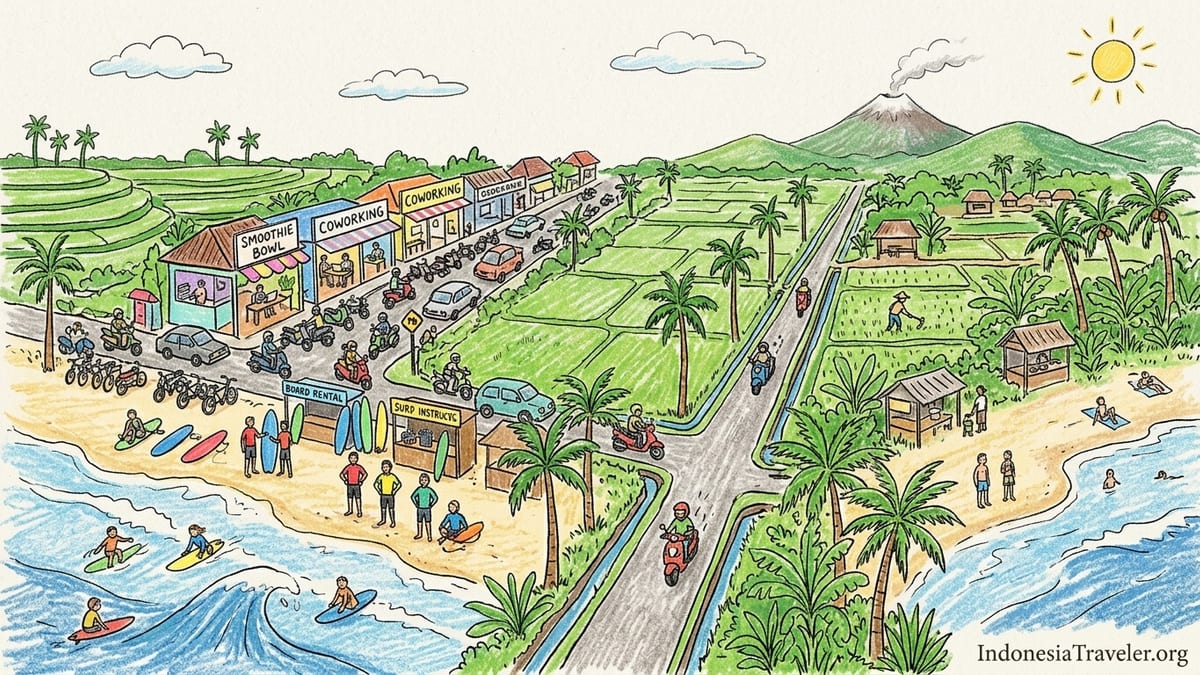
My first real base in Canggu was around Batu Bolong, a few minutes’ walk from the beach. On paper it sounded ideal. Batu Bolong and nearby Old Man’s have become the island’s poster children for longboard-friendly waves, with gentle, slow-breaking sets that surf schools use for supervised beginners alongside more confident surfers farther outside. The beach is lined with board rental stands and instructors in matching rash vests, all happy to quote a two-hour lesson price in seconds. If you arrive with a vague ambition to stand up on a board once in your life, Canggu makes that feel both normal and achievable.
Off the sand, Canggu lives up to its reputation as Bali’s unofficial coworking capital. Within a ten-minute scooter ride of Batu Bolong I counted multiple coworking spaces with day passes, air conditioning and rows of people on video calls. Cafés like those along Jalan Batu Bolong and Jalan Pantai Berawa serve flat whites and smoothie bowls that would not look strange in Melbourne or Los Angeles, and the Wi-Fi speeds generally kept up with full workdays. I have filed articles from Canggu cafés while watching afternoon storm clouds build over the rice fields, then closed my laptop and been in the water within twenty minutes.
The trade-off is what happens every time you need to move around at the same time as everyone else. Canggu’s road network grew out of village lanes, not city planning. By late afternoon, the short trip from Berawa to Batu Bolong can stretch well over half an hour in slow, stop-start traffic, even though the distance is only a few kilometers. Pavements are fragmented or simply absent. I tried walking from my guesthouse north of Batu Bolong to a café cluster near Canggu Padang Linjong and spent most of the route stepping into the edge of the road to dodge parked scooters and potholes. If you do not ride a scooter, you are essentially trapped in a loop of car hires and app-based rides, watching meters tick slowly upward while engines idle.
Beach conditions are another Canggu reality check. Batu Bolong’s rolling waves are fantastic for supervised surf lessons, but they are not a calm, sheltered lagoon. There is regular whitewater, shifting channels and days where the current pulls noticeably along the beach. Families sometimes set up near the shorebreak, but I have watched more than one parent underestimate the power of what looks like a “small” day and end up clutching a child who just got tumbled in the foam. If you want to float in clear, flat water for half an hour, Canggu is not built for that.
Seminyak: Polished Comfort With Its Own Price Tag
After Canggu, checking into Seminyak felt like stepping sideways into a different version of Bali. I stayed twice in this area, once near Double Six Beach and once within walking distance of one of the big-name beach clubs. The hotel stock here is simply more established. You see mid-range and high-end resorts with polished lobbies, multiple pools and direct beach access in a way Canggu is only starting to develop at scale. Well-known properties cluster along the sand, and newer design hotels fill the inland grid with rooftop pools and spa menus longer than their cocktail lists.
That shows up clearly when you go out to eat. Seminyak’s restaurant scene has matured over more than a decade, so you can walk from a casual warung to an international-standard tasting menu without needing a scooter. Beachfront venues span laid-back beanbag bars to upscale operators serving plated mains and imported wines. On my last visit, a sunset cocktail and main course at a well-known beachfront restaurant cost somewhere between 200,000 and 400,000 rupiah before tax and service, depending on how heavy my hand was on the drinks menu. That is significantly more than a nasi campur and fresh juice at a Canggu warung several streets back from the beach, but you are paying for a choreographed sunset experience with table service, live DJs and a neat line of loungers facing the horizon.
Seminyak’s comfort comes with its own frictions. Road congestion between late afternoon and night is no joke. The main north-south artery near the beachfront fills with cars and scooters heading to and from popular restaurants and bars. I once tried to ride a scooter from central Seminyak to Canggu for dinner and spent close to an hour wedged between exhaust pipes and delivery drivers. Metered taxis crawl but cannot teleport, and even app-based rides inch forward at the same speed. Walking is more viable here than in Canggu, with more continuous pavements near the main strips, but crossing multi-lane roads requires patience and a certain level of urban confidence.
The ocean in Seminyak is also not a gentle paddling pool. Seminyak, Legian and Kuta share an exposed west coast beach that picks up swell. Lifeguard flags go up, currents sweep alongshore and short, punchy shorebreak waves can slam into unsuspecting swimmers. You can absolutely learn to surf here with one of the many surf schools lined up along the sand, and they do solid business with absolute beginners. But the water has a very different character from a lagoon like Sanur or some of the more protected pockets in Nusa Dua. Strong swimmers with a surf instructor nearby will be fine. Families who picture waist-deep, lake-like conditions for their children will probably be surprised.
Uluwatu: Drama, Cliffs And Surf For The Confident
Uluwatu was where I finally understood why experienced surfers talk about “the Bukit” with a particular light in their eyes. Perched on the cliffs of the Bukit Peninsula, Uluwatu’s coastline has almost nothing in common with the low, sandy profile of Canggu or Seminyak. Limestone headlands drop sharply into the ocean, and narrow staircases thread down through warungs and homestays to coves carved out at sea level. When the swell lines up, walls of water run along reef breaks under the cliffs, dotted with surfers dropping in and disappearing into sections of hollow green.
The setting is spectacular, but it is not beginner territory. Uluwatu’s main break is a powerful left-hand reef wave that has been a destination for accomplished surfers since the 1970s. Padang Padang, Bingin and Impossibles, all within a short drive, each add their own flavor of challenging reef and fast sections. There are friendlier options on this peninsula for lower-intermediate surfers, and smaller inside breaks at some beaches that surf schools quietly direct nervous clients toward, but if you arrive as a first-timer with only a couple of hours of water confidence, this is not where any cautious instructor will push you into the main lineup.
This geography makes everyday life in Uluwatu different too. On one three-night stay near Padang Padang I timed the walk from my guesthouse to the sand. It took roughly ten minutes of descending steps cut into the rock, and another ten coming back up in the midday heat, with boards and beach bags. Repeat that twice a day and you begin to factor “stair tax” into your plans. Many of the most famous viewpoints, warungs and cliffside bars require some degree of stair climbing or careful stepping over uneven rock. Travelers with limited mobility, very young children or a low tolerance for stairs will feel those constraints immediately.
Uluwatu is also one of the most car and scooter-dependent corners of southern Bali. Accommodation is scattered along the ridge roads rather than concentrated in a tight, walkable village center. My usual routine became renting a scooter and riding fifteen to twenty minutes to whichever beach looked best for the tide and swell that day, or booking a car transport for the evening to visit Uluwatu Temple for the sunset kecak performance. Without your own wheels, you lean heavily on drivers or app rides, and every day involves a series of point-to-point journeys that eat into your time and budget.
Surfing Ability: The Line That Quietly Divides These Areas
Across my stays it became clear that surfing ability, more than Instagram aesthetics, is what really divides Canggu, Seminyak and Uluwatu as bases. Batu Bolong in Canggu gives absolute beginners and cautious intermediates a strong introduction. The waves there often break more gently, allowing instructors to push learners into whitewater or small green waves that run long enough for a novice to pop up, wobble, fall, then paddle back for another try. You still have to respect the reef and other surfers around you, and crowds can turn the lineup into a chaotic zigzag of boards, but it is one of the few places on Bali’s west coast where complete novices and more capable longboarders reliably share the same general patch of water.
Seminyak’s surf schools operate on an exposed beach where the sand underfoot offers a softer landing than reef. For someone nervous about falling onto rock, that can be reassuring. The trade-off is that the waves are shorter, punchier and often close out quickly, so beginners spend more time popping up for a few seconds before a wave collapses. It works well for a first lesson and for travelers who want a simple “I surfed once in Bali” memory rather than a week of progression, but I felt the limits of that beachbreak quicker than in Canggu.
Uluwatu lives primarily in the realm of intermediate to advanced surfers. The main breaks reward paddle strength, timing and confidence on reef-bottom waves that can produce long rides and heavy wipeouts on bigger days. When I stayed on the Bukit with friends of mixed abilities, the least experienced among us often ended up at friendlier spots away from Uluwatu itself, or skipping surf sessions entirely in favor of pool days and cliff walks. If you are traveling as a group where only one or two people surf at a higher level, basing everyone in Uluwatu for a full week can skew the holiday heavily around their sessions and leave others watching from the cliff, literally and metaphorically.
Swimming And Beach Time: Where Families Actually Relax
One of the biggest mistakes I made on my first Bali trip was assuming any “beach” area would automatically offer calm, swimmable water for hours of family-friendly bobbing around. Canggu and Seminyak cured me of that notion. Both sit on Bali’s more exposed west coast, where swell and currents are part of the daily reality. I have enjoyed plenty of refreshing dips in front of the beach clubs and warungs, but they are short sessions between sets, staying inside the shorebreak and always keeping an eye on the flags and lifeguards.
Families I met who were happiest with their swimming options often based themselves somewhere completely different, such as Sanur on the southeast coast or the more sheltered sections of Nusa Dua. In Sanur, the offshore reef softens the ocean’s energy, so inside that barrier the water can feel more like a giant, sandy-bottom pool at mid tide, especially in the morning. Parents I spoke to there appreciated being able to let children play in waist-deep, relatively calm water while they watched from the shade. In parts of Nusa Dua, resort frontages open onto beaches where the swell is filtered enough that confident but non-surfing swimmers can stay in for long stretches without constantly bracing for the next heavy set.
By contrast, when I stayed in Canggu with a friend who could not swim confidently, the sea became a background view rather than a playground. She was comfortable floating in the shallowest part of the shorebreak for a few minutes at a time, but anything more than that required a pool. We ended up spending far more time in hotel pools and beach club daybeds than on open-water swims. If your ideal Bali holiday involves daily, relaxed swimming sessions for all ages and skill levels, choosing a base solely among Canggu, Seminyak and Uluwatu is already narrowing your options.
Costs, Commuting And The Myth Of The “Cheapest” Area
People often ask which of these three districts is “cheapest.” After multiple trips, my honest answer is that none of them win by default. Each can be economical or expensive depending on how you structure your days, where you stay and how often you commute between them. On one Canggu stay I booked a mid-range guesthouse a short walk from Batu Bolong, paying a nightly rate that roughly matched what I had previously paid for a slightly older but larger hotel room in Seminyak a few backstreets from the beach. The difference in nightly cost was marginal. What changed was how I spent money once I was there.
In Seminyak, my food and drink bill climbed faster. Beachfront sunset cocktails and dinners at smart restaurants add up quickly compared with modest meals at inland warungs. In Canggu, specialty coffee, brunch dishes and coworking passes quietly consumed the budget instead. Uluwatu felt cheapest in daily spending when I stayed in a simple guesthouse off the main road and ate most meals at family-run warungs near the cliffs, but transport costs spiked each time I wanted to go somewhere beyond scooter range at night or hire a car for a day trip.
Where you lose the most usable holiday hours is in commuting between areas. One stay in particular drove this home. I based myself in Canggu but arranged several dinners and meetings in Seminyak and Jimbaran. Over a seven-day period, I logged roughly ten cross-town journeys. Afternoon and early evening rides between Canggu and Seminyak regularly took 40 to 60 minutes one way in traffic. Conservatively, that meant around ten hours of my one-week holiday vanished into sitting on the back of a scooter or in a car, watching brake lights. If you assign value to your time, that is an invisible cost you rarely see in budget breakdowns.
The same logic applies in reverse. Friends who based themselves in Seminyak but surfed almost every morning in Canggu were setting alarms for pre-dawn transfers to beat traffic, then returning tired and sunburnt in the early afternoon. Over a week they probably lost a full waking day to commuting. When you see estimates of taxi prices from the airport to these areas, they may look roughly similar on paper, but the ongoing movement between districts is what quietly inflates both your spend and your travel fatigue.
Pererenan And Seseh: The “Quieter Canggu” That Still Shares Its Problems
As Canggu has grown busier, a common suggestion has been to “just stay in Pererenan or Seseh instead.” I have tried that too, spending several nights in Pererenan and taking day trips to Seseh. Both villages sit only a few kilometers west of core Canggu, and you immediately feel the difference in noise and pace. There are still rice fields, more local banjar life and fewer lined-up beach clubs. Cafés and small restaurants have followed the early-wave expats, but the density remains lower. If you crave a version of Canggu that looks more like the one from five or ten years ago, these pockets come close.
What they do not do is solve the transport issue completely. The same narrow road network that funnels traffic into Batu Bolong also carries vehicles from Pererenan and Seseh. Morning and sunset bottlenecks still occur as residents and visitors filter toward the surf and restaurant strips. Certain shortcuts that used to connect Pererenan to central Canggu have been overwhelmed with scooters and delivery drivers. If you stay out near Seseh and plan to eat in Batu Bolong most nights, you will still spend a chunk of your holiday time sitting on a scooter, negotiating tight corners bounded by rice paddies and drainage ditches.
Surf-wise, Pererenan offers its own set of peaks that suit more experienced surfers, with faster waves and shallower sections at lower tides. There are beginner-friendly moments, but nothing like Batu Bolong’s consistency for novices. Seseh is quieter still in the water, largely attracting surfers who already know how to read a lineup and are comfortable with fewer crowds but also less infrastructure. If you are a beginner or casual surfer, basing yourself in Pererenan or Seseh and commuting back to Batu Bolong for lessons simply pushes the same time-loss problem one step outwards.
Key Trade-Offs: What You Gain And Lose In Each Base
After treating Canggu, Seminyak and Uluwatu as roughly interchangeable for too long, I have ended up seeing at least five clear trade-offs that should shape how you choose a base. First is infrastructure versus atmosphere. Seminyak delivers more mature hotel stock, polished service and walkable clusters of restaurants and shops. Canggu and its fringe areas feel younger, looser and, in some corners, trend-obsessed, with accommodation options that range from homestays and surf camps to chic villas tucked down unmarked lanes.
Second is how you move. Canggu, Pererenan and Seseh are built for scooters and drivers, not pedestrians. Seminyak offers somewhat better pavements and the ability to walk between many of its key spots, while Uluwatu demands either your own scooter or a budget for repeated car hires. Third is ocean use. Canggu works well if someone in your group wants to surf at beginner to intermediate level and is happy sharing a crowded but friendly lineup. Seminyak caters to both entry-level surf lessons and casual swims, albeit in punchier water. Uluwatu shines for confident surfers and people who are content to watch the ocean from a balcony or bar rather than be in it every day.
Fourth is cost profile. None of these is automatically “cheap” once you factor in how you actually live in them. Seminyak can drain your wallet through beachfront dining and shopping. Canggu makes it easy to spend daily on coffee, coworking and nights out, plus rides in and out of the area’s choke points. Uluwatu tempts you with simple, affordable warungs but pushes transport spending higher if you want to explore beyond your immediate surroundings. Fifth is time. Every decision to base in one area and play in another comes with a commuting tax. When I added up the hours spent shuttling between districts, the totals were uncomfortable. Over two weeks split between Canggu and Seminyak but with frequent cross-visits, I lost the equivalent of at least one full day of leisure time to traffic.
There are softer trade-offs too. Canggu’s intense social scene suits some travelers brilliantly and exhausts others. If your idea of a good week is bouncing between surf, laptop, café and bar with familiar faces popping up everywhere, Canggu delivers. If you came for quiet evenings and the sense of being somewhere distinctly different from your home city, Uluwatu’s cliffside sunsets or Seseh’s village lanes may feel closer to what you pictured when you booked flights to Bali.
The Takeaway
After staying in all three, I no longer tell people “just stay in Canggu” when they ask where to base in Bali. Canggu is still my reference point because of its surf schools, cafés and coworking culture, but I would now only choose it as a base for three nights if my goal was a short, socially intense stopover focused on surfing Batu Bolong, sampling a few hyped restaurants and catching up on work in between. For a week, I would pick Canggu only if I was comfortable on a scooter, did not mind traffic and wanted to be surrounded by other visitors living a similar semi-nomadic lifestyle.
For three nights of relatively straightforward comfort, Seminyak makes more sense. Landing late, checking into a hotel within walking distance of the beach and knowing I can find a good breakfast, sunset drink and solid dinner without hiring a scooter removes a layer of decision fatigue. Over a full week, Seminyak is best for travelers who like structure: couples who want dinner reservations, shoppers who enjoy boutiques and families with older children who are strong swimmers or keen to try surf lessons under lifeguard supervision. I would not base a two-week family trip entirely in Seminyak unless everyone in the group is happy treating the ocean as a sometimes-rough playground rather than a placid swimming pool.
Uluwatu is where I would send confident surfers and scenery-driven travelers. For three nights, it is an unforgettable hit of cliffs, waves and sunsets, even if you never touch a board. A week there makes sense if at least one person in the group surfs at an intermediate or higher level and everyone else is content with pools, viewpoints and beach coves accessed by stairs. For two weeks, Uluwatu works mainly for people who either fully embrace scooter life or are ready to budget for frequent car transfers and accept that getting anywhere involves hills and steps.
If I had to plan a two-week trip for first-time visitors who wanted both beach and culture without sacrificing too many usable hours to traffic, I would probably split time between somewhere calm and swimmable, like Sanur or a quieter pocket of Nusa Dua, and just one of these three areas rather than trying to sample all of them. The reality of southern Bali in 2026 is that no single beach base wins for everyone. Canggu, Seminyak and Uluwatu each deliver a distinct version of Bali, and the best one for you depends far less on what is trending online and far more on how you actually want to spend your days.
FAQ
Q1. Is Canggu really the best place to learn to surf in Bali?
Canggu, especially Batu Bolong and Old Man’s, is one of the better spots for supervised beginners, but it shares that category with places like Kuta and parts of Legian. The waves are often gentle and rolling rather than heavy, yet crowds and a reef bottom mean you should always learn with a reputable instructor rather than trying to figure it out alone.
Q2. How bad is traffic between Canggu and Seminyak in practice?
In peak late afternoon and early evening periods, a journey of only a few kilometers between Canggu and Seminyak can easily take 40 to 60 minutes each way. Over a week of daily cross-district dinners or surf sessions, that can add up to many hours of your holiday spent in slow-moving scooters or cars.
Q3. Which area is best if I do not ride a scooter?
Seminyak is generally the most manageable if you do not ride a scooter, because more hotels, restaurants and shops sit within walkable clusters and pavements are somewhat better. Canggu and Uluwatu both assume that you will either ride yourself or rely heavily on drivers, which increases both costs and the amount of time you will spend in vehicles.
Q4. Where should families with small children base themselves?
Families with small children who want calm water for swimming are often better off in Sanur or selected parts of Nusa Dua than in Canggu, Seminyak or Uluwatu. Among the three compared here, Seminyak can work for families with confident swimmers, but parents should be aware that the surf is stronger and the shorebreak heavier than many first-time visitors expect.
Q5. Is Uluwatu suitable for absolute beginner surfers?
The main surf breaks around Uluwatu are geared toward intermediate and advanced surfers who are comfortable on reef and in more powerful waves. Absolute beginners should not expect to learn on Uluwatu’s primary waves and will usually be directed by instructors to gentler inside sections or different beaches entirely.
Q6. Are Pererenan and Seseh really quieter alternatives to Canggu?
Pererenan and Seseh are quieter than central Canggu in terms of nightlife and crowds, with more visible rice fields and village life. However, they still depend on the same narrow road network, so traffic bottlenecks and time spent commuting into Batu Bolong or Berawa for restaurants and surf are still part of the experience.
Q7. Which area offers the best value for money overall?
None of the three areas is automatically the best value. Seminyak tends to have higher restaurant and shopping bills, Canggu encourages daily spending on cafés and coworking, and Uluwatu can feel cheap in day-to-day food costs but more expensive in transport. How you use each place matters more than its reputation.
Q8. Can I comfortably walk around these areas instead of using transport?
In Seminyak you can walk between many hotels, restaurants and beach access points, although some roads are busy. In Canggu, pavements disappear frequently and distances between clusters of venues are larger, so scooters and cars are common. Uluwatu is spread out with hills and stairs, so walking works only in short sections and you will still need vehicles for longer trips.
Q9. If I have two weeks, should I try to stay in all three places?
It is possible but not always wise. Each change of base costs you packing, transfer time and energy, and commuting between them for day trips consumes more hours. Many travelers get a better experience by combining just one of these areas with a calmer swimming base such as Sanur or Nusa Dua rather than shifting repeatedly within the busy south.
Q10. Which area is best for remote workers staying one or two weeks?
Canggu is usually the strongest choice for remote workers thanks to its coworking spaces, café culture and social scene, as long as you are comfortable with traffic and scooter-heavy streets. For those who prioritize quieter evenings and do not need constant networking, a split between Canggu for workdays and a calmer area for downtime can balance productivity with rest.